




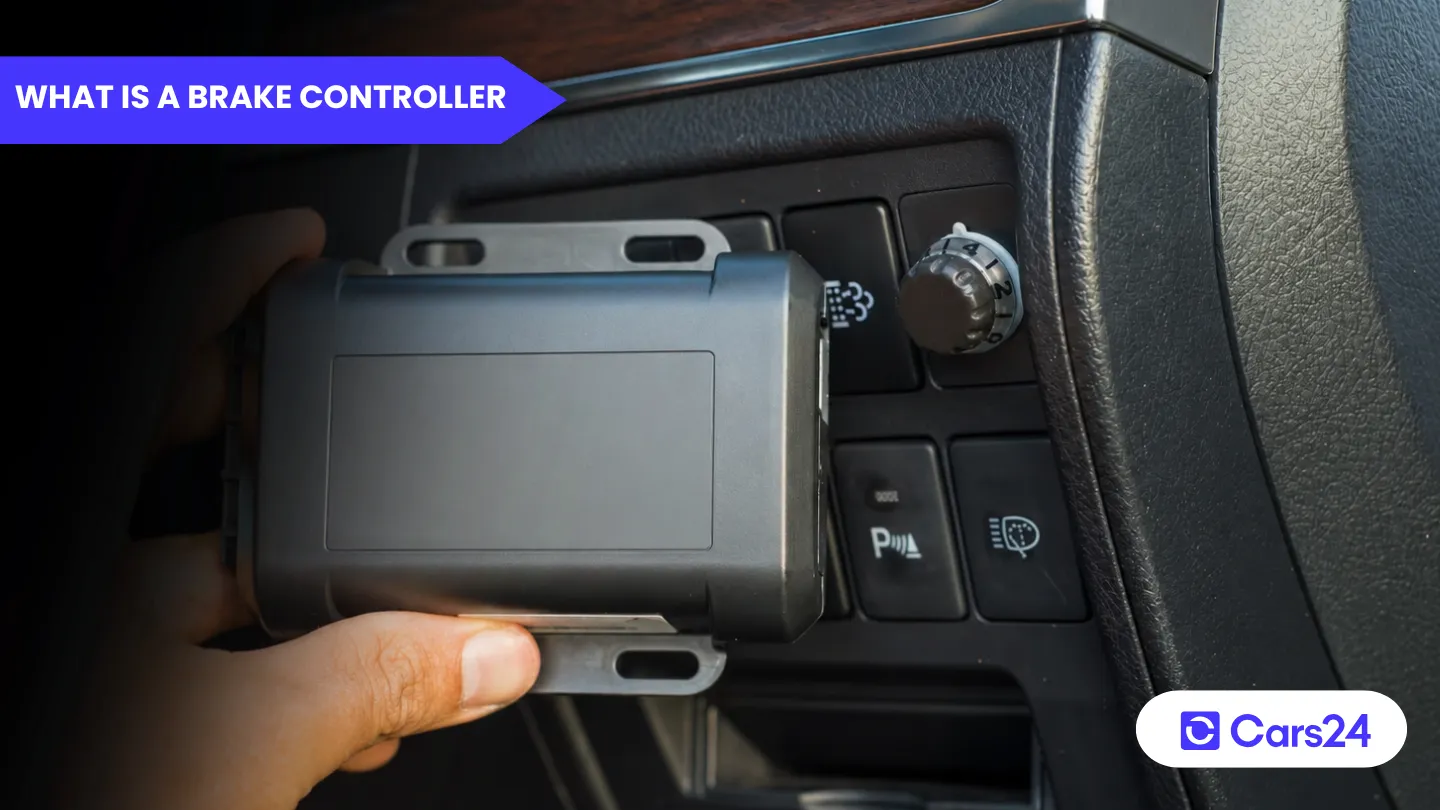
Many drivers assume a standard 7-pin plug is all they need to tow in Australia, until a heavier trailer reveals the legal requirement they missed. That missing piece is usually a brake controller.
Suddenly, questions about the heavier 750kg and 2,000kg towing thresholds become very real, especially when you’ve already spent thousands on the van itself. A brake controller helps your trailer stop smoothly and safely alongside your vehicle. Here’s how it works.
What is a brake controller?
A brake controller is an electronic device in your car that sends a signal to the trailer’s electric brakes, telling them how hard to brake. When you press your car’s brake pedal, the controller activates the trailer’s brakes at the same time and with the same force, stopping both vehicles safely together.
Why do you need an electronic brake controller?
Without an electronic brake controller, your car is trying to stop the caravan’s weight alone, and that’s how jackknifes happen.
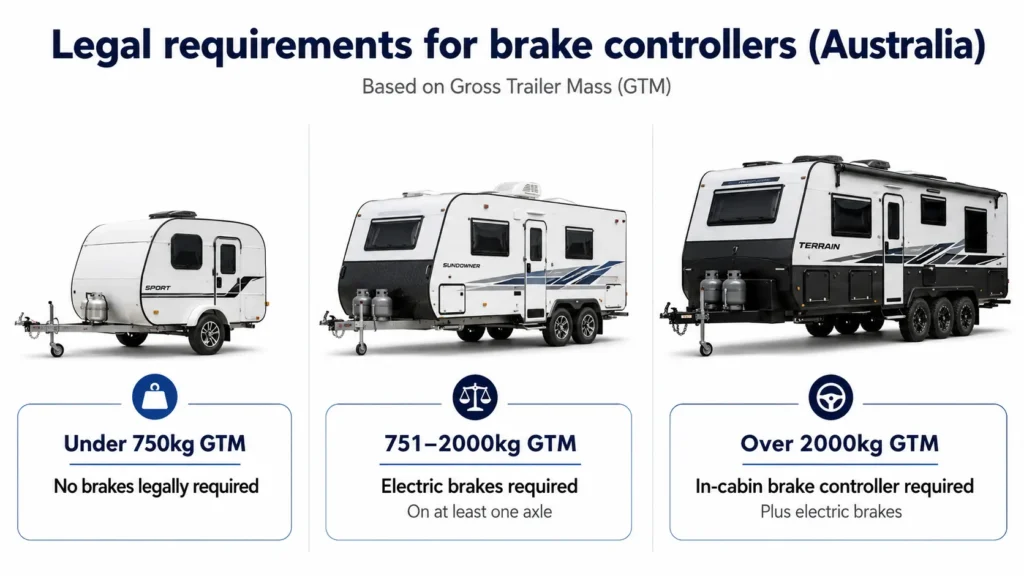
If your caravan weighs less than 750kg GTM (Gross Trailer Mass), you legally don’t need brakes on the van. If it weighs between 751 and 2000kg (most family vans), you legally need electric brakes on at least one axle. Trailers over 2000kg GTM require an operable in-cabin brake control system and electric brakes.
For most Australians towing caravans, horse floats, or larger boats, a proportional brake controller is now considered the safest option.
How does a brake controller work for towing?
Towing heavy is a responsibility, and understanding the gear under your car’s dashboard could save your life. Let’s go through how the brake controllers actually work.
Imagine you’re running at full speed, pulling a heavy shopping trolley. When you try to stop, what happens? The trolley slams into your back, right? That’s similar to what happens when a heavy trailer keeps pushing the tow vehicle under braking.
A brake controller makes the caravan brake at the same time as you, so it never pushes.
There are two types of brake controllers mainly, in Australia:
Type 1: Time-delayed brake controllers (old ones)
You set a fixed amount of braking force (say, 60%) and a delay time (say, 0.5 seconds). Every time you touch your car’s brake pedal, the controller waits for that half second, then sends that fixed 60% to the trailer brakes.
Why time-delayed controllers fall short for serious towing.
In an emergency stop, you need immediate full power; instead, you get a delay and only 60%. In a gentle stop in traffic, you get a harsh 60% jerk. They are affordable, but less suited to heavy caravans or varying road conditions like steep descents.
Type 2: Proportional or inertia-based brake controllers (modern)
These brake controllers have a tiny sensor inside called an accelerometer. It measures exactly how fast you’re slowing down, in real-time, in G-forces. You’re braking gently in traffic: deceleration = 0.1 G. Controller sends 10% braking power to trailer.
During an emergency stop on the freeway, deceleration = 0.6 G. The controller sends 60% braking power to the trailer. The harder the tow vehicle brakes, the more braking force the trailer receives.
The downhill brake control
The controller senses that extra deceleration and automatically increases trailer braking to compensate, preventing the van from pushing you faster.
Key components of a proportional brake controller
Inside your car:
| Component | What it does |
|---|---|
| Accelerometer/Inertia sensor | Measures your deceleration in real-time and allows the trailer to mimic your car’s stopping force |
| Control unit (ECU) | Hidden under the dash; processes sensor data and calculates the exact voltage to send to the trailer. |
| User interface/remote head | A visible knob/button that allows you to adjust settings or manually trigger the trailer brakes |
| Wiring to the brake pedal switch | Tells the controller when you’ve touched the brakes (instant trigger, no delay). |
| Manual override button | Safety trigger that lets you apply only the trailer’s brakes to stop swaying or snaking without using the car’s brakes |
| 12V power feed from battery | Provides the current to send to the trailer magnets. Heavy towing needs thick wiring |
| Wiring harness/7-pin/12-pin plug | Electrical link that carries the signal from the car’s brake pedal to the trailer |
Inside your caravan/load:
| Component | What it does |
|---|---|
| Electromagnets | Located inside the wheel hubs, they receive the electrical signal and pull against the drum to activate the brakes |
| Brake shoes/drums | Parts that create friction to slow the trailer’s wheels when the magnets are activated |
| Breakaway switch | Automatically slams the trailer’s brakes if it becomes detached from the car |
| Breakaway battery | Powers the brakes for at least 15 minutes in the event of a breakaway, ensuring the trailer stops even without the car’s power |
How to install and use an electric brake controller?
Step 1: Install the brake controller box correctly
Mount the brake controller’s control unit where you can reach it but not hit it with your knee. The accelerometer must be mounted flat and in line with the vehicle’s direction.
Step 2: Set the maximum gain (braking force)
On an empty straight road at about 25-30 km/h, slide the manual override lever fully. The trailer brakes should lock up briefly. Reduce the gain setting slowly until the wheels just don’t lock under full manual override. That’s your baseline gain for a loaded van.
Step 3: Test and fine-tune
Brake normally at 50-60 km/h. If you feel the trailer pushing you, increase the gain slightly. If you feel the trailer jerking or locking wheels, decrease the gain. The ideal setup should feel smooth and balanced under braking.
Step 4: Adjust for conditions
Reduce gain by 1-2 points on wet roads (locking up is dangerous here). Increase gain by 1 point when going downhill. Reduce the gain significantly when you are returning home with an empty trailer.
Legal requirements for electronic brake controllers in Australia
Trailer braking requirements are primarily governed by Australian Design Rule (ADR) 38 and Vehicle Standards Bulletin 1 (VSB1). Requirements below are current as of May 2026 in Australia. Always verify rules with your state transport authority.
| Trailer GTM | Braking system requirement | Brake controller requirement | Breakaway system required? |
|---|---|---|---|
| 0-750kg | Generally exempt from fitting brakes | Not required | No |
| 751-2000kg | Brakes are required on at least one axle | Optional: Override brakes (mechanical/hydraulic) are legal in this range | No |
| >2000kg | Brakes required on all wheels | Mandatory: Must be operable from the driver’s seat | Yes (for more than 15 minutes) |
Key compliance rules for the GTM of more than 2000kg
- In-reach operation: The brake controller must be reachable from the driver’s normal seating position.
- Manual override: The unit must allow the driver to manually engage the trailer brakes independently of the vehicle’s brakes.
- Proportional control: The system must be able to progressively increase or decrease braking force in proportion to the signal from the towing vehicle.
- 15-minute rule: The automatic breakaway system must be capable of keeping the trailer brakes fully applied for at least 15 minutes if the trailer becomes uncoupled while moving.
- Battery monitoring: In some states (like NSW), there was a strict requirement for a remote battery monitor in the cabin to show the state of the breakaway battery. While some specific local rules have been repealed or updated recently, a fully charged and functional battery is always required in the trailer.
Portable and Bluetooth brake controllers
Plug-and-play portable brake controller units that plug into a 12V cigarette lighter are generally legal as long as they are securely mounted within reach and meet the manual override requirements.
Wireless/Bluetooth brake controller systems are ADR-compliant because they allow the driver to adjust settings and trigger manual overrides via a remote or smartphone mounted in the cabin.
Tip: You should ask your brake controller installer for a compliance report to protect your insurance claim in the event of an accident.
Car-mounted vs. trailer-mounted brake controllers
| Feature | Car-mounted | Trailer-mounted |
|---|---|---|
| Location | Under car dash/on fascia | Trailer’s drawbar or chassis |
| Flexibility | One car, many trailers: Your car can tow any trailer with electric brakes. | Many cars, one trailer: Any suitable vehicle can tow this specific trailer. |
| Installation | Permanent; usually requires an auto electrician to hardwire. | Often, “Plug & Play.” Can be installed by the owner in minutes. |
| Vehicle Mod | Requires drilling or splicing into the car wiring | No car modifications; ideal for leases or hire cars |
| Driver interface | Physical dial/knob fixed to the dash | Wireless remote or smartphone app mounted in the car |
| Best for | Dedicated tow vehicles used for multiple trailers | Families with multiple cars, hire fleets, or share a caravan |
Are trailer-mounted brake controllers legal in Australia?
Yes, trailer-mounted brake controllers are legal in Australia, provided they meet specific Australian Design Rule (ADR) 38 standards. They must allow the driver to:
- Progressively adjust the braking force from the driver’s seat.
- Manually override the brakes to stop trailer sway.
Common mistakes when installing or using the brake controllers
1. Using the factory 7-pin plug for heavy vans
The standard 7-pin flat plug has tiny pins. Upgrade to a 12-pin flat plug for heavy towing, where the brake and power pins are larger and can handle 15+ amps.
2. Mounting the controller at an angle
Some brake controllers need to be perfectly level for the accelerometer to work. Read the manual. Redarc units are fine on any angle; Tekonsha need to be level.
3. Forgetting the trailer earth
A bad earth return path can cause brake issues. Ensure the trailer plug has a dedicated earth pin, and the trailer chassis has a clean, bolted earth connection.
4. Setting gain once and forgetting it
Every load is different. That empty tradesman’s trailer needs much lower gain than the loaded van. Adjust before every trip.
Modern cars with AEB require different brake controller wiring
Modern cars with AEB (Autonomous Emergency Braking), systems such as adaptive cruise control, or EV regenerative braking can trigger deceleration without the brake pedal being pressed, meaning standard brake controllers may not engage the trailer. Source your brake signal from the brake lamp terminal of the trailer plug rather than the pedal switch, and use a proportional controller with an accelerometer. For vehicles like the Ford Ranger or Everest, car-specific wiring kits or protection diodes (e.g. EPDK-001) may also be needed.
Does regenerative braking in EV/hybrid cars affect brake controller performance?
Yes, in high-regen modes (one-pedal driving) in EVs, the car slows down via the motor without necessarily sending a signal to the brake lights. Standard brake controllers that wait for a brake light signal won’t engage the trailer. Modern proportional brake controllers are generally better suited to EV and hybrid towing setups because they measure deceleration directly.
FAQs about brake controllers for towing
1. What is a Redarc brake controller?
Redarc is a popular Australian brake controller brand that uses a “stealth” design where the main unit is mounted behind the dashboard, with only a small, discreet rotary knob visible on the dashboard.
2. What is a Tekonsha brake controller?
Tekonsha is an American brake controller brand that has been a staple in the local towing industry for decades. It is a bulky unit typically mounted under the dash within reach of the driver and features a bright LCD screen.
3. How does the brake controller connect to the trailer?
A car-mounted brake controller (e.g., Redarc, Tekonsha) is hard-wired into your car’s electrical system, and it is wired to Pin 5 of the trailer socket, where you connect the trailer. Trailer-Mounted Brake Controller is mounted permanently on the trailer’s drawbar, draws power from the car’s tail light circuit, and is managed through a remote or mobile app via Bluetooth.
4. Can I tow a caravan without an electric brake controller?
Yes, but only for very light trailers. Above 2,000kg, electric brakes are (legally) mandatory, and therefore, a brake controller is mandatory.
5. Does a brake controller automatically work?
Yes, most modern proportional and time-delay brake controllers automatically work once set up.
6. Can I pull a trailer with electric brakes without a brake controller?
No, absolutely not. The trailer has the brake magnets and drums, but nothing is telling them to activate.

Comments
New Comment