




We’re now in early 2026. The used EV market you’re shopping in today is shaped by what happened in 2024 and 2025, two years that dramatically expanded Australia’s electric vehicle footprint.
Hundreds of thousands of EVs are now on local roads. Early adopters have started upgrading. Prices have adjusted. Supply has broadened.
For used car buyers, this is no longer a fringe segment. Buying a used EV is now a credible alternative to petrol and diesel, provided you approach it methodically.
What 2025 tells us about today’s used market
The most recent Annual 2025 Automotive Insights Report (AIR) by the Australian Automotive Dealer Association (AADA), in partnership with AutoGrab, shows clear concentration around a handful of brands. Tesla held the largest BEV market share, with the Tesla Model 3 and Tesla Model Y leading overall sales.
Brands such as BYD and BMW posted strong growth, while others saw softer year-on-year results.
Read more: Top 10 best-selling BEV models in Australia for 2025
The battery is still the core decision
No matter how strong the brand or resale demand, battery condition defines the purchase. All lithium-ion batteries degrade gradually. That’s normal. What matters is how much usable capacity remains.
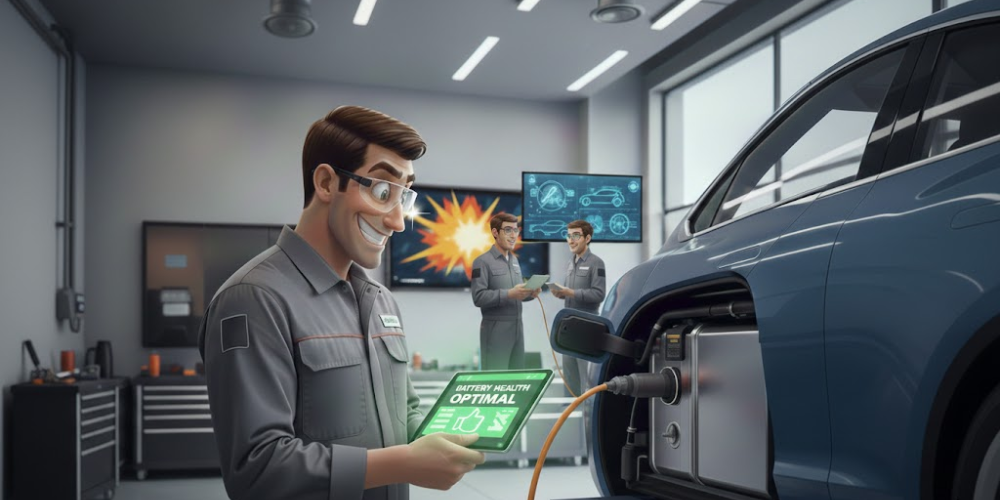
When assessing a used electric car:
- Compare the full-charge displayed range to the original WLTP claim
- Ask whether a battery health (state of health) report is available
- Confirm the remaining battery warranty
- Check for charging irregularities or warning lights
In 2026, many 2022–2023 EVs will be entering the used market. Most will still have an active battery warranty, which is a meaningful advantage for buyers.
Warranty
Most EVs sold in Australia carry:
- A general vehicle warranty
- A separate high-voltage battery warranty (often around eight years)
Many manufacturers guarantee a minimum capacity retention of around 70% during the warranty period.
If that battery coverage remains active, your downside risk drops significantly.
Before committing, confirm:
- Remaining years and kilometre limits
- Transferability to second owners
- Exact capacity guarantee terms
This is where used EV buying differs most from petrol ownership.
Charging access determines ownership comfort
In 2026, public charging infrastructure is broader than ever, but home charging remains the most practical solution.
Before buying, consider:
- Do you have access to off-street parking?
- Can you install a home AC charger?
- Will daily driving exceed the realistic range?
Also confirm:
- The portable charging cable is included
- Charging ports support Australian Type 2 and CCS2 standards
- Connectors and ports show no damage
Charging convenience influences long-term satisfaction more than acceleration figures.
Real-world range- context over numbers

Official range claims are laboratory-tested. Real-world results vary based on:
- Temperature
- Highway speeds
- Driving style
- Battery age
A city-based commuter may find even moderate-range EVs more than sufficient. Regional drivers should prioritise larger battery variants.
In 2026, range anxiety is less about infrastructure and more about buying the right specification for your usage.
Performance can still surprise you
Even single-motor EVs deliver immediate torque. Dual-motor variants can rival performance cars in acceleration.
For households with probationary drivers, check local power restrictions before purchasing higher-output models.
Electric does not automatically mean conservative.
The usual used-car checks still apply
Despite fewer moving parts, an EV remains subject to wear. Always:
- Verify service history
- Inspect tyres (EV weight can increase wear)
- Check suspension condition
- Run a PPSR search
- Confirm recall rectifications
Mechanical simplicity does not eliminate due diligence.
Is 2026 a good time to buy a used electric car in Australia?
With 2024–2025 sales feeding into today’s used inventory, supply is stronger than it has ever been. That creates a pricing opportunity, particularly for high-volume models still under battery warranty.
The formula remains simple:
- Prioritise battery health
- Confirm warranty coverage
- Ensure charging practicality
- Choose models with a strong market presence
Approached methodically, buying a used electric car in Australia in 2026 is no longer a trust leap. It’s a calculated move.

Comments
New Comment