




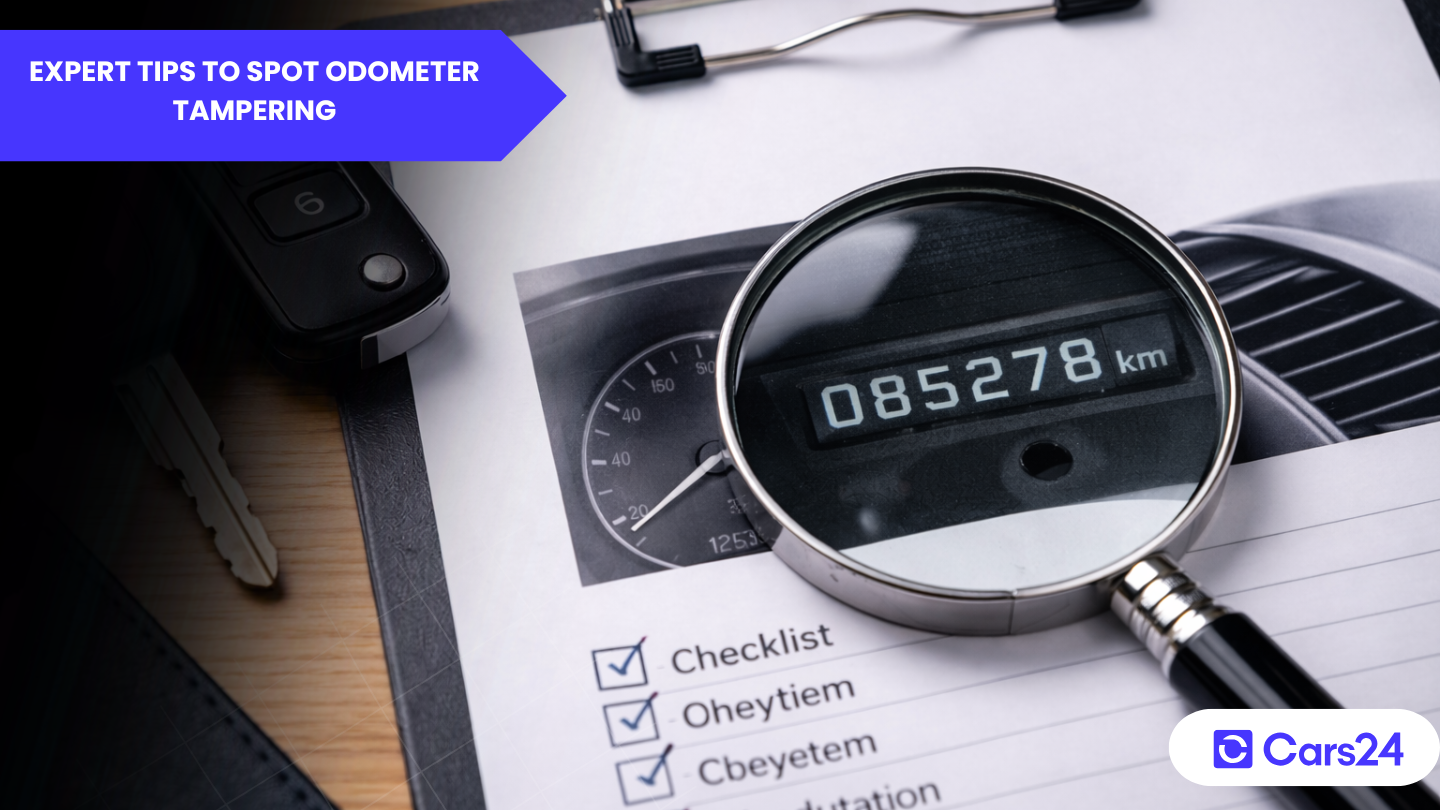
A low odometer reading can make a used car feel like a great find. Fewer kilometres, less wear, better resale value, lower risk. That is what most buyers assume.
But the number on the dashboard is not proof. It is a claim that needs to match the car’s paperwork, condition, price and ownership story.
Odometer tampering happens when the kilometre reading is changed, wound back, replaced or misrepresented so a car looks less used than it really is. It is illegal in Australia, but it still happens in the used-car market. NSW Fair Trading issued 28 fines in one month in 2025 as part of an odometer tampering crackdown, and buyers were urged to check vehicle history before purchase.
The risk is simple. A car showing 80,000 km may have actually travelled far more. That can affect the price you pay, the service schedule, the condition of major parts and the repairs you face later.
This guide explains how to check if an odometer has been tampered with before you buy, without turning the process into a full investigation.
What is odometer tampering?
Odometer tampering is when someone interferes with a vehicle’s odometer reading so the displayed kilometres do not show the true distance travelled.
This can include:
| Type of odometer issue | What it means |
| Rolling back the odometer | The kilometre reading is reduced to make the car look less used |
| Replacing the instrument cluster | The dashboard unit is changed without proper disclosure |
| Digital reprogramming | Software is used to alter the odometer reading |
| False advertising | The seller lists a lower kilometre reading than the car has travelled |
| Missing records | Service or repair records are removed to hide kilometre history |
The odometer reading affects how buyers judge value, condition and future repair risk. That is why a false reading can make a used car look safer, newer and more valuable than it really is.
Can an odometer be tampered with?
Yes, an odometer can be tampered with.
| More on this: Odometer Rollback: Myths, Facts and Warning Signs |
Older analogue odometers can be mechanically altered. Newer digital odometers can also be replaced or reprogrammed. Western Australia’s Consumer Protection says both analogue and digital odometers are vulnerable to tampering, and newer vehicles with digital control units may allow the odometer to be replaced or reprogrammed using fraudulent software.
So, do not assume a digital dashboard makes a car safe from odometer tampering. A clean screen and modern display do not prove the kilometres are genuine.
Is odometer tampering illegal in Australia?
Yes. Odometer tampering is illegal in Australia.
In WA, Consumer Protection states that both analogue and digital odometers can be vulnerable to tampering. Changing an odometer can breach Australian Consumer Law and can result in a maximum penalty of $50,000.
In NSW, it is an offence to interfere with an odometer reading. This includes altering, removing, replacing or interfering with a vehicle’s odometer to make the reading inaccurate. Suspected odometer tampering can be reported to NSW Fair Trading through Service NSW.
NSW penalties have also become stricter. In February 2025, NSW Fair Trading warned that sellers reducing the kilometres displayed on a vehicle could be fined $1,100 per offence, with court penalties of up to $55,000 per offence. From 1 September 2025, penalty notices increased from $1,100 to $5,500, while courts can still impose fines of up to $55,000 per offence.
The legal point matters, but it does not mean recovery is easy after you buy. Complaints, proof, inspections and paperwork can take time. Your strongest protection is checking the odometer before money changes hands.
How do you check if an odometer has been tampered with?
The best way to check if an odometer has been tampered with is to compare the kilometre reading with the car’s age, service history, invoices, condition, pricing and vehicle history report. Do not rely on the dashboard alone.
Use this quick check:
- Compare the odometer reading with the car’s age.
- Check service records for past kilometre readings.
- Look for gaps or sudden drops in the kilometre history.
- Compare interior wear with the displayed kilometres.
- Check the price against similar cars with similar kilometres.
- Ask whether the odometer or instrument cluster has ever been replaced.
- Run a vehicle history check.
- Walk away if the seller cannot explain mismatched information.
A genuine car should tell the same story across the odometer, documents and condition.
Start with the story, not just the dashboard
Rolling back the odometer works because buyers want low kilometres to be true.
The moment you see a low odometer reading, your brain starts filling in the blanks. You imagine less wear, fewer repairs and a better deal. That emotional reaction is exactly why odometer tampering can be so effective.
So before you trust the number, pause and ask:
Does the car look like it has travelled those kilometres?
Does the service history support the reading?
Does the seller’s story feel specific or too polished?
Is the low odometer reading being used to justify a much higher price?
If the low kilometres excite you, that is your cue to slow down and verify them properly.
Check how the car is being sold
Pay attention to the language in the listing.
Phrases like “genuine low kms”, “hard to find with this mileage”, “extremely low kilometres for age” or “barely driven” are not automatically suspicious. Many low-kilometre cars are genuine. Compare the car with similar listings. If one car is priced much higher purely because of the car odo reading, ask for proof that the kilometres are genuine.
Look for:
| Listing clue | What to ask |
| “Genuine low kms” | Can I see service records with kilometre readings? |
| “Only driven on weekends” | Do the service dates and ownership history support that? |
| “Elderly owner” | Is there paperwork to back the low usage claim? |
| “Rare low-km example” | How does the condition compare with the odometer reading? |
| Higher-than-market price | Is the price based mainly on the low kilometres? |
A low odometer reading is valuable only when the evidence supports it.
Does the car’s condition match the odometer reading?
Wear and tear should broadly match the kilometres shown. A car with 45,000 km should not usually have a heavily worn steering wheel, sagging driver’s seat, smooth pedals, tired carpets and faded dashboard buttons. A car with higher kilometres can still be in good condition, but the story needs to make sense.
Check these areas closely:
- Driver’s seat bolsters
- Steering wheel texture
- Brake and accelerator pedals
- Gear selector
- Door handles
- Seatbelts
- Carpet around the pedals
- Dashboard buttons
- Boot area
- Tyres and brake wear
Physical wear does not prove odometer tampering by itself, but it helps you question whether the car has lived the life the seller claims.
Does the service history support the kilometres?
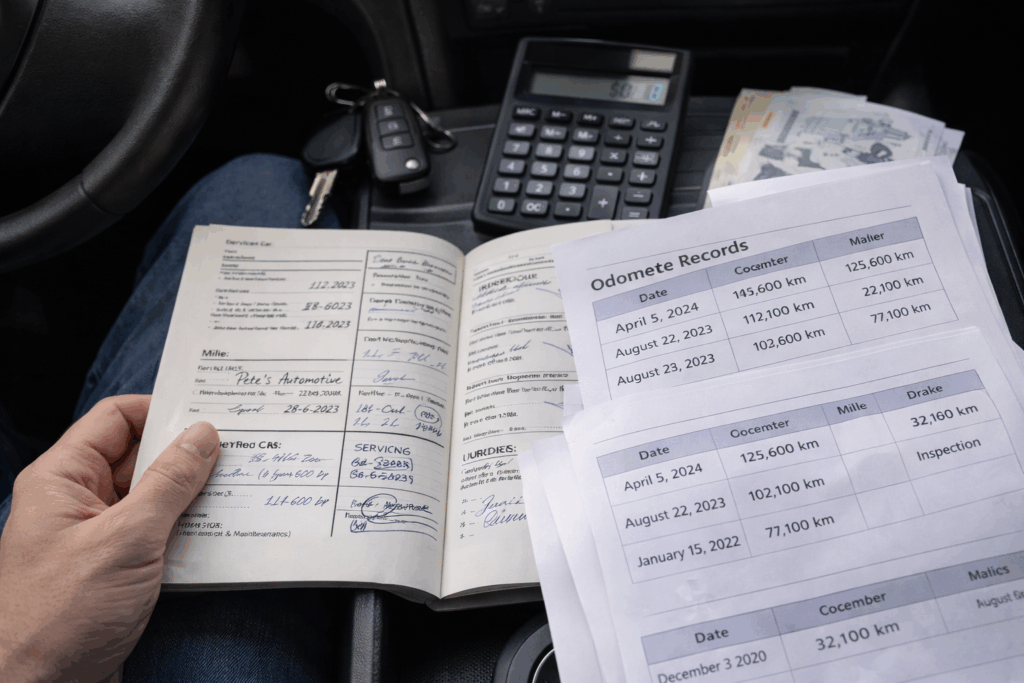
Service records are one of the strongest ways to check an odometer reading. A proper service history should show dates, kilometre readings, workshop details and invoices. The kilometres should rise naturally over time.
For example, if a car had 95,000 km recorded at a service in 2023, it should not show 62,000 km in 2026 unless there is a documented reason, such as an instrument cluster replacement with proper disclosure.
Check:
| Document | What to look for |
| Logbook | Consistent service dates and kilometre entries |
| Workshop invoices | Odometer readings printed on repair records |
| Tyre invoices | Kilometres recorded during tyre replacement |
| Roadworthy or inspection reports | Any recorded kilometre history |
| Previous sale listings | Older advertised odometer readings |
| Vehicle history report | Any mismatch or suspicious reading |
A missing service history does not always mean odometer fraud, but it does remove one of the easiest ways to verify the car.
| You’ll also find this useful: How to Understand Car Mileage and How an Odometer Works |
Watch for kilometre data that looks too neat
Day to day driving is usually uneven. Some months are busy, some are quiet. Kilometres rarely rise in perfectly smooth or rounded patterns.
Be cautious if:
- Multiple records show almost no change in kilometres.
- The car has several inspections close together with neat, rounded readings.
- Kilometres jump strangely between records.
- There is a long gap before the car suddenly appears with low kilometres.
- Records start only recently, even though the car is much older.
If someone has been rolling back the odometer, they may try to create a newer paper trail that looks clean. That is why older records matter more than a few recent ones.
Be careful with extremely low kilometres
Low kilometres are not always a win. A genuine low-kilometre car can be a great buy, but only if it has been maintained properly. Cars that sit unused for long periods can still develop problems. Rubber parts age, fluids break down, seals can dry out and batteries can fail.
A well-maintained car with 120,000 km can be a better buy than a neglected car with 35,000 km.
When checking a low-kilometre car, ask:
- Has it been serviced by time as well as kilometres?
- Has it sat unused for long periods?
- Are the tyres old even if they have tread left?
- Do the fluids and battery look maintained?
- Does the condition match the claimed usage?
The best used car is not always the one with the lowest odometer reading. It is the one where the kilometres, condition and maintenance all line up.
Can digital odometer be tampered with?
Yes, a digital odometer can be tampered with.
Digital odometer tampering can happen through reprogramming, replacement of the instrument cluster or electronic interference. WA Consumer Protection specifically warns that newer cars with digital control units or computers can allow odometers to be replaced or reprogrammed using fraudulent software.
This is why buyers should not trust the dashboard display on its own. You need to check documents, history and condition together.
| Need more clarity? How to Spot a Wound-Back Odometer in Australia |
What should you do if you suspect odometer tampering?
If you suspect odometer tampering before buying, stop and ask for proof. Do not let the seller rush you.
Do this before you pay:
- Ask for the full service history.
- Compare every recorded kilometre entry.
- Ask whether the odometer or cluster was replaced.
- Run a vehicle history check.
- Get an independent inspection.
- Compare the car’s price with similar vehicles.
- Walk away if the story does not add up.
If you discover the issue after purchase, report it to the relevant state or territory authority. In NSW, suspected odometer tampering can be reported to NSW Fair Trading through Service NSW.
Recent NSW enforcement also shows why this issue is not theoretical. In March 2026, NSW reported compensation orders after investigators uncovered odometer tampering, including one case where a Toyota Prado was bought with 397,000 km and sold weeks later with 107,000 km showing.
Should you buy a car if the odometer looks suspicious?
No. Not unless the seller can explain the issue with clear documents.
A suspicious odometer reading can affect:
- The price you pay
- Engine wear
- Transmission condition
- Suspension life
- Brake and tyre wear
- Service timing
- Resale value
- Future repair costs
If the odometer reading, paperwork, condition and price do not tell the same story, walk away. There will always be another car.
Quick odometer tampering checklist
Before buying a used car, check this:
| Check | What you want to see |
| Odometer reading | Makes sense for the car’s age |
| Service history | Dates and kilometres increase logically |
| Invoices | Workshop records support the odometer |
| Interior wear | Matches the displayed kilometres |
| Pedals and steering wheel | Not heavily worn on a low-km car |
| Tyres and brakes | Condition fits the claimed usage |
| Price | Not inflated only because of low kilometres |
| Seller answers | Clear and document-backed |
| Vehicle history report | No unexplained kilometre mismatch |
| Inspection | Mechanic confirms condition matches usage |
If two or more checks feel wrong, treat it as a serious red flag.
Final takeaway
Odometer tampering survives because buyers want low kilometres to mean a better car.
The smarter approach is to stop treating the odometer as proof. Treat it as one claim that needs support from service records, invoices, condition, price and history.
If the odometer reading, paperwork, condition and seller’s story all match, you are on safer ground. If they do not, walk away before you pay.
It is much easier to avoid a suspicious car than to prove odometer tampering after the money has changed hands.
FAQs
What is odometer tampering?
Odometer tampering is when a vehicle’s kilometre reading is changed, wound back, replaced or misrepresented so the car appears to have travelled less than it really has.
Can odometer be tampered with?
Yes, an odometer can be tampered with. Both analogue and digital odometers can be altered, replaced or reprogrammed, so buyers should check the car’s documents and condition, not only the dashboard reading.
Can digital odometer be tampered with?
Yes, a digital odometer can be tampered with. Digital readings can be altered through software, replacement parts or instrument cluster changes, which is why service history and vehicle records matter.
What are the signs of rolling back the odometer?
Common signs include unusually low kilometres for the car’s age, missing service history, worn pedals or steering wheel, inconsistent invoices, sudden kilometre drops and a seller who cannot clearly explain the car’s history.
Is odometer tampering illegal in Australia?
Yes. Odometer tampering is illegal in Australia. Penalties and enforcement vary by state, but consumer protection authorities treat it as a serious offence.
Is a low odometer reading always better?
No. A low odometer reading is useful only if the car has been maintained properly and the records support the kilometres. A neglected low-kilometre car can still have ageing fluids, tyres, seals and battery issues.
What should I do if I suspect odometer tampering?
Pause the purchase, ask for service records, check the vehicle history, get an independent inspection and report suspected tampering to the relevant consumer protection authority in your state or territory.

Comments
New Comment