




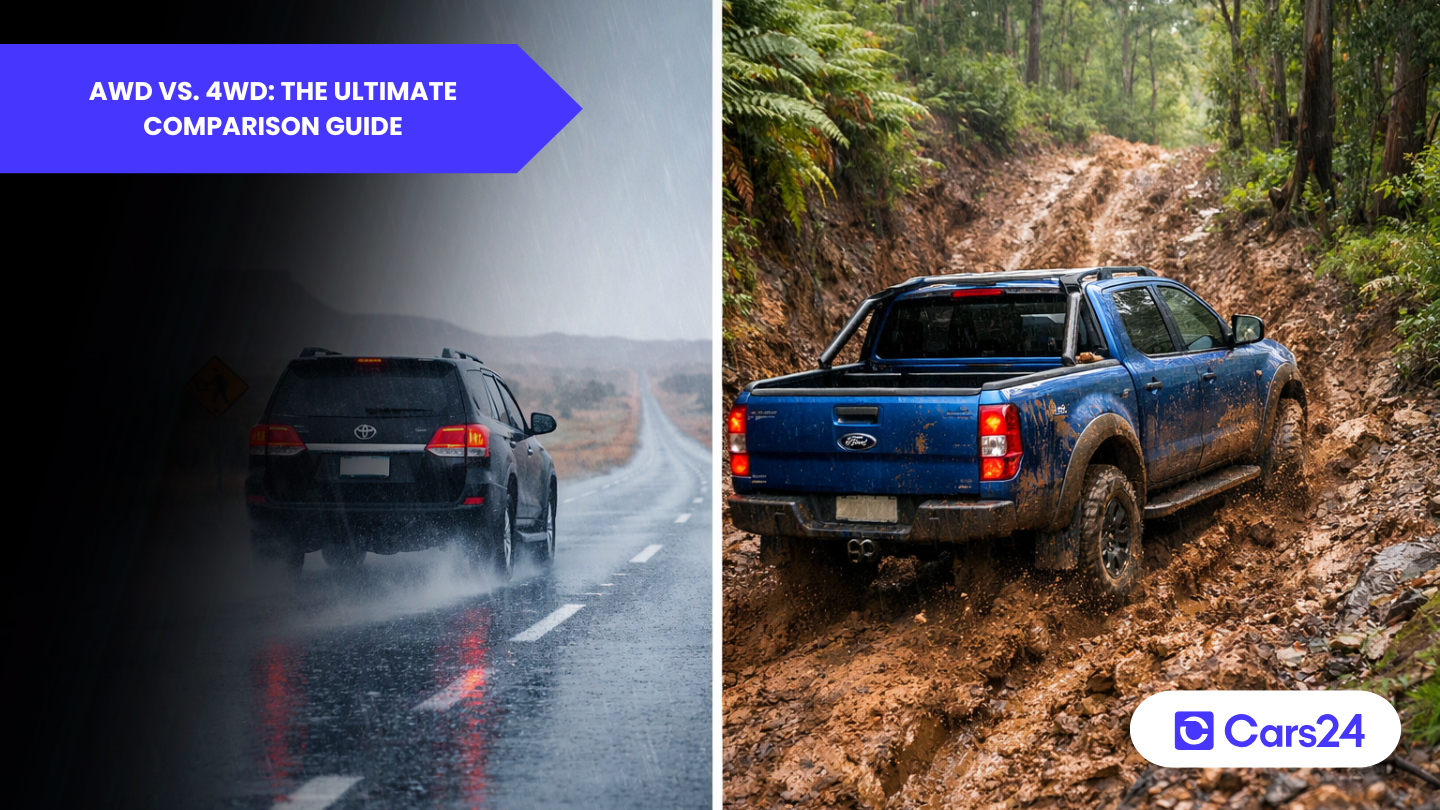
When you see AWD and 4WD on a car brochure, do you really know what the difference is? Many buyers don’t think about AWD vs. 4WD because the two get thrown around so loosely that many assume they’re the same. While they may sound similar, AWD and 4WD are built for different driving conditions.
This guide will help you understand everything about AWD vs. 4WD, their pros and cons, examples, comparisons, FAQs, hybrid drive, etc.
An overview of AWD vs. 4WD
Brands often label AWD and 4WD interchangeably in ads and brochures, but the primary mechanical distinction lies in how power is split between the front and rear axles.
All-Wheel Drive (AWD) uses a centre differential to allow the front and rear wheels to rotate at different speeds for smooth cornering on dry bitumen. Four-Wheel Drive (4WD) uses a transfer case that locks the front and rear axles together so they must spin at the exact same speed for maximum traction off-road.
Now let’s understand each drive type in more detail.
How does AWD work?
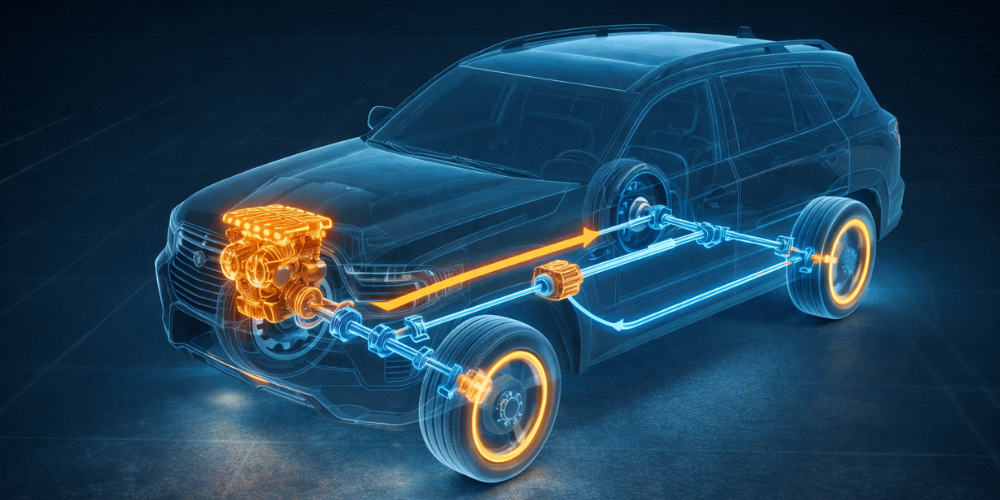
In Australia, AWD is common in SUVs and performance cars because it automatically manages traction on slippery bitumen or gravel roads without driver input. It works by sending power from the engine to both the front and rear axles simultaneously through three primary mechanical layouts.
A centre differential lets the front and rear wheels rotate at different speeds; power distribution in most AWD systems is front-biased and shifts rearward when needed, and torque vectoring can direct power between the left and right wheels to improve stability and cornering.
AWD systems are not all the same but vary significantly by brand and mechanical design. Here are some popular examples:
- Subaru (Symmetrical AWD): This provides a balanced weight distribution and constant power to all wheels, making cars like the Subaru Outback or Forester feel very stable on wet highways.
- Toyota RAV4 (On-Demand AWD): The front wheels do 100% of the work until they slip. Then, an electronic clutch sends power to the back, resulting in better fuel economy.
- Volkswagen/Audi (Haldex/Quattro): Popular in the VW Tiguan or Audi Q5, it can engage the rear wheels in milliseconds before you even notice a slip during heavy acceleration.
How does 4WD work?
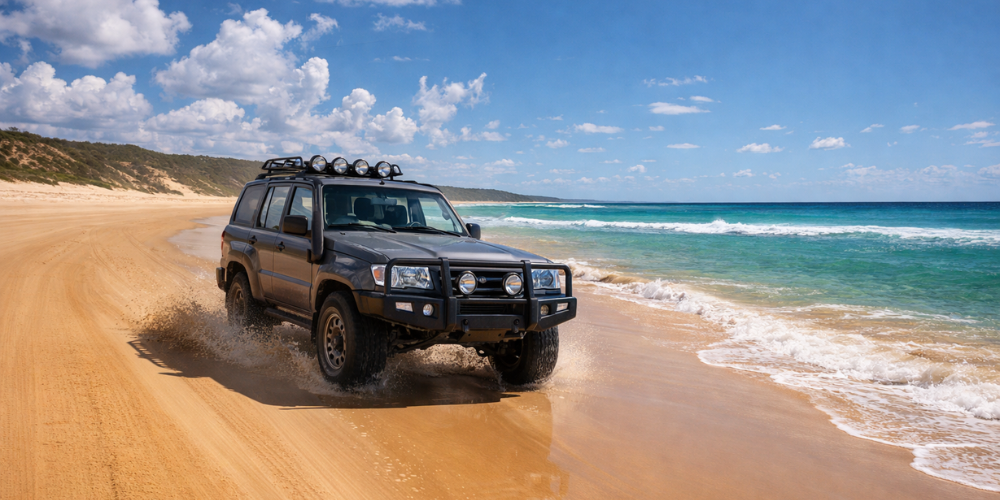
4WD (or 4×4) systems are designed for heavy-duty off-roading, such as beach driving on Fraser Island or navigating muddy tracks in the High Country. Unlike AWD, it mechanically locks axles together and uses a dual-range gearbox.
A 4WD system relies on three key components: a transfer case to split engine power between the front and rear driveshafts, dual-range gearing with high range for normal off-road driving and low range for maximum torque on steep or difficult terrain, and differential locks that force wheels on the same axle to rotate at the same speed when traction is uneven.
Here are some popular examples of 4WD/4×4:
- Toyota HiLux (Part-Time 4WD): Runs in RWD (2H) on sealed roads for efficiency, with selectable 4H and 4L for off-road conditions.
- Toyota LandCruiser 300 Series (Full-Time 4WD): Drives all four wheels continuously, using a centre differential to prevent drivetrain wind-up on dry roads.
- Mitsubishi Pajero Sport (Super Select II): Offers 2WD, 4WD with an open centre diff for bitumen, or locked 4WD for off-road use.
- Suzuki Jimny (Lightweight 4WD): Uses a simple part-time system with a manual transfer case and low-range gearing for tackling sand and rough terrain.
Pros and cons of AWD
Choosing an AWD vehicle is often a balance between enhanced safety on unpredictable roads and higher long-term ownership costs.
| Pros 👍 | Cons 👎 |
| Superior traction and grip on wet/slippery surfaces | Higher purchase price than equivalent 2WD versions |
| Better active safety with smart power transmission to wheels | More fuel consumption than a 2WD equivalent |
| Ease of use as AWD is fully automatic | Tyre sensitivity and all tyre replacement costs |
| Towing stability on wet ramps or uneven surfaces | Higher maintenance costs due to extra gears and differentials |
| Better resale value than 2WD counterparts | Limited off-road ability compared to true 4WDs |
Pros and cons of 4WD
Owning a true 4WD (4×4) is often a trade-off between unmatched freedom and significant running costs.
| Pros 👍 | Cons 👎 |
| Superior off-road capability than AWDs | Significant running costs of fuel and expensive tyres |
| Heavy towing performance for up to 3.5 tonnes | Compromised on-road safety and handling |
| Built and designed for rugged use | Urban manoeuvrability issues and vision obstruction for self and others |
| Strong resale value for 4WD popular models | Maintenance headaches due to specialised repairs |
| Better visibility due to elevated driving position | Driveline bind on the highway (more on it below) |
AWD vs. 4WD: A terrain comparison table
AWD is safe for on-road and light-duty use, while 4WD is better for serious off-road exploration. The following table compares their capabilities across common Australian driving environments:
| Terrain | AWD Performance | 4WD Performance |
| Wet bitumen | Excellent stability ✅ | Good; 4H works better ❌ |
| Gravel roads | Excellent stability ✅ | Very good; Stable in 4H ❌ |
| Firm beach sand | Capable at low tyre pressure ❌ | Excellent; Reliable power split ✅ |
| Soft sand/dunes | Poor; Could overheat & “hung up” ❌ | Superior; low-range (4L) torque ✅ |
| Deep mud | Very poor; Lacks low-speed grunt ❌ | Superior; 4L and diff locks ✅ |
| Snow and ice | Excellent; Automatic adaptation ✅ | Good; Strong for deep snow ❌ |
| Rocky trails | Limited; lacks low-range crawling ❌ | Excellent; Rugged and low-range gears ✅ |
| Water crossings | Risky; Not designed for wading ❌ | Preferred; Higher wading depths ✅ |
Also read: What makes a good off-road vehicle?
Which one should you buy?
Choosing between AWD and 4WD depends on whether you value on-road safety and convenience (AWD) or off-road freedom and heavy-duty utility (4WD).
| Your needs | Buy AWD if | Buy 4WD if |
| Driving environment | You mostly drive on urban or sealed roads | You plan to tackle bush tracks, dunes, or muddy inclines |
| Ownership costs & practicality | You prefer fuel efficiency for your commute | You can handle high ownership costs for off-road freedom |
| Towing requirements | You usually tow a light load on paved roads | You pull heavy caravans on a slippery surface |
| Ease of use vs. control | You prefer an automatic system | You want manual and engaging control over the drive |
| Long-distance touring | You mostly take weekend trips to alpine resorts or campsites | You’re planning a long remote outback travel |
If you’re planning only one or two mild off-road adventures a year, an AWD SUV like a Subaru Outback or Toyota RAV4 will likely suffice. However, if you are drawn to the rugged beauty of the Northern Territory or Western Australia’s remote tracks, a dedicated 4WD like a Ford Ranger or Toyota LandCruiser is the safer, more capable investment.
The hybrid drive vs. AWD vs. 4WD
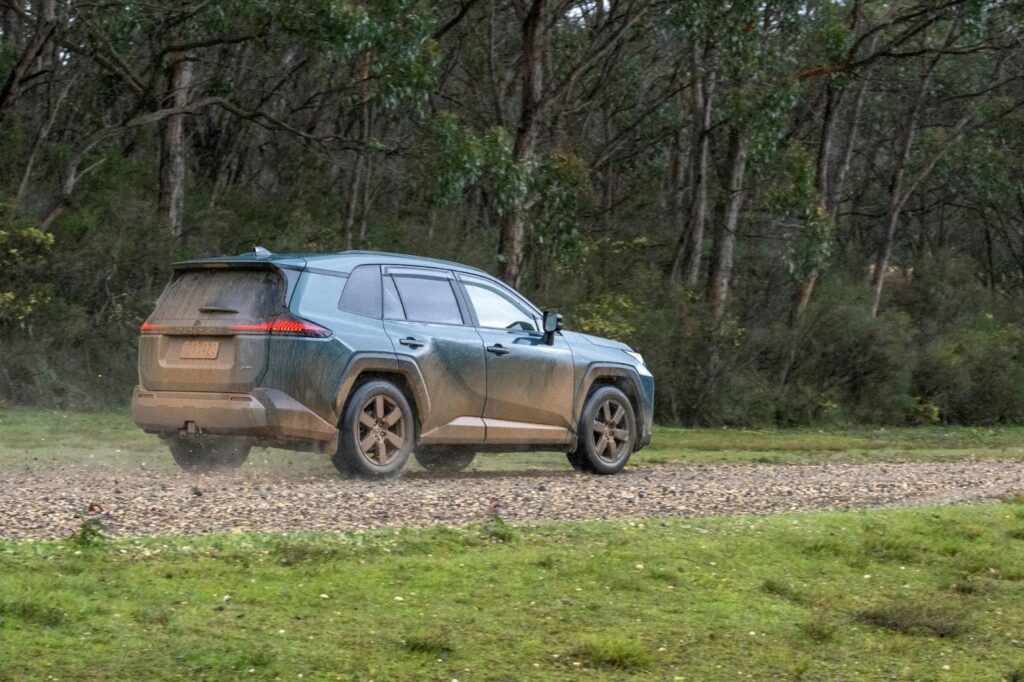
Hybrid vehicles with AWD or 4WD often use electric AWD (e-AWD), in which separate electric motors power the front and rear wheels. SUVs like the Mitsubishi Outlander and Toyota RAV4 combine the efficiency and road safety of AWD with the instant low-range torque of electric motors for light off-road use.
For most drivers, hybrid AWD systems are suitable for sealed roads, gravel tracks, and occasional beach or camping trips. Hybrids react quickly to slippery conditions and require less mechanical complexity than traditional 4WD setups.
However, they are not designed for extreme off-roading, as they typically have lower ground clearance and less durability for deep water crossings or serious rock crawling.
Also read: Utes vs. cab chassis: Which utility vehicle fits your needs?
Popular AWD and 4WD cars in Australia
AWD SUVs
- Mazda CX-5
- Subaru Outback
- Subaru Forester
Hybrid AWD SUVs
- Toyota RAV4
- Mitsubishi Outlander PHEV
- Nissan X-Trail e-POWER
4WD Utes and SUVs
- Ford Ranger
- Toyota HiLux
- Toyota LandCruiser Prado
Final words
Think of AWD vs. 4WD not as rivals but as tools built for different jobs. In everyday driving across Australia, on wet highways, gravel backroads, and mountain trips, AWD is often the smarter choice.
But if your plans include serious adventure, deep sand, muddy tracks, steep climbs, or remote touring, then a proper 4WD is the machine built for the job.
So here’s a simple rule: buy for the terrain you’ll actually drive, not the fantasy trip you might take once a year. The car should match your lifestyle!
FAQs about AWD vs. 4WD
1. Which is better, 4WD or AWD?
The “better” depends on your lifestyle. AWD is better for most Australians who stick to sealed roads, highways, and gravel tracks. 4WD is better if you plan to tackle soft sand, deep mud, or serious outback ruts.
2. Do all SUVs have 4WD or AWD?
No. Many entry-level SUVs like the Toyota Corolla Cross or Kia Seltos are 2WD (front-wheel drive) to save on cost and fuel.
3. Can you go 4WD in an AWD?
No, AWDs lack low-range gearing and suitable ground clearance for terrains like a soft beach or a steep, rocky bush track. However, you can do light off-roading (gravel, firm dirt) with AWD.
4. Can you turn AWD on and off?
Typically, no. Most modern AWD systems are “on-demand” and automatic.
5. Are there electric AWD and 4WD vehicles?
Yes. Many EVs (e.g. Tesla Model Y or Kia EV6) use dual motors for AWD. There are also growing options for electric/hybrid 4WDs, like the GWM Tank 300 Hybrid, which retains mechanical off-road gears.

Comments
New Comment