




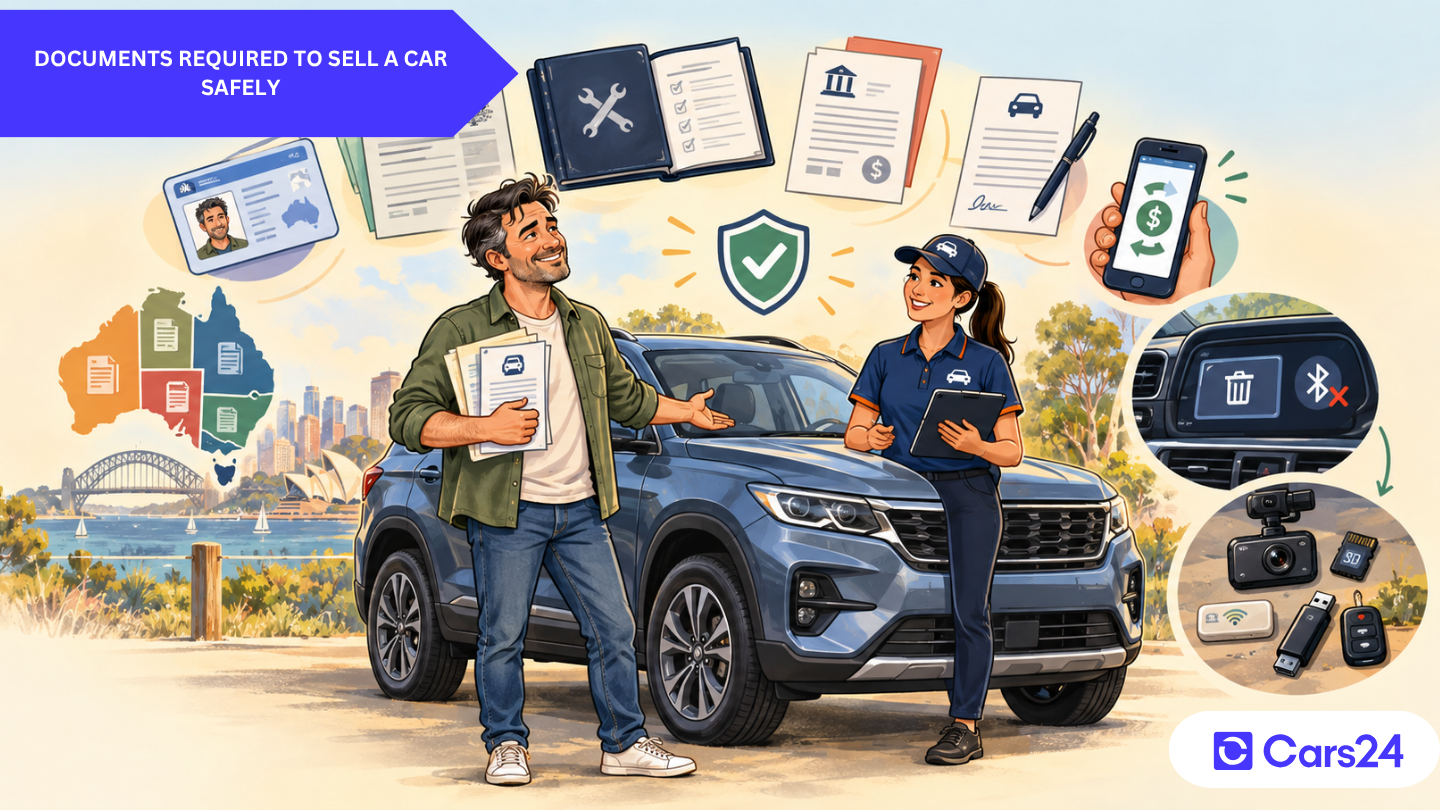
From your driver licence to the data still saved in your car, here’s what Cars24 needs from you, why it needs it and what you should protect before handover.
Selling your car comes with a small avalanche of “Do you have this?” questions. Your licence, rego details, proof that the car is yours to sell, its Service records, and a finance payout letter, perhaps. And eventually, where should the money be transferred?
Which raises a perfectly fair question: how much of this do you actually need to hand over, and why?
If you’re planning to sell your car with Cars24, the documents required to sell a car depend on your vehicle and your circumstances. A car you own outright is usually simpler than one with finance owing. Joint ownership, company cars or estate vehicles can need extra authority. And while service history is useful, it is not the same thing as legal ownership or transfer paperwork.
Then there is the part sellers do not always think about until the last minute: data. Your documents can carry your address, licence number and signature, while the car itself may still remember your phone, contacts, saved destinations or connected accounts.
So before you start sending over every document you can find, it is worth knowing what Cars24 may ask for, what each document is actually doing in the sale and what personal information you should clear out before the car changes hands.
What should you have ready before you start selling?
You do not need to empty the glovebox onto the kitchen table before you even begin. Cars24 starts with the basics: your car’s registration number or VIN and the state it is registered in. That gets things moving. The other documents become important once you decide to continue with the sale.
Here is what you will generally want handy:
- your driver licence or another photo ID
- your current rego certificate or registration details
- proof that the car is yours to sell, or that you have permission to sell it
- spare keys and the owner’s manual, if you still have them
- your logbook, service history and any useful maintenance records
- a current payout statement if there is still finance owing
- your bank details later, when it is time to arrange payment
And if your service folder is missing a few years, don’t panic and start hunting through old drawers. Service history is useful because it helps show how the car has been maintained, but it is not a legal requirement for selling a car across Australia. Give Cars24 the records you do have and the vehicle will still be assessed on its condition and other details.
Not sure which old invoices and logbook entries are actually useful? Our guide to checking your car’s service history before selling explains what is worth bringing along.
Why does Cars24 ask for your ID and proof of ownership?
Put simply, Cars24 needs to know two things: who are we buying the car from, and are they allowed to sell it?
That is where seller identity verification comes in. Your photo ID helps confirm who you are, while ownership documents help show that you have the right to sell the vehicle.
One small but important point: registration and ownership are not always the same thing. Your rego certificate shows the registered operator and vehicle details, but it does not always prove legal ownership on its own. That is why Cars24 can ask for extra proof or authority where needed.
Your details can also be used to complete the sale, arrange payment and handle registration-related paperwork. If the car is jointly owned, belongs to a company or is part of a deceased estate, a little more paperwork may be needed to show who has authority to sell it.
What is the car sale document when you sell to Cars24?
If you were hoping there was one legal document for selling a car in Australia that covered the whole process, unfortunately it is not quite that simple. When you sell to Cars24, the main car sale document is the Purchase Agreement, which includes the Cover Sheet and the Terms and Conditions.
The Cover Sheet records details such as your information and the Total Purchase Price, while the Terms cover things like your authority to sell the car, ownership, the accuracy of the odometer reading and any finance or other encumbrance attached to the vehicle.
Separate from that, your state or territory may also require registration paperwork, such as a Notice of Disposal or transfer form. That paperwork does a different job: the Cars24 agreement records the sale between you and Cars24, while the government paperwork deals with the vehicle’s registration record. So if you have searched for a document for sale of car and wondered which single form you need, the answer is that there may be more than one because they are covering different parts of the sale. You can read the current Cars24 Terms of Sale before signing.
Can you sell a car to Cars24 if finance is still owing?
Yes. Having finance left on the car does noT stop you from selling it to Cars24. What matters is that the finance is declared and the payout can be worked into the sale properly. Cars24’s Terms allow an outstanding encumbrance to be paid from the Total Purchase Price, provided the right information is supplied. In practice, that can mean getting a current payout statement from your lender and giving the authority needed to clear the finance as part of the settlement.
This is also where the PPSR comes in. A PPSR search can show whether a security interest is recorded against the vehicle, but it is important not to confuse that with proof of ownership. The PPSR is a national register of security interests, not a register of who legally owns the car.
If there is still money owing, the best thing to do is get an up-to-date payout figure from your lender and follow the Cars24 settlement process from there. You can also read more about selling a financed car and how to read a PPSR report.
Do roadworthy and transfer documents change by state?
Yes, it does. Roadworthy and transfer paperwork is set by each state, not nationally, so what you need in NSW isn’t what you need in Victoria or Queensland.
NSW wants a Notice of Disposal, plus proof of sale kept on file. Victoria has its own disposal and roadworthy rules. Queensland asks for a safety certificate on registered transfers, unless you’re selling to a licensed dealer. ACT and NT sometimes add age-based inspections depending on the vehicle.
Don’t go off what a friend needed for a private sale in another state. Check what’s actually asked for on your transfer, and contact your registration authority if you’re unsure.
Cars24 handles most of the transfer, but you may still need to sign or provide a document or two. Worth a quick check before handover.
When should you share bank details and personal information?
You do need to share some personal information during the sale, but not all at once and not with just anyone who asks.
Cars24 pays sellers by bank transfer, and its current seller information says payment details are provided after the inspection. The transfer is then arranged ahead of scheduled pickup. Just keep in mind that bank processing times can vary, so this is not the same as promising that the money will appear in your account instantly.
The safest rule is simple: only share your licence, bank details or other personal information through the proper Cars24 process. If you get a message that feels unusual, asks for something you were not expecting or wants extra information out of the blue, check it through the official Cars24 website or contact channel before sending anything.
If you want to know more about what Cars24 collects and why, the Cars24 Privacy Policy explains how personal information can be used, stored and handled, as well as your options for access, correction and privacy complaints.
What personal data should you remove from the car before handover?
That paperwork’s only step one. Your car probably knows more about you than you’d think.
Before you hand it over, clear out the glovebox: old insurance papers, toll notices, parking permits, anything with your name on it. Check the service invoices too, they often have personal details tucked in. Unpair your phone, wipe the contacts and recent nav destinations, sign out of any connected services, and grab your USB drives, dashcam card, toll tag and garage remote.
Want to do a full infotainment reset? Check the owner’s manual first. Resets aren’t the same across vehicles, and some wipe more than just your personal data.
The next owner needs your service history, not your home address or your Spotify login.
Frequently asked questions
Does my registration certificate prove I own the car?
Not necessarily. Registration tells you who the vehicle’s registered operator is, not always who owns it or has the right to sell it. That’s why Cars24 may ask for both your registration details and something that proves you’re entitled to sell.
Do I need a roadworthy certificate to sell to Cars24?
Depends where you are. Roadworthy and safety-certificate rules come down to your state and the type of sale. Queensland, for instance, exempts some transfers to licensed motor dealers from needing one.
What should I keep after the car is sold?
Hang onto the signed sale agreement, the disposal or transfer confirmation, proof of payment, and your finance payout confirmation if you had one. Together they’re your paper trail showing what was agreed and when the sale actually went through.
Selling a car shouldn’t mean signing over documents without knowing why they’re needed. Once you know what proves identity, ownership, finance and transfer, the paperwork stops being confusing. When you’re ready, sell your car with Cars24 and work through what’s needed for your vehicle and state.
Comments
New Comment