




Every now and then, a fuel name pops up that most drivers recognise, but it’s hard to properly explain if someone asks them on the spot; E85 fuel is one of those.
In all likelihood, you must have heard E85 fuel mentioned in car forums, in conversations about tuned engines, or in occasional motorsport discussions. And at the same time, plenty of drivers have spotted E85 fuel at the servo and wondered whether it’s something they should actually be putting in their car.
So what exactly is E85 fuel? Is it just another petrol choice, something that’s supposed to be better for engines, or one of those fuels that only a few modified cars can actually use?
For those wondering, the truth is a bit more interesting. E85 fuel sits in a slightly odd space in the fuel world, and it’s not a gimmick, but it’s not meant for every car either. It’s a specific blend with its own advantages, trade-offs, and of course, a bit of history behind it. Once you understand what E85 fuel actually contains, the whole thing starts to make more sense.
The name already gives away the basics
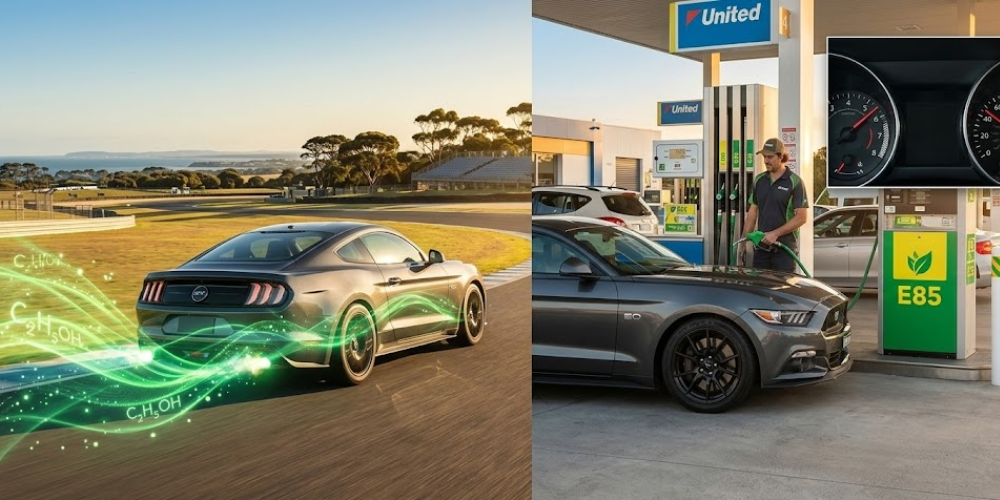
The easiest way to understand what is E85, is to start with the name itself; “E” stands for ethanol, and the number mirrors the percentage of ethanol in the blend. So, E85 fuel contains up to 85 percent ethanol, with the remainder composed of petrol.
In Australia, the exact composition of E85 fuel can vary slightly depending on the season, which is why it usually sits somewhere between 70 and 85 percent ethanol – depending on seasonal fuel requirements. That makes a difference because E85 fuel behaves very differently from standard petrol. Most Australian drivers are already familiar with another ethanol blend, E10, which contains up to 10 percent ethanol, which is mild enough to run, many modern cars can run on it without facing any problems.
E85 fuel, however, contains far more ethanol, and that heavier blend changes how the fuel works inside an engine. The reason E85 fuel behaves differently really comes down to what’s in it.
But first, what is ethanol?
Before going further, it’s worth answering a basic question: what is ethanol?
Ethanol is an alcohol-based fuel produced by fermenting plant materials such as sugar cane, corn, grains, or other agricultural crops. Once fermentation happens, the alcohol is distilled and blended with petrol to create fuels like E10 or ethanol 85 fuel. Because ethanol comes from plant sources rather than crude oil, it’s commonly described as a biofuel.
That renewable angle was one of the reasons energy sources like E85 fuel started gaining attention globally, although that’s not actually the main reason most car enthusiasts talk about it today. But what really made E85 fuel popular is how it performs in high-performance engines.
Why performance drivers talk about E85 fuel
Among car enthusiasts, E85 fuel has slowly built a bit of a reputation over the years. A lot of that comes down to something called octane rating. It might sound technical, but the idea is actually pretty simple. It just tells you how well a fuel can handle pressure inside the engine before it burns. If fuel ignites too early, the engine can start knocking, which isn’t great for performance or the engine itself.
Fuels with higher octane can handle higher pressure and temperature, which is why performance engines often require them. Regular petrol in Australia generally sits around 91 RON, while premium fuels such as 95 or 98 have higher octane ratings designed for performance engines. E85 fuel, on the other hand, typically lands somewhere around 100 to 105 RON.
For modified vehicles, that means E85 fuel can potentially unlock more power. The higher octane means the engine can be tuned to run more aggressively, which can help squeeze out more power. There’s another interesting thing about E85 fuel, too, because it contains a lot of ethanol, and it tends to burn a little cooler than regular petrol. In high-performance engines, especially turbocharged ones, that cooler burn can help keep temperatures under control when the engine is working hard.
Put those things together, and it’s easy to see why E85 fueling often comes up in racing circles and performance builds. But this is also where some of the confusion around E85 fuel begins, because what works well for a modified engine doesn’t always make sense for everyday cars.

The myth that E85 fuel is simply “better petrol”
A common assumption is that E85 fuel must be superior to petrol simply because it has a higher octane rating, but E85 fuel isn’t just premium petrol with extra power. Ethanol actually contains less energy per litre than petrol, which means engines usually need to burn more E85 fuel to produce the same amount of energy.
As a result, vehicles running on E85 fuel typically experience lower fuel economy compared with standard petrol. Drivers who switch to E85 fuel often notice they’re refuelling more frequently. In many cases, fuel consumption increases by 20 to 30 percent, depending on the vehicle and its tuning.
Which raises a fair question: if E85 fuel uses more fuel per kilometre, then why do enthusiasts still bother with it? For performance builds, the trade-off can be worth it. The higher octane and cooler burn characteristics of E85 fuel allow engines to run more aggressive setups safely. For everyday driving, though, the benefits are much less obvious.
Not every engine is designed for E85 fuel
This is probably the most important thing to know about E85 fuel: most standard petrol cars simply aren’t built to run on it. Vehicles that can safely use E85 fuel are known as “flex-fuel vehicles”, or FFVs. These cars are engineered to handle different ethanol concentrations without damaging the fuel system. Flex-fuel vehicles typically include:
• ethanol sensors that detect fuel composition
• specialised fuel lines and seals
• higher-capacity fuel injectors
• engine management systems that automatically adjust fuel delivery
Without those components, running E85 fuel in a regular car could cause issues over time. That’s why the safest rule is simple: only use E85 fuel if the vehicle manufacturer confirms your car is compatible with E85 fuel or the engine has been professionally modified for it. If your owner’s manual doesn’t mention E85 fuel, your car probably wasn’t designed to run it.
Finding E85 fuel in Australia
Despite all the buzz around E85 fuel online, it’s still not something you’ll see at every servo across Australia. A few service stations do stock E85 fuel, particularly ones that cater to performance cars, but compared with everyday options like 91, 95, 98 or E10, it’s still pretty niche. That’s why people searching “E85 close to me” often realise there aren’t many places selling it nearby. For most Aussie drivers, E85 fuel is something they might come across now and then rather than something they fill up with regularly.
So where does E85 fuel actually fit in?
E85 fuel is a petrol blend made up of mostly ethanol, up to about 85 percent, with the rest being regular petrol. Because of its higher octane rating and the way ethanol burns, E85 fuel can work really well in certain engines, especially modified or performance-focused cars.
But E85 fuel was never meant to replace regular petrol for everyone. For most cars on Australian roads, the everyday options like 91, 95, 98 or E10 are still the right choice. E85 fuel tends to make the most sense for vehicles that are specifically built, or properly tuned, to run on it.
So if you ever spot E85 fuel at the bowser and start wondering whether you should give it a go, the easiest thing to do is check your owner’s manual first. In most cases, your car will already tell you exactly what it prefers.
FAQs
Can any car run on E85 fuel?
Not really! Because most regular petrol cars in Australia aren’t built to run on E85 fuel. You’ll generally only see it used in Flex-Fuel Vehicles (FFVs) or cars that have been properly modified and tuned for ethanol blends. If your owner’s manual doesn’t specifically say the car can handle E85, it’s best to stick with the usual petrol options like 91, 95 or 98.
Is E85 fuel better for performance?
In the right setup, it can be. E85 fuel has a higher octane rating (usually around 100-105 RON), which allows tuned engines to run more aggressive ignition timing and higher boost. That’s why you’ll often hear about it in racing or modified performance cars. For everyday cars, though, you probably won’t notice much of a benefit.
Does E85 fuel use more fuel?
Yes, it usually does. Because ethanol contains less energy per litre than petrol, engines running on E85 fuel often burn through it faster. In many cases, drivers notice around 20-30% higher fuel consumption, which means you’ll likely be visiting the servo more often.
Is E85 fuel easy to find in Australia?
Not everywhere. E85 fuel is still fairly niche in Australia, so you won’t see it at every servo. A few stations, including some United Petroleum and Ampol locations, do offer it, usually in areas with a strong performance-car scene. Compared with common fuels like 91, 95, 98 or E10, though, it’s still pretty limited.
Is E85 fuel better for the environment?
It can be, depending on how it’s produced. E85 fuel contains a high percentage of ethanol made from plant sources, which means part of the fuel comes from renewable materials instead of crude oil. That said, the overall environmental impact depends on things like how the ethanol is grown, processed and transported.
What does E85 actually mean?
The name is pretty straightforward. The “E” stands for ethanol, and the number refers to the percentage in the blend. E85 fuel usually contains about 70-85% ethanol, with the rest being regular petrol.

Comments
New Comment