




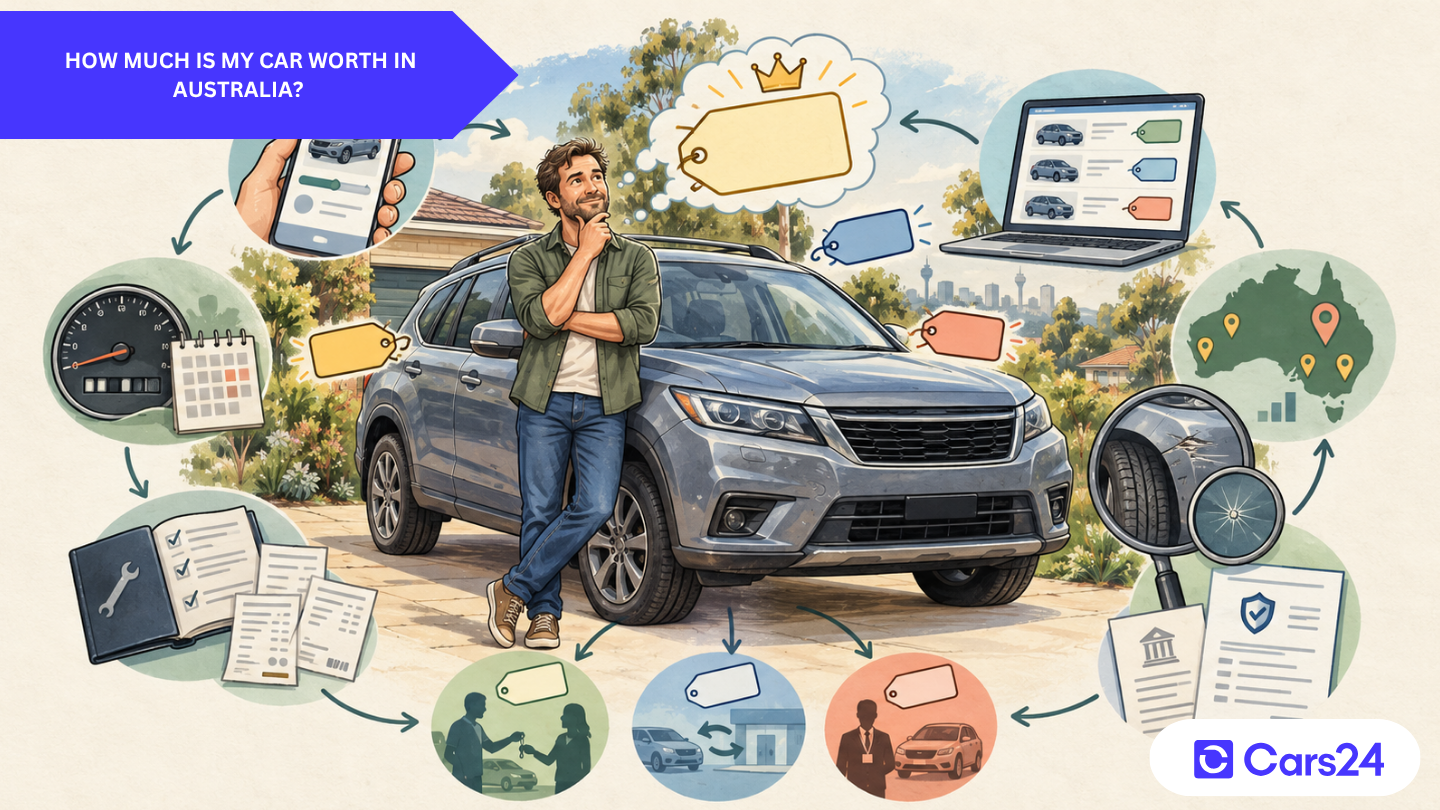
One car, several possible prices. Here’s how to work out what yours may be worth in today’s Australian market.
The most generous car valuer in Australia is usually the person who owns the car. Fair enough, too. You remember what you paid for it, the new tyres you put on last year and that Sunday afternoon you spent trying to polish out the scratch near the boot. You know the car has started every morning, carried the weekly shop and never caused much trouble.
The next buyer does not have any of that history in their head. They see the year, kilometres, condition and what else is available for the same money.
So you do what most sellers do and start looking online. “How much is my car worth Australia” goes into the search bar and, within minutes, you have several different answers. One valuation tool gives you an estimate. A similar car is advertised for thousands more. Then an interested buyer comes along with a number that sits somewhere else entirely.
At that point, it is reasonable to wonder: my car is worth what, exactly?
The slightly frustrating answer is that your car does not have one fixed price waiting to be discovered. Its current market value sits within a range, shaped by the car itself, what buyers are looking for and how you decide to sell it.
A good used car valuation helps you make sense of that range. It gives you a realistic place to start, so you are not relying only on what you originally paid, the highest listing you can find or the hopeful number already sitting in your head.
Why can the same car have several different values?
Say you find a car online that looks almost identical to yours. It has the same badge, the same colour and was built around the same time. It is advertised for $30,000, so naturally, you start thinking yours must be worth about $30,000 too.
Possibly, but there may be more separating the two cars than you can see in the photos. The other one might be a higher variant, have fewer kilometres on the clock or come with a complete service history and a newer set of tyres. Even then, $30,000 is what the seller is asking for. It may not be what a buyer eventually pays.
The way you sell also changes the number you are looking at. With a private sale, the price is whatever you and an individual buyer agree on. A trade-in value is the amount a dealer is prepared to put towards your next car. A professional car buyer also needs to consider your car’s condition, current demand and what it may cost to prepare the vehicle for resale.
That is why these figures rarely match perfectly. Comparing the highest advertised price you can find with a real purchase offer does not give you a fair picture of your car value. They are two different numbers, created for two different types of sale.
What determines the value of my car?
There’s no single detail that decides your car value. It’s usually a mix of what the car is, how it has been used, how well it has been looked after and what buyers want at the time.
Start with the exact car you own
If you’re comparing your car with one online, make sure it is actually the same car.
Saying you own a Toyota RAV4, Ford Ranger or Mazda CX-5 is only the beginning. The variant, engine, transmission and whether it is 2WD or 4WD can all move the price. Factory features can make a difference too.
Your rego or VIN can help confirm the exact version. It’s worth checking before you decide that the similar-looking car advertised online is your perfect match.
Age and kilometres matter, but not separately
A five-year-old car with 50,000 kilometres on the clock won’t usually be viewed in the same way as one that has travelled 150,000. That part is fairly straightforward.
Where it becomes less obvious is when condition enters the picture. Low kilometres won’t do all the work if the car has missed services, needs new tyres or has mechanical problems. Equally, a higher-kilometre car with regular maintenance and clear records may still give an assessor plenty to work with.
Take an honest look at the condition
You know the scrape near the boot that you stopped noticing months ago? A buyer is seeing it for the first time.
Dents, damaged paint, worn seats, windscreen chips, warning lights and features that no longer work can all affect a used car valuation. Tyres matter as well, particularly if a new set will be needed soon.
This doesn’t mean a few stone chips will ruin the price. Used cars come with signs of use. What matters is whether the issue is minor, expensive to fix or likely to affect how the car drives.
Your service records help tell the story
Paperwork isn’t the exciting part of selling a car, but it can be genuinely useful.
A stamped logbook, digital service record or folder of workshop invoices shows what has been done and when. It won’t add a set amount to every valuation, but it gives an assessor more context than simply being told the car has always been looked after.
Don’t worry if the history isn’t perfect. Bring what you have. A few solid records are still better than none.
Previous damage and finance need their own checks
A repaired scrape from a car park is not the same as major accident damage, so the effect on value depends on what happened and how well it was repaired.
It is better to be clear about any history you know. A car history check may show a registered security interest, stolen status or written-off status, so an old problem can easily become a new conversation later.
Finance owing doesn’t stop you from having the car valued either. You’ll just need a current payout figure from your lender so the outstanding amount can be handled during the sale. If that’s your situation, our guide to selling a financed car in Australia explains what happens next.
Then there’s the market itself
This is the part you can’t control. Buyer tastes change, more cars like yours come up for sale and demand can be stronger in one location than another.
That’s why second hand car values in Australia don’t stay fixed. The valuation you received last year may have been perfectly reasonable then, but it may not show the current market value of your car today.
How can I check the current market value of my car?
You’ll get a clearer answer by checking a few different sources rather than hanging everything on one number.
- Pull together the model year, exact variant, transmission, kilometres and current condition first. If you’re unsure which version you own, your rego or VIN should help clear it up.
- Look for several cars that genuinely match yours. A similar badge and colour aren’t enough if the other car is a higher variant, has travelled far less or comes with features yours doesn’t have.
- Keep in mind that online listings show asking prices. The final amount agreed between the seller and buyer may be lower, but that part of the deal usually isn’t visible.
- Use an online car valuation alongside those listings. Cars24 ValueCheck draws on data from 70,000 car listings processed each month, including listing and delisting prices, to estimate the current market value of your car.
- Enter the kilometres and condition as they stand today. Picking the wrong variant or leaving out a fault may produce a number, but it won’t make the used car valuation more useful.
- Treat the online figure as an informed starting point. If you continue with Cars24, inspection and verification allow us to look at the actual car before confirming a post-inspection purchase amount.
How much can I sell my car for?
The answer partly depends on how much work you want to take on.
A private sale may give you room to set your own asking price, but you will need to prepare the advertisement, take photographs, respond to enquiries, arrange inspections and test drives, negotiate and organise secure payment. It can work well if you have time and are comfortable managing the process.
A trade-in keeps the old and new car within the same transaction. When comparing deals, look at the total changeover cost rather than concentrating only on the trade-in number.
Selling to a professional car buyer gives you a purchase amount based on the car and the buyer’s assessment of the market. The figure may differ from a private asking price, but the process can involve fewer strangers, fewer messages and less negotiation.
The right route is not automatically the one with the largest number written at the top. Consider the final amount, the time involved and how much certainty you want from the sale.
Should I fix my car before getting a valuation?
Start with the easy things. Clean the car, remove your belongings, find the spare key and gather the service records.
Be more careful with expensive repairs. A repair costing $2,000 will not automatically add $2,000 to the sale price. Get a quote and consider whether the work is likely to change the car’s value enough to justify the spend.
If you decide not to repair something, describe it honestly. An assessor can then value the car that is actually in front of them.
How Cars24 works out what your car is worth
Cars24 gives you a simple place to start. Enter your rego or VIN, select your state and provide the kilometres and condition. Where available, you may receive an initial online valuation based on the vehicle details and current market data.
If you like the starting point and choose to continue, the car moves to inspection and verification. This lets us check the exact variant, condition, history and information supplied. We can then determine a post-inspection purchase amount if the car meets our acceptance criteria.
You decide whether you want to proceed. If you accept, the Purchase Agreement and Cover Sheet are completed, with the total purchase price recorded in the documents. Cars24 can then help manage the required paperwork and applicable finance steps. Payment is transferred to your nominated bank account, subject to normal bank processing times, and pickup or handover is arranged.
Have your identification, registration or ownership details, service records and finance payout information ready where applicable. Our car-selling document checklist can help you prepare.
Ready to replace the guesswork with a market-informed starting point? Find out what your car may be worth with Cars24.
Frequently asked questions about used car valuation
How accurate is an online car valuation?
An online valuation is an estimate based on the vehicle information supplied and the market data used by the provider. Its usefulness improves when you enter the correct variant, kilometres, features and condition. An inspection can identify details that an online form cannot, so the final purchase amount may be different.
Does a full service history increase my car’s value?
It can support the valuation by showing how the car has been maintained, but there is no standard dollar amount added for a complete logbook. Age, kilometres, present condition and market demand still need to be considered.
Does high mileage make a car difficult to sell?
Not necessarily. Higher kilometres can affect value, but buyers also look at age, maintenance, condition and the type of driving the car has done. Clear service records can provide useful context for a higher odometer reading.
Do modifications add to my car value?
Some buyers may appreciate particular modifications, but others may prefer a car in its original condition. Aftermarket wheels, suspension changes or performance work do not automatically return what you spent on them. Factory options are generally easier for an assessor to identify and compare.
Can I value a car that still has finance owing?
Yes. The vehicle can still be valued, but the outstanding finance must be addressed before ownership is transferred. Have a current lender payout figure ready so the remaining balance is clear.
How often should I check the market value of my car?
Check it again when you are genuinely preparing to sell. Used-car supply, buyer demand, your kilometres and the vehicle’s condition can all change. A fresh valuation will be more useful than relying on a figure you received months ago.
Comments
New Comment