




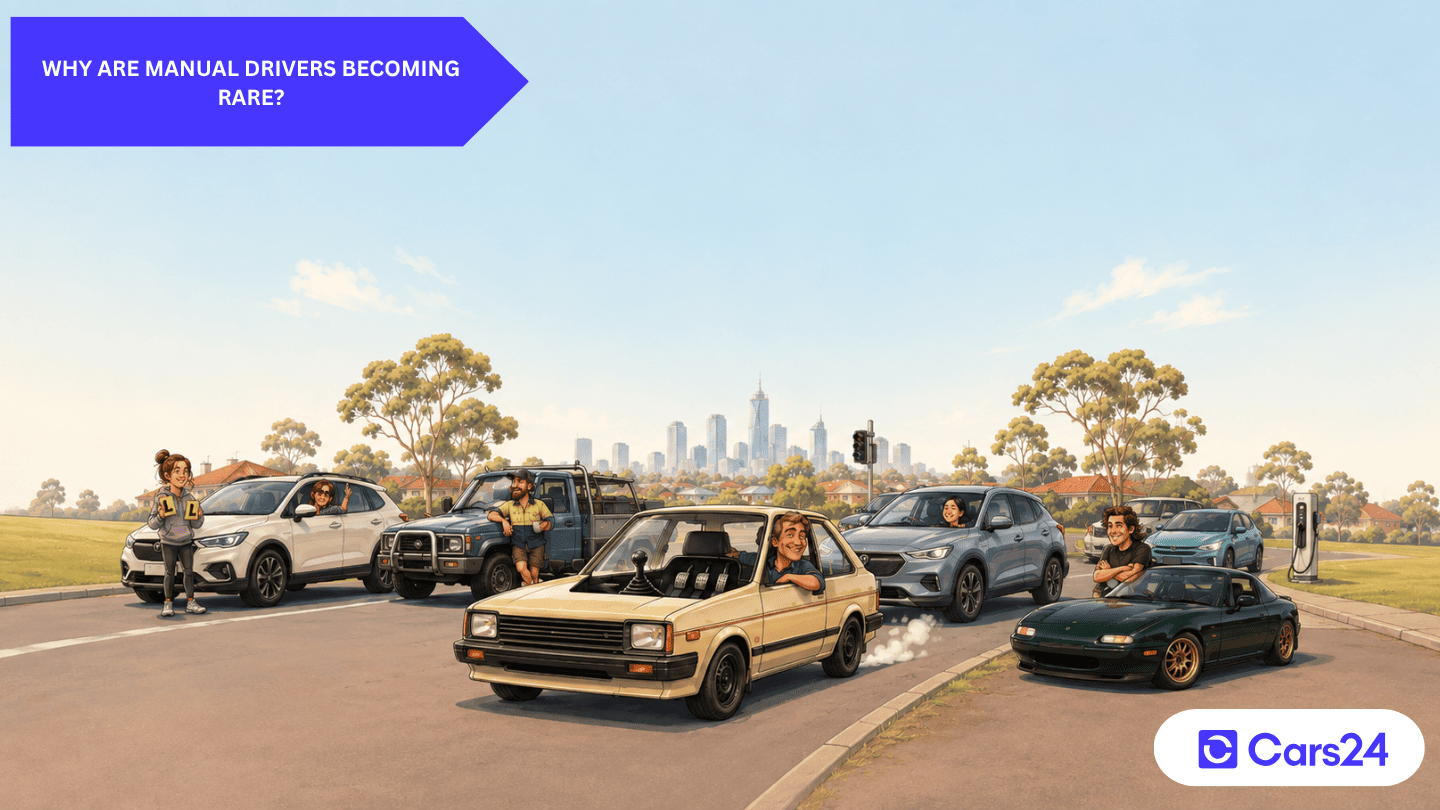
Manual driving used to be a normal part of growing up around cars in Australia. For a lot of people, manual transmission was something they first met in an older Corolla, Lancer, Barina, Commodore, Falcon, Hilux or hand-me-down hatch that had already done years of school runs, supermarket trips and weekend drives before it landed in their hands. Now, a manual car feels more like something you find in an older used car, a work ute, a regional driveway, an off-road garage or a weekend car owned by someone who still enjoys gear shifting for the feeling of it.
So why are manual drivers becoming rare in Australia? The answer is not that Australians suddenly became worse drivers, less interested in cars or too lazy to learn. The bigger story is that the cars around us changed, learner habits followed and the used-car market quietly started reflecting what new-car buyers had already been choosing for years.
Australia has become an automatic-first car market
The biggest reason manual drivers feel rare is also the most obvious one: new manual cars have become rare. ABC News reported in May 2026 that fewer than 4,000 new manual vehicles had been sold nationally since the start of the year, compared with more than 359,000 automatics. That is not a close race, and it shows how far the manual transmission has moved away from everyday new-car buying.
This did not happen overnight though. Manual cars once had a natural home in small hatchbacks, basic sedans, older utes and affordable first cars, but most new buyers now walk into an automatic-first market without really questioning it. For the average Australian shopping in 2026, automatic is not a luxury upgrade anymore; it is usually just what the car comes with.
The types of cars Australians buy have changed too
Australians did not just stop buying manuals. They also stopped buying many of the car types where manuals used to feel normal. FCAI reported that SUVs accounted for 60.7% of Australian new-vehicle sales in 2025, while passenger vehicles fell to 13.0%, which matters because the average family SUV, hybrid SUV, plug-in hybrid or city crossover is usually automatic by default.
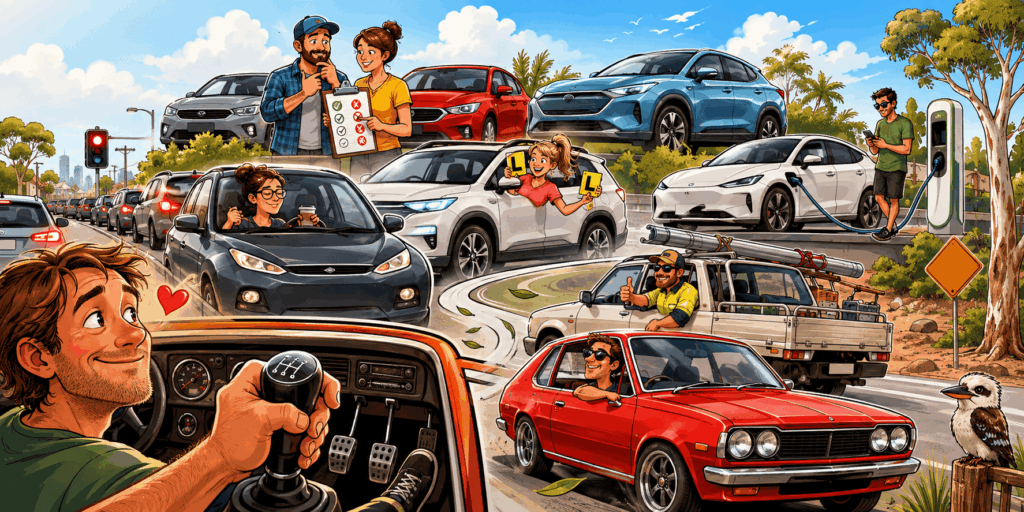
This is where the manual transmission decline becomes less about personal preference and more about what is actually available. If the family garage is now filled with automatic SUVs, hybrids and crossovers, fewer people even get the chance to practise in a manual car. The market teaches buyers what normal looks like without ever making a formal announcement about it, and in Australia’s current market, normal usually means two pedals.
Learners are following what is already in the driveway
Learner drivers often get blamed for the decline of manuals, which is a little unfair when you think about it. Most learners practise in whatever car is available at home, and if that car is an automatic RAV4 Hybrid, Outlander PHEV, Everest, Prado, Corolla Hybrid or family SUV, automatic becomes the practical path by default. The most recent widely reported state-level figures still show the direction of travel, with automatic driving tests outnumbering manual tests by a wide margin in NSW and Victoria in the early 2020s.
That creates a loop that is genuinely hard to reverse. Fewer households own manuals, so fewer learners get manual driver training, so fewer new drivers shop for manuals, so brands have even less reason to keep offering them. A driver’s manual or road-rules handbook can explain road rules, licence conditions and safe driving behaviour, but it cannot create regular manual practice if there is simply no manual car in the driveway.
Licence rules make manual less convenient to learn later
Licence conditions also push the choice toward automatic in ways that are more practical than emotional. In NSW, for example, P1 drivers who pass their test in an automatic can only drive that type of car unsupervised while the automatic condition applies. Other states and territories have their own rules around automatic-only conditions, so anyone planning to upgrade to a manual licence should check with their state transport authority rather than assuming the process works the same way everywhere.
None of this makes learning manual impossible or pointless. It just means the decision takes more planning than it used to, particularly if someone needs lessons, a suitable test vehicle and time to practise regularly. For city drivers who only plan to buy automatic hatchbacks, SUVs, hybrids or EVs, that extra effort often does not feel worth it anymore.
Automatics suit everyday Australian driving better than they used to
The old manual versus automatic debate used to come down to price, control, fuel use and that slightly old-school idea that automatic drivers were taking the easy option. In 2026, the average buyer cares more about traffic comfort, resale value, safety features, hybrid availability and what is actually listed for sale nearby. Modern automatics, CVTs and dual-clutch transmissions have improved so much that the idea of automatics being the weaker or lazier option just does not hold up anymore.
Australian traffic adds another layer to the argument. TomTom’s 2025 Traffic Index ranked Adelaide, Melbourne, Gold Coast and Sydney among the country’s most congested cities, with Sydney drivers losing 93 hours a year in rush-hour traffic and Adelaide drivers losing 109 hours. A clutch is genuinely enjoyable on a quiet back road, but it is considerably less enjoyable when you are crawling through school traffic, inching out of a shopping centre or sitting in the same peak-hour queue for the fifth morning in a row.
EVs, hybrids and fuel pressure are speeding up the shift
EVs and hybrids did not start the decline of the manual car, but they are making a mainstream comeback harder to imagine. Electric vehicles do not use a conventional manual gearbox and most hybrids and plug-in hybrids are automatic by design. In May 2026, FCAI reported that battery electric vehicles reached a record 20% of Australian new-vehicle sales, while electrified vehicles across BEV, hybrid and plug-in hybrid categories accounted for 46% of the market for that month.
The 2026 car market is being shaped by more than convenience. Ongoing fuel-price pressure has made running costs feel more urgent for Australian buyers, and many people are looking more seriously at hybrid, plug-in hybrid and electric options in both the new and used-car market. Manuals are no longer just competing with automatics; they are competing with cars where the idea of changing gears yourself is not really part of the experience at all.
What does this mean if you are buying a used manual car?
In the used-car market, a manual can still make sense, but the buyer pool tends to be more specific than it used to be. Older manual hatchbacks may appeal to budget-conscious buyers, manual utes and 4WDs can still suit work or regional use, and some manual performance cars attract enthusiasts who specifically want that extra involvement. At the same time, a manual is likely to be a harder sell to buyers who want easy commuting, shared family driving or the strongest possible resale market down the line.
Condition matters a lot when you are looking at a used manual. Clutch feel, service history, gearbox behaviour, odometer consistency and how hard the car was previously used can all make a significant difference, particularly in older vehicles or cars that have seen heavy work. When comparing used cars through Cars24, it is worth looking at inspection details, service history, PPSR status, odometer checks and overall condition together rather than treating transmission type as the only thing worth checking.
Is it worth learning to drive a manual car in 2026?
Is it worth learning to drive a manual car when most new cars are automatic? For city buyers who plan to drive an automatic SUV, hybrid, EV or late-model used car, it is probably not essential anymore. For regional drivers, tradies, farm users, off-roaders, enthusiasts and buyers looking at a wider range of older used cars, manual driver training can still be genuinely useful because those parts of the market still include vehicles where it matters.
Are manual cars worth it in a broader sense? It depends on the driver, the car and how you actually use it. A manual is not automatically better or worse in 2026; it is just a deliberate choice now rather than a default one, and that makes it worth thinking through properly before you commit.
Are manual drivers disappearing completely?
Manual drivers are not disappearing. They are becoming more concentrated in specific parts of the market: older used cars, regional areas, farms, commercial vehicles, off-road communities and enthusiast garages. The manual transmission has not died in Australia; it has moved from being the everyday default to being an intentional choice made by people who actually want it.
That is the real shift. Manual used to be normal because the market around it made it normal. In 2026, Australia is automatic-first, SUV-heavy and increasingly electrified, and that is why manual drivers feel rarer than they used to, even though they have not gone anywhere.

Comments
New Comment