




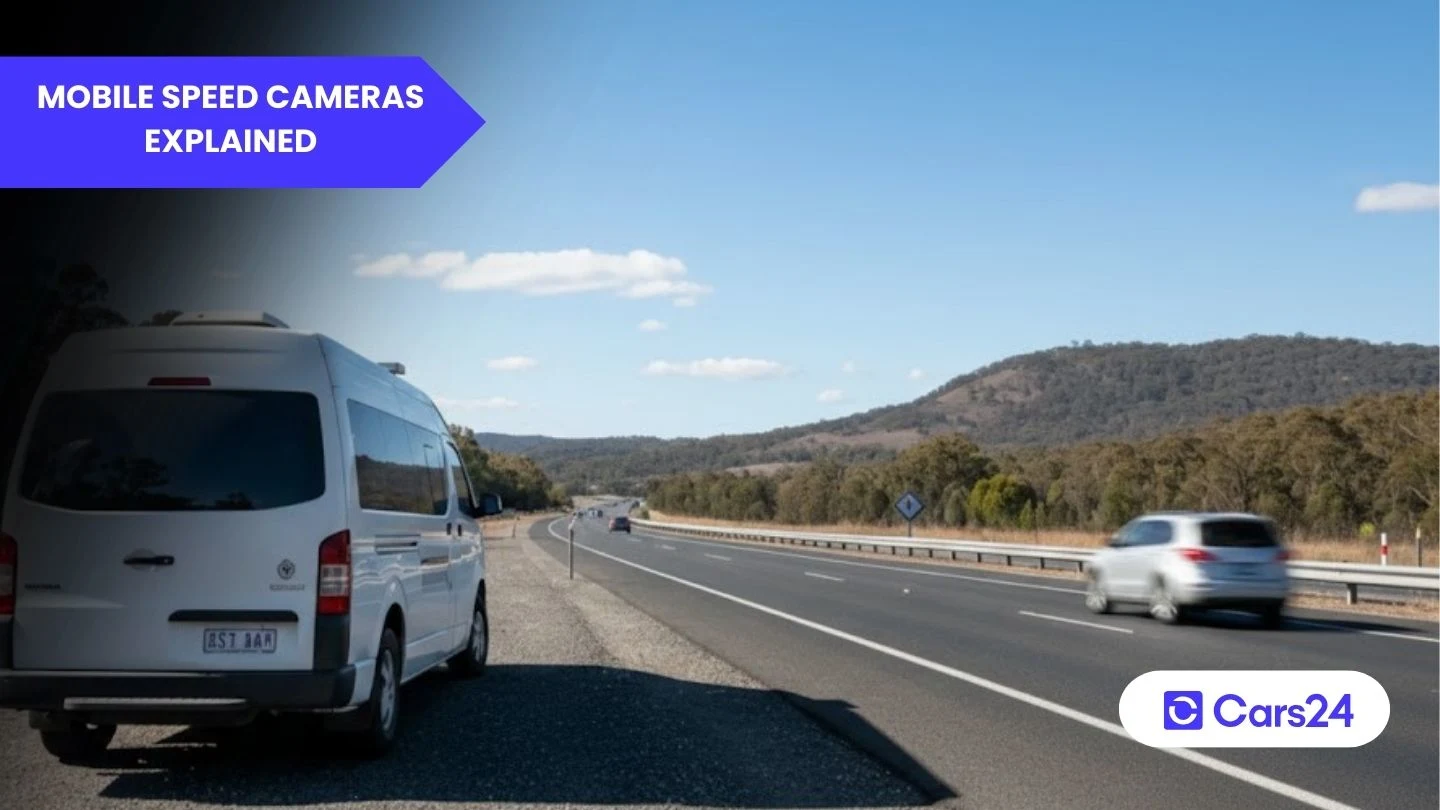
Do you feel anxious when you see a white mobile speed camera van on the side of the road? Or did a fine already arrive in your mailbox, leaving you confused and frustrated?
The mystery around the mobile speed cameras may be annoying, but it’s not that complex to understand. Learn how these speedometer cameras work, the different types used across Australia, and how to spot them.
This isn’t about beating the system; it’s about becoming a more aware, confident, and safer driver, all while protecting your licence and your wallet.
Mobile speed cameras explained in brief

Mobile speed cameras are portable, vehicle-mounted systems deployed to enforce speed limits anywhere, anytime. They use radar or laser to measure speed with pinpoint accuracy, often set up in unmarked or marked vans/SUVs parked in unusual spots.
An operator visually confirms the offence before a high-resolution camera captures evidence (driver, license plate, time, speed, lane, location, camera ID, etc.). The newest type of mobile speed camera uses an unmanned trailer parked beside the road, and it can scan multiple lanes at once using LIDAR.
It can also identify cars with expired registration and cars with outstanding fines or toll fees. These unmanned mobile speed cameras were being trialled in Victoria and are already in use in WA.
The trailer itself is unmanned, but it is positioned and set up by a speed camera operator and can be remotely operated for up to 10 days, after which it’s scheduled for maintenance. To protect the unit from would-be wrongdoers, it is also fitted with a surveillance camera on board and a bulletproof casing.
All Australian states enforce strict demerit points and escalating fines for speeding offences. The cost isn’t flat; it’s a sliding scale based on how fast you were going over the limit.
A benefit of a mobile speed camera over the fixed speed cameras is its unpredictability, which acts as a deterrent to would-be overspeeding drivers across a wider road network.
How do mobile speed cameras work?
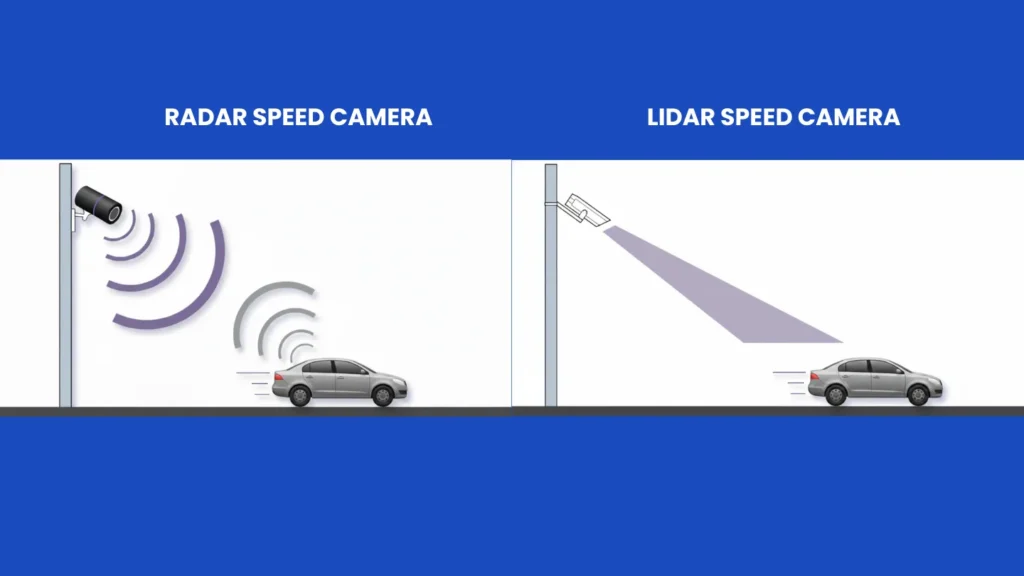
Today’s mobile speed cameras are like a high-tech sniper rifle mixed with a powerful computer, all packed into that white van or SUV you see parked on the roadside. They primarily use one of two technologies: Radar or LIDAR.
| Function | Radar | LIDAR |
|---|---|---|
| How it works? | The speed camera unit sends out a beam of radio waves. These waves hit your car and bounce back with the Doppler Effect. If your car is moving towards the radar, the waves that bounce back get squashed together and have a higher frequency. If you’re moving away, the waves are stretched out and have a lower frequency. | LIDAR (Light Detection and Ranging) is the newer, more precise technology and uses a pulsed infrared laser beam. It calculates the time it takes for each pulse to travel to your car and bounce back. By measuring these, it can calculate your distance. Based on how rapidly your distance is changing between each pulse, the computer calculates your speed. |
| What triggers it? | The device measures this tiny frequency change with remarkable accuracy and instantly calculates your speed. This beam has to “see” you, to trigger. | Unlike radar’s wide cone, a LIDAR beam is extremely focused – usually just a metre wide at 300 metres away. The operator has to literally aim it at a specific vehicle. |
| How it picks you? (the speeding driver) | The beam is like a cone that spreads out. It can monitor multiple lanes at once, but it’s typically focused on a specific direction. Modern radar is designed to pick the fastest object in its beam. | Because the LIDAR’s beam is focused, it’s very hard for it to accidentally target the wrong car. If you get a ticket from a LIDAR camera, it was almost certainly meant for you. |
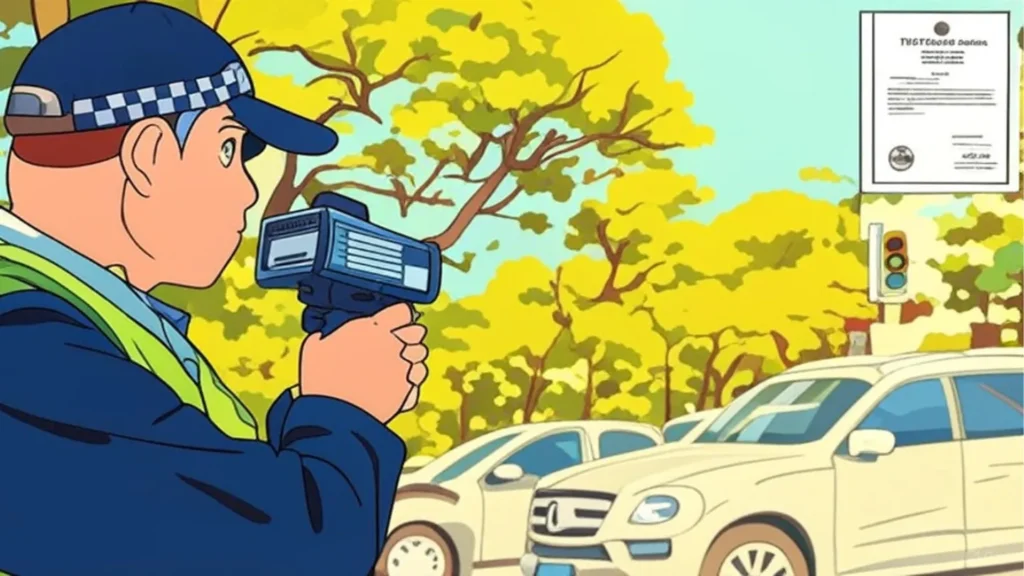
The mobile speedometer cameras can be inside a van, an unmarked SUV, or even on the back of a motorbike. These devices don’t measure your speed as you pass the van; they measure it from the moment you enter their beam, which can be well before you see them.
Once your speed is locked in, the high-res digital camera fires. It’s usually a series of high-definition images that show your number plate, your face (in most jurisdictions), the make, model, and colour of your car. A digital overlay on the photo also shows the exact speed, location, date, time, and the device’s unique ID number.
Do mobile speed cameras flash?
Generally, modern speed cameras do not use a visible flash during the day. They may use a subtle infrared flash or a very low-powered white flash that is often hard to see in daylight.
Modern digital speed cameras can capture a sharp, clear image using natural light during the day. At dusk, dawn, or at night, the speedometer camera uses an invisible infrared “flash.” This flash lights up the scene perfectly to capture your number plate and, in most states, the driver’s face.
How far away can mobile speed cameras detect?
The mobile speed cameras using radar can detect your speed from several hundred metres away. However, for an accurate, prosecutable reading, the operator typically needs to be within a few hundred metres.
The key point is they will have your speed locked in well before you get close enough to spot them. That means slamming on the brakes AFTER you’ve spotted the camera or slowing down as you pass a camera won’t get you out of a speeding fine.

Can mobile speed cameras capture speeding offences in poor weather conditions?
Yes, they can operate effectively in poor weather, but with some limitations.
Radar (for Speed): Radio waves used by radar can penetrate rain, fog, and mist. Extremely heavy rain can cause some signal scatter and reduce maximum range, but the accuracy is not affected within its operational distance.
Cameras (for Evidence): It can still capture a usable image in light rain or mist, but in very heavy rain or in thick fog, photo evidence is hard to get.
How accurate are mobile speed cameras?
The mobile speed cameras are certified to an accuracy of within ±2 km/h under ideal testing conditions. In the real world, the total system accuracy is considered to be within a few km/h. Both Radar and LIDAR speed cameras are capable of measuring speed with a margin of error far smaller than 1%.
By law, these devices must be tested and calibrated regularly. This is often done:
- Internally, with an electronic self-test every time it’s powered on, or…
- Externally, with a certified tuning fork for the radar and using a static target at a known distance, for LIDAR.
For a speed measurement to be used in court, the operator must produce a calibration certificate proving the device was certified within the required period (usually 12 months). If they can’t, the fine on yourself is invalid.
Challenging a fine on the grounds of “the machine was inaccurate” is almost impossible if the device has a valid calibration certificate.
What is the tolerance of a mobile speed camera?
There is no official “forgiveness” tolerance. However, all states apply an “enforcement threshold” to account for the potential margins of error.
These thresholds are administrative and can be changed at any time, so don’t rely on them. The only safe and legal speed is at or below the posted limit. Based on documentation and reports, the general practice is as follows:
| State | Official Tolerance/Practice | Accurate? |
|---|---|---|
| NSW | ±2% (~+1.2 km/h in 60 zone) | Yes |
| VIC | +3 km/h | Yes |
| QLD | +3 km/h | Yes |
| SA | 2–3 km/h, not published | Broadly yes, not official |
| WA | Not formally stated (~+2–3 km/h) | Approximate, not official |
| TAS | Not specified, aligns to +3 km/h | Yes |
| ACT | Not published (~+2–3 km/h) | Approximate |
Most Australian states operate with an unofficial tolerance for mobile speed cameras of around +2–3 km/h, generally in line with the technical margin of error, but only Victoria has this codified in public regulations for mobile systems.
New South Wales has shifted to enforce any detectable speeding offence over the posted limit (strictest in the country).
Do mobile speed cameras get you from the front or back?
Yes to both. The mobile speed camera setup depends on the technology and how the operator has positioned the vehicle to capture vehicles from either side.
- Rear-Only Capture: Vans parked on the roadside with a large rear window capture vehicles travelling away from them (from the rear).
- Frontal Capture: The mobile speed camera can be positioned to photograph oncoming traffic. It also captures the driver’s face and issues fines to the actual driver and not just the registered owner.
LIDAR units are particularly effective for front-on measurement because the operator can easily target a specific vehicle’s front number plate from a long distance.
How can you spot a mobile speed camera?
The Australian police have gotten very clever, but they’re not invisible. Here’s what you can look for:
The universal giveaways
- The lone parked vehicle: A single vehicle (white SUV or van) parked legally on the side of the road, often tucked just behind a crest of a hill or around a gentle bend.
- Unusual parking spot: If you see a car parked in a strange spot, like in a breakdown lane, or pulled over on a wide median strip.
- The darkened windscreen: The front and rear windscreens will often be heavily tinted or reflective.
- No obvious driver: If you can’t easily see a person in the driver’s seat.
State-specific tactics
- New South Wales (NSW): Uses marked and unmarked vehicles. There are no warning signs required by law before a mobile speedometer camera.
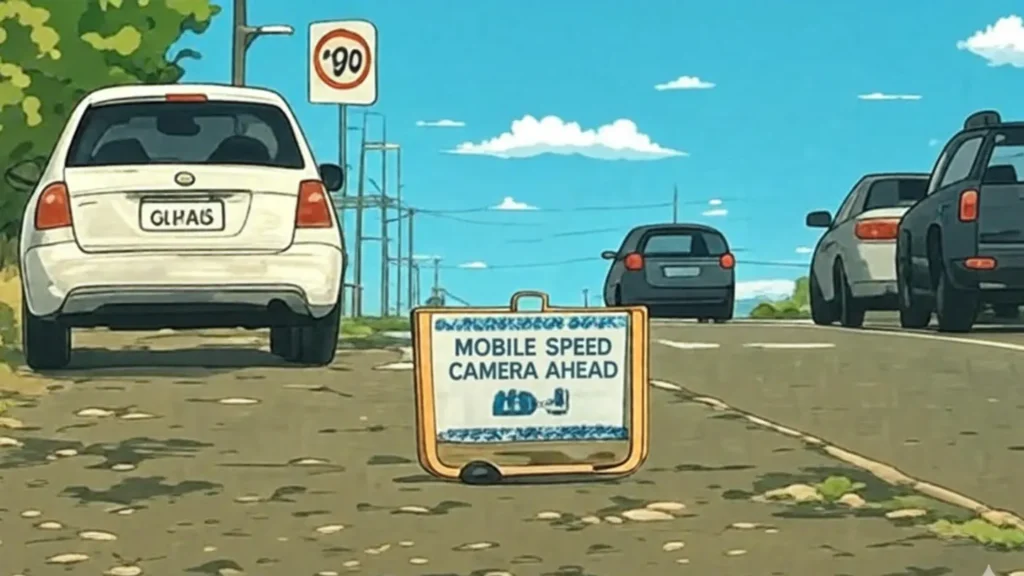
- Victoria (VIC): It is a bit more transparent. You will often see large, yellow “Mobile Speed Camera Ahead” signs before you reach the van (white and marked).
- Queensland (QLD): It also uses warning signs. The vehicles are marked with police livery or “Road Safety” signage. They are often silver Ford Territory SUVs or similar.
- South Australia (SA), Western Australia (WA), Tasmania (TAS): These states generally use marked vehicles (white vans with signage) and often, but not always, use warning signs.
More: New mobile & seatbelt camera spots announced in Victoria in Sep 2025
Different kinds of speed cameras in Australia
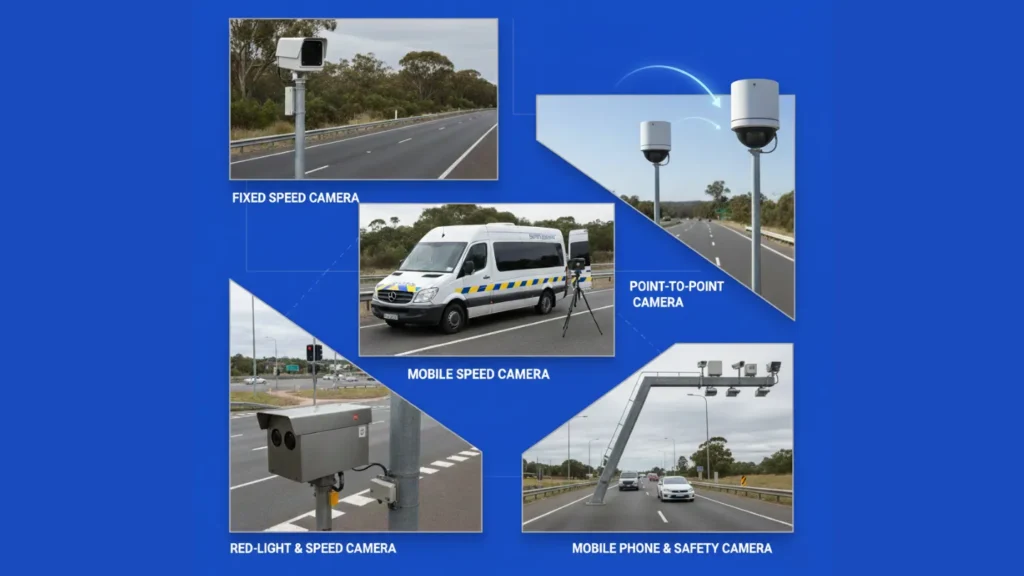
There are five types of commonly used speed and road safety enforcement cameras in Australia. In some places, police also use “hand-held Speed Camera Devices” and specialised cameras for seatbelt detection.
Specific camera types may be deployed in school zones and work zones, also, but these typically fall under fixed, mobile, or safety camera classifications.
| Camera type | Purpose | What it looks like? | How it catches you? |
|---|---|---|---|
| Fixed Speed Camera | To slow traffic at a known, high-risk crash site. | Large roadside cabinet, often with a flash. | Radar measures your speed at a single point. |
| Mobile Speed Camera | To create general deterrence. | White van or SUV parked on the roadside. | Radar/Laser measures your speed from front/back. |
| Point-to-Point Camera | To enforce a consistent, safe speed over a long stretch. | Cameras on gantries, spaced kilometres apart. | Calculates your average speed between two points. |
| Red-Light/Speed Camera | To prevent severe intersection crashes caused by red-light running and speeding. | Mounted at traffic light intersections. | Triggers if you jump a red light OR if you are speeding. |
| Mobile Phone/Safety Camera | To tackle the growing issues of driver distraction and not wearing seatbelts. | Trailers, vehicles on overpasses, or fixed units. | AI analyses images to detect phone use or no seatbelt. |
Where are the mobile speed cameras deployed?
These speedometer cameras are not just randomly placed anywhere the police wish to catch out motorists. They are strategically placed in locations where data shows there’s a high risk of crashes, or where people are known to speed illegally. Here are the common deployment grounds:
- Roadwork sites: Reduced speed limits in work zones are for the safety of the road workers.
- School zones: During school zone hours (usually 8-9:30 am and 2:30-4 pm), these areas become a top priority.
- Motorways and highways: You’ll find them on on-ramps, off-ramps, and along straight stretches where speed can creep up.
- Known crash hotspots (black spots): Governments have reams of data on where accidents frequently happen.
- Residential streets and “Rat Runs”: If there’s a quiet backstreet that people use to avoid traffic, and they speed down it.
How do you know if you’ve been caught in mobile speed cameras?
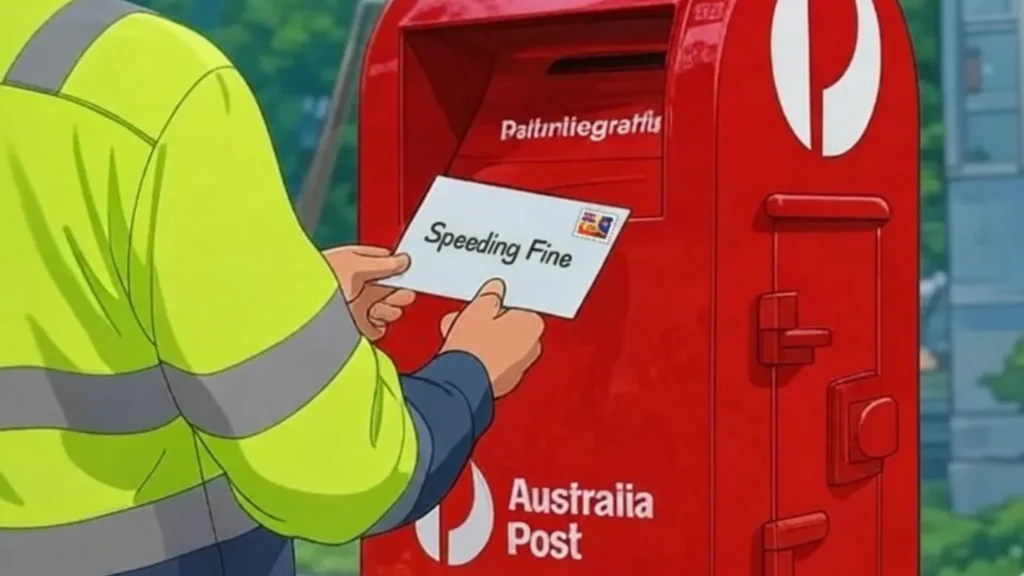
You will be notified by official mail (physical letter). There is no email, no text message, and no phone call from the police as an initial notification. A Notice of Penalty or an Infringement Notice will be sent to the address of the registered operator of the vehicle. It can take anywhere from two to four weeks, and sometimes longer.
How to check a mobile speed camera fine?
If you think you will get one, you have proactive options. You will need your driver’s licence details and/or your vehicle’s registration number to check a mobile speed camera fine.
You must check the website for the revenue or fines department in your state:
- NSW: Service NSW (online or app)
- VIC: Fines Victoria
- QLD: Queensland Government Penalty Management
- SA: SA Gov eFines
- WA: WA Police Pay a Fine
- TAS: Tasmanian Department of Justice
- ACT: Access Canberra
- NT: NT Government Fines
Can you contest a mobile speed camera fine?

Yes, you can. But you need a valid, legal ground, not just a feeling that it’s unfair. “I don’t think I was speeding” is not a valid defence. Here are the common legitimate grounds for contesting a fine:
- You were not the driver
- The details are wrong
- You had an extreme emergency (difficult to prove)
- Calibration issue (which is rare)
Not paying the fine is considered contesting. After that, you have to request an internal review by the issuing authority (e.g., Revenue NSW).
If the internal review is rejected, you can elect to have the matter heard in a local court. Be aware that if you lose, you may be liable for court costs also.

New Comment


Dennis
SA do not display signs for mobile cameras
Read more