




Odometer Rollback is one of those things that sounds like an old scam. Something that happened back when dashboards had spinning numbers and dodgy sellers used drills but unfortunately, Odometer Rollback persists as a significant issue in Australia. In fact, it shows up in modern cars as well and it does not always leave a neat trail.
This is not intended to alarm, but to educate you. Most used cars are fine, but if you are spending your hard-earned money, it helps to know what is normal and what is not. The aim of this article is to clear up common myths, explain the facts and point out warning signs that are actually useful.
What an odometer is and why people mess with it
An odometer is the distance counter on the dashboard that shows how many kilometres the vehicle has travelled. The number displayed is the odometer reading, which is meant to count up and keep counting up for the life of the vehicle. The odometer for car buyers matters because kilometres affect resale value and service timing.
An odometer rollback is exactly what it sounds like: when the kilometres shown on the dash are deliberately reduced to make a car look lower mileage than it really is. According to Consumer Protection WA, this can happen on both older analogue odometers and modern digital ones. In newer cars, the reading can be altered by reprogramming the system rather than physically touching the cluster. They also state that misrepresenting a vehicle’s odometer is illegal under Australian consumer law and can attract serious penalties.
Lower kilometres can lift a car’s price, which is why rollback happens.If the car has done more kilometres than the odometer shows, routine servicing may have been missed, which can lead to expensive problems later on.
Myths that cause confusion
- Digital means it cannot be touched
This is probably the most common myth around odometer rollback. People see a modern digital dash and assume it is locked down.
Both analogue and digital odometers can be altered. Consumer protection bodies across Australia have been clear on this point. In newer cars, rollback often happens through software reprogramming rather than physically winding numbers back. That is why digital odometer rollback appears alongside older forms of tampering in official warnings.
If someone points to the fact that a car is digital as proof that the kilometres must be genuine, that is not a guarantee. Remember that it is just a screen displaying a number.
- It only happens to old cars with huge kilometres
Odometer rollback is not limited to old cars. It happens wherever there is a meaningful price jump between low kilometres and higher ones. That can apply just as easily to a relatively new car as it can to an older one. The age of the vehicle matters far less than the value of the story being told about it.
ABC reporting on odometer tampering in Australia has described the practice as widespread and notes recent crackdowns with maximum penalties ranging from $50,000 to $200,000 depending on the state and circumstances. That does not mean every used car is under suspicion but it does mean the issue is being taken seriously by the regulators.
- If a seller sounds confident, the kilometres must be right
Confidence alone proves very little.
Most people who fall for this are not reckless. They are excited, time poor, and drawn to the simplicity of the odometer reading because it feels like a clear and simple measure. When that number becomes the focus, odometer fraud has room to hide. Odometer rollback works best when the dashboard reading is accepted without looking beyond it.
- A PPSR check will confirm the kilometres
A PPSR check is essential, but it does not verify odometer readings. Its job is to flag things like outstanding finance, write offs, or stolen vehicles. The PPSR does not include odometer readings, and it is upfront about that.
That is why the advice stays the same. Always do the PPSR check, but do not stop there. It protects you from big legal and financial problems. It does not protect you from odometer rollback on its own.
Warning signs worth paying attention to
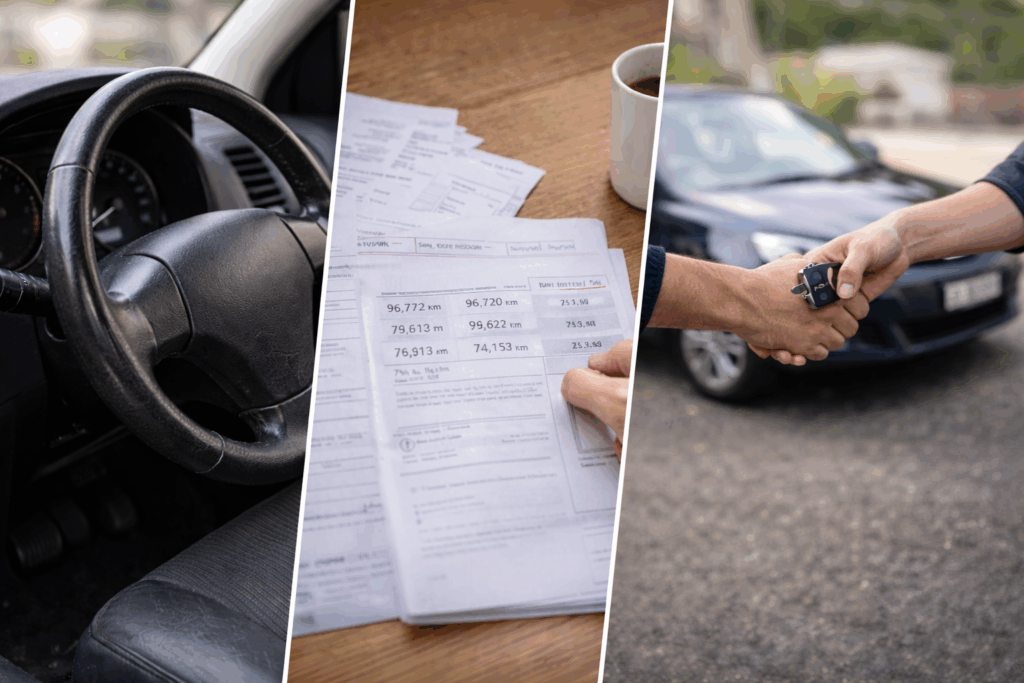
- The car looks more worn than the odometer suggests
If the odometer shows low kilometres but the driver’s seat looks tired and the steering wheel has turned glossy from matte, it usually comes from long-term use polishing the surface.
In itself, this does not prove odometer rollback or odometer fraud because city driving, ride-share use, and frequent short trips can wear interiors faster than long highway runs and that’s normal! It matters whether the wear lines up with the story being told.
If the seller describes light use and careful ownership but the cabin suggests otherwise, treat it as a signal to slow down and verify rather than something to ignore. When it comes to spotting odometer rollback, mismatches matter more than any single detail.
- The service history does not make sense over time
Most cars leave a trail as they age with service invoices, logbook stamps, inspection paperwork, and sometimes even registration documents. Across these documents, the odometer reading should rise steadily over time.
Selling vehicles without logbooks can sometimes be a deliberate tactic to hide a car’s true mileage. They encourage buyers to reconsider a deal if key documentation is missing, especially when low kilometres are being used to justify the price.
Gaps in a car’s history do not automatically mean odometer fraud. Paperwork can be lost as vehicles change ownership. However, when there is little to support a low odometer reading and the seller cannot explain the history clearly, it often signals odometer rollback.
- The dashboard area tells a story if you look closely
The area around the instrument cluster is one of the few places where physical clues can still show up, including scratches near the cluster, mismatched screws, loose trim, or small gaps in the dash suggest the dashboard has been handled at some point.
But it’s worth noting that Australian consumer protection bodies have documented cases where odometer rollback involved replacing the dashboard or instrument cluster entirely. Because of that, the condition of this area becomes part of the bigger picture and on its own, it might mean nothing. Alongside other inconsistencies, it becomes information you do not ignore.
- The way the deal is handled often matters more than the car
Sometimes the clearest signal has nothing to do with the vehicle and everything to do with how the sale unfolds.
Pressure is often the clearest red flag. If you are being rushed to pay, seller is reluctant to share the VIN, refuses to allow an independent inspection, or pushes to meet in unusual places that are not exclusive to odometer fraud. But they do appear frequently in deals where something does not stand up to scrutiny. These behaviours show up again and again in deals where the story does not hold together.
Odometer rollback relies on urgency. It works when buyers feel they cannot slow down, ask questions, or walk away. The most effective way to protect yourself is to take your time. A genuine seller will not push back when you want to verify information, review documents or book an inspection.
| Also read: How to Spot a Wound-Back Odometer |
The facts Australians should know
- An odometer reading is not a continuous record of a car’s life. In Australia, kilometres are only recorded at certain points, such as servicing, inspections, or registration changes. If those moments are spaced out or skipped, gaps will form and that’s normal. It is also why an odometer reading is not treated as a full history.
- It is also worth knowing that low kilometres do not automatically mean a better car. This is why consumer protection bodies focus less on one number and more on whether the overall car history holds together.
- It is integral to understand this because buyers sometimes accuse the wrong cars and genuinely miss the right ones. New tyres do not automatically mean odometer fraud because tyres are replaced for age, punctures, or safety. Same goes for a clean interior, some owners simply take very good care of their cars. Even a missing logbook does not automatically trigger odometer rollback.
Conclusion:
How to detect odometer fraud without becoming technical
Most people search how to detect odometer fraud because they want a method that fits normal life. Here is a practical approach that works in Australia and stays simple.
- Treat the odometer as one clue not the whole truth
- Use state tools when they apply.
- Ask for service invoices that show kilometres over time
- If anything feels off get a pre-purchase inspection
A pre-purchase inspection is a general safety net that often improves your odds because a mechanic can spot wear patterns that do not add up with a low odometer reading.
If you want a phrase you can keep in your head, it is this: Odometer Rollback breaks consistency and your job is to check for consistencies.

Comments
New Comment