




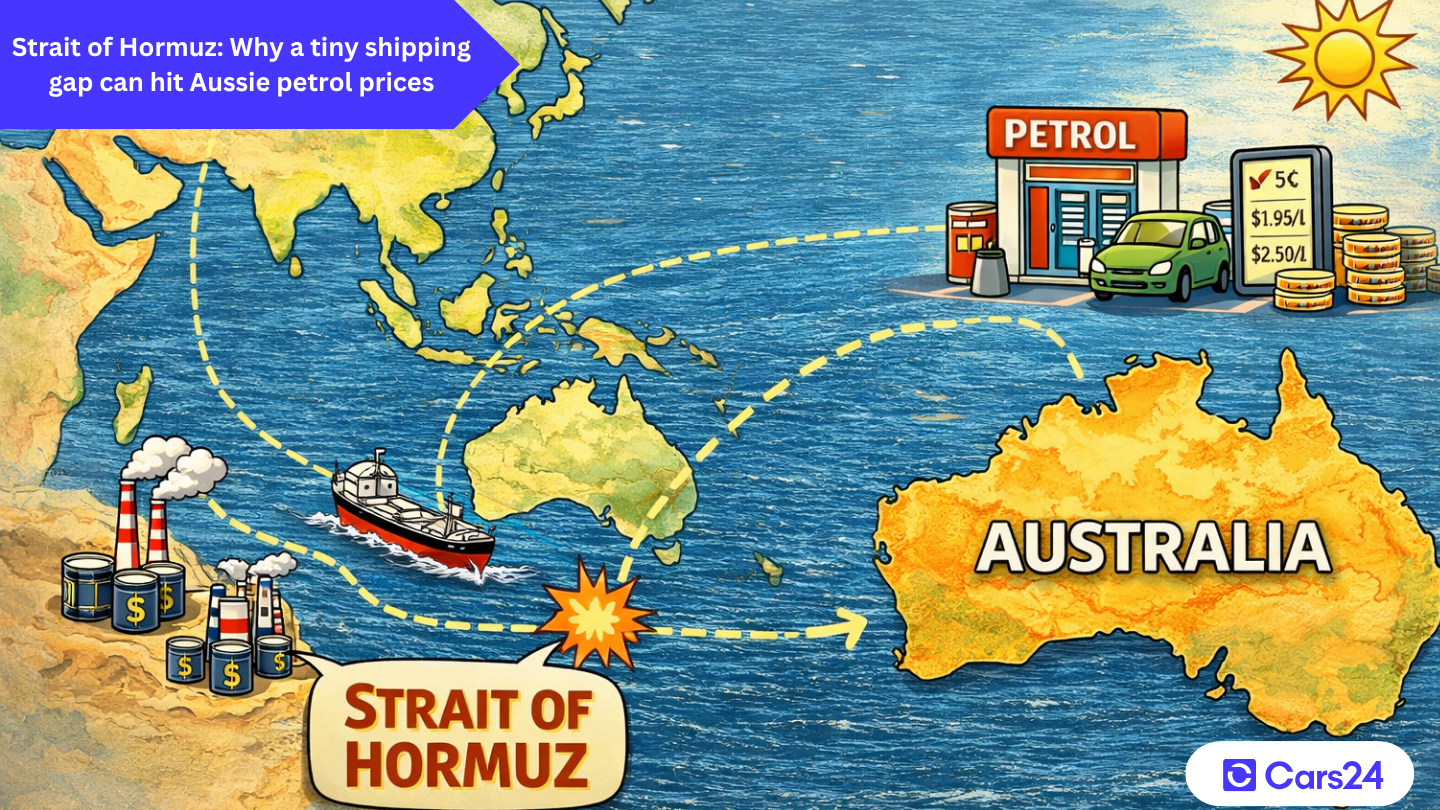
Why the Strait of Hormuz matters for petrol prices in Australia
Petrol prices in Australia don’t always wait for something local to happen before they start climbing. That is what makes fuel shocks so frustrating and in many ways, so poorly understood. By the time you notice the jump at the bowser, the real trigger has often come and gone – somewhere far earlier in the chain, where global trade routes, oil markets and political tensions are already in motion. And nowhere makes that connection clearer than the Strait of Hormuz, a narrow stretch of water that somehow manages to influence the cost of driving on the other side of the world.
Reason why the Strait of Hormuz keeps returning to the centre of the conversation whenever petrol prices start to climb – especially now, as rising tensions between Iran and the United States start disrupting tanker traffic and putting pressure on a route that carries a significant share of global oil.
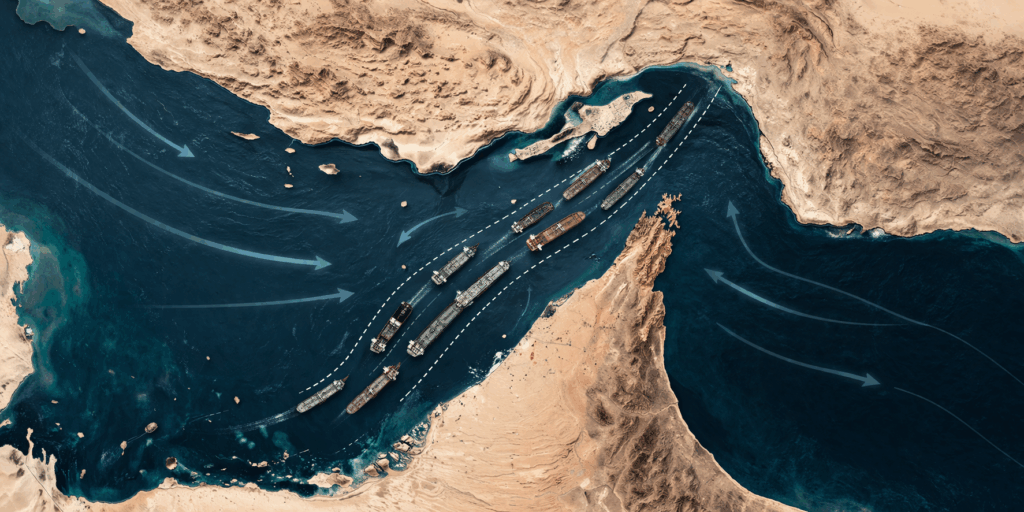
The Strait of Hormuz isn’t just another headline or passing geopolitical reference; it sits at the heart of how fuel actually moves across the world. When pressure builds there, the impact doesn’t stay contained – it sets off a chain reaction that travels through oil pricing, shipping networks and refining hubs before eventually landing somewhere much closer to home. And that’s the part worth unpacking, because understanding how that chain works is exactly what explains why petrol prices in Australia can shift.
Why are petrol prices rising in Australia right now
Recent developments make this connection even harder to ignore – as tensions between Iran and the United States begin to disrupt tanker movement through the Strait of Hormuz, the impact is already being felt across global energy markets. That’s a key answer to ‘why are petrol prices rising in Australia’ right now, even though the trigger sits thousands of kilometres away.
In response, the Australian government has stepped in with a series of fuel-security measures. Fuel excise has now been temporarily halved for three months to ease immediate pressure on consumers, alongside adjustments to minimum stockholding requirements and technical changes aimed at improving diesel supply.
Why this global oil chokepoint matters so much
What makes this moment particularly telling is not just the policy response, but what it reveals about how the fuel supply chain actually works. Even the risk of disruption through the Strait of Hormuz, which carries roughly 20 percent of the world’s oil, is enough to push global prices higher and shape the oil price impact on fuel markets like Australia.
This is when something that feels distant and geopolitical becomes immediate and personal. Because once global oil prices move, those changes don’t stay contained within markets or trade routes. They get priced in early, often before any physical shortage appears, which is why costs can rise even when supply still seems stable on the surface.
What is the Strait of Hormuz and why it matters globally
To understand why the Strait of Hormuz carries this level of influence, it helps to move beyond thinking of it as a distant geopolitical flashpoint and instead recognise it as a structural pressure point in the global fuel supply chain. Positioned between Iran and Oman, the Strait of Hormuz acts as the primary maritime exit for oil and gas shipments from the Persian Gulf, meaning that a significant share of the world’s energy trade must pass through this narrow corridor before reaching international markets.
What makes the Strait of Hormuz particularly significant is not just the volume of energy that moves through it, but the concentration of that flow within a constrained space. When such a large portion of global oil and LNG is channelled through one route, even minor disruptions, delays, or perceived risks around the Strait of Hormuz can trigger outsized reactions in global markets. This is why the Strait of Hormuz is often described as a chokepoint – not because it is permanently constrained, but because the system’s dependence on it makes it inherently sensitive to disruption.
How the Strait of Hormuz impacts the global fuel supply chain
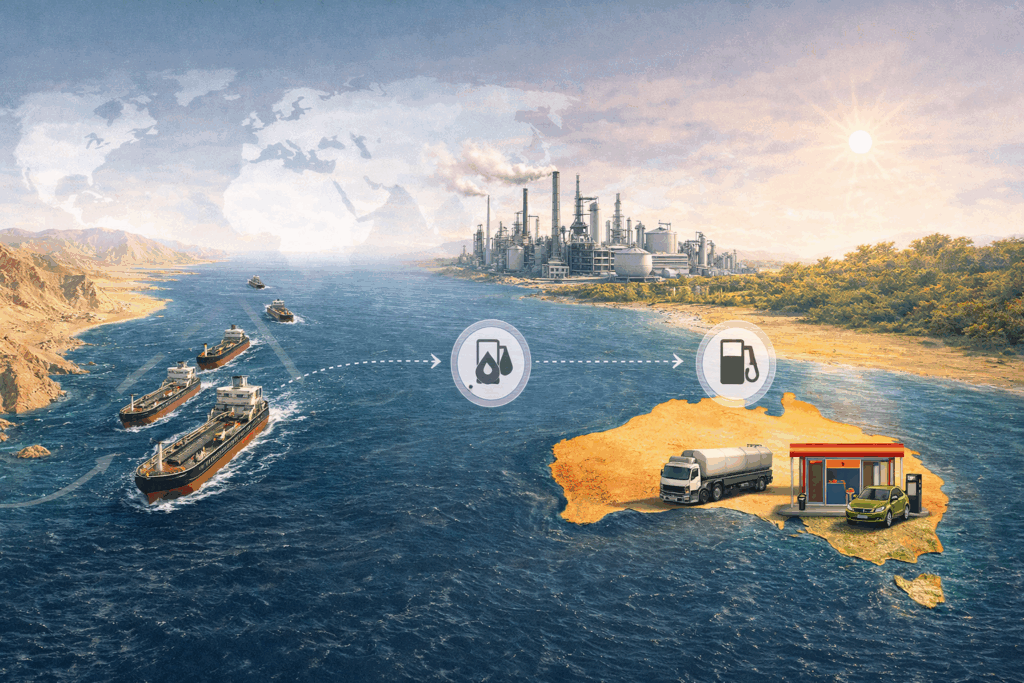
The easiest way to make sense of this is to think of fuel as something that travels through a long, interconnected system rather than something that simply appears locally. Australia might not be buying most of its fuel directly from the Middle East, but the Strait of Hormuz still sits at a very important point in that journey. It is one of the main routes through which oil leaves the Gulf and enters global markets, eventually making its way to large refining centres across Asia.
And that is where Australia comes in. We rely heavily on these Asian refineries for petrol and diesel, which means the prices we pay are shaped by what is happening earlier in the chain, not just locally.
So when tensions build around the Strait of Hormuz, the effect spreads outward. Oil shipments become riskier, insurance becomes more expensive and supply feels tighter even if nothing has technically stopped. These changes are picked up by global markets and built into pricing almost immediately. By the time fuel is refined and priced in places like Singapore, those costs are already sitting there, waiting to be passed on.
Oil price impact on fuel: how global risks affect Australia
Fuel prices in Australia are shaped less by local supply and more by how the global system is priced.
Key data points
| Key factor | What the data shows |
| Oil flowing through Strait of Hormuz | ~20–21 million barrels per day (around 20% of global petroleum liquids consumption) |
| Share of this oil going to Asia | ~75–85% (majority flows to Asian markets) |
| Australia’s refined fuel imports | ~75%+ of consumption |
| Benchmark used for Aussie fuel pricing | Singapore Mogas 95 (petrol) & Singapore Gasoil (diesel) |
A large share of the world’s oil moves through the Strait of Hormuz, most of it heading into Asian markets where it is refined. Australia then relies heavily on these same regions for fuel, with over three-quarters of its petrol and diesel imported and priced against Singapore benchmarks.
How global disruptions affect petrol prices in Australia
Once this system is understood, Australia’s exposure becomes easier to contextualise. Despite being a major energy exporter, Australia remains heavily dependent on imported refined fuels, with a significant portion of petrol and diesel consumption supplied by overseas refineries. This reliance means that disruptions linked to the Strait of Hormuz do not need to directly interrupt Australian imports to have an effect; it is enough for the Strait of Hormuz to disrupt or destabilise the broader regional supply system that Australia depends on.
Why Australia is vulnerable to fuel supply shocks
Over the past decade, domestic refining capacity has declined, with several refineries closing or being converted into import terminals. This is where the Strait of Hormuz becomes relevant beyond pricing.
As a result, we now rely more heavily on imported refined fuel than before. This shift has improved efficiency and access to global supply, but it also means the system is more closely tied to international shipping and refining networks.
Disruptions or uncertainty at key points in global supply routes can affect how reliably fuel moves through the system, even if overall supply remains available.
Why fuel prices rise even without shortages
This brings us to a critical insight: markets react to expectation as much as reality. The Strait of Hormuz does not need to be fully closed for prices to rise; it only needs to become uncertain. Traders, insurers, and suppliers all price at risk, which means that even partial disruption or heightened tension around the Strait of Hormuz can lead to higher costs across the system. By the time those costs reach consumers, the increase can feel sudden, even though it has been building within the supply chain for days or weeks.
Diesel, logistics, and the wider cost of living
The impact becomes even more pronounced when looking at diesel, which plays a central role in the broader economy. While petrol prices affect households directly, diesel prices influence logistics, agriculture, mining and freight, meaning that any disruption linked to the Strait of Hormuz can extend far beyond the petrol pump and into the wider cost of living. This is why diesel price movements often outpace petrol during periods of global supply stress, amplifying the economic impact of disruptions tied to the Strait of Hormuz.
At this point, the reliance on Strait of Hormuz becomes less about a single event and more about systemic vulnerability. It represents a convergence point where geopolitical tension, trade dependency and logistical complexity intersect, creating a scenario where a geographically small corridor exerts disproportionate influence over global energy stability.
Australia’s recent policy responses reflect an awareness of this vulnerability. Measures such as releasing fuel reserves, adjusting stockholding requirements and introducing temporary tax relief are attempts to cushion the domestic impact of global shocks, but they do not eliminate the underlying exposure to disruptions around the Strait of Hormuz.
How currency and global benchmarks shape fuel prices
Fuel prices in Australia are also shaped by the value of the Australian dollar, because fuel is traded globally in US dollars. That means the exchange rate plays a direct role in how much Australia pays for the same imports.
When the Australian dollar is stronger, those imports become relatively cheaper. When it weakens, the cost rises, even if global oil prices haven’t changed. And this is where it starts to add up, because currency doesn’t move in isolation. If oil prices are rising at the same time the Australian dollar is falling, both begin pushing prices in the same direction.
What to watch when petrol prices start rising
For anyone trying to make sense of why petrol prices are rising in Australia, this layered system is the key to understanding the connection.
- Brent crude oil prices
Rising crude prices usually signal higher fuel costs globally. - Global supply routes & geopolitical risks
Disruptions in key regions or shipping lanes can tighten supply and increase costs. - Singapore fuel benchmarks
Australia prices fuel against Singapore benchmarks, so increases there often flow through locally. - AUD vs USD exchange rate
A weaker Australian dollar makes fuel imports more expensive. - Refinery outages in Asia
Temporary shutdowns can reduce supply and push benchmark prices higher. - Seasonal demand trends
Higher global demand during peak periods can add upward pressure on prices.
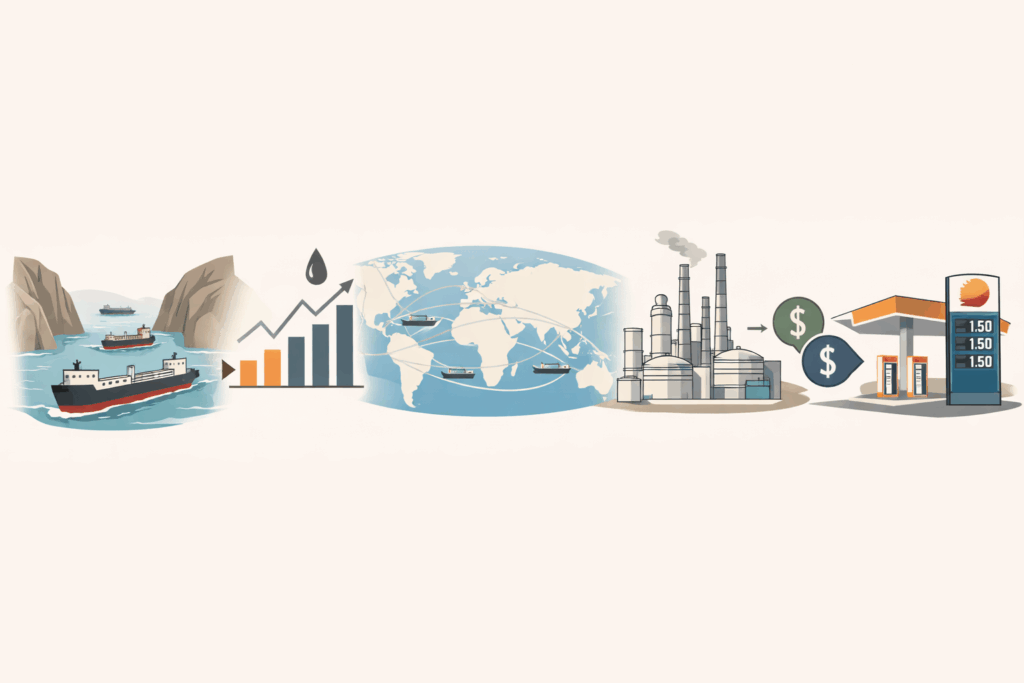
What it all comes down to: the Strait of Hormuz and petrol prices in Australia
At its core, this isn’t just a story about one shipping route or one moment of geopolitical tension. It’s a reflection of how tightly connected the fuel system really is.
Australia doesn’t need to be directly involved in a disruption for it to feel the impact. Being part of a globally priced, import-reliant system means that shifts in supply, pricing, or even expectations elsewhere can travel quickly through the network we depend on.
What makes the Strait of Hormuz so important is not just the volume of oil that passes through it, but how much of the system leans on that flow remaining steady. When that stability is questioned, the effects don’t stay contained – they begin to show up in pricing decisions, in supply behaviour and eventually in everyday costs.
So the real takeaway isn’t just that petrol prices can rise because of distant events. It’s that those events are part of the same system Australia operates within. And once you start seeing fuel prices through that lens, they stop feeling unpredictable – not because they won’t change but because you begin to understand why they do.
Comments
New Comment