




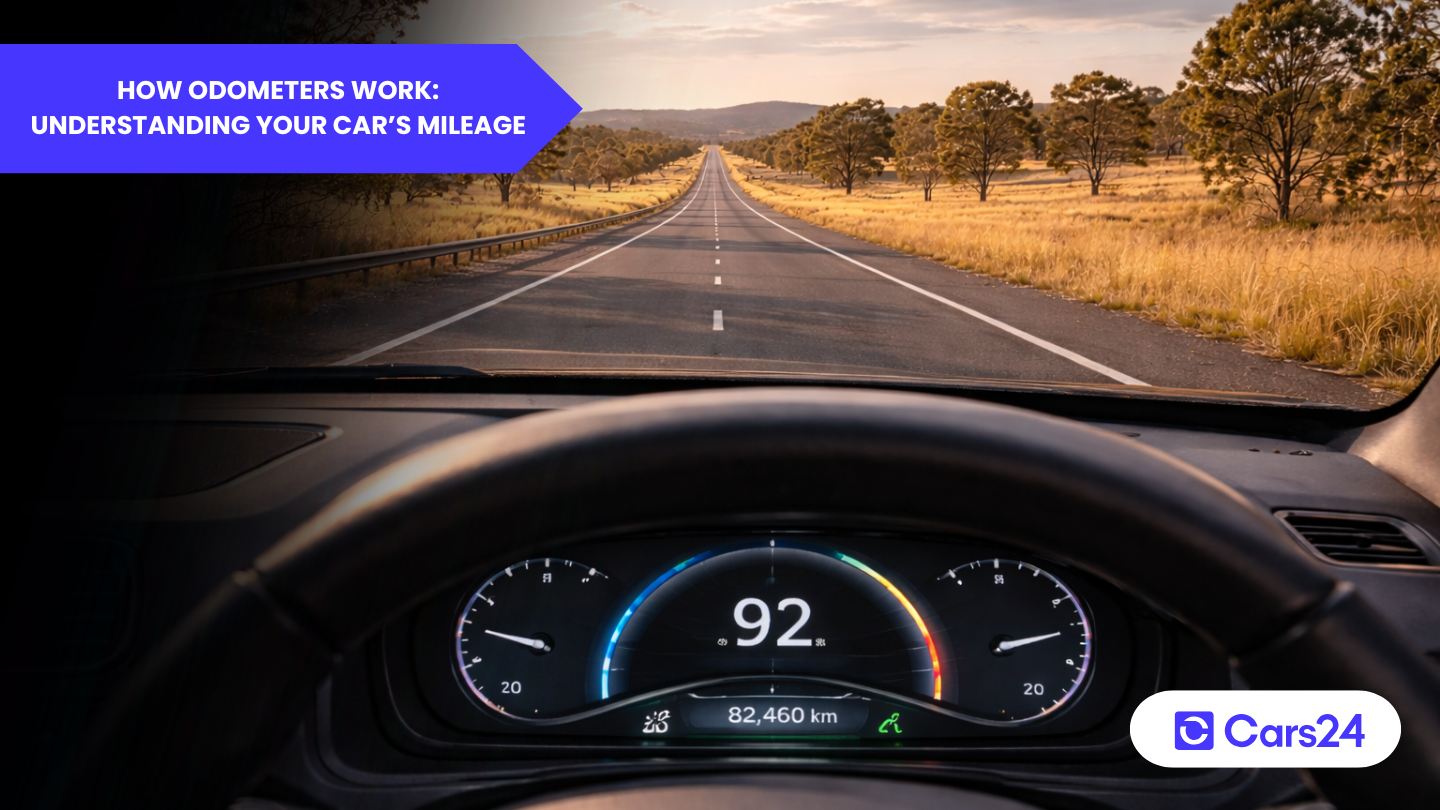
You glance at it every time you start the car, a row of digits on your dash that slowly climbs every time you drive. Some days it means nothing. Other days, especially if you’re buying or selling, it suddenly means everything.
To properly understand car mileage, you need to look at more than just the figure on the screen. That figure on your dash is the result of thousands of small movements happening underneath your vehicle every time you drive and once you understand how an odometer works, mileage starts to make a lot more sense.
Most people know what mileage is in theory, simply put – it’s the total distance a car has travelled, measured in kilometres here in Australia. But understanding car mileage properly means knowing what that distance actually represents and how that number is created in the first place.
What mileage actually tells you
Mileage tends to shape first impressions instantly; low mileage feels safe and high mileage prompting hesitation. To understand car mileage, context matters. It tells you how far a car has travelled, not how well it has been treated.
In day-to-day driving, a car that’s done 180,000 kilometres running between places like Wagga and Melbourne on long highway stretches can often be in better mechanical shape than a 90,000-kilometre hatch that’s spent its whole life crawling through Sydney traffic. Open roads are steady on engines but constant braking, short trips and cold starts are not.
So, low-mileage used cars are so popular because they feel safer. It feels like less wear and fewer headaches down the track and that instinct is completely understandable. But if you really want to understand car mileage, you have to look at how those kilometres were built, not just how many there are.
Understanding car mileage properly starts with understanding how that number is created in the first place. That’s where how an odometer works comes in.
What is an odometer and why it matters
If you have ever wondered what is an odometer, it is simply the device in your vehicle that records the total distance travelled. It is built into your instrument cluster and it increases automatically as your car moves. Knowing what is an odometer helps you understand car mileage because the odometer is the tool responsible for creating that number. Every kilometre you see is the result of precise counting.
The principle behind how an odometer works has not changed for decades. What has changed is the technology used to do the counting.
How distance becomes mileage
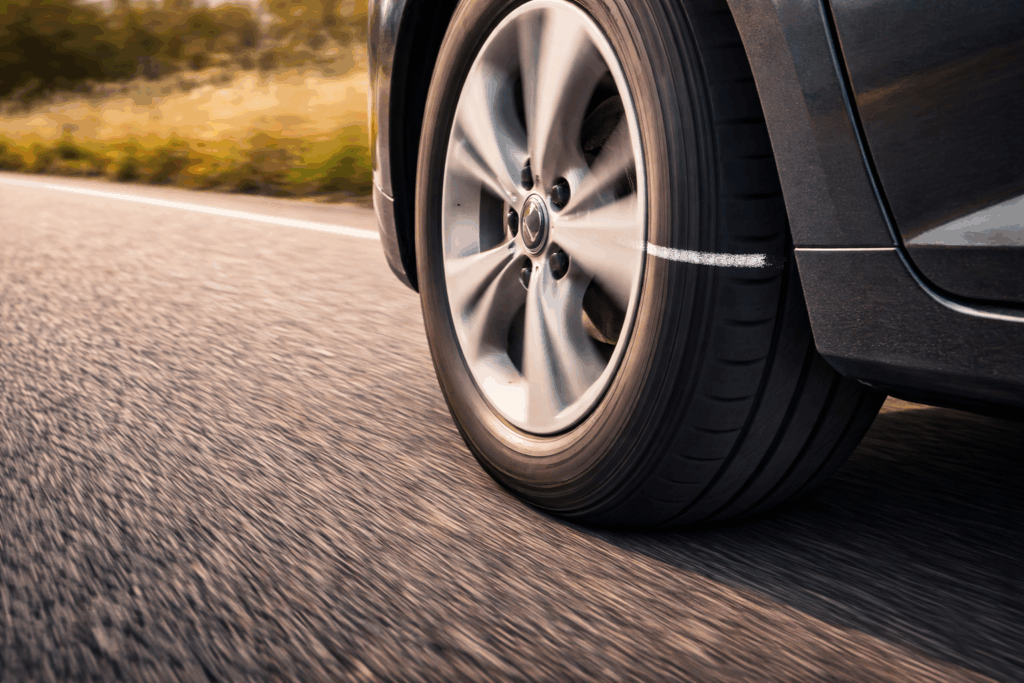
At its core, how an odometer works comes down to counting wheel rotations. Each time your tyre completes one full revolution, your vehicle travels a specific distance equal to the tyre’s circumference.
Imagine that you drew a small dot on your tyre, every time that dot touches the road again, the wheel has completed one full turn. Each full turn moves the car forward a certain distance and that distance depends on how big the tyre is.
So if the wheel turns once, the car moves forward a little. If it turns thousands of times, the car moves forward thousands of little steps. Now, add all those small movements together and you get the total kilometres your car has travelled.
That idea sits at the heart of how an odometer works in both older cars and modern ones. The maths hasn’t really changed over the years but what has changed is the way cars count and store those wheel turns.
Mechanical odometers and old-school engineering
In older cars, how an odometer worked was completely mechanical and there were no computers involved. Think of it like a long spinning rope. A flexible cable connected the wheels of the car to the dashboard and when the wheels turned, that cable turned too. When the cable turned, it moved tiny gears inside the dashboard.
Those tiny gears were connected to number wheels, a bit like the numbers on an old clock. As the gears turned, the numbers rolled forward. So when you saw the display change from 99,999 to 100,000, you were actually watching little metal wheels turning inside.
Everything depended on movement; if the car moved, the wheels turned. If the wheels turned, the cable spun. If the cable spun, the gears moved. And if the gears moved, the numbers changed. That’s why understanding how an odometer works in older cars is pretty easy. You could almost imagine all the parts moving together like a chain reaction.
Digital odometers and modern systems
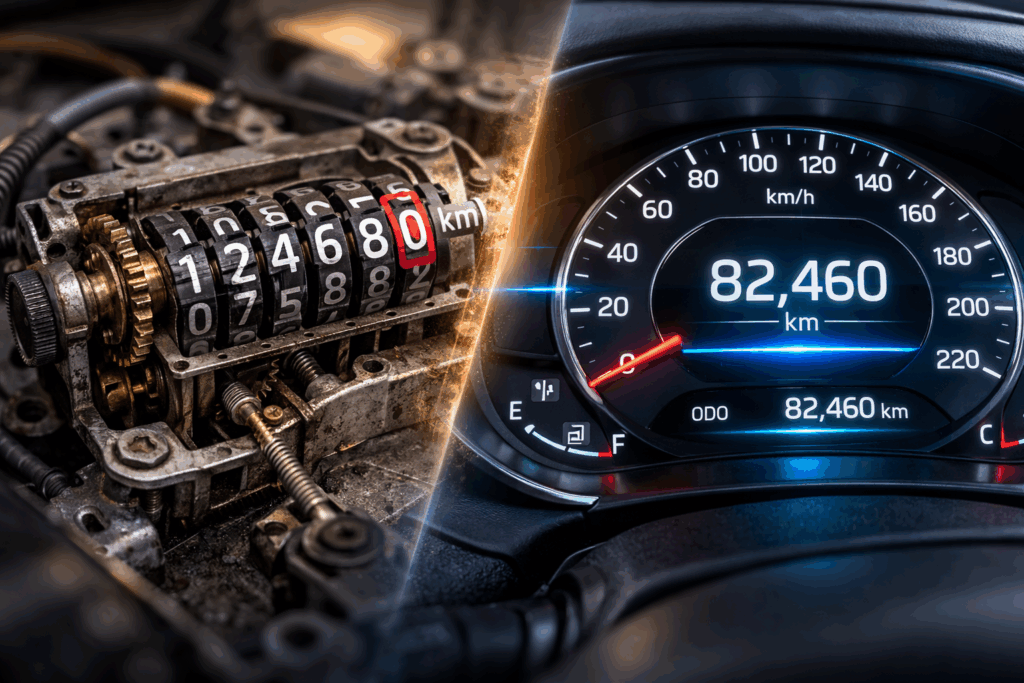
When cars moved from cables and gears to computers and sensors, the way mileage was recorded changed, but the basic idea did not.
In modern vehicles, there is no spinning cable running up to the dashboard. Instead, there are small sensors placed near the wheels or inside the transmission. Every time the wheel rotates, the sensor detects that movement and sends a tiny electronic signal to the car’s computer. You can think of it like a tap on the shoulder – one tap means one rotation.
The vehicle’s computer then takes those signals and uses a programmed tyre circumference to calculate the total distance travelled. That number is stored in the system and displayed on your dashboard as kilometres. The principle revolves around counting the rotations. Multiply by the distance covered in one rotation and add it to the total.
The difference is that modern systems store this information as data rather than as physical movement. In many cars, the mileage is saved in more than one electronic module. The instrument cluster shows it, but other systems may also record it. That is one reason digital odometers are generally more consistent and integrated than older mechanical ones.
Understanding car mileage in a modern vehicle means recognising that the number you see is the result of sensors, signals and calculations happening in the background every second you drive.
The hardware looks different today, yet the foundation is identical. Each turn of the wheel contributes to the running total you see on screen.
Why your mileage reading is not mathematically perfect
Most drivers think the odometer is perfect down to the last kilometre. It is very accurate, but it is not exact in a mathematical sense. The system is set up based on the original size of your tyres. Over time, tyres wear down a little. Different tyre brands can also be slightly different in size. If you change your wheel or tyre size, that can affect how far the car travels with each full rotation. Since distance is worked out using the tyre’s size, even small changes can slightly alter the final reading over thousands of kilometres.
In Australia, speedometers are designed so they do not show a speed lower than what you are actually travelling. Because the odometer often uses the same data as the speed system, small built-in tolerances can catch-up to the mileage reading as well.
These are not large differences but small, normal variations. When you understand car mileage properly, you see it for what it is: a very reliable guide to distance travelled, not a precision lab instrument.
The trip meter and everyday practicality
While the main odometer records total lifetime distance, your trip meter measures shorter distances and can be reset. It is one of the most practical features in your car.
You can use it to track fuel consumption on a long drive up the coast, you can measure your weekly commute and you can record kilometres driven for business purposes.
If you have ever needed to maintain a logbook for work related travel in Australia, you already understand how important accurate mileage readings are and knowing how an odometer works helps you trust the data you are recording. The trip meter may be small but it reinforces why understanding car mileage matters in daily life.
Low-mileage used cars and buyer psychology
Low-mileage used cars are among the most searched vehicles in Australia because of a single logic that wins every time – lower kilometres mean less wear.
Sometimes that is true. But not always.
A ten-year-old vehicle with very low kilometres may have spent long periods unused. Long inactivity can lead to battery degradation, tyre flat spotting and dried seals. On the other hand, a higher-kilometre vehicle that has been serviced consistently and driven regularly may feel smoother and more predictable.
If you truly want to understand used car mileage, you need to evaluate it alongside service history and driving patterns. Kilometres tell you how far but they do not tell you how carefully.
What’s the highest mileage a car can go
People often ask what’s the highest mileage a car can go before it is considered too much, to tell you the truth, there is no single answer.
In Australia, it is common to see vehicles comfortably exceed 250,000 kilometres with proper maintenance. Many Toyota and other reliable models push well beyond that. Some cars go past 300,000 kilometres without major internal engine work if servicing has been consistent.
Looking at car mileage also means thinking about durability. Modern vehicles are built to last far longer than earlier generations ever did, thanks to better lubricants, tighter manufacturing tolerances and stronger materials throughout the engine and drivetrain. The kilometre reading on its own does not decide when a car is at the end of its life. What truly matters is how it has been maintained and how it has been driven over time.
How to verify a car’s mileage properly
If you are buying used, knowing how to verify a car’s mileage is essential. The process does not have to feel complicated, but it does require attention to detail. Here’s how to approach it logically:
• Start with service records. Every service invoice should include the odometer reading at the time of inspection. The numbers should move forward steadily and make sense in chronological order. Sudden jumps or missing years are worth questioning.
• Compare the condition with the claimed kilometres. If a car shows very low kilometres but the pedals are heavily worn or the driver’s seat is sagging, the physical condition may not align with the displayed mileage. The car’s wear should match its story.
• Check registration or inspection documents. In many cases, mileage is recorded during inspections or ownership changes. These checkpoints help confirm whether the reading has progressed normally over time.
• Use professional diagnostic tools where possible. Modern vehicles store data electronically. A diagnostic scan can sometimes reveal stored mileage information within the vehicle’s systems.
Kilometres, servicing and long term ownership
Mileage is not just about resale value. It directly affects maintenance schedules. Most Australian vehicles follow service intervals based on kilometres travelled. Oil changes, brake inspections and major services are tied to specific kilometre milestones.
If you ignore mileage milestones, you risk accelerating wear. If you understand car mileage, you can anticipate servicing needs and budget accordingly. That is one reason why the odometer remains such a central feature of every vehicle.
Age versus distance
Mileage never tells the full story on its own. It always needs to be looked at alongside the car’s age.
A five-year-old vehicle showing 100,000 kilometres might just reflect a normal driving pattern in Australia, especially for someone commuting daily or travelling between suburbs and regional towns. On the other hand, a fifteen-year-old car with only 40,000 kilometres can raise different questions. Has it spent long stretches parked up? Has it been driven only occasionally?
Neither situation is automatically good or bad. When you look at kilometres together with age, it starts to make sense. Distance shows how far the car has travelled, while age shows how long it has existed and it is the relationship between the two that reveals whether the numbers make sense.
Bringing it all together
Once you understand how an odometer works, mileage stops feeling mysterious. It becomes what it really is – a running total of every journey your vehicle has taken.
To understand car mileage is to understand usage. It helps you evaluate low-mileage used cars realistically. It helps you answer what’s the highest mileage a car can go with more confidence. It helps you know how to verify a car’s mileage before committing to a purchase.
The number on your dashboard is not just a statistic but a record of movement. Of school runs and road trips and long highway drives through regional Australia.
When you know how an odometer works and what it is actually measuring, you stop judging cars by kilometres alone and begin to see the story behind the number. That perspective is what ultimately makes you a smarter buyer and a more informed owner.

Comments
New Comment