




In plain terms, roadworthiness refers to a vehicle’s condition being safe and legally compliant enough to operate on public roads. A roadworthy vehicle must meet a minimum standard of safety, not a perfect one, but one that poses no undue risk to its driver, passengers or other road users.
The concept of roadworthiness covers everything from your tyres and brakes to your lights, steering and windscreen. Think of it as the baseline health check a car must pass before it’s considered acceptable for public roads. If a car fails to meet this standard, it is deemed unroadworthy, and driving it can result in fines, loss of insurance coverage, or, in worst-case scenarios, a catastrophic accident.
What is RWC and what does RWC mean?
RWC stands for Roadworthy Certificate or commonly called roadworthy certs. It’s the official document issued by a licensed vehicle tester or authorised inspection station confirming that a vehicle has passed a roadworthy inspection and meets the required safety standards at the time of assessment. So when someone says “Does the car come with RWC?” during a private car sale, they’re asking whether the vehicle has been inspected and certified as safe. This is a completely normal and, in many situations, legally required question to ask.
The roadworthy certificate is not proof that a car is in perfect condition or that it won’t develop a problem in the future. It simply means that on the day of inspection, the vehicle meets the minimum safety standards set by your state or territory. Think of it like a restaurant health inspection; it doesn’t guarantee the best meal of your life, but it means the kitchen won’t make you sick.
When are roadworthy certs required in Australia?
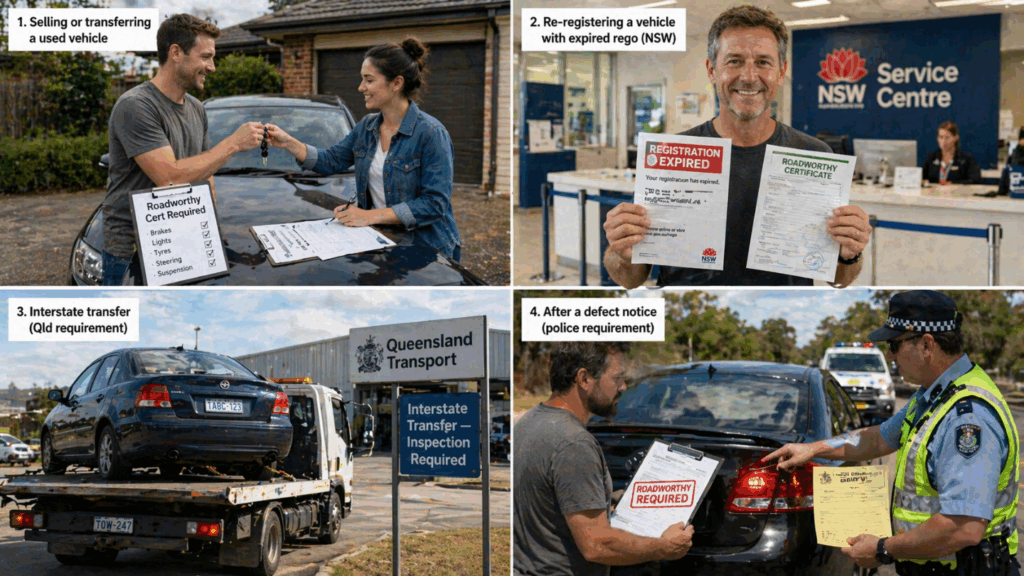
This is where things get important and where many Australians get caught out. Roadworthy certs are required in specific situations that vary by state, but some of the most common triggers include:
- Selling or transferring ownership of a registered vehicle.
- Re-registering a vehicle that has been off the road (written off or lapsed rego)
- Transferring a vehicle interstate
- Resolving a defect notice issued by the police or transport authorities
- Some states require it upon registration renewal after a certain number of years.
What does a roadworthy inspection actually check?
A roadworthy inspection is a structured assessment carried out by a licensed vehicle tester. The inspector examines specific components of a vehicle against a set of safety criteria. While the exact checklist varies slightly between states, a standard roadworthy inspection in Australia covers:
- Tyres- Tread depth, condition, correct sizing
- Brakes- Performance, condition of pads, rotors and lines
- Lights- Headlights, tail lights, indicators, hazards
- Steering and suspension- For play, wear or abnormal movement
- Windscreen and windows- Cracks, chips, wiper function
- Body and chassis- Rust, structural integrity, sharp edges
- Seatbelts- Condition, buckle function, correct anchorage
- Engine bay- Fuel, oil and coolant leaks
- Exhaust system- Leaks, excessive emissions
It’s worth noting that a roadworthy inspection is not a mechanical inspection. It won’t reveal every issue with the car, it won’t tell you the clutch is worn, the air conditioning is failing or that the head gasket is on its way out. If you are buying a used car, a separate pre-purchase mechanical inspection by a qualified mechanic is always recommended in addition to confirming the RWC.
Roadworthy certificates across Australian states
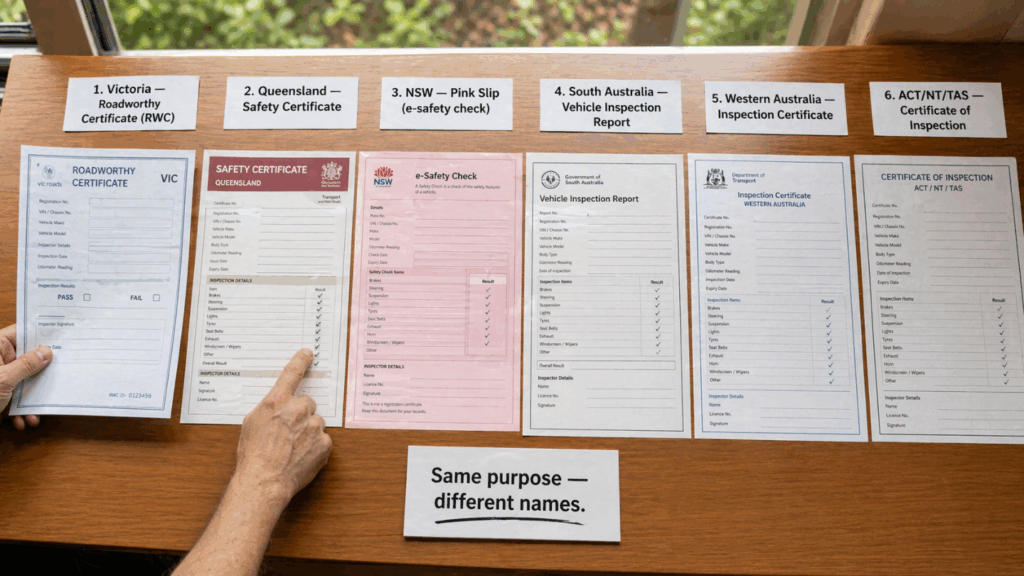
Each state and territory manages its own scheme, so terminology and specific requirements can differ. Here’s a quick overview of each state:
- Victoria- Roadworthy Certificate (RWC)
- Queensland- Safety Certificate
- NSW- Pink Slip (e-safety check)
- South Australia- Vehicle Inspection Report
- Western Australia- Inspection Certificate
- ACT/NT/TAS- Varies by territory
So if you are buying a car in Queensland and the seller hands you a “Safety Certificate,” that is the Queensland equivalent of an RWC. The underlying purpose of confirming minimum vehicle safety standards is the same across the board.
Who can issue a roadworthy certificate?
Not just anyone can issue a roadworthy certs. In Victoria, for example, only licensed Vehicle Testers at VicRoads-approved workshops are authorised to conduct inspections and issue RWCs. In Queensland, a licensed safety inspection station must carry out the assessment. In NSW, the e-Safety check must be completed at an authorised inspection station.
This licensing requirement exists to ensure objectivity and accountability. A licensed tester risks their certification if they knowingly issue a certificate for an unroadworthy vehicle. When getting your vehicle inspected, always verify that the workshop is authorised by the relevant state transport authority.
How long is a roadworthy certificate valid?
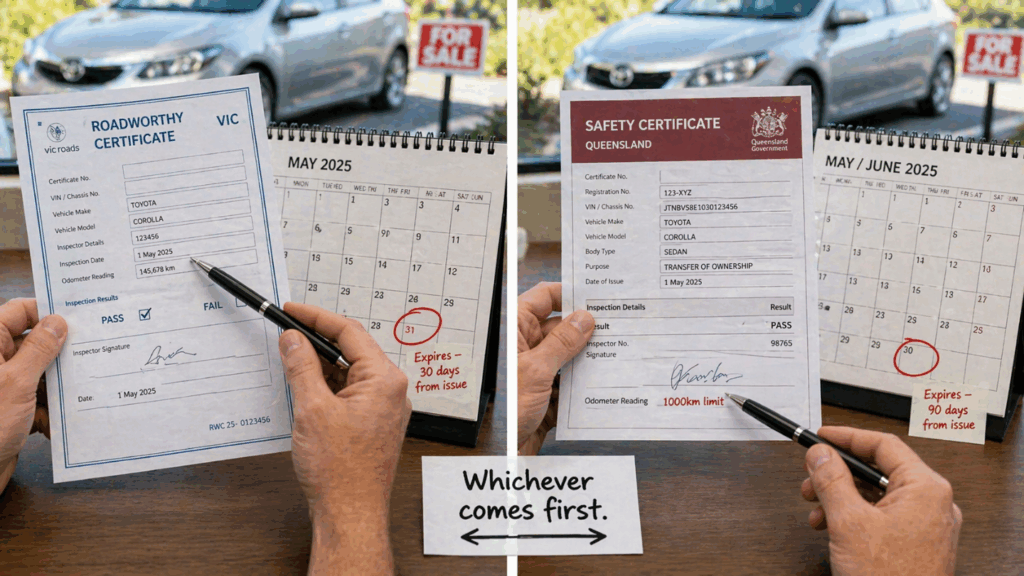
This is one of the most common confusions. In most Australian states, a roadworthy certs is valid for a limited period, usually 30 days from the date of issue in Victoria or until the vehicle changes ownership (whichever comes first). In Queensland, the safety certificate is valid for 90 days or 1000 kilometres, whichever comes first.
The time limit underscores that an RWC reflects the vehicle’s condition on a specific day. A car that passes a roadworthy inspection in January could develop a fault in February. The certificate does not guarantee the vehicle remains in the same condition indefinitely- it is a point-in-time assessment.
What happens if a vehicle fails a roadworthy inspection?
If a vehicle doesn’t meet the required safety standards during a roadworthy inspection, it will receive a Defect Notice listing items that need to be rectified before a certificate or roadworthy certs can be issued. The vehicle owner is then responsible for having the identified faults repaired and bringing the vehicle back for a re-inspection or recheck.

Comments
New Comment