




Has your weekly fuel bill spiked even when you seem to be driving right? Well, your driving behaviour isn’t the only factor that impacts fuel usage.
So, before you go for that maintenance or repair, you need to know what all influences your car’s fuel usage. The culprit will either be a mechanical, behavioural or external issue.
Read this comprehensive guide to all the factors that impact fuel usage in cars in Australia and get a handle on your living expenses.
Invisible fuel leak vs. problematic fuel consumption
You might be visiting the fuel station more often, but these two conditions differ in how they affect your car and your wallet.
An invisible fuel budget leak is the wasted fuel that never actually contributes to moving your car. It is often a physical loss or a silent inefficiency (like a faulty fuel cap) that goes unnoticed because the car still seems to run normally.
Problematic fuel consumption occurs when your engine is forced to drink more fuel than it should due to inefficiency caused by mechanical strain (like worn spark plugs) or external factors.
Mechanical factors that affect fuel usage
You would probably not even hear most of the mechanical issues that lead to high fuel usage. When a car’s mechanical components aren’t performing optimally, fuel consumption increases.
1. Rolling resistance & tyres

Under-inflated tyres increase the surface area in contact with the road, creating more friction (rolling resistance). The engine must then burn more fuel simply to keep the car moving at a steady speed.
Supposedly, even a 3% fuel consumption increase adds up to several extra litres of fuel per trip on long highway drives (like when going from Melbourne to Sydney). This difference is more noticeable on long highway drives than short city trips.
2. Air-to-fuel ratio (engine breathing)
An engine needs a precise mix of air and petrol to burn fuel efficiently. A clogged air filter restricts airflow, and the engine’s computer (ECU) may inject more fuel to compensate for the lack of oxygen.
Vehicles driven in dusty regional areas or on unsealed roads often require more frequent filter changes than those in the city.
3. Combustion efficiency (the spark)
Old spark plugs or faulty ignition coils may misfire or produce a weak spark. The unburned fuel due to incomplete combustion is simply pushed out the exhaust pipe as waste. Apart from higher fuel usage, this issue can cause jerky performance during acceleration.
4. Sensor inaccuracy
A dirty or faulty Oxygen (O2) Sensor or Mass Airflow (MAF) sensor might send incorrect data to the ECU, making it think the engine needs more fuel than it actually does. This is known as “running rich”. This issue can guzzle a lot of fuel without obvious signs.
5. Internal engine friction
Old or incorrect engine oil creates internal resistance (friction), forcing the engine to work harder just to turn its own crankshaft.
6. Alignment and drag
Poor wheel alignment causes the tyres to scrub against the road rather than rolling straight. Similarly, binding brakes that don’t fully release create constant drag. A car with misaligned wheels requires more power and fuel to run.
7. Electrical load from AC and electronics

A car’s electronics need extra fuel because they draw power from the alternator, which is turned by the engine. In Australian summers, heavy A/C usage can increase fuel consumption significantly.
Also read: Tips to increase car mileage or fuel economy
Behavioural factors that affect fuel usage
A car’s mechanical issues are often constant and can be fixed, but driving habits often have the most direct impact on fuel consumption.
1. Acceleration & braking
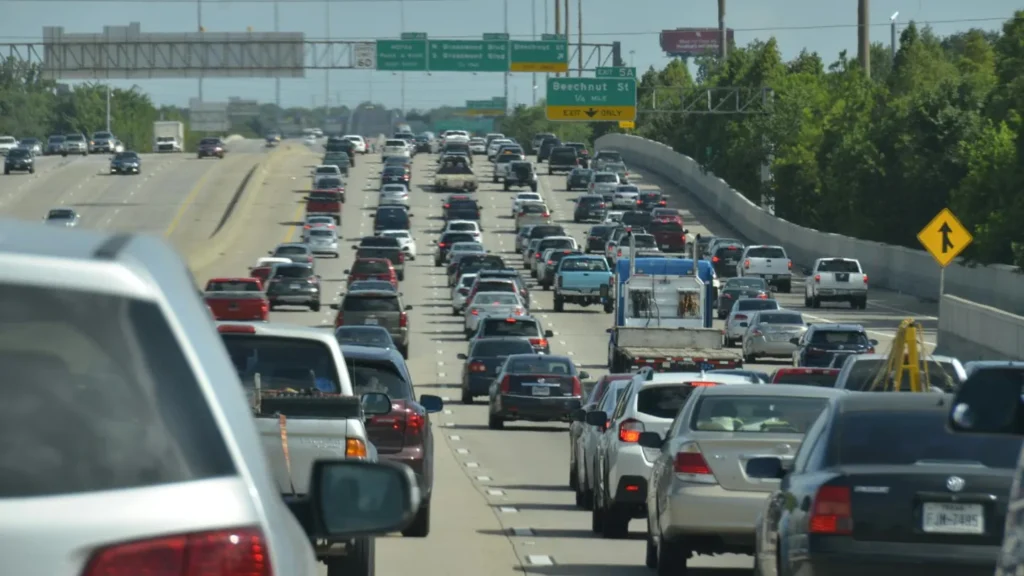
Engines consume the most fuel when moving a vehicle from a standstill. Aggressive acceleration forces the fuel injectors to squirt fuel more rapidly, while hard braking wastes the kinetic energy you just paid for.
2. Excessive cruising speeds
Driving just slightly faster than necessary exponentially increases the engine’s workload due to wind resistance. Aerodynamic drag increases more than proportionally with speed. Maintaining a constant speed between 50 km/h and 80 km/h is often considered efficient.
3. Engine idling
You may leave your engine running while waiting for passengers or sitting in non-moving traffic, believing that restarting the car uses more fuel. But modern fuel-injected engines are highly efficient at restarting, especially for longer waits (>10 minutes).
4. Poor gear management (manual & automatic)
Driving in a gear that is too low for your speed keeps engine RPM unnecessarily high, burning more fuel per kilometre. Shifting up to a higher gear as early as possible (at lower RPMs) reduces the load on the engine for manual cars. And gentle acceleration encourages the transmission to shift into higher, more economical gears sooner in an automatic car.
5. Lack of trip planning
An engine is least efficient when it is cold. It takes several kilometres for the engine and oil to reach the optimal operating temperature. Doing five separate 2 km errands throughout the day will use significantly more fuel than completing all five in one 10 km loop.
6. Open window drag

At high speeds, open car windows create “buffeting” (aerodynamic drag), which is harder for the engine to overcome than running the AC. Open windows are generally efficient below ~60 km/h, but increase drag at higher speeds.
External factors that affect fuel usage
Some external factors that affect your car’s fuel consumption are physical modifications, while several are invisible environmental and infrastructure factors.
1. The towing factor
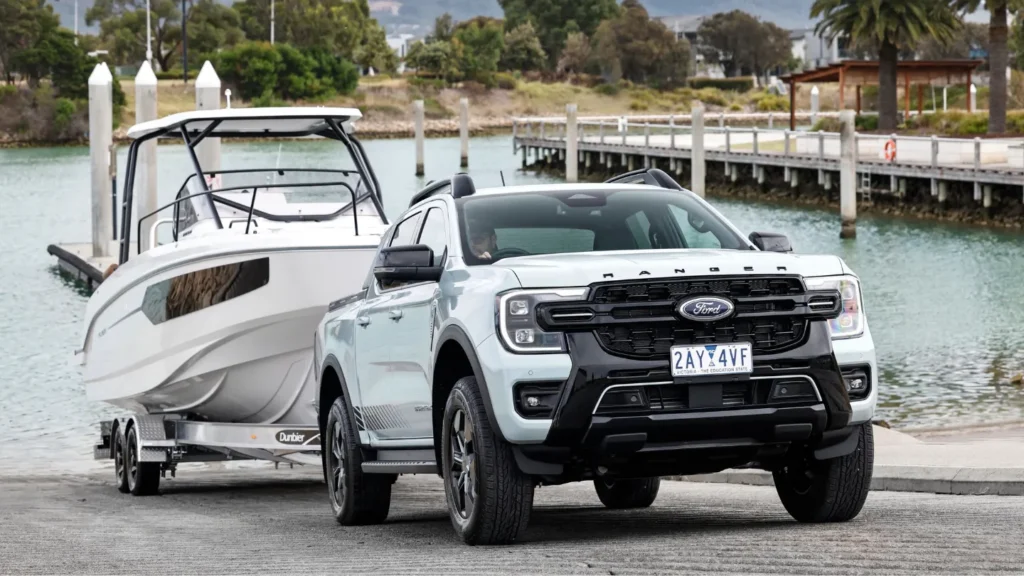
The more mass you pull, the more energy (fuel) your engine must expend to overcome inertia, especially during acceleration and hill climbs. The shape of the load can be more punishing than the weight.
For instance, a tall, flat-fronted box caravan increases drag exponentially with speed. A lower-profile pop-top caravan or a streamlined camper trailer generally yields better fuel economy.
Moreover, inappropriate tyre pressures (in the vehicle and the caravan) and unbalanced weight distribution also make the engine work harder.
2. Fuel chemistry and energy density
The chemistry of Australian fuel types determines how much energy is actually available to the engine per litre. E10 (Ethanol blend) has a lower energy density than pure petrol, so you need more of it than regular U91. Using U91 (Octane/RON) petrol on a car that requires 95/98 also causes the engine to run inefficiently to prevent damage. Here is what to do if you fill the wrong fuel.
Diesel fuel is more energy-dense than petrol, and diesel engines are thermally more efficient. This is why a diesel Toyota LandCruiser will typically use significantly less fuel than its petrol equivalent when towing heavy loads.
3. Accessories and modifications

Accessories influence fuel usage through aerodynamic drag and weight. Roof rack (loaded or unloaded), bull bars, 4WD gear like a winch, snorkels, lift kits, drawers, and extra batteries, larger and heavier (M/T) tyres, etc., increase load and aerodynamic drag, which raises fuel consumption.
Even powerful aftermarket spotlights (driving lights) or heavy-duty fridge setups put a higher load on the alternator (eventually on the engine).
4. Air temperature and humidity
Cold air is denser than warm air, meaning the engine can burn more fuel to match the higher oxygen levels, but it also reaches operating temperature more slowly. Conversely, extreme heat (40°C+) makes the air less dense, and your engine’s cooling fans and air conditioning must work much harder.
5. Road surface and conditions
Smooth bitumen offers the least resistance to tyres. Coarse “chip-seal” (common on regional Australian highways) and unsealed gravel roads increase rolling resistance, and hence fuel usage.
6. Urban design and infrastructure
Frequent traffic lights, school zones, and speed bumps force a “brake-accelerate” cycle that prevents your car from reaching its efficient cruising speed.
7. Headwinds and crosswinds
Wind is a massive invisible external fuel usage factor for long-distance drivers in the flat, vast Australia. A strong headwind increases the aerodynamic drag exponentially, making you refuel often.
Also read: Dirty Fuel is back in Australia. Should you be concerned?
Common car issues that cause high fuel consumption
Identifying mechanical issues is one of the most effective ways to lower your fuel bills. Neglected maintenance can boost fuel consumption by an estimated 20% to 50%. The table below outlines common vehicle issues in Australia that affect fuel usage, with estimated fixing costs.
| Issue | *Potential fuel savings | Effort level | Estimated fix cost (AUD) |
|---|---|---|---|
| Under-inflated tyres | Up to 10–20% | Very low | $0 (Free at service stations) |
| Dirty/clogged Air Filter | Up to 10–15% | Low | $30–80 |
| Worn spark plugs | 5–10% | Medium | $150–350 (varies by engine) |
| Faulty Oxygen (O2) sensor | 10–40% | Medium | $225–500+ per sensor |
| Wheel misalignment | Up to 10–15% | Low | $65–150 |
| Dirty Mass Air Flow (MAF) sensor | 10–20% | Medium | $20 (DIY clean) to $300 (Replace) |
| Wrong/degraded engine oil | 2–5% | Low | $150-250 (Full service) |
| Clogged fuel injectors | 5–15% | High | $20 (Additive) to $600+ (Professional) |
| Sticking brake caliper (drag) | 5–10% | High | $300–600 per corner |
| Faulty engine thermostat | 5–10% | High | $200–450 |
*Estimates vary based on vehicle type, driving conditions, and severity of the issue
Fuel consumption calculator for Australians
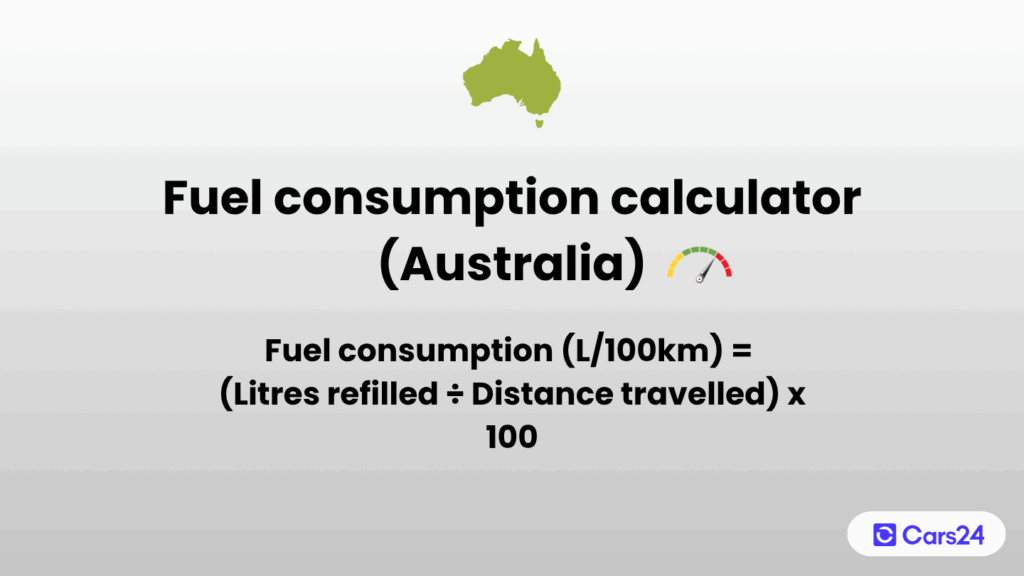
Fuel consumption is measured in Litres per 100 Kilometres (L/100km) in Australia. This metric tells you how many litres of fuel your car needs to travel 100km; the lower the number, the more efficient the vehicle.
Calculate your car’s actual (average) fuel consumption regardless of driving style or conditions, using this standard formula:
Fuel consumption (L/100km) = (Litres refilled ÷ Distance travelled) x 100
How to use the fuel consumption calculator formula:
Step 1: Fill your tank until the pump automatically stops.
Step 2: Reset your trip meter to zero.
Step 3: Drive normally until you need to refuel again.
Step 4: Refill completely and record the exact number of litres added from the pump receipt.
Step 5: Note the distance on your trip meter.
Step 6: Apply the formula above.
Trip cost formula
If you know your L/100km and want to budget for a specific trip (e.g., Sydney to Canberra, ~300km), use:
Trip cost = (Distance ÷ 100) x L/100km x Fuel price per litre
Example:
- Distance: 300 km
- Consumption: 8.0 L/100km
- Fuel Price: $2.10/L
- Cost: (300÷100)x8x2.10 = $50.4
We have also made a formula to calculate rising expenses with fuel price spikes.
Final thoughts
The amount of fuel used comes down to the car itself, the way you drive, and the conditions around you. A healthy car with proper maintenance will always sip less fuel than one that is strained, neglected, or dragging extra weight. Then your habits and Australian realities like towing, headwinds, rough roads, etc., matter too.
High fuel use is usually a clue, not a mystery. Find the cause first, because most of the time it is fixable. Keep the car maintained, drive smoothly, and plan your trips well. Do that, and you will save real money every time you fill up.
FAQs
1. Is 10 litres per 100km good?
10L/100km is considered decent fuel consumption for a large 4WD or a loaded ute, but it’s relatively thirsty for a modern hatchback or sedan, which should ideally sit between 5L and 7L/100km.
2. What causes high fuel consumption in petrol engines?
High consumption in petrol engines is frequently caused by fouled spark plugs or a faulty oxygen sensor or other mechanical issues, and driving behaviour like excessive idling and “heavy foot” acceleration.
3. What causes high fuel consumption in diesel engines?
The main fuel usage offenders are a clogged Diesel Particulate Filter (DPF) or carbon build-up in the EGR valve for diesel engines. Added weight and wind resistance of heavy bull bars, roof racks, and towing setups in big diesel utes and trucks also affect fuel usage.
Comments
New Comment