




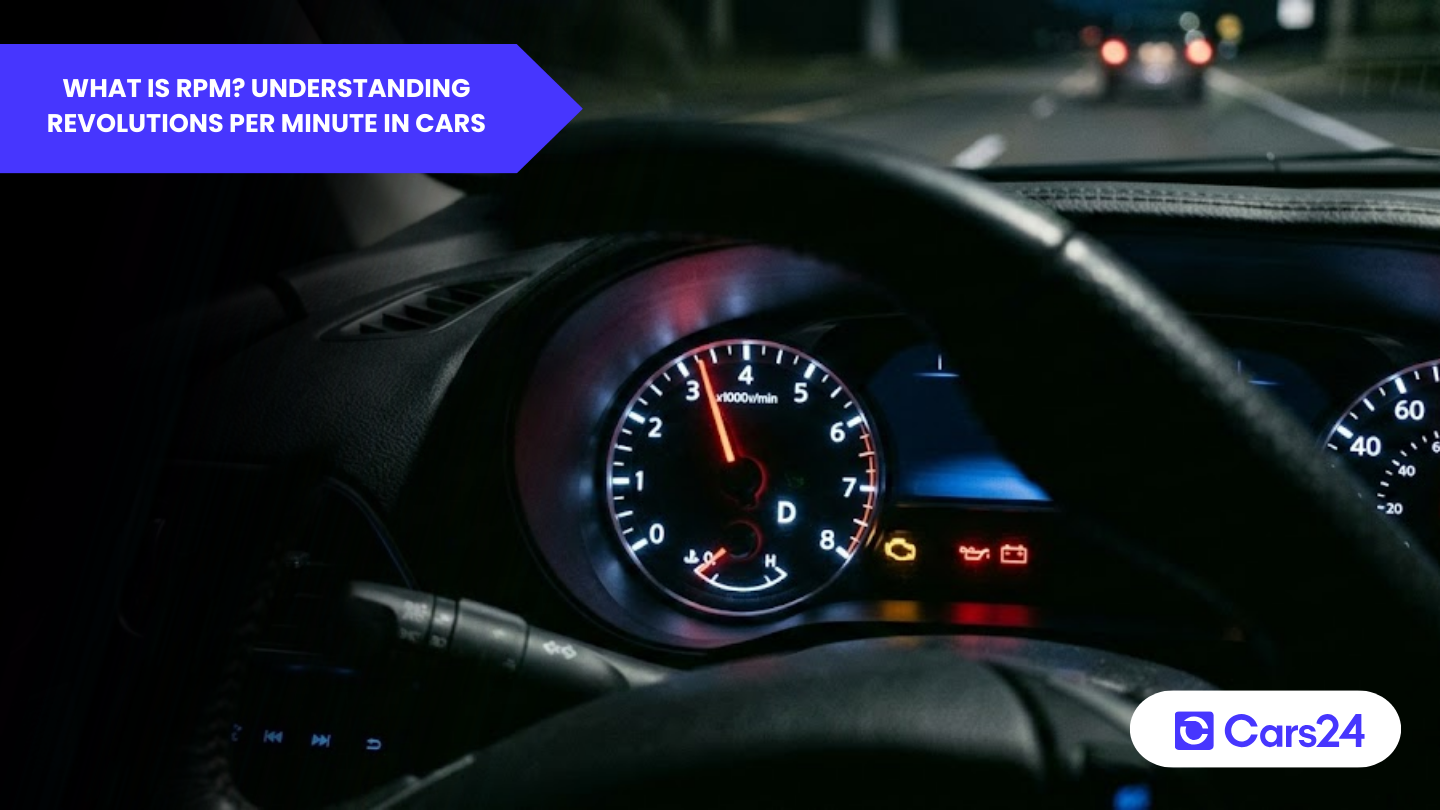
What is RPM and why does it matter when you drive? This guide explains the RPM meaning, how revolutions per minute work in a car engine, what the car rev counter shows, and how RPM affects power, fuel efficiency and everyday driving.
Every car has a way of telling you how hard its engine is working. Not through words, but through a small gauge on the dashboard that rises and falls as you drive. That gauge tracks RPM. So, what is RPM and why does it play such an important role in how your car performs?
RPM is short for revolutions per minute and it describes how quickly your car’s engine is spinning. The number reflects how many times the engine’s crankshaft rotates in one minute. Every time the crankshaft spins, the pistons inside the engine move up and down, producing the power that keeps your car moving.
Understanding RPM meaning isn’t just something mechanics care about. Whether you’re commuting through Sydney traffic, cruising the Pacific Highway, or learning to drive in Melbourne, knowing how revs per minute work helps you understand your vehicle better. It can improve fuel efficiency, make gear shifts smoother and even help you recognise when something might be wrong under the bonnet.
Understanding what is RPM is actually quite simple once you look at how the engine works – let’s break it down.
What Is RPM in a Car?
RPM stands for revolutions per minute and it measures how fast a car’s engine is spinning. Inside the engine, pistons move up and down while a component called the crankshaft turns that motion into rotation that powers the wheels. RPM measures how many times that crankshaft rotates in one minute.
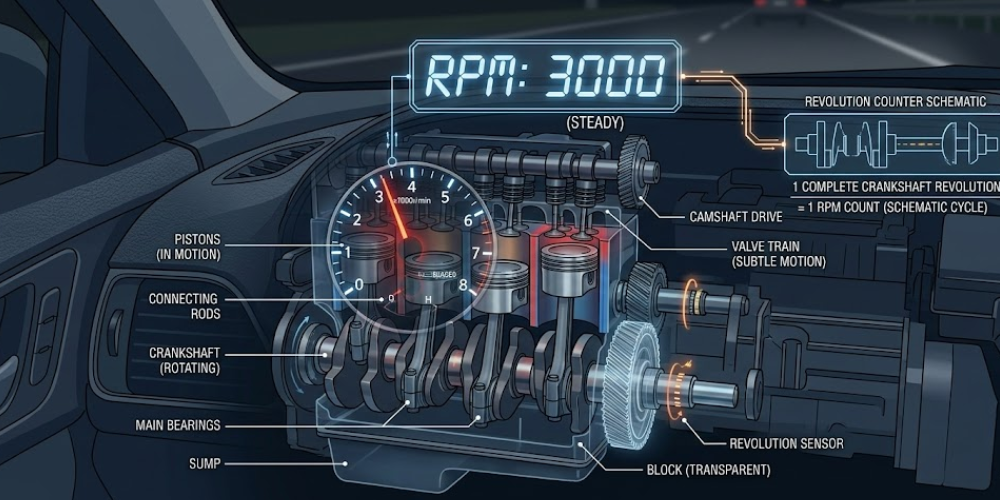
So if your car is running at:
- 1,000 RPM, the engine completes about 1,000 revolutions per minute
- 3,000 RPM, it completes about 3,000 revolutions per minute
- 6,000 RPM, it completes about 6,000 revolutions per minute
As RPM increases, the engine works faster, producing more power but also burning more fuel. Lower revs per minute usually mean the engine is working more efficiently and using less fuel. In short, RPM shows how fast your engine is working while you drive.
Where You See RPM in Your Car
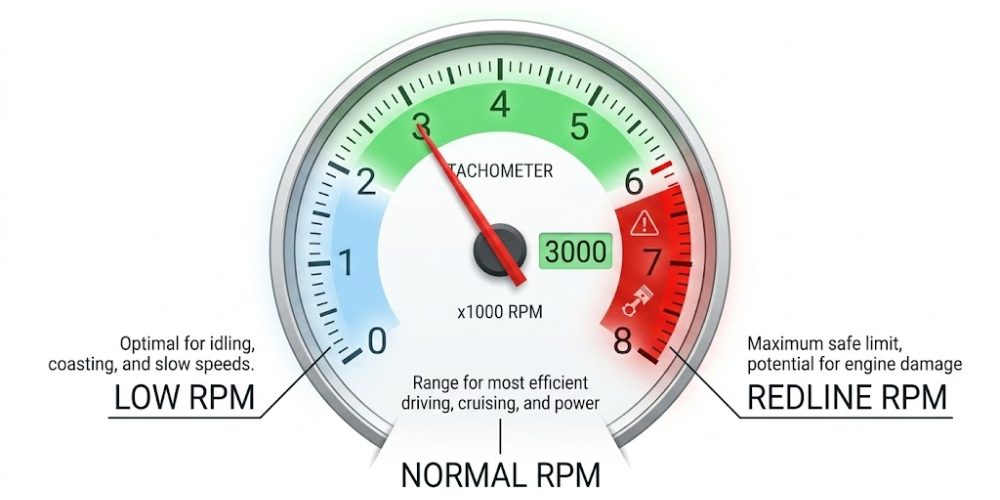
You’ll usually see RPM on a gauge called the tachometer, which is often referred to as the car rev counter or simply the tacho. It typically sits next to the speedometer on your dashboard and shows how fast the engine is spinning.
Instead of displaying the full number of revolutions per minute, the tachometer uses smaller numbers that represent thousands. So the numbers you see on the dial actually need to be multiplied by 1,000. For example:
- 2 on the gauge = 2,000 RPM
- 3 on the gauge = 3,000 RPM
- 6 on the gauge = 6,000 RPM
Most tachometers also include a small marking such as “×1000 r/min” to indicate this. As the needle climbs higher on the car rev counter, the engine is spinning faster and producing more power. Near the top of the gauge, you’ll usually notice a section highlighted in red. This is called the redline and it marks the maximum engine speed recommended by the manufacturer.
Pushing the engine beyond this point can put extra strain on its components. That’s why modern vehicles are equipped with rev limiters, which automatically prevent the engine from exceeding its safe RPM range and help protect it from damage.
Why RPM Matters While Driving
Think about the last time you accelerated onto a highway. The engine got louder, the car picked up speed and the RPM needle climbed higher. That small movement actually says a lot about what your engine is doing.
Once you understand RPM, it becomes easier to balance:
- engine power
- fuel efficiency
- engine wear
Higher RPM Means More Power
When you press the accelerator, the engine spins faster and RPM increases. This allows the engine to produce more horsepower, which is why higher RPM is often needed when overtaking or climbing steep hills. Performance driving often happens at higher RPM ranges because that’s where engines typically produce maximum power.
Lower RPM Improves Fuel Efficiency
When the engine runs at lower RPM, it burns less fuel. That’s why cruising steadily on the highway often results in better fuel economy. Maintaining moderate revs per minute can help reduce fuel consumption and engine strain during everyday driving.
Somewhere in the Middle is Where Most Everyday Driving Happens
Most normal driving happens somewhere in the middle. Keeping RPM within a balanced range allows the engine to operate efficiently while still delivering enough power when needed.
Typical RPM Ranges in Modern Cars
To understand what is RPM, you also need to understand what do these RPM numbers actually look like when you’re driving. The exact revolutions per minute your car runs at will depend on the engine, transmission and gearing. But most modern passenger cars follow fairly similar RPM patterns in everyday driving.
To put those numbers into context, here’s how RPM usually looks across different driving situations.
| Driving Situation | Typical RPM Range | Explanation |
| Idle | 600–1,000 RPM | Engine running but vehicle stationary |
| City driving | 1,500–2,500 RPM | Normal acceleration and traffic conditions |
| Highway cruising | 1,800–2,500 RPM | Efficient cruising speeds |
| Maximum RPM | 6,000–7,000 RPM | Upper limit before redline |
These ranges aren’t fixed rules. The exact RPM your car runs at depends on factors like engine size, gear ratios, and transmission type. But for most drivers, these ranges offer a good reference point for how revs per minute behave in everyday driving.
RPM vs Speed: Why They Are Not the Same
Many drivers assume RPM and speed are directly connected, but they actually measure two different things. RPM shows how fast the engine is spinning, while the speedometer tells you how fast the car is moving on the road.
The two are linked through the car’s mechanical setup, which includes things like gear ratios, engine power, vehicle weight and even tyre size; all play a role in how RPM translates into road speed.
This is why the same car can travel at the same speed but show very different RPM readings depending on the gear you’re using. For instance, a car might sit at around 2,000 RPM while cruising at 100 km/h in sixth gear, but if you drop down to third gear at the same speed, the engine could be spinning closer to 4,000 RPM.
The car hasn’t suddenly become faster; the engine is simply working harder because of the lower gear. That’s also why shifting gears changes the sound of the engine and the RPM reading, even when your road speed doesn’t change immediately.
Manual vs Automatic Cars: How RPM Behaves
The way RPM behaves can change depending on the type of transmission your car has. Manual and automatic vehicles manage engine speed in slightly different ways, which is why the RPM gauge may behave differently when you drive them.
Manual Transmission
In a manual car, the driver controls when to change gears. As you accelerate, the engine speed rises and the RPM on the car rev counter climbs higher. When the RPM reaches a certain range, the driver shifts to the next gear to keep the engine running smoothly.
Many drivers use the tachometer to judge the right moment to shift gears. With experience, you begin to recognise the RPM range where the engine delivers a good balance of power, smoothness, and fuel efficiency.
Automatic Transmission
In an automatic car, gear changes are handled by the vehicle’s transmission system and onboard computer. The system continuously adjusts RPM to deliver smooth acceleration and efficient fuel consumption without the driver needing to intervene.
Because of this, drivers in automatic cars usually do not need to monitor the car rev counter as closely as those driving manual vehicles. However, the RPM gauge can still provide useful insight into how hard the engine is working, especially during acceleration, overtaking, or climbing steep roads.
What Is the Best RPM for Fuel Efficiency?
Many drivers want to know the best RPM range for saving fuel. While the ideal range varies between vehicles, most cars achieve good fuel efficiency when operating between:
1,500 and 2,500 RPM
Driving smoothly and avoiding sudden acceleration helps keep RPM within this efficient range. Manual drivers can also improve fuel economy by shifting gears early, provided the engine doesn’t begin to struggle or vibrate. If the engine feels like it’s labouring at very low RPM, shifting to a lower gear may be necessary.
Is High RPM Bad for Your Engine?
Seeing the RPM needle climb on the tachometer can sometimes make drivers nervous. But the truth is that high RPM is not automatically bad for your engine. Car engines are designed to run safely across a wide range of speeds. When you accelerate quickly, climb a hill, or overtake another vehicle, the engine naturally spins faster and the RPMs increase. In those moments, higher revolutions per minute simply mean the engine is working harder to produce more power.
Problems usually arise only when the engine spends too much time very close to its maximum RPM. Running the engine at extremely high revs per minute for long periods can lead to a few issues, such as:
- higher fuel consumption
- increased engine temperature
- faster wear on engine components
To help prevent this, the tachometer includes a section marked in red, often called the redline. This area shows the upper limit of the engine’s safe operating range.
Modern vehicles add another layer of protection through something called a rev limiter. If the engine approaches its maximum safe RPM, the system automatically restricts engine speed so the engine cannot spin beyond its safe limit. So while seeing higher RPM during acceleration is completely normal, your car is also designed with safeguards to keep the engine operating safely.
Can RPM Help Identify Car Problems?
Yes, monitoring RPM can sometimes help detect mechanical issues early. If the engine speed fluctuates unexpectedly or the tachometer needle jumps without a clear reason, it may indicate a problem.
Possible causes include:
- worn spark plugs
- vacuum leaks
- faulty throttle sensors
- clogged air filters
- fuel system issues
- transmission problems
Unusual RPM behaviour can sometimes be one of the earliest warning signs that something isn’t functioning properly.
RPM in the Age of Electric Vehicles
As Australia continues to adopt electric vehicles, the role of RPM is evolving. Traditional petrol and diesel engines rely on multiple moving components and gears, which is why revolutions per minute are so important.
Electric motors work differently. Many EVs use single-speed transmissions and deliver power instantly, which means drivers usually don’t need to monitor engine revs.
Electric motors can still spin extremely fast, sometimes over 20,000 RPM but most EV dashboards don’t display this information because it’s not necessary for driving.
Even so, RPM remains essential for the millions of petrol and diesel vehicles currently on Australian roads.
The Simple Way to Think About RPM
If all this sounds technical, there’s an easy way to understand it.
Your engine is always spinning. RPM simply measures how fast that spinning happens.
- Low RPM → relaxed engine and better fuel efficiency
- Medium RPM → balanced everyday driving
- High RPM → maximum power and acceleration
Once you start noticing your RPM gauge, the way your car behaves begins to make much more sense.
FAQs
What is RPM in a car?
RPM stands for revolutions per minute and measures how many times the engine’s crankshaft rotates every minute.
What RPM should a car be at 100 km/h?
Many cars cruise between 1,800 and 2,500 RPM at 100 km/h, depending on gearing and transmission.
Is high RPM bad for your engine?
High RPM is not inherently harmful, but constantly running near the redline can increase fuel consumption and engine wear.
What is a car rev counter?
A car rev counter, or tachometer, displays the engine’s RPM and helps drivers understand how fast the engine is running.
Final Thoughts
Understanding RPM gives you a much clearer sense of what’s going on under the bonnet. It affects everything from how smoothly your car accelerates to how efficiently it uses fuel.
Next time you’re driving, take a quick look at the tachometer. That moving needle isn’t just another dial on the dashboard. It’s showing how hard your engine is working in that moment.
And once you start noticing it, driving becomes a little more interesting. You’re not just behind the wheel anymore; you actually understand what your car is doing.

Comments
New Comment