





One August morning in 1888, a woman accompanied by her two sons pushed a strange machine out of a workshop in Mannheim, Germany. No one was awake to witness a moment that would later be etched into history.
This machine had three wheels, powered by a small engine at the back with a reputation for being temperamental. She was Pforzheim-bound on a 100-kilometre journey to her mother’s home, which would become the first long-distance drive in car history. The woman was Bertha Benz and the machine belonged to her husband, Karl Benz.
This single trip laid the groundwork for a debate that refuses to die – “when and where was the first car invented?”. The answer is subject to what you think a “car” actually is.
Why this question refuses to have a simple answer
Pose the question of who invented the first car in everyday conversation and you are most likely to hear the name Karl Benz. Among historians, the same question is met with a moment of hesitation, not out of disagreement, but because the automobile was shaped by a sustained period of trial and error rather than a single breakthrough.
For centuries, inventors had been experimenting with vehicles that could move without horses, which led to the advent of steam-powered machines, electric experiments and even wind-driven apparatus, before petrol engines eventually took over.
This is why conversations about when and where the first car was invented tend to go in circles. People aren’t always disagreeing on the facts; they’re arguing on what counts as a car. Is it the first machine that moved on its own? The first one built to carry people? Or the first design that evolved into the modern automobile? Change the definition and you’ll find that the answer changes with it.
A quick walk through the vehicles that came before
If we’re talking strictly about chronology, the story actually begins in 1769, when French engineer Nicolas-Joseph Cugnot built a steam-powered vehicle designed to haul artillery. It moved on its own, rolled on wheels and even travelled on roads! While very different from modern cars, it is often cited as the earliest self-propelled road vehicle and certainly qualifies as a landmark achievement in car history.
Throughout the early 1800s, inventors experimented with steam-powered and electric vehicles across Europe. Some of these machines even carried passengers for short periods and they were definitely hard to ignore. This led to the government framing laws aimed at controlling steam road locomotives, including the well-known Red Flag Act of 1865, which, for the first time, placed strict limits on steam road vehicles, including very low speed restrictions and a rule requiring someone to walk ahead carrying a red flag.

But most of these vehicles went on to become traction engines, industrial machines, or public transport experiments. They did not develop into personal cars or shape the automotive world as we perceive it. While these early machines are an integral part of car history, they are not why cars became part of everyday life.
When the automobile, as we know it, finally took shape
The tale of when and where the first car was invented becomes clearer when we arrive in Mannheim, Germany. By the mid-1880s, Karl Benz was no longer trying to modify horse-drawn carriages, instead, he focused on a different goal altogether: building a lightweight personal vehicle designed around an internal combustion engine, with the engine and body built as one – this was the birth of the automobile. In 1885, he finally completed what would become known as the Benz Patent-Motorwagen.
Unlike earlier steam or electric machines, it was developed as a personal car from the start, not an industrial tool or experimental transport. The following year, Benz applied for German patent DRP 37435, officially titled “vehicle powered by a gas engine.” The patent was dated 29 January 1886, which is why many histories denote this moment.
The same year, Benz demonstrated the vehicle publicly on the streets of Mannheim, marking one of the first real appearances of a gasoline-powered automobile on public roads.
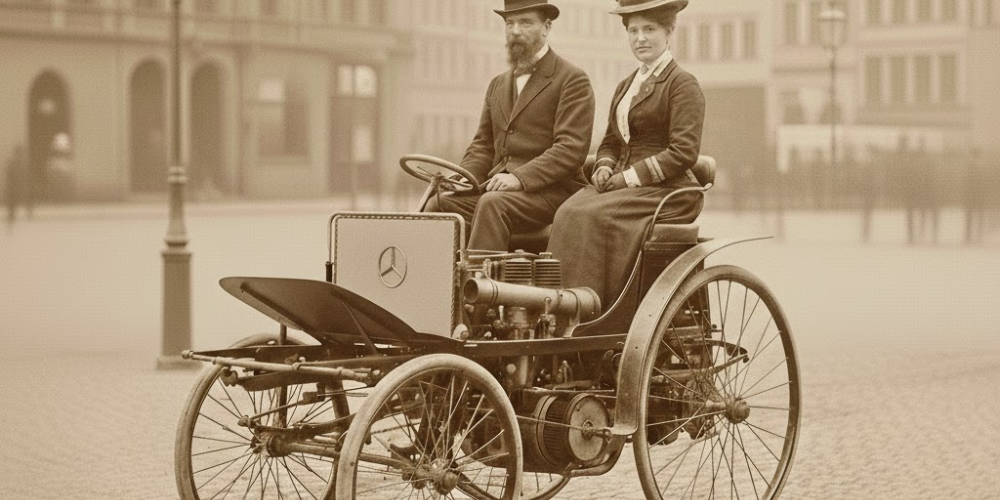
This is why, when the word car refers to the modern automobile, history generally settles on a consistent answer:
- When was the first car invented? 1885–1886
- Where was the first car invented? Mannheim, Germany
- Who invented the first car? Karl Benz
These answers endure because Benz’s invention laid the foundation for the automotive vehicle that shaped car history and evolved into modern automobiles.
Why Bertha Benz matters more than most people realise
A patent, on its own, rarely changes the world because history is full of inventions that looked promising in theory but never worked outside a workshop. It is the moment an invention is put to test and that’s where Bertha Benz comes in.
Her 1888 journey, which she took without informing her husband, helped prove that the automobile could travel long distances, exposing practical flaws that needed to be fixed. And it corroborated to the public that this wasn’t just an inventor’s curiosity, but a usable machine.
Fuel was bought from pharmacies, brake linings were improvised at a shoemaker’s shop and repairs were handled along the way. This moment truly changed how the world understood the automobile.
Karl Benz or Clever Marketing?
Mercedes-Benz has long associated 1886 with the birth of the automobile and it would be a mistake to assume this story exists only because of branding. The company did not sketch the narrative, it built on what historians were already saying.
The past often distinguishes between a prototype and an ancestor. A prototype proves that something can be done. An ancestor leads directly to what comes next. Karl Benz’s credit has very little to do with marketing; its design influenced other inventors, manufacturers copied and refined it. Over time, that idea evolved into the automotive vehicle we recognise today.
Many early vehicles were prototypes. They showed that self-propelled transport was possible, but their ideas didn’t transform. And that continuity, more than any marketing campaign, is why Karl Benz remains focal when people ask who invented the first car.
Giving credit where it’s due: Daimler and Maybach
While Karl’s contributions were revolutionary, he was not working in a vacuum.
Around the same time, Gottlieb Daimler and Wilhelm Maybach were working on a related idea of their own; building compact, high-speed internal combustion engines that could power small vehicles.
In 1885, they unveiled the Reitwagen or the “riding car.” It looked more like a motorised bicycle than a car, but it proved something crucial: petrol engines could be light, fast, and practical enough for personal transport. Soon after, Daimler began fitting these engines into four-wheeled vehicles, pushing automotive development forward along a parallel path.
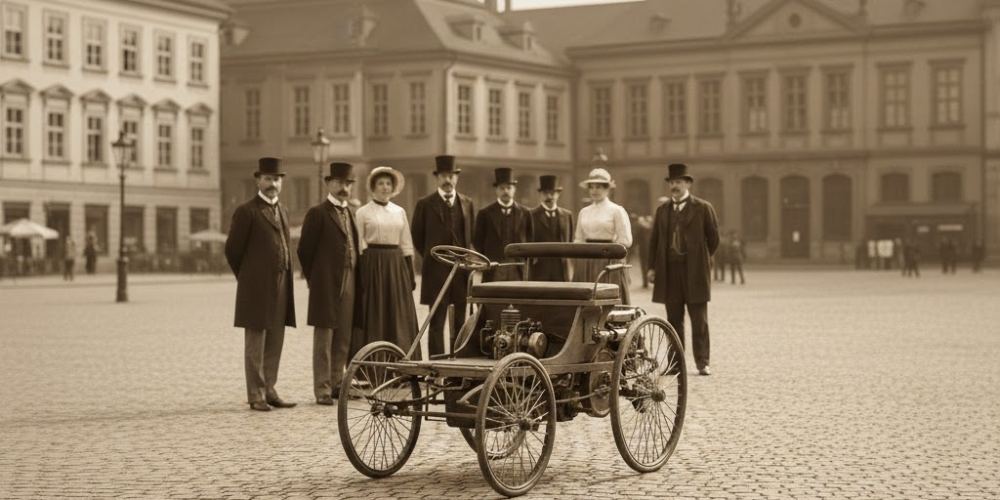
Their contribution matters enormously to car history. Without them, the automobile would not have evolved as quickly or as effectively as it did.
So, when was the first car invented, really?
There’s a straightforward way to answer this and end this discourse.
If you mean the first self-propelled road vehicle, the story goes back to the 18th century, to steam-powered machines like Nicolas-Joseph Cugnot’s. That answer holds up historically, technically, and under even the most pedantic debate.
But if by car you mean the ancestor of the modern automobile, the kind of vehicle that directly led to what we drive today, the answer is clear. That moment belongs to 1885-1886, in Mannheim, with Karl Benz and his gasoline-powered Motorwagen.
And if anyone still feels unconvinced, there’s one detail worth remembering. The fact that the Motorwagen actually worked was proven because of Bertha Benz who set out before sunrise in 1888, in an era when women had no legal claim to inventions they helped create. The courage she showed during her journey transformed a fragile machine into a usable mode of transport. And it’s more significant than any patent or marketing catchphrase, which is why this story still matters.

Comments
New Comment