




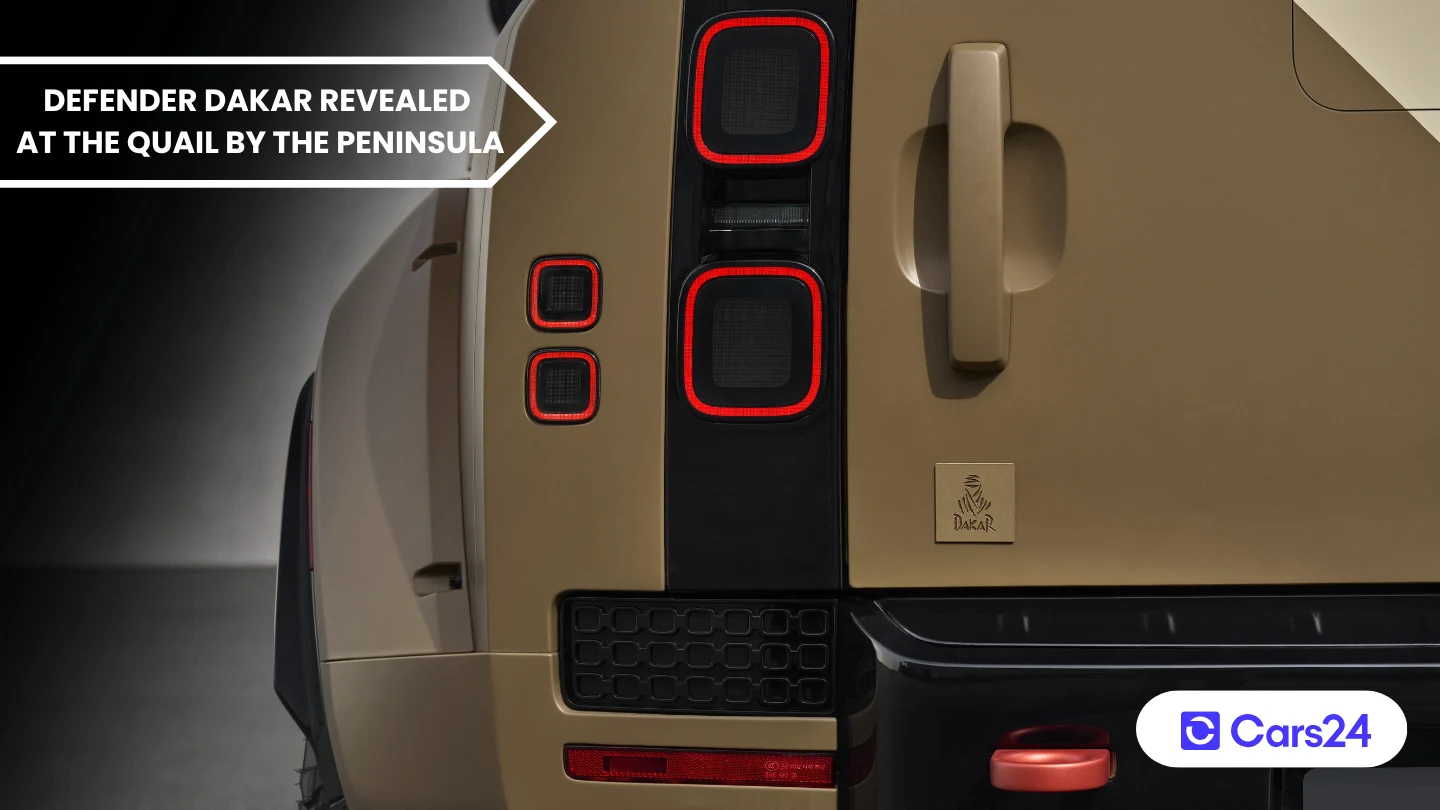
A Defender with 35-inch tyres, a 476kW V8 and a Flight Mode sounds slightly unhinged. And that is precisely what Land Rover has just revealed. The Defender Dakar is a limited-run, road-legal version of the brand’s D7X-R Dakar Rally car, which won its class in the 2026 Dakar Rally on its competitive debut.
Revealed as a Design Preview Model at The Quail during Monterey Car Week, the Dakar isn’t simply a Defender with some rally-inspired graphics and a few extra bits of plastic. Land Rover has carried over the D7X-R’s body architecture, transmission and driveline, while adapting its suspension and off-road hardware for road use.
And yes, there is a very serious V8 under the bonnet.
476kW and 750Nm from a twin-turbo V8
The Defender Dakar uses a 4.4-litre twin-turbocharged V8 producing 476kW and 750Nm. It’s the same basic engine used by the D7X-R, but the road-going Dakar isn’t constrained by Dakar race regulations. Land Rover says it therefore produces its full output, while also gaining greater cooling compared with the Defender Octa.
Performance figures are still being kept under wraps. Land Rover hasn’t announced the Dakar’s 0-100km/h time, top speed or fuel consumption.
We’ll have to wait until the 2027 Dakar Rally for the full technical picture. But this is what we have up until now:
Defender Dakar key specifications
| Specification | Defender Dakar |
| Engine | 4.4-litre twin-turbo V8 |
| Power | 467kW |
| Torque | 750Nm |
| Transmission | Rally-derived |
| Driveline | Rally-derived |
| Tyres | 35-inch all-terrain |
| Wheels | Forged 20-inch |
| Suspension | Coil springs with Bilstein dampers |
| Seating | 2+2 |
| Drive modes | Dunes, Gravel, Flight Mode |
| Reservations | Early 2027 |
Read more: Opinion: Here’s why we think Mahindra Scorpio Lifestyler can beat Toyota HiLux
The hardware is where things get interesting
The Defender Dakar gets a wider track and increased ride height, along with coil-spring suspension and Bilstein dampers developed with the D7X-R in mind. Then Land Rover has fitted those enormous 35-inch all-terrain tyres to forged 20-inch wheels.
For comparison, this isn’t the sort of tyre package you normally associate with a high-performance road SUV. Here, it’s part of a much broader focus on high-speed desert and loose-surface driving. There are new Dunes and Gravel drive modes, too.
But the feature that will probably get the most attention is Flight Mode. Developed for the D7X-R, it is designed to help control the vehicle during jumps and deliver smoother landings when the Defender is being driven hard over rough terrain. It is difficult to imagine many situations where an Australian owner will need to activate it on the way to Bunnings, but it does underline just how closely this Defender is tied to its rally sibling.
The Dakar looks the part
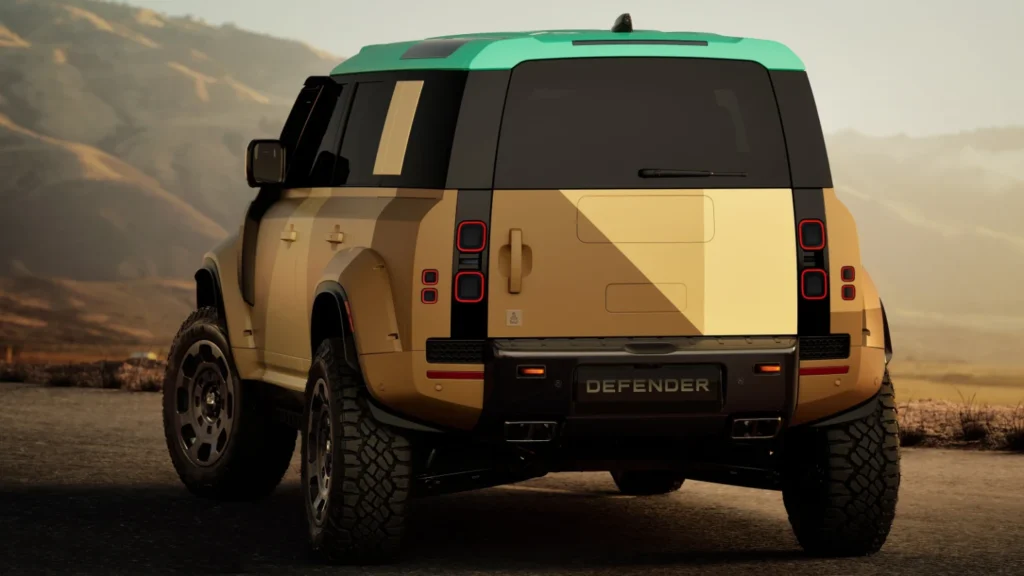
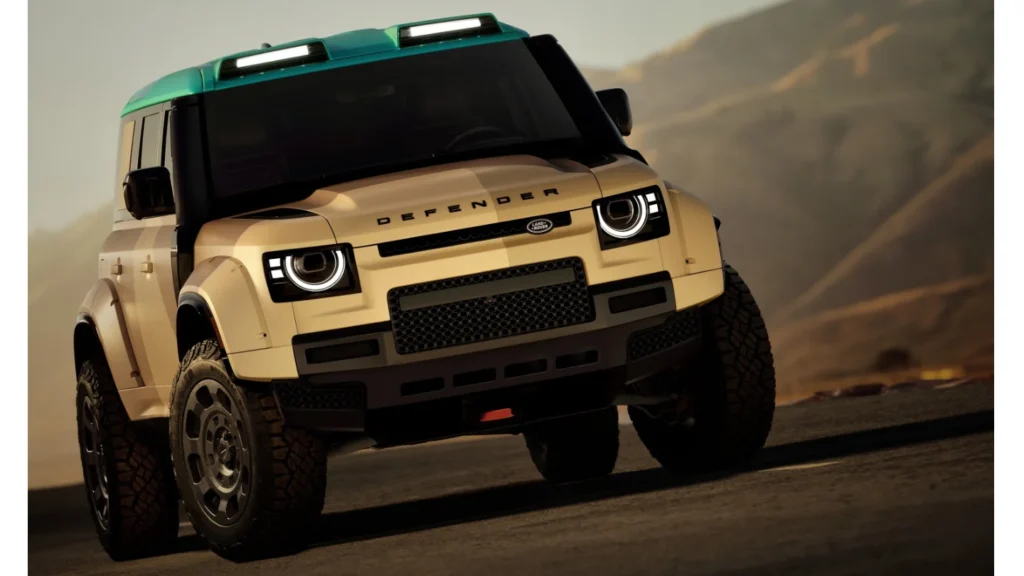
Land Rover hasn’t been shy with the bodywork, either. The Defender Dakar gets a carbon-fibre bonnet, twin raised carbon-fibre air intakes and extended wheel arches with exposed rivets. A fixed metal roof, roof-mounted light pods, a metal front undershield and additional underbody protection add to its competition-inspired appearance.
The launch specification will be finished in Dakar Sand with a Yanbu Turquoise roof, echoing the colours of the D7X-R that won its class at the 2026 Dakar Rally. Buyers will also be able to choose Narvik Black or Alaska White, with an optional matte protective film.
It’s a 2+2 Defender inside
The Dakar also gives up some of the Defender’s everyday practicality in favour of a more focused cabin. It gets a 2+2 seating layout with dedicated race seats up front. Four-point racing harnesses will be available as an option, while the rear storage area has been designed to carry race helmets.
There are also dedicated mounting points in the loadspace for the spare wheel and an air compressor. So while the Dakar remains road legal, its interior is clearly aimed at owners who plan to do more than drive it between home and the supermarket.
Could Australia get the Defender Dakar?
This is the bit Land Rover hasn’t answered yet. Registrations of interest are already open, with reservations scheduled to begin in early 2027. However, the company has not announced production numbers, pricing or which markets will receive the limited-run model.
That means there is no confirmed Australian launch at this stage.
Australia would seem like a natural market for something like this. The Defender already has a strong following here, and buyers have plenty of opportunity to put serious off-road hardware to use. Whether Land Rover agrees is another matter.
More information is expected at the 2027 Dakar Rally in Saudi Arabia, where the company plans to reveal the Defender Dakar’s full technical specifications. Until then, the headline numbers tell most of the story: 467kW, 750Nm, 35-inch tyres, rally-derived suspension and a road-legal Defender that has been engineered to survive the sort of terrain that would leave most SUVs asking for a break.

Comments
New Comment