




Key takeaways
- Subaru Outback achieves five stars under ANCAP’s stricter 2026 assessment criteria.
- The SUV scored 92 per cent for crash protection, including strong pedestrian protection.
- Missing rollover airbag deployment, child detection and emergency calling features attracted penalties.
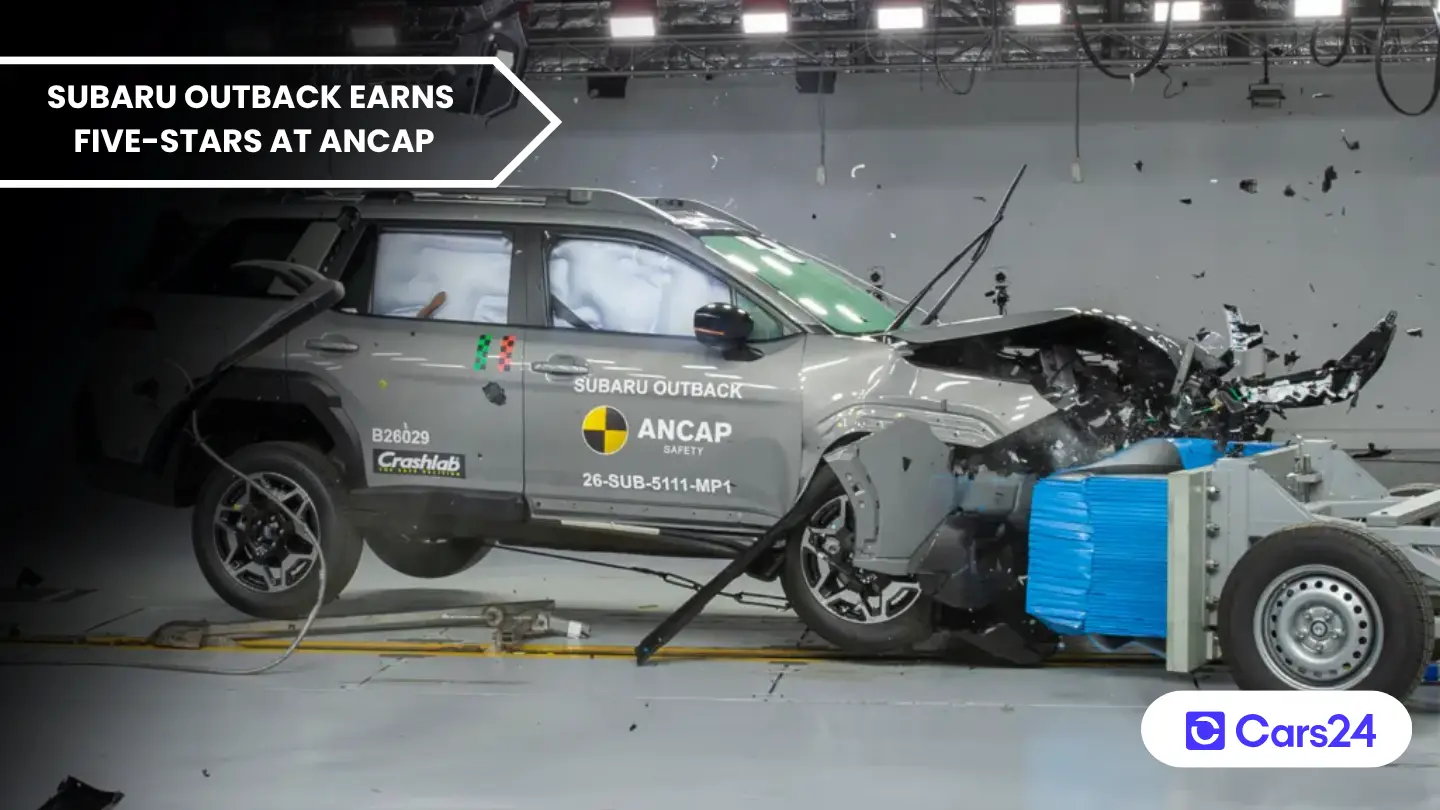
The Subaru Outback has earned a five-star ANCAP safety rating following testing under the organisation’s tougher 2026 assessment criteria. The petrol-powered family SUV scored 92 per cent for Crash Protection, although shortcomings involving its side curtain airbags, child presence detection and emergency calling technology affected its overall results.
The rating applies to all Subaru Outback variants built from October 2025 onwards in Australia. The latest-generation model went on sale locally in November 2025 and is assessed under ANCAP’s 2026-2028 protocols.
The result is particularly relevant for Australian families considering the Outback for its combination of passenger space, practicality and all-road capability.
Read more: 2027 Subaru Crosstrek gets a bigger engine in Australia
How did the Subaru Outback perform in ANCAP testing?
The Subaru Outback recorded the following scores across ANCAP’s four assessment categories.
| ANCAP assessment | Score |
| Safe Driving | 64% |
| Crash Avoidance | 66% |
| Crash Protection | 92% |
| Post Crash | 80% |
| Overall rating | Five stars |
Crash Protection was the Outback’s strongest category, with ANCAP reporting good levels of protection for adult and child occupants across frontal and side impact tests.
It also achieved full points for whiplash protection in rear-end collisions and recorded strong results in full-width frontal and side impact assessments.
One of its more notable results came from pedestrian impact testing. ANCAP awarded rare full scores for pelvis, upper-leg and lower-leg protection, recognising the design of the Outback’s front bumper area.
However, protection for cyclists was less favourable, while a penalty was applied during frontal offset testing for the vehicle’s compatibility with other cars. This reflects the potential injury risk the Outback could pose to occupants of another vehicle in a collision.
Why did the Subaru Outback lose safety points?
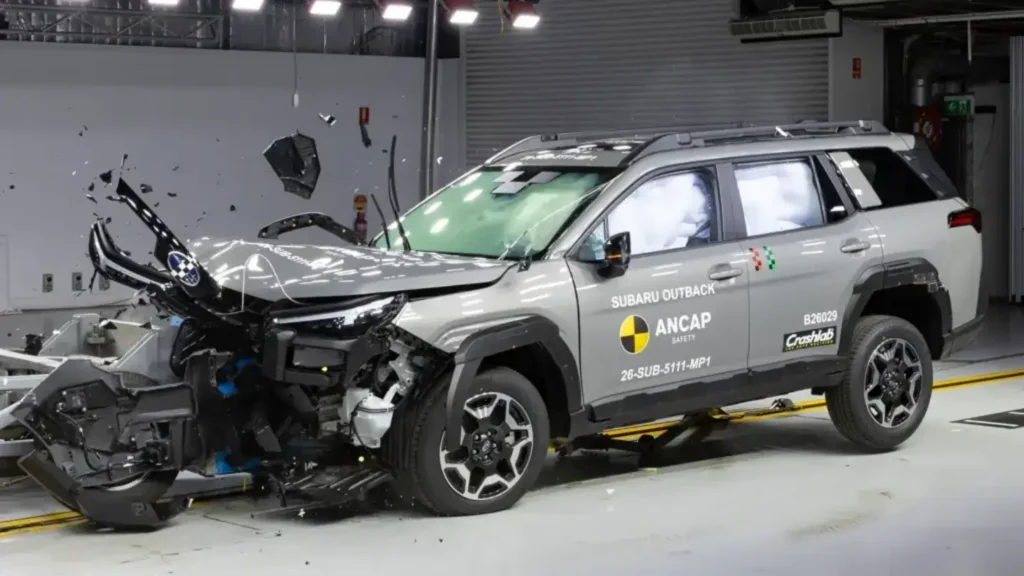
Despite its strong crash protection performance, ANCAP identified an issue with the Outback’s side curtain airbags.
Under the latest testing requirements, vehicles are encouraged to deploy head-protecting curtain airbags when a rollover is detected. These airbags help protect occupants from head injuries and reduce the risk of ejection during a rollover.
The Outback’s curtain airbags were not shown to deploy in response to a rollover alone. A side impact must first trigger their deployment, resulting in an ANCAP penalty.
The SUV also misses out on two features that have become increasingly relevant under the latest safety assessment criteria.
It does not offer child presence detection, which can alert drivers if a child is inadvertently left inside the vehicle. It also lacks an automatic emergency calling system, known as eCall, which can notify emergency services following a serious collision.
ANCAP has encouraged Subaru to introduce both features in future model updates.
What safety technology does the Subaru Outback offer?
The Outback still comes with a range of active safety and driver assistance systems.
Its driver monitoring system can detect signs of distraction, fatigue and impairment, while rear-seat occupancy detection provides reminders to encourage passengers to wear their seatbelts.
The SUV also features autonomous emergency braking, lane support systems, adaptive cruise control and speed limit recognition.
ANCAP recorded good performance from its lane support technology, particularly when the vehicle unintentionally drifts towards the road edge or into the path of oncoming and overtaking traffic.
Its autonomous emergency braking system performed well in several scenarios involving turning vehicles, pedestrians and cyclists travelling in the same direction. However, performance was less consistent at intersections, particularly when crossing the path of another vehicle or motorcycle.
The adaptive cruise control system also showed limitations when responding to motorcycles, pedestrians and cyclists.
In terms of post-crash safety, the Outback features multi-collision braking, which automatically applies the brakes following an initial impact to help prevent subsequent collisions. It also activates the hazard lights to warn other road users.
What the five-star ANCAP rating means for Australian buyers
The Subaru Outback’s five-star result confirms strong occupant protection performance under ANCAP’s latest assessment criteria. Its 92 per cent Crash Protection score is particularly notable, with good results across several frontal and side impact tests.
Families choosing the Outback also get ISOFIX anchorages for the two outer second-row seats, along with top tether anchorages across all three rear seating positions. However, ANCAP found that some child restraints could not be safely installed in certain seating positions, so buyers should check compatibility before purchasing.
The missing child presence detection and eCall systems are worth considering, particularly for families who value additional occupant monitoring and emergency response technology.
The rollover airbag finding is another area where the Outback falls short of ANCAP’s latest expectations.
Nevertheless, its five-star rating shows that the SUV delivers strong protection in several important crash scenarios. Buyers should look beyond the overall star rating and consider how its individual safety features match their requirements.

Comments
New Comment