




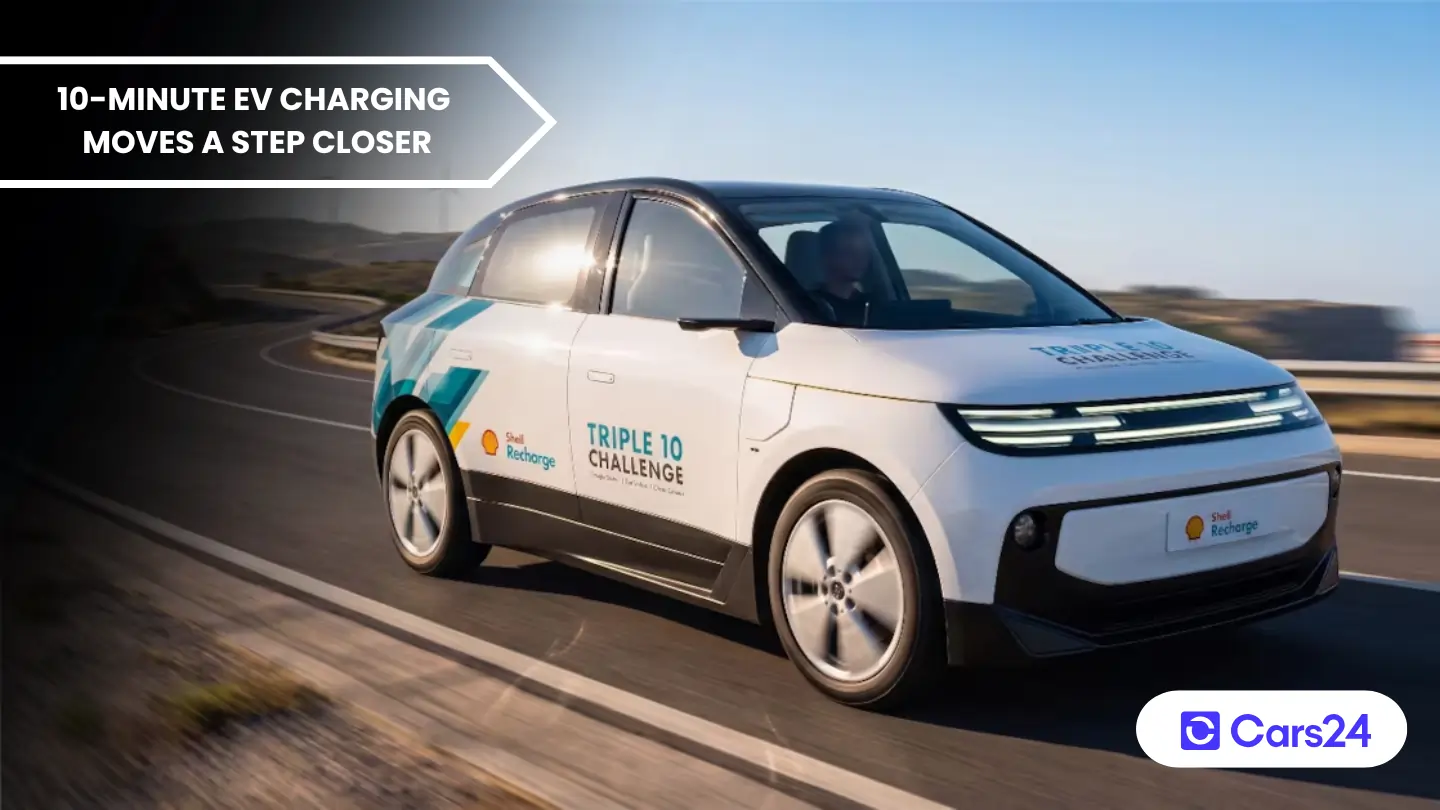
An electric vehicle prototype developed in the UK has managed to charge from 10 to 80% in 10 minutes flat, and it doesn’t need some exotic megacharger to do it. A standard 150kW DC fast charger, the kind already appearing along Australian highways, is enough.
The car is the Triple 10 demonstrator, a project led by Shell’s lubricants and coolants division in collaboration with race engineering specialist RML Group, Gordon Murray Group, British motor manufacturer Empel, and testing house Horiba MIRA. The name spells out its three headline targets: 10-minute charging, 10km per kWh efficiency, and a lifetime CO2 footprint of just 10 tonnes.
A small battery that charges like a big one
The prototype’s battery is just 31kWh, a fraction of what most EVs carry. But thanks to an efficiency figure of 10km per kWh, that’s still enough for around 310 kilometres of range. Enough, Shell argues, to cover Melbourne to Geelong and back twice, or to knock off a Sydney to Newcastle run with charge to spare.
The trick to making a small battery charge this quickly is immersion cooling. Rather than running coolant through plates that touch only about 15% of each battery cell’s surface, the Triple 10 prototype completely submerges the cells in a dielectric fluid. This electrically insulating liquid surrounds the entire cell, which allows heat to be removed in a much better way. This results in the battery management system not needing to reduce charging speeds as aggressively to prevent the cells from overheating.
In a conventional EV, that thermal protection kicks in around the 50-60% mark. This is the reason why charging slows to a crawl before you hit full. The Triple 10 can reportedly sustain close to its full 175kW charge rate to a much higher state of charge, hence charging in 10-minutes.
Light, simple, and surprisingly practical
The demonstrator weighs 1,170kg, making it comparable to a base-spec Volkswagen Polo. Despite being an EV, it is also lighter than the BMW i3. Power comes from a 101kW front-mounted electric motor driving the front wheels. Combined with a low drag coefficient of 0.267Cd, its lightweight design helps in maximising efficiency from its relatively small battery pack.
Inside, the cabin offers seating for four people. The compact battery pack is positioned beneath the rear seats and boot floor, helping preserve passenger space. The interior features a simple layout with two screens and lightweight composite seat frames made using flax fibres.
The prototype also uses a single cooling circuit for multiple systems. The same dielectric fluid cools the battery, electric motor, power electronics, onboard charger and cabin climate system. According to the project team, this approach reduces complexity and weight compared with the separate cooling systems used in many current EVs.
What does it mean for Australian drivers?
Shell has not confirmed any Australian plans for the Triple 10 technology, and the car itself is a tech demonstrator, it won’t go on sale in this form. But its relevance for Australian drivers is more immediate than most overseas EV concepts.
The prototype is designed around 150kW DC chargers, which are becoming increasingly common on Australia’s major highway corridors. If immersion cooling makes it into a production vehicle, it could significantly cut charging stops on long-distance trips without waiting for a new generation of ultra-fast infrastructure to arrive.
For the Sydney to Brisbane run, or the long hauls across regional Victoria and Western Australia where charging stops already factor into trip planning, a 10-minute turnaround changes the conversation considerably.
Not coming soon, but not science fiction either
There’s no production timeline, no manufacturer deal announced, and no direct successor planned. Shell is clear that this is a technology demonstrator, not a preview of a coming road car.
The prototype tells us that charging an EV in 10-minute is definitely achievable without us having to rely on charging infrastructure that has yet to become available widely. The battery is standard cylindrical cells. The chargers are already on the ground. The engineering is an elegant combination of available parts, not a moonshot.
While the technology is still in its early stages, it does show us motorheads how battery innovation could continue to reduce EV charging times in the years ahead.

Comments
New Comment