




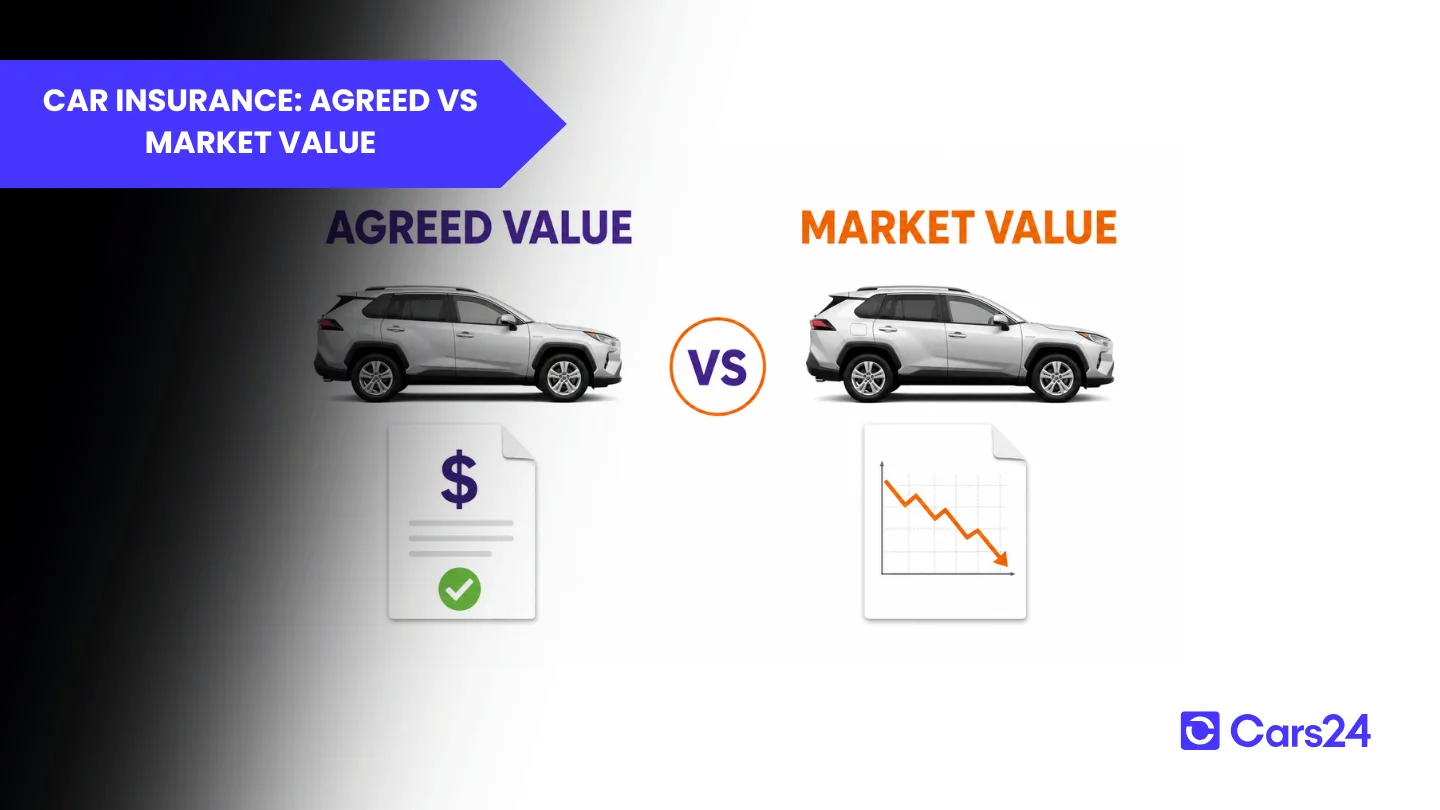
You might only think about agreed value versus market value when the thought of your car being stolen or written off tomorrow hits you. You think, “Would my payout actually be enough to replace the car I lost, or even clear the finance still owing on it?”
Agreed value is more expensive but gives you a fixed payout amount, while market value payout depends on what your car was worth at the time of the loss.
Understand which comprehensive car insurance policy is suitable for you before renewal time or signing a new policy, so that you have the maximum peace of mind.
What is Agreed Value in car insurance?
You and the comprehensive car insurer agree on a specific dollar amount when you take out the policy. That’s exactly what they pay you if your car is written off or stolen.
Example: Your car is worth maybe $25,000 on the market. You agree with the insurer on $22,000. If it’s written off tomorrow, you get $22,000.
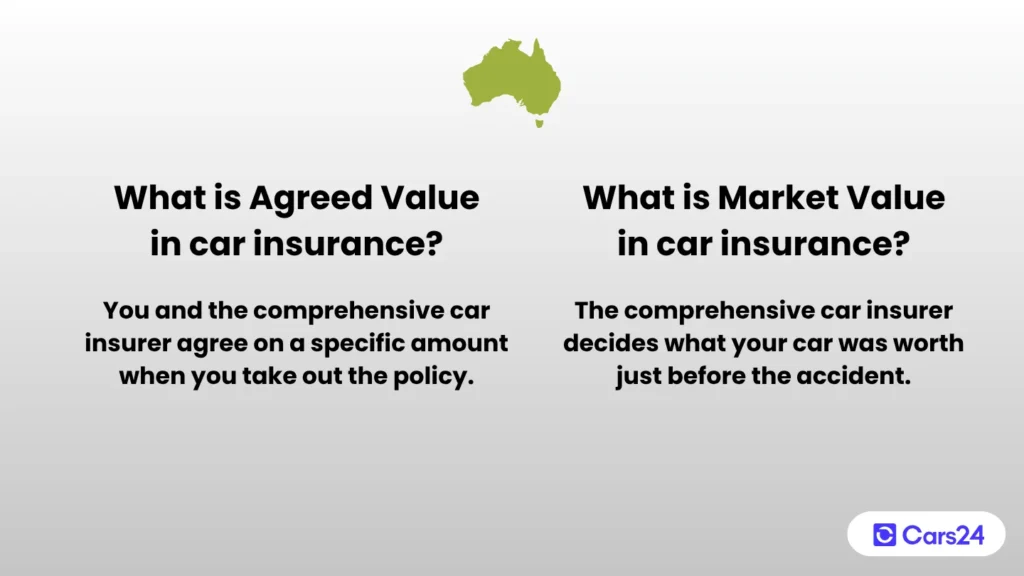
What is Market Value in car insurance?
The comprehensive car insurer decides what your car was worth just before the accident. They look at age and mileage, condition, service history, recent sales of similar cars, and auction prices.
Example: Your car is written off (checked with PPSR). The insurer says “similar cars are selling for $18,000.” That’s what you get. You can’t argue much.
Is the Market Value less than the Agreed Value?
Almost always, yes. Agreed value is generally higher because it is locked in earlier, while market value reflects depreciation at the time of the claim. In unusual market conditions, market value can briefly exceed agreed value, especially during used-car price spikes.
Also read: Understanding car insurance jargon
Which is better in Australia: Agreed Value vs Market Value?
Agreed value generally suits newer, financed, modified, or enthusiast cars because it offers payout certainty. Market value is often better suited to older, lower-value or high-mileage vehicles where cheaper premiums matter more than a guaranteed payout.
| Feature | Agreed Value | Market Value |
| Payout amount | Fixed. A specific amount is locked in when you sign or renew the policy | Variable. Matches the open-market value at the time of the accident or write-off |
| Premium cost | Higher (5-15% more) | Lower |
| Financial certainty | High. You know exactly how much cash you will receive | Low. You won’t know the exact payout until the insurer assesses the market |
| Best for | Drivers with car loans, modified cars, or classic collectibles | Everyday, budget-conscious drivers with standard, mass-market cars |
Readers also asked: Which is the cheapest car insurance in Australia?
How is Market Value calculated (and why it can surprise you)?
Car insurers in Australia use a formula based on real-time market data to find out your car’s market value during a claim. They use the following data sources:
- Redbook (industry standard) for appreciation curves, trade-in values
- Recent car sales (from used car sellers like Cars24) for actual private and dealer sales
They calculate the market value by adding a specific percentage of the car’s value from each of these sources, then adjusting the total value for kilometres, condition, and location.
Also, factors like above-average kms (+5,000km/year over average), poor condition, no service history, a previous repairable write-off, a modified car (unless declared and approved), and a remote location (NT, far north QLD, WA) lower your car’s market value.
How to legally dispute a low-ball Market Value assessment in Australia?
Request the insurer’s valuation report within 10 business days under the General Insurance Code of Practice. Collect 3–5 comparable listings from used car listings, Redbook or auctions within similar kilometres and conditions.
Challenge outdated or trade-in pricing using current market data. If you have not heard back, escalate to Internal Dispute Resolution, then the Australian Financial Complaints Authority (AFCA).
Readers also asked: What are the different types of car insurance coverage?
How do Agreed Value car insurance policies work?
There’s no single official calculator for a car’s agreed value. Each insurer uses its own. Some online tools can help you calculate the agreed value of your car (e.g., the Redbook Value Calculator), but they are not official.
You can have a rough estimate of what the agreed car value they’ll offer. You have to consider these factors:
- Car’s current market value (retail): Insurer won’t let you insure for more than this unless it’s a classic or special vehicle.
- Your requested value: You suggest a number. They approve or counteroffer.
- Car age: Older cars get lower maximum agreed values (often capped at 70-80% of retail).
- Insurer’s risk appetite: Some insurers offer higher agreed values. Budget insurers offer lower.
- Your car’s specifics: Kilometres, condition, modifications, and model demand.
What happens if I write off my car with an Agreed Value policy?
If your car is written off with an agreed value policy, the payout process is highly predictable, and you will get a fixed dollar amount minus a few legal and financial deductions.
Why does my car’s Agreed Value drop at every annual renewal notice?
Depreciation. Most insurers apply a fixed percentage of agreed value drop at each renewal, regardless of your car’s actual condition or low kilometres. Your car might still be worth more than the depreciated agreed value in the real market, but the insurer’s automatic formula doesn’t know that.
What can you do if your car insurance Agreed Value is too low?
If your agreed value feels too low, but it’s 10-20% below market value, you should consider a better payout.
You can ask the insurer to increase the agreed value at renewal. They almost always will, though your premium will go up slightly. If you don’t wanna pay the increased premium, another option is to shop around before the renewal. You can either switch insurers or use a better quote to negotiate with your current insurer.
Depreciation: Agreed Value vs Market Value
Depreciation is the single biggest factor separating these two policy types. They handle it very differently. Here is how the depreciation works on each car insurance policy:
| Policy type | How depreciation affects you | Who bears the risk |
|---|---|---|
| Agreed Value | Fixed number you set. Depreciation happens between renewals, not during the policy term. You know exactly what you’ll get | Insurer bears the risk if the market drops faster than expected |
| Market Value | Depreciation happens in real time. Your payout drops every single day you drive the car, silently | You bear the risk. The insurer pays whatever the car is worth at the moment of the crash |
Agreed value has a bigger payout than the market value in the initial new car ownership and coverage years, but by around year 5, both values nearly converge.
How Agreed vs Market Value affects your premium
The car insurance premium for agreed value is usually more than it is for market value coverage. The premium gap between agreed and market value policies shrinks with car age as the sum insured is smaller, so the absolute dollar difference between policies is smaller. Insurers also care less about the exact value of an older car.
Which one should you choose? Agreed vs Market Value

The right choice depends mainly on your car’s age, value, finance situation, and how much payout certainty matters to you.
An agreed value car insurance policy is usually better for newer, financed, modified, or enthusiast cars because it locks in a fixed payout amount for the policy term. Market value is generally better suited to older cars where lower premiums matter more than payout certainty.
| Situation | Better option | Why? |
| New or financed car | Agreed value | Helps protect you from rapid depreciation and loan shortfalls |
| Modified, rare, or enthusiast car | Agreed value | Market value may not reflect the true value of modifications or collectability |
| Older everyday car | Market value | Depreciation has slowed, so the payout gap is usually smaller |
| Tight insurance budget | Market value | Lower premiums may matter more than payout certainty |
For a brand-new car, agreed value is often worth the extra premium because new vehicles depreciate quickly in the first few years. It can also help ensure you are not left paying off part of a car loan after a write-off.
For older cars, the difference between agreed and market value payouts becomes much smaller, which is why market value often makes more financial sense.
However, agreed value can still be worthwhile for classic or enthusiast cars like a Subaru WRX, Mazda MX-5, or Volkswagen Golf GTI, where real-world values may be higher than standard insurer estimates.
What to ask your insurer before choosing agreed or market value
Before buying a policy, confirm:
- whether your cover is agreed or market value,
- how much the agreed value drops at renewal,
- whether modifications and accessories are covered,
- and whether an agreed value is available for older vehicles.
Readers also asked: A guide to finding the best car insurance
Special situations (financed cars, modifications, 4x4s)
An agreed value car insurance policy is often essential for financed cars and modified 4x4s. It helps you avoid debt after a write-off and protects expensive modifications and accessories on your car.
Is Agreed Value car insurance better for a financed car?
Yes. Agreed value is often the smartest financial decision you can make with a car bought on loan. Here is how agreed value protects you:
| Risk with Market Value | How Agreed Value solves it |
|---|---|
| Market value drops below your loan balance | You set the agreed value above what you owe. Loan is fully covered |
| Insurer’s write-off payout is less than your remaining debt | No gap. You’re not left paying off a car you no longer have |
| Depreciation outpaces your loan repayments | Agreed value is locked for the policy term. Market value falls daily |
Understanding the Agreed Value benefit with numbers
Suppose you have a 2023 Toyota RAV4 SUV, bought for $45,000. The loan balance is $38,000, and the car is 18 months old.
| Policy | Payout if written off | Loan balance after payout |
|---|---|---|
| Market Value (insurer says $32,000) | $32,000 | You owe $6,000 still |
| Agreed Value (you set at $40,000) | $40,000 | $0 (plus $2,000 in your pocket) |
It’s worth it to avoid being $6,000 in debt for a car you no longer have.
What happens to your 4×4 accessories and modifications during a claim? (Agreed vs Market Value)
Market value policies will ignore or undervalue the modifications and accessories on your off-road car. Agreed Value (with proper declaration) can cover them.
Most market value policies state: “We pay the market value of an unmodified example of your vehicle. Accessories and modifications are not separately valued.” So your $15,000 worth of 4×4 gear adds $0 to your payout.
For your agreed value car insurance policy, declare every accessory, provide receipts, get a professional appraisal, use a specialist insurer, and pay the extra premium.
We have also written about illegal car modifications in Australia.
FAQs about Agreed vs Market Value car insurance
1. Does Agreed vs Market Value vary by state?
No. Car insurance is regulated nationally. The definitions and rules for agreed vs market value are the same in NSW, VIC, QLD, WA, SA, TAS, ACT, and NT. However, premiums vary by state (higher in NSW and VIC due to more claims, lower in TAS and SA).
2. Can I switch between Agreed Value and Market Value insurance?
Most insurers only allow you to switch at renewal, not mid-policy. If you do not actively choose one, the insurer may assign a default option depending on the age and type of your car. Always check your certificate of insurance to confirm your cover type.
3. What happens if my Agreed Value is higher than the car’s Market Value?
The insurer will usually pay the agreed value listed on your policy. However, if the agreed value is unrealistically high compared to the car’s actual market value, the insurer may investigate whether the vehicle was over-insured.
4. Are modifications covered under Market Value policies?
Only declared and approved modifications are usually covered under market value policies. Even then, insurers may not fully compensate for expensive accessories or aftermarket upgrades, which is why agreed value is often preferred for modified cars.
5. Does Agreed Value cover my car loan?
Yes, if you set the agreed value high enough to cover the remaining finance amount. Review your agreed value at every renewal to ensure it still reflects your loan balance and the car’s value.

Comments
New Comment