




You are scrolling through used cars online and two listings catch your eye. Both look clean, fit your budget and say 5-star ANCAP. Good news, right? Yes, but not the whole news!
A 5-star ANCAP rating is a strong sign, but it does not automatically mean both cars offer the same level of safety. One may have been tested in 2016. The other may have been tested in 2024. One rating may apply to all variants. The other may only apply to certain versions. One car may still have all its safety features working properly. The other may have had repairs, missing sensors, worn tyres or unresolved recalls.
That is why reading an ANCAP rating properly matters, especially when you are buying used.
This guide explains ANCAP safety ratings: what they mean, what they do not mean, why the tested year matters, and what else you should check before buying a used car in Australia.
What is ANCAP?
ANCAP stands for the Australasian New Car Assessment Program. It is the independent vehicle safety rating program for Australia and New Zealand.
In simple terms, ANCAP tests and assesses cars to see how well they perform in different safety situations. It looks at how a car protects people in a crash, how well it can help avoid a crash, how it protects pedestrians and cyclists, and what happens after a crash.
For most passenger cars, SUVs and light commercial vehicles, the result is shown as a star rating. Commercial vans are a little different: ANCAP assesses them through a separate Commercial Van Safety Comparison, with gradings such as Platinum, Gold, Silver, Bronze or Not Recommended.
Think of ANCAP like a safety report card for cars. It does not tell you whether a car is stylish, cheap to service or fun to drive. It focuses on safety performance.
But here is the part many people miss: ANCAP is not the same as a roadworthy certificate, registration check, car vehicle report, PPSR check or mechanical inspection.
ANCAP tells you how a vehicle model performed when it was assessed. It does not tell you everything about the exact used car you are looking at today.
What does an ANCAP rating actually tell you?
An ANCAP rating tells you how a car model performed in controlled safety testing and assessment.
It can tell you whether the vehicle did well in crash protection, whether it had useful crash avoidance technology, whether it offered protection for vulnerable road users, and whether its overall safety package met ANCAP’s standards for that testing year.
So, if a used car has a 5-star ANCAP rating, that is a positive sign. It means the model performed strongly when tested. But it does not answer every safety question.
It does not tell you whether the specific used car has been repaired properly after an accident. It does not tell you whether the tyres are worn. It does not tell you whether a warning light has been ignored. It does not tell you whether the car has an unresolved recall or if a previous owner has modified something that affects sensors.
That is why ANCAP is best used as a starting point. It tells you about the model. A car history report, inspection and condition check tell you about the actual used car.
You need both layers before making a confident decision.
What does a 5-star ANCAP rating mean?
A 5-star ANCAP rating means the car achieved a high level of safety performance under the ANCAP criteria used at the time it was tested.
That sounds straightforward, but there are two things to remember.
First, 5-star does not mean “nothing can go wrong.” No safety rating can promise that. Real-world safety depends on the driver, road conditions, speed, weather, maintenance, tyre condition and how the car has been looked after.
Second, a 5-star rating from one year is not always the same as a 5-star rating from another year. ANCAP updates its criteria over time, which means newer ratings usually reflect tougher and more modern safety expectations. ANCAP says vehicle safety continues to evolve as structures, restraints and automated technologies improve.
So yes, a 5-star ANCAP is good. It is the kind of rating many buyers should look for but should not stop there.Before you decide, check when the car was tested, whether the rating applies to the exact variant you are buying, and whether the used car itself is still in good condition.
The detail buyers often miss: the TESTED year
If you remember only one thing from this article, make it this:
Do not read the stars without reading the tested year.
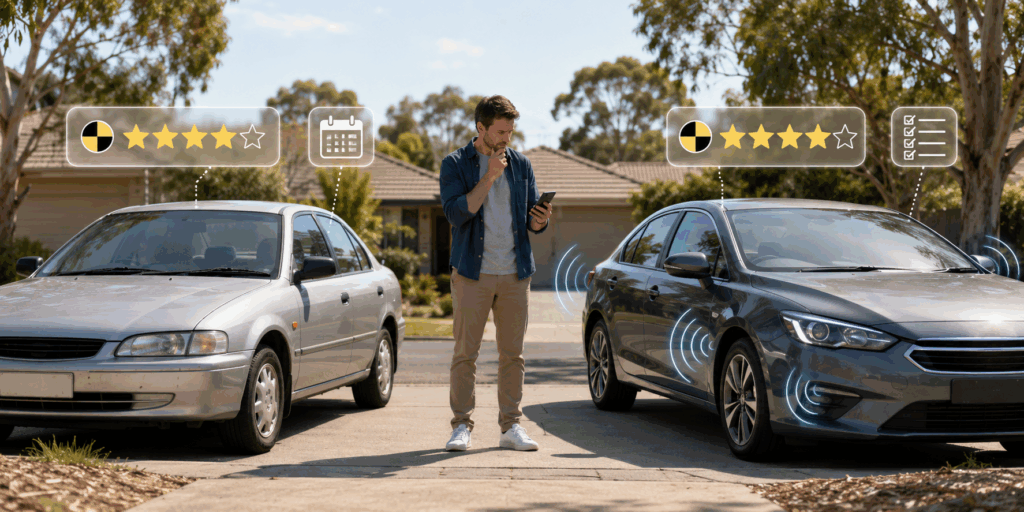
The tested year tells you which ANCAP criteria the car was assessed against. This matters because ANCAP’s safety standards do not stay frozen forever. They become stricter over time as cars, roads and safety technology improve.
So, a 5-star car tested in 2015 or 2016 may still be a good used car. But it was tested under older rules. A 5-star car tested in 2024 or 2026 has been assessed under newer expectations. Both can be useful. They are just not identical.
| Rating scenario | What it means for a used-car buyer |
| 5-star ANCAP, tested in 2016 | Strong result under older ANCAP criteria |
| 5-star ANCAP, tested in 2024 | Strong result under newer, tougher criteria |
| 5-star ANCAP, tested in 2026 | Strong result under the latest ANCAP framework |
| No ANCAP rating | ANCAP has not rated that vehicle or version |
| Rating applies only to selected variants | You need to check whether your exact car is covered |
There is also one useful caveat here. ANCAP says the safety rating held by your car does not expire; once a vehicle is tested and rated, that rating remains valid for the life of that vehicle. The rating validity period is mainly about how long a manufacturer can use that rating to promote newly built vehicles. For used-car buyers, the tested year is not a hard “expiry date”; it is a clue to how current the rating criteria were.
This is why two cars can both say 5-star ANCAP and still tell different safety stories. The smarter question is not just, “How many stars does it have?” It is: “When was it tested, and does this rating apply to the exact car I am buying?”
What changed in ANCAP ratings from 2026?
You may see searches around an Australia car safety standards update and ANCAP changes. The wording can get confusing, so let’s keep it simple.
The 2026 change is an ANCAP assessment update. It does not mean ANCAP has become the legal standard for cars in Australia. Legal vehicle standards are covered separately by the Australian Design Rules, also called ADRs. The Department of Infrastructure describes ADRs as Australia’s national standards for road vehicle safety, anti-theft and emissions, which relevant vehicles must comply with when first supplied to the Australian market.
ANCAP is different. It is a consumer safety rating program. Its job is to assess and publish safety information so buyers can compare cars more easily. From 2026, ANCAP started grouping its ratings into four clearer safety areas.
Safe Driving looks at how well the car helps the driver stay alert, supported and in control. Crash Avoidance looks at how well the car can help prevent a crash in the first place, through features like AEB, lane support and driver assistance. Crash Protection focuses on what happens if a crash does occur, including how well the structure, airbags and seatbelts protect people inside the car. Post Crash looks at what happens after impact, including emergency support, rescue information and systems like eCall where fitted.
For a buyer, the idea is simple: ANCAP is no longer only asking, “How well does this car protect you in a crash?” It is also asking, “Can this car help avoid the crash, support the driver, and help people get assistance afterwards?”
For a regular buyer, this means ANCAP is no longer just about what happens during a crash. It also looks closely at how the car helps prevent crashes and what support exists after a crash.
That includes things like driver assistance, autonomous emergency braking, lane support, pedestrian and cyclist detection, emergency call systems and post-crash response.
One feature worth understanding is eCall, or emergency call. In cars that have it fitted, eCall can automatically connect the vehicle to an emergency response centre after a serious crash, usually when airbags deploy or crash sensors detect an impact.
The simplest takeaway is this: ANCAP is asking harder questions now. Not just, “Can this car protect you when something goes wrong?” But also, “Can this car help stop something from going wrong in the first place?” and “Can it help people get support after a crash?”
How to read an ANCAP safety rating page
When you check an ANCAP page, do not just look at the star rating and leave. The useful details are usually sitting around it.
Start with the stars, but keep reading.
First, check the star rating. This gives you the headline safety result.
Next, check the tested year. This tells you how current the rating is and which criteria were used.
Then check the build dates and on-sale dates. Some ANCAP ratings apply only to cars built during specific periods.
After that, check the Applies To line on the ANCAP page. This is where many buyers get caught. A rating may cover petrol variants but not a hybrid or PHEV. It may apply to some trims but not a base variant, or to one body style but not another. The exact year, build date and powertrain all matter.
Then look at the safety features. Does the car have autonomous emergency braking? Lane support? Blind-spot monitoring? Adaptive cruise control? Driver monitoring? Side airbags? Seatbelt reminders? eCall?
Once you know what the rating assumes, check whether the actual used car has those features fitted and working.
Finally, read the notes, technical report and exclusions on the ANCAP page. Yes, the boring-looking parts. Those details may tell you if a variant is excluded, if the result is based on a sister model, if a certain powertrain is unrated, or if the rating only applies from a particular build date.
The simplest place to start is ANCAP’s own safety ratings search on ancap.com.au. Search the make and model, then match the page against the year, build date, variant and powertrain of the car you are considering. That is how you move from “this car says 5-star” to “this exact car’s rating actually makes sense.”
Does the ANCAP rating apply to every variant?
Not always, this is one of the most important things to check before buying used.
Car model ranges can be messy. The same model name may cover different trim levels, engines, body styles, safety features and build years. Sometimes a safety rating applies across the range. Sometimes it does not.
For example, one variant may have the full safety package as standard, while another may miss a key feature. A petrol version may be rated, while a hybrid or PHEV version may not be included. A facelifted model may have changed enough that an older rating does not tell the whole story.
This does not mean the car is bad. It just means you need to be specific.
Instead of asking:
“Is the Toyota/Kia/Mazda/Hyundai rated 5-star?”
Ask:
“Is this exact year, variant, body type and powertrain covered by that ANCAP rating?”
That small shift can save a lot of confusion.
Is a 5-star ANCAP rating enough on its own?
No, and this is where used-car buying becomes different from new-car shopping. A 5-star ANCAP rating is a strong model-level signal. It tells you the vehicle performed well when assessed. But a used car has a life behind it.
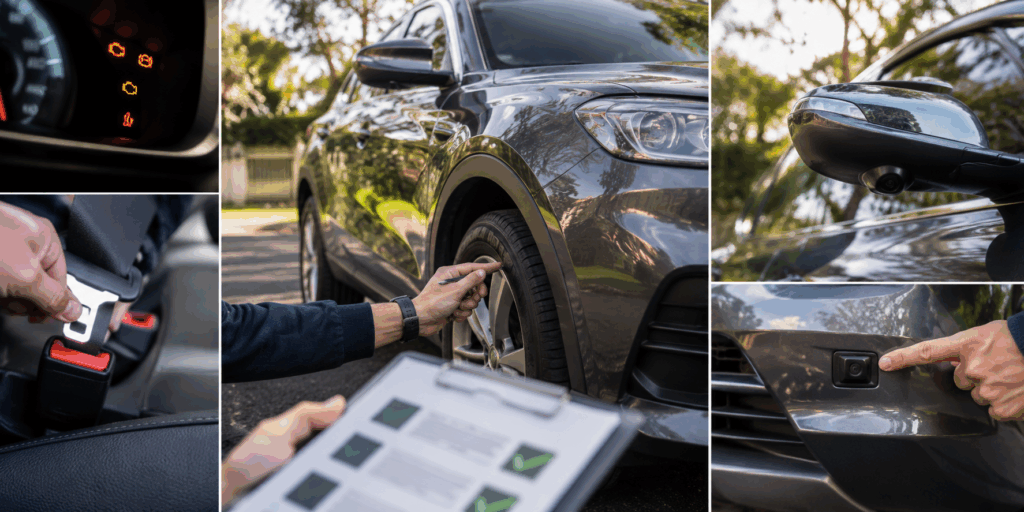
It may have been driven carefully. It may have been serviced on time. It may have a clean history.
Or it may have been in an accident, repaired poorly, fitted with aftermarket parts, driven on worn tyres, or sold with a safety system that no longer works as it should.
ANCAP cannot know that from the rating alone. That is why a proper used-car decision needs more than one check.
You want the ANCAP rating for the model. Then you want a car vehicle report or car history report for the specific car. You also want to check recalls, roadworthy requirements, service history, tyres, brakes, lights, airbags, seatbelts and any visible repair signs. A 5-star ANCAP rating helps you shortlist. It does not replace checking the car.
ANCAP rating vs car vehicle report vs roadworthy vs inspection
A lot of buyers mix these up because they all sound like “safety checks.” But they do different jobs.
| Check | What it answers |
| ANCAP rating | How did this model perform in safety testing? |
| Car vehicle report or car history report | What is the background of this exact car? |
| PPSR check | Is there finance owing, written-off history or stolen status recorded? |
| Registration check | Is the car registered and what are its basic details? |
| Roadworthy certificate | Does the vehicle meet minimum road-use condition rules? |
| Mechanical inspection | What condition is this specific car in today? |
| Recall check | Are there unresolved manufacturer safety recalls? |
None of these replaces the other. ANCAP is about the model’s safety performance. A car history report is about the individual car’s background. A roadworthy certificate is about minimum road-use conditions. A mechanical inspection looks at the actual vehicle in front of you.
A smart used-car buyer does not ask which one matters. They ask how all of them fit together.
What if a used car has no ANCAP rating?
An unrated car is not automatically unsafe, it means that ANCAP has not published a rating for that vehicle, or the rating does not apply to that exact version.
A current example makes this easier to understand. ANCAP’s page for the Toyota RAV4 released into the Australasian market from March 2026 lists it as Unrated. The page identifies it as a medium SUV with hybrid and plug-in hybrid vehicles, and says full safety performance details will be added if a rating becomes available.
That does not mean every 2026 RAV4 is automatically unsafe. It means ANCAP has not published a rating for that version yet. For buyers, especially those looking at newer, demonstrator or near-new used vehicles, it is a reminder to check the official ANCAP page instead of assuming a familiar model name automatically carries a current rating.
There are many reasons a car may have no ANCAP rating. The car may not have been tested. It may be an older model. It may be a low-volume vehicle. It may sit outside ANCAP’s usual star-rating scope. It may be a used import. Or the specific variant you are looking at may not be covered by the published rating.
If a car has no ANCAP rating, do not panic. Just avoid assuming things.
Check whether there is a Used Car Safety Rating available. Look closely at the safety features. Confirm the car’s compliance and registration details. Run a car history report. Check recalls. Consider a mechanical inspection.
The key point is simple: Unrated does not always mean unsafe, but it does mean you need more information before deciding.
Are Used Car Safety Ratings different from ANCAP?
Yes, and this is useful to know if you are buying an older used car.
ANCAP ratings are based on controlled crash testing and safety assessments. They are especially useful for newer vehicles and recently tested models.
Used Car Safety Ratings are based on real-world crash data. They look at how different used cars have performed in actual crashes over time. The 2025 Used Car Safety Ratings, compiled by Monash University Accident Research Centre, analyse crash outcomes from 9.5 million vehicles and 2.6 million injured road users across Australia and New Zealand between 1987 and 2023.
So, they answer slightly different questions. ANCAP asks: How did this model perform in safety testing? Used Car Safety Ratings ask: How has this model performed in real-world crashes?
Used Car Safety Ratings are compiled from real-world crash data, so they tend to be more useful for models that have been on sale long enough to generate meaningful crash statistics. That is why they are often more helpful when you are comparing older used cars.
The best approach is not to pick one and ignore the other. Use both where available.
Are older cars less safe?
Not automatically. A well-kept older car can still be a sensible buy, especially if it suits your budget and has a clean history. Older does not always mean bad. Newer does not always mean perfect.
But it is fair to say that newer cars often come with more advanced safety technology. They may have better crash avoidance systems, stronger driver assistance features and ratings based on newer ANCAP criteria.
So, the question is not:
“Is this car old?”
The better question is:
“What safety rating does it have, when was it tested, what features are fitted, and what condition is the car in today?”
That gives you a calmer, more useful answer. For example, a 2016 5-star used car may still be a good option. But if you are comparing it with a 2024 5-star used car, the newer rating may reflect tougher testing and more modern safety systems.
Budget matters. Use matters. Condition matters. The rating is one part of the picture.
Can you compare ANCAP ratings across SUVs, hatchbacks, sedans and utes?
Yes, but do it carefully. A 5-star small hatchback and a 5-star large SUV are both strong results, but they are not exactly the same kind of vehicle. Size, weight, structure and purpose all matter.
This is why it makes sense to compare within the same category first.
If you are looking for a family SUV, compare used SUVs with other used SUVs. If you are looking for a city car, compare hatchbacks with hatchbacks. If you need a ute, compare utes with similar work and lifestyle use cases.
After that, look at the details:
the tested year
the exact variant
the safety features
the car’s history
the car’s condition
the kind of driving you actually do
That is much more useful than saying “SUVs are always safer” or “small cars are unsafe.” Real life is not that neat.
Can modifications affect car safety?
Yes, they can. ANCAP tests vehicles in standard form. If a used car has been modified, the original rating may not tell the full story anymore. ANCAP says it tests standard vehicles without bullbars or other accessories fitted, and that incompatible bullbars can affect crash performance as well as interfere with collision avoidance systems and sensors.
This is especially relevant for things like bullbars, suspension changes, aftermarket accessories, removed seats, replaced seatbelts, sensor changes or poor-quality accident repairs.
Modern car safety is not only about metal and airbags. It is also about cameras, radars, sensors, software and calibration. If those systems are blocked, damaged or not repaired properly, features like autonomous emergency braking or lane support may not work as intended.
So, when viewing a used car, ask practical questions.
Has it had accident repairs?
Have any safety systems been replaced?
Are there warning lights on the dash?
Has a bullbar or accessory affected sensors?
Do the cameras and radars look clean and undamaged?
Are airbags and seatbelts intact?
A modified car is not automatically a bad buy, but it does deserve a closer look.
Used car safety checklist before you buy
Here is a simple safety checklist you can use before buying a used car in Australia.
- Check the ANCAP rating. Start with the model’s published safety result.
- Check the tested year. A newer datestamp usually reflects newer criteria.
- Confirm the exact model, variant and powertrain. Do not assume every version is covered.
- Read the ANCAP notes and exclusions. Look for variant limits, build dates and unrated versions.
- Check key safety features. Look for AEB, lane support, airbags, blind-spot monitoring and eCall where fitted.
- Confirm those features are working. Warning lights, damaged sensors or missing cameras matter.
- Run a car vehicle report or car history report. This helps you understand the specific car’s background.
- Check PPSR details where relevant. Look for finance owing, written-off records or stolen status.
- Search for open recalls. A strong ANCAP rating does not cancel out an unresolved recall.
- Check registration and roadworthy requirements. These vary by state and territory.
- Inspect tyres, brakes, lights, seatbelts and airbags. These affect real-world safety every day.
- Ask about accident repairs and modifications. Poor repairs or incompatible accessories can affect safety systems.
- Consider a mechanical inspection. Especially if the car is older, modified, imported or has an unclear history.
This may look like a long list, but the idea is simple:
Check the model, then check the actual car.
ANCAP helps with the first part. A history report, inspection and condition check help with the second.
Where Cars24 fits into the safety decision
Cars24 does not replace ANCAP, and it should not.
ANCAP helps you understand how a model performed in safety testing. Cars24 helps with the used-car buying layer that comes after that.
That means looking at the car’s background, condition, documentation, quality checks and purchase support before you make a decision.
Cars24 says every car on its website has passed its 300-point inspection, and its Australian site also lists RWC and PPSR as included under Cars24 Edge. That helps answer some of the questions ANCAP cannot answer on its own: what this specific used car has been through, and whether it still makes sense today.
A good used-car process should help you answer questions like:
Is this model well rated?
Is this exact variant covered?
Does the car have a clear history?
Has it been inspected?
Are the details easy to understand?
Do I know what I am paying for?
Do I have support after purchase?
That is where ANCAP and Cars24 can work together in a buyer’s mind.
Use ANCAP to judge the model’s safety rating. Use Cars24’s checks, history support and buying process to understand the used car in front of you.
Because in the used-car market, the badge is only one part of the story. The life the car has lived matters too.
Quick answers about ANCAP ratings
What does ANCAP stand for?
ANCAP stands for the Australasian New Car Assessment Program. It is the independent safety rating program for Australia and New Zealand, helping buyers compare vehicle safety performance through crash testing and safety assessment.
Is ANCAP mandatory in Australia?
No. ANCAP is not a legal certification scheme. It is a safety rating program. Legal vehicle standards in Australia are covered separately by the Australian Design Rules.
What is a good ANCAP rating?
A 5-star ANCAP rating is generally considered a strong safety result. For used cars, buyers should also check the tested year, exact variant, safety features and current vehicle condition.
Is a 5-star ANCAP rating from 2016 still good?
It can still be a positive sign, but it was tested under older criteria. A 5-star rating from 2016 should not be treated as identical to a 5-star rating from 2024 or 2026.
Does an ANCAP rating expire on a used car?
ANCAP says the safety rating held by your car does not expire; it remains valid for the life of that vehicle. However, ANCAP rating validity periods affect how long manufacturers can use that rating to promote newly built vehicles. For used cars, the tested year helps you understand how current the rating criteria were.
Is ANCAP the same as a roadworthy certificate?
No. ANCAP rates the safety performance of a vehicle model. A roadworthy certificate checks whether a specific vehicle meets minimum road-use condition requirements.
Is ANCAP the same as a car history report?
No. ANCAP tells you about model-level safety performance. A car history report or car vehicle report gives background information about the specific used car.
What if a car has no ANCAP rating?
An unrated car is not automatically unsafe. It means ANCAP has not rated that car or that exact version. Buyers should check other safety information, vehicle history, recalls, condition and inspection results.
What should I check besides the ANCAP rating?
Check the tested year, variant, safety features, car history, recalls, registration, roadworthy status, tyres, brakes, repairs, modifications and overall condition.
Final takeaway: read the rating, not just the stars
An ANCAP rating is one of the best places to start when comparing used cars in Australia. It gives you a clear safety signal and helps you shortlist models with more confidence. But the star rating is only the headline.
The tested year tells you how current the rating is. The variant notes tell you whether the rating applies to the exact car. The safety features tell you what the car should have. The history report and inspection tell you what the car has been through.
So, if a used car says 5-star ANCAP, take it seriously. Just do not take it blindly. Read the rating properly, check the car carefully, and make the decision with the full picture in front of you.

Comments
New Comment