




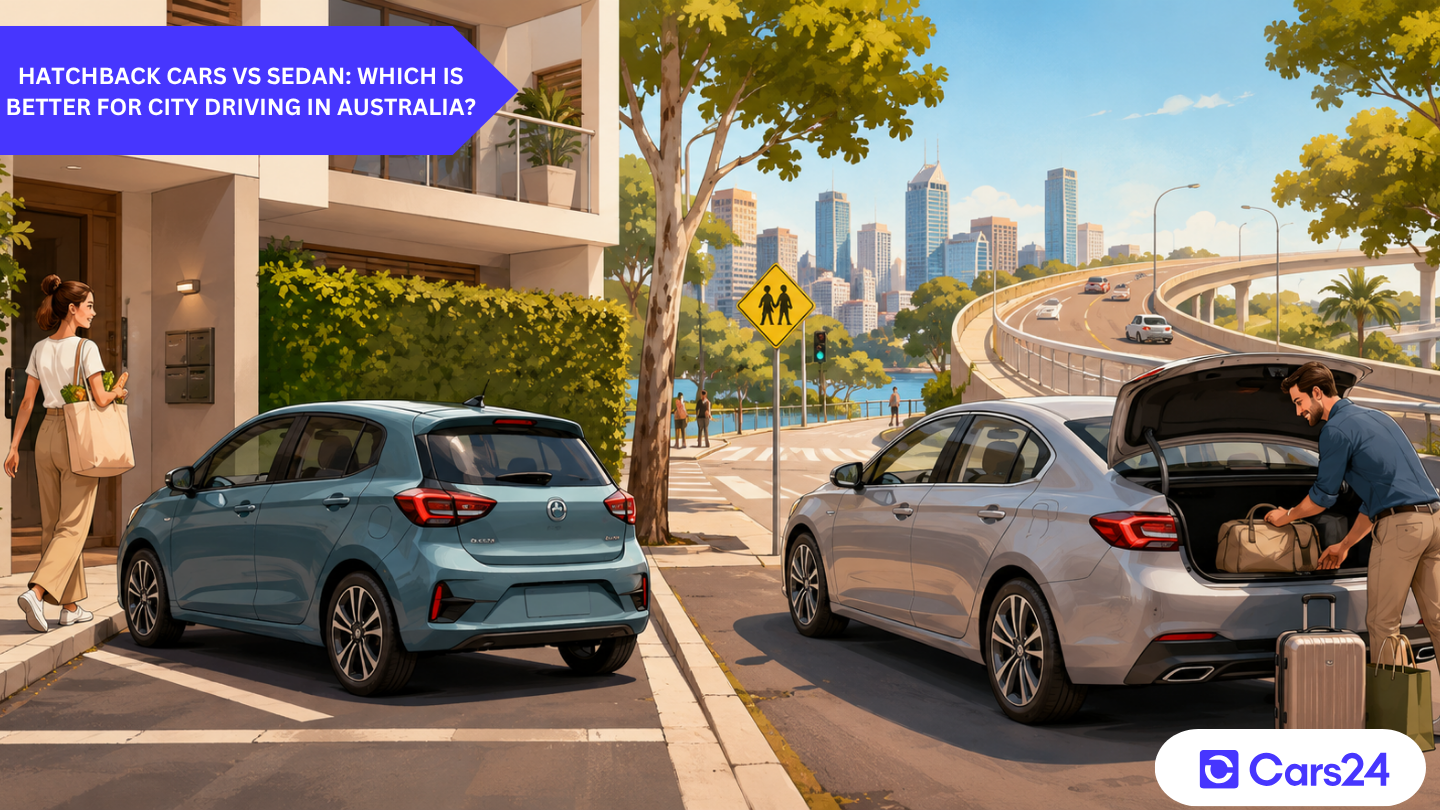
Hatchback cars vs Sedan is not just a car-body debate anymore. It is the kind of choice that shows up in very ordinary moments: reversing into an apartment car park, crawling through school-zone traffic, doing a full grocery run after work, or realising your “quick weekend plan” now includes luggage, passengers and a highway stretch.
The funny thing is, Australia has mostly moved on to SUVs and utes. FCAI’s 2025 market data shows SUVs made up 60.7% of new vehicle sales, while passenger vehicles, the category that includes many sedans and hatchbacks, sat at just 13.0%. Passenger vehicle sales also fell 22.6% year-on-year, which tells you how sharply the market has shifted away from traditional city cars.
But that is exactly why sedans and hatchbacks still deserve a proper look in the used-car market. If you do not need the size, cost or parking stress of an SUV, a used hatchback or sedan can still be one of the more sensible ways to drive around Australian cities in 2026.
Hatchback or Sedan: which is easier to live with in Australian cities?
For most city-first buyers, a hatchback is usually easier to live with. It is generally shorter, simpler to park and more flexible when you need to load groceries, prams, bags, sports gear or something awkward from Bunnings.
A sedan makes sense when your city driving stretches further. If your week includes longer commutes, regular passengers, airport runs or weekend highway drives, the extra length can work in your favour. You get a separate boot, a more settled cabin and in many models, better comfort for people sitting in the back.
So the answer is not “hatchback wins” or “sedan wins”. The useful answer is this: choose the car that matches where you park, how far you drive, who sits in the car and what you carry most often.
What is the difference between Hatchback and Sedan cars?
The main difference between hatchback and sedan cars is that a hatchback has a rear door opening into a shared cabin-and-cargo area, while a sedan has a separate enclosed boot.
In a hatchback, the rear window and boot door usually lift together. That gives you a wider opening and makes it easier to load bulky items. Most hatchbacks also let you fold the rear seats down, so the boot can expand into the cabin area when you need more space.
In a sedan, the boot is separate from the passenger cabin. That can make the cabin feel quieter and keeps luggage hidden from view. The trade-off is that the boot opening is usually less flexible, so large or odd-shaped items can be harder to fit.
Fuel economy: Hatchback vs Sedan in Australia in 2026
Fuel economy matters more in 2026 because Australian fuel prices have been unusually sensitive to global supply shocks and domestic policy changes. In early April 2026, the Australian Government temporarily halved the fuel excise on petrol and diesel, reducing fuel costs by 26.3 cents per litre. The measure started on 1 April 2026 and is scheduled to run until 30 June 2026.
That timing matters for buyers. The temporary cut can ease short-term fuel pressure, but it does not change the long-term running cost of the car you choose. So, when comparing hatchback cars vs sedans, the better question is not “which body type is always cheaper to run?” It is “which exact car uses less fuel in the way I actually drive?”
A small petrol hatchback can be efficient in stop-start city traffic. An automatic hatchback car can also feel easier in peak-hour driving because there is less effort in constant braking and moving. But a hybrid sedan may use less fuel than an older petrol hatchback and a newer hatch may be more efficient than a larger sedan with an older engine.
The safest comparison is model by model. The Australian Government’s Green Vehicle Guide lets buyers compare vehicle fuel consumption, running costs and emissions before shortlisting a car.
City-driving comparison: Hatch vs Sedan
| City-driving factor | Hatchback | Sedan |
| Tight parking | Usually easier because of shorter length | Can need more space, especially in older car parks |
| Stop-start traffic | Often practical, especially as an automatic hatchback car | Comfortable, but size and engine matter |
| Boot access | Wide tailgate, easier for bulky items | Enclosed boot, better for keeping luggage hidden |
| Rear passengers | Good in many models, but varies by size | Often more comfortable in compact and mid-size sedans |
| Highway driving | Fine for short and medium trips | Often calmer on longer drives |
| Fuel economy | Depends on engine, weight, fuel type and driving style | Hybrid sedans can be very efficient |
| Used-car appeal | Strong for first cars, city commuters and downsizers | Strong for commuters, small families and comfort-focused buyers |
When a Sedan makes sense
A sedan makes sense if your city driving regularly spills beyond the city. Maybe your commute includes motorway stretches, or you carry adults in the back. Maybe you do airport runs, client visits, weekend drives or school runs with bags everywhere. In those cases, a sedan can feel less like an old-school choice and more like a calmer used car that still avoids SUV bulk.
Sedans are also useful when you want luggage separated from the cabin. Laptop bags, prams, suitcases and work gear can sit in an enclosed boot, out of sight and away from passengers.
If you are looking for the best used car sedan, compare options like Toyota Camry, Toyota Corolla sedan, Mazda 3 sedan, Hyundai i30 sedan, Kia Cerato sedan and Tesla Model 3, depending on availability. Start with condition, kilometres, service history, safety rating and fuel type before getting attached to a badge.
You can explore used sedan cars for sale in Australia on Cars24 and filter by price, year, fuel type, kilometres and transmission.
When a Hatchback makes sense
A hatchback makes sense when easy everyday use matters most. If you mostly drive through inner suburbs, shopping centres, office parking, school zones and apartment basements, a hatchback will usually feel more natural. The shorter rear makes parking less dramatic, the tailgate is easier for everyday loading, and fold-down seats help when your small errand turns into a bulky-item situation.
The best hatchback cars are not always the smallest ones. A good city hatch should feel easy to see out of, comfortable in traffic, practical enough for your bags and efficient enough for your weekly kilometres. Automatic hatchback cars are especially popular for city use because they make stop-start driving feel less tiring.
Popular used hatchbacks in Australia include Toyota Corolla hatch, Hyundai i30, Mazda 3 hatch, Volkswagen Golf, Suzuki Swift, Toyota Yaris, Kia Picanto, MG3 petrol/hybrid hatch and MG4 electric hatch, depending on live stock and budget. MG lists the MG3 as petrol and hybrid, while the MG4 is positioned as an EV hatchback.
You can browse used hatchback cars for sale in Australia on Cars24 and compare by price, transmission, odometer, fuel type and features.
Are Hatchbacks or Sedans safer?
Body type alone does not decide safety. The safer car is the specific model with the better safety rating, stronger safety features, cleaner history and better condition.
That matters even more in 2026 because ANCAP now uses its Stages of Safety framework. The four assessment areas evaluated from 2026 are Safe Driving, Crash Avoidance, Crash Protection and Post Crash, giving buyers a clearer way to understand safety before, during and after a crash.
So do not compare hatchback cars vs sedan by assuming one shape is automatically safer. Check the specific car’s ANCAP rating, tested year, variant coverage, airbags, AEB, lane support, reversing camera, tyre condition, service history and whether all sensors are working properly.
What should you check before buying a used Hatchback or Sedan?
With used cars, the body shape is only the first layer. The actual car matters more.
Before buying, check:
- PPSR and finance owing
- Written-off or stolen status
- Service history
- Odometer consistency
- Tyres, brakes and suspension
- Safety rating and tested year
- Condition report and inspection details
- Warranty, return policy and after-sale support
A PPSR search can tell you if a car is debt-free, not reported as written off and not reported as stolen. The official PPSR also recommends searching when you first find the car and again on the day of purchase, so you know the result is current before money changes hands.
This is where Cars24 helps make the comparison cleaner. On Cars24, you can compare inspected used sedans and hatchbacks with clear listings, condition details, PPSR checks, warranty support and return options, so the decision is not based only on body type or listing photos.
Final verdict: Hatchback cars vs Sedan for city driving
For most city-first buyers, a hatchback will feel easier, it is compact, flexible and usually less annoying to park. A sedan is better when your everyday driving includes passengers, longer roads, secure luggage space or a calmer cabin. The smartest choice is not the one that wins on paper. It is the one that suits your actual week, then passes the checks that matter: condition, history, safety, fuel use and value.
FAQs
Is a Hatchback better than a sedan for city driving?
A hatchback is usually better for city-first driving because it is easier to park, simpler to reverse and more flexible for everyday cargo. A sedan is better if your city driving includes longer commutes, regular passengers or luggage you want kept separate from the cabin.
Which is cheaper to run: Hatchback cars vs Sedan?
A hatchback is often cheaper to run in city traffic, but not always. Fuel economy depends on engine size, fuel type, transmission, weight and driving habits. A hybrid sedan can use less fuel than an older petrol hatchback, so compare the exact model before deciding.
Is a Hatchback cheaper to insure than a sedan in Australia?
Not always. Insurance depends on the exact model, driver age, location, claims history, repair costs, theft risk and insurer. Some small hatchbacks can be cheaper to insure, but a performance hatch may cost more than a basic sedan.
Which has better resale value, Hatchback or Sedan?
Resale value depends more on brand, model, kilometres, condition, service history, fuel type and demand than body type alone. In 2026, SUVs dominate new sales, but well-kept used hatchbacks and sedans still appeal to buyers who want affordable city transport.
Are Hatchbacks safer than Sedans?
No body type is automatically safer. Compare the specific car’s ANCAP rating, tested year, safety features, variant coverage and condition. A newer hatchback with strong safety tech may be safer than an older sedan, and the reverse can also be true.
What is the main difference between Hatchback and Sedan cars?
The main difference between hatchback and sedan cars is the boot design. A hatchback has a rear door that opens into a shared cabin-and-cargo area, while a sedan has a separate enclosed boot behind the cabin.
Are automatic Hatchback cars good for city driving?
Yes, automatic hatchback cars are very practical for city driving. They are usually compact, easy to park and less tiring in stop-start traffic, especially for daily commuting, learner drivers and buyers who mostly drive in urban areas.
What is the best used car sedan for Australian city driving?
The best used car sedan depends on your budget and driving needs. Common options include Toyota Camry, Toyota Corolla sedan, Mazda 3 sedan, Hyundai i30 sedan, Kia Cerato sedan and Tesla Model 3. Always compare condition, safety, kilometres and running costs.

Comments
New Comment