




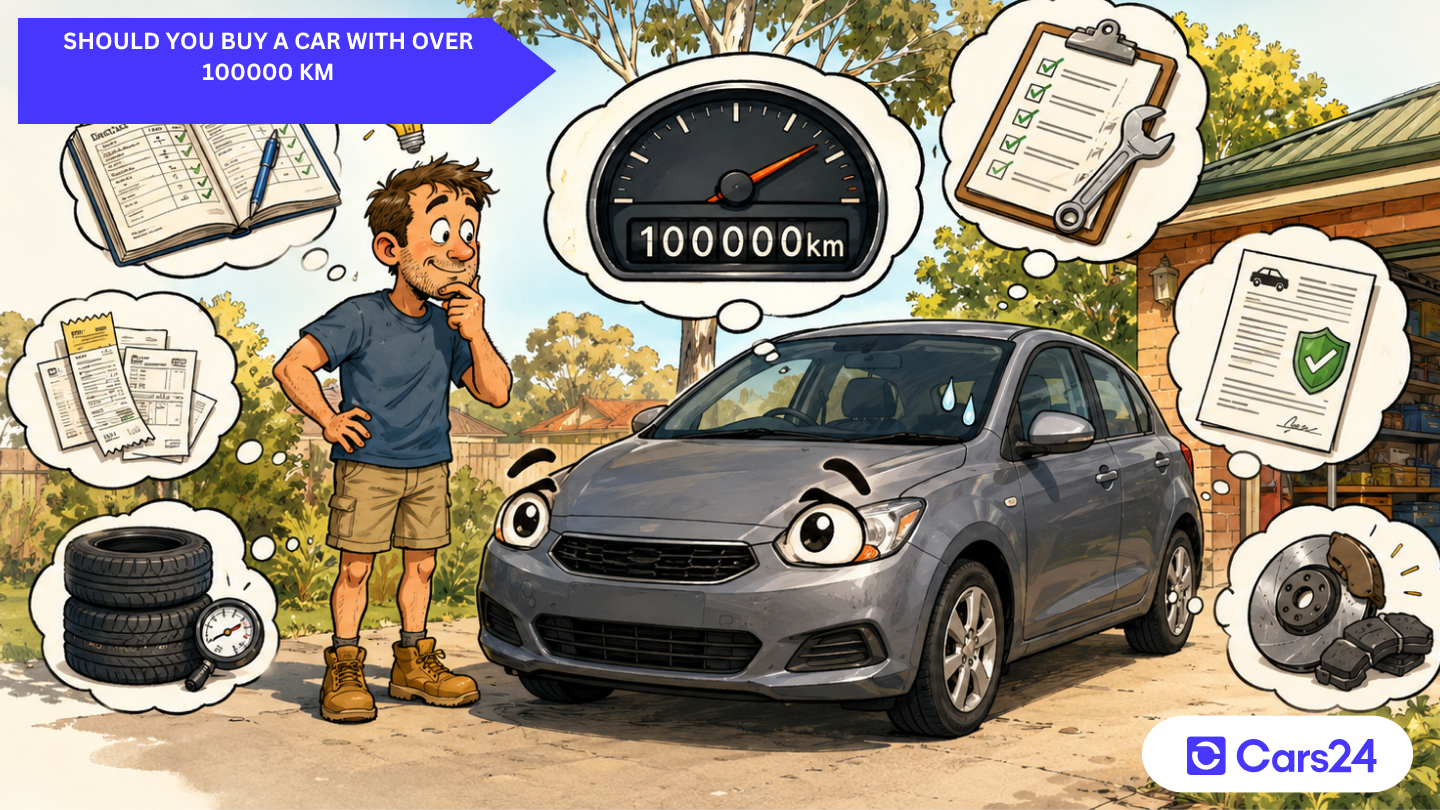
Buying a car with high kms is a bit like grabbing a meat pie from a servo on a long drive. You are not sure exactly what is in it but the price is right, you are hungry and it smells fine from the outside. Similarly, a car may look clean, the price may be tempting and the photos may be doing their best work, but that six-figure number on the dash can still make you pause. It is one of those used-car moments where common sense and panic start having a full debate in your head.
But the good news is that 100000km is not automatically too high for a used car. One must discover whether those kilometres make sense for the car’s age, service history, condition, price and future maintenance. A well-looked-after car with 110000km can be a better buy than a lower-km car that has been neglected, thrashed around town or serviced only when something started making a noise.
Is 100000km too high for a used car?
No, 100000km is not automatically too high for a used car in Australia. A car at this mileage can still have plenty of life left if it has been serviced on time, driven sensibly and checked properly before sale. What matters is not just the number, but the story behind the number.
Think of it like a pair of Blundstones. A pair worn gently for weekend markets will age very differently from a pair worn daily on a muddy worksite, even if both are the same age. Cars work the same way because kilometres tell you distance, but they do not tell you how hard the car’s life has been.
That is why 100000 km mileage should be treated as a checkpoint, not a rejection stamp. Once a car crosses that mark, you should look more closely at servicing, ownership use, inspection results and price. If those things line up, buying a car with high kms can still make strong sense.
What is the average km per year car benchmark in Australia?
The ABS Survey of Motor Vehicle Use is no longer running, but its final release remains a useful official benchmark. It states that an average of 12.1 thousand kilometres per vehicle in the 12 months to June 2020, with passenger vehicles averaging 11.1 thousand km and light commercial vehicles averaging 15.3 thousand km.
So, for used-car shopping today, it is safer to use around 12,000km a year for passenger cars as a practical benchmark, while remembering that utes, vans and work vehicles often sit higher. A five-year-old passenger car with about 55,000km-65,000km is broadly normal, while the same car at 110,000km has clearly done more driving than average.
Vehicle type and lifestyle matter just as much as the number. A small hatch used for errands may travel far less than a ute used for work, towing or regional runs. A family SUV in the outer suburbs can also build kilometres quickly through school runs, office commutes, sport, groceries and weekend trips, because every “quick stop” somehow becomes a 20-minute drive.
| For more context on this: How Many Kms Is Too Many for a Used Car? A Guide for Australian Buyers |
Why does 100000km make buyers nervous?
The 100000km mark worries buyers because it often sits near a major maintenance stage. Depending on the car, this can be when items like spark plugs, transmission fluid, coolant, brake components, suspension parts, tyres or timing belts become more important. The fear is not silly; it just needs better context. A high-km car with the major work completed can be far less stressful than one that is cheap upfront but waiting for a big service bill.
This is where paperwork becomes your best friend. A clean logbook, service invoices and inspection details tell you more than polished tyres and a nice air freshener ever will. If the previous owner has kept proper records, you are not guessing in the dark.
Highway kms and city kms are not the same
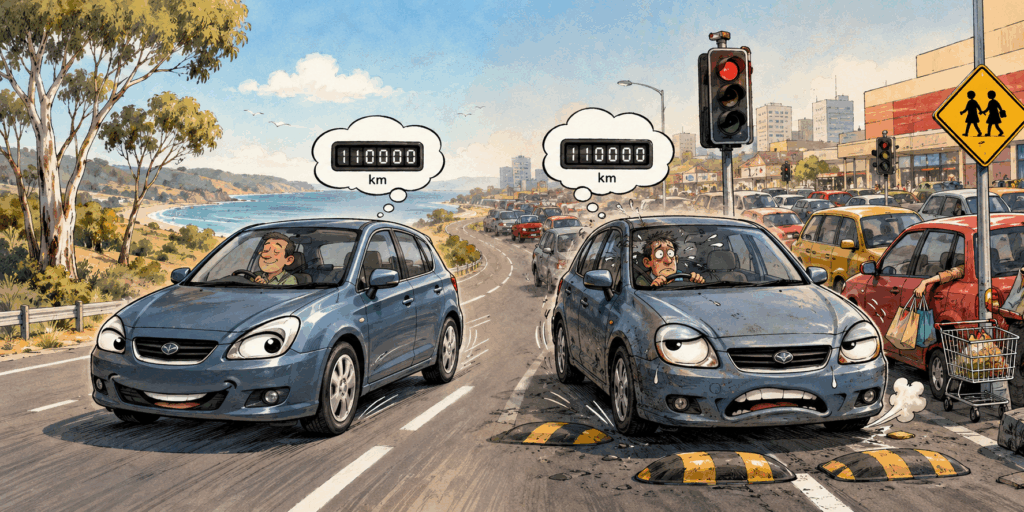
Two cars can both show 110000km and be in very different condition. One may have spent most of its life cruising between Brisbane and the Sunshine Coast, or between Geelong and Melbourne, at steady speed with the engine warm and the brakes barely working. The other may have spent years doing stop-start city traffic, short school runs, kerbside parking and five-minute trips where the engine barely warms up.
Highway kilometres are usually easier on a car because the engine, gearbox and brakes settle into a steady rhythm. City kilometres can be harsher because the car is constantly stopping, starting, turning, braking, cooling down and warming up again. It is the difference between a relaxed coastal drive and trying to leave a packed Westfield car park on Christmas Eve. When buying a car with high kms, ask where the car was driven, how it was used, whether it towed regularly and whether the service history supports the seller’s story.
How to tell if a used car has high kms
The easiest way to understand how to tell if a used car has high kms is to compare the odometer with the car’s age. Around 13000km a year gives you a useful starting point. If the car has travelled much more than that, it is fair to call it higher than average for its age.
Then look at whether the car feels like the number on the dash, basically, the wear and tea should match the mileage. A 100000km car should not have collapsed seats, heavily worn pedals, shiny-smooth steering, tired buttons and an interior that looks like it has lived through ten summers of beach trips without a clean.
You should also check whether the odometer readings make sense across service records, registration documents and vehicle history checks. If the kms jump strangely, disappear for years or do not match the car’s condition, pause before getting emotionally attached. A cheap car is only cheap if it does not become expensive after you buy it.
What should you check before buying a car over 100000km?
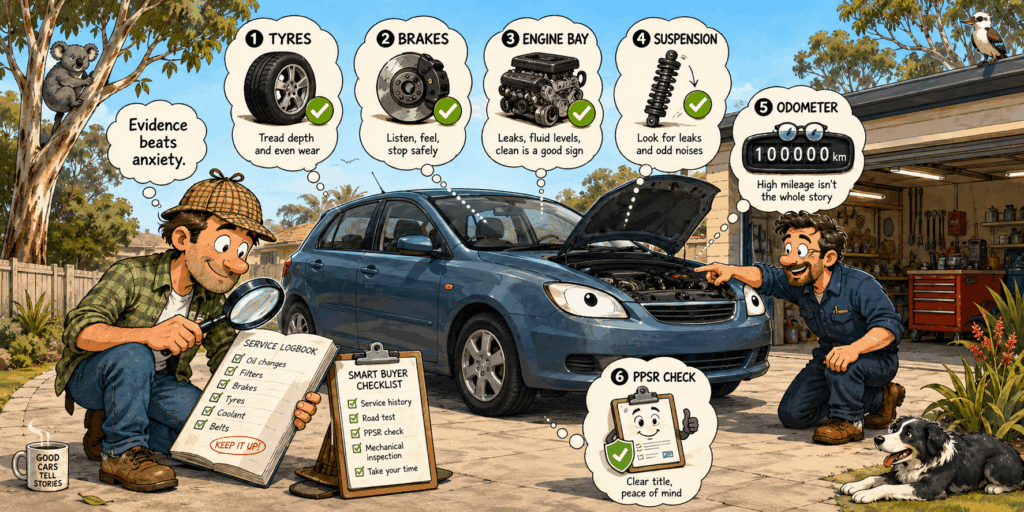
Start with the service history because this is where the truth usually lives. You want regular servicing at the correct intervals, not just one fresh service done right before sale. Next, ask whether the major 100000km service has been completed. If the car uses a timing belt, confirm whether it has been replaced at the correct interval. If it uses a timing chain, check whether there are any known issues for that specific engine, because “chain” does not automatically mean “ignore forever.”
Also inspect the everyday wear items. Tyres, brakes, suspension, battery, fluids and transmission behaviour all matter more once a car has passed 100000km. A test drive should feel smooth, predictable and boring in the best possible way, not like the car is auditioning for a mechanic’s invoice.
Why PPSR and NEVDIS checks matter more on high-km cars
When a used car has higher kms, you want fewer unknowns everywhere else. A PPSR vehicle search can help show whether the vehicle has finance owing and may also show if it has been recorded as stolen or written off. Written-off and stolen vehicle information is supported by NEVDIS, the national system that exchanges vehicle and driver licence information across Australian states and territories. A PPSR or car history check should not replace an inspection, but it should sit beside it. Think of it as checking both the car’s body language and its background story. For a car over 100000km, you want both to make sense.
How much should high kms affect the price?
The answer depends on much more than the odometer. High kilometres usually reduce value because buyers expect more wear and possible future maintenance. But the impact is not the same for every car. The price needs to make sense against similar listings. If the high-km car is only slightly cheaper than lower-km options, there needs to be a clear reason to choose it. If it is dramatically cheaper, do not celebrate too early because the market usually discounts cars for a reason.
| Relevant read: Can low mileage guarantee a reliable used car? |
Registration and transfer details still matter
Mileage is only one part of the used-car decision. You also need the ownership side to be clean, because each state and territory has its own registration transfer process. For example, buyers can check official transfer guidance through Service NSW, VicRoads / Transport Victoria, Queensland TMR or WA Department of Transport, depending on where the vehicle is registered.
This is especially useful when looking at older or higher-km cars because paperwork gaps can become annoying later. A car may drive well, but if transfer details, registration status, roadworthy requirements or seller documents are messy, the buying experience can quickly become more painful than expected.
Before paying a deposit, confirm the seller’s details, registration status, VIN, service records and transfer requirements. It is a little boring, yes, but it is the boring admin that saves you from expensive surprises.
When buying a car with high kms can be a smart move
A high-km used car can be a smart buy when the service history is complete, the major service is done, the condition is honest and the price reflects the mileage. It can also work well when the car is a proven mainstream model with strong parts availability and no obvious red flags. This is where careful buyers can find value others scroll past.
Many people automatically avoid cars over 100000km, which can push prices down even when the car itself is still in good shape. That creates opportunity for buyers who know what to check. The best high-km car is rarely the one with the loudest listing description. It is the one with the least mystery. Boring service records, normal wear, clean checks and a sensible price are much more useful than “first to see will buy.”
When you should walk away
Walk away if the seller cannot explain the car’s history, refuses an inspection, has no service records or keeps brushing off basic questions. Also be careful if the interior looks far more worn than the odometer suggests. A tired cabin can sometimes tell you what the listing is trying not to say.
Warning lights, rough gear changes, oil leaks, coolant smells, smoky starts, uneven tyre wear and clunky suspension are all reasons to slow down. Some issues may be minor, but once a car has higher kilometres, small problems can stack up quickly. A car that feels wrong on the test drive should not be talked into feeling right.
Do not let a low price rush the decision. If the car needs tyres, brakes, fluids, suspension work and a major service, that “bargain” can turn into a very expensive weekend project. A used car should make your life easier, not give you a new hobby called “waiting at the mechanic.”
How Cars24 helps you look beyond the odometer
When you are looking at cars over 100000km, confidence comes from checks, not guesswork. Cars24 helps by putting key information in front of buyers before they commit, including inspection details, vehicle history context and condition visibility across listed used cars. That means the odometer is not the only thing you are relying on.
Every Cars24 quality-certified vehicle goes through a 300-point mechanical inspection, including checks across major areas such as the engine, transmission, brakes, tyres, suspension, body, electronics, service history and vehicle background. That matters even more when a car has crossed 100000km, because buyers need to know what has been checked, not just what the listing says.
Cars24 also supports eligible buyers with a 30-Day Return Guarantee and warranty coverage, which gives you time to see how the car fits real life. The real test of any car is the daily routine: the commute, the school run, the grocery shop, the weekend drive and the moment you realise whether the seat is actually comfortable in traffic.
FAQs
Is 100000km a lot for a used car?
100000km is not automatically a lot for a used car. It depends on the car’s age, service history, driving type and condition. A three-year-old car with 100000km has worked hard, while a ten-year-old car with the same mileage may be perfectly reasonable if it has been maintained properly.
What is the average km per year car benchmark in Australia?
A practical average km per year car benchmark in Australia is around 13000km as a rule of thumb. Use this as a starting point when comparing a car’s age and odometer reading. Utes, vans and regional vehicles may travel more, while city runabouts may travel less, so the benchmark should guide the question rather than end it.
How to tell if a used car has high kms?
To understand how to tell if a used car has high kms, compare the odometer with the car’s age, then check whether the condition matches the number. Look at service records, seat wear, pedals, tyres, brakes, suspension and vehicle history. If the paperwork and physical condition do not line up, investigate further.
Is buying a car with high kms risky?
Buying a car with high kms can be risky when the history is missing, the service schedule has been ignored or the car has hidden mechanical issues. It can still be a good decision when the vehicle has complete records, a clean history check, fair pricing and an inspection that supports its condition.
Does high mileage reduce used car value?
Yes, high mileage usually reduces used car value because buyers expect more wear and possible future maintenance. The reduction depends on the make, model, age, condition, service history and market demand. A well-serviced mainstream car can still hold value better than a lower-km car with poor records.
How much is my car worth if it has high kms?
A high-km car is usually worth less than a similar lower-km car, but the difference depends on condition, age, make, model, variant, demand and service history. A car with complete records and clean checks can hold value better than a lower-km car with missing paperwork or obvious wear.
Should I avoid a used car with no service history?
Yes, it is usually safer to avoid a high-km used car with no service history unless a trusted inspection gives you a very strong reason to continue. Service records show whether the car has been maintained properly over time. Without them, you are relying too heavily on the seller’s word.
Are highway kilometres better than city kilometres?
Highway kilometres are generally easier on a car than city kilometres because the engine runs at steady temperature and the brakes, suspension and transmission usually face less stop-start stress. City driving can cause more wear through short trips, traffic, parking, braking and speed humps. The best answer still depends on servicing and condition.
Should I buy a car over 100000km from Cars24?
Buying a car over 100000km from Cars24 can help reduce uncertainty because buyers can review inspected used cars with clearer condition and history information before purchase. Eligible Cars24 vehicles may also come with return and warranty support, which gives buyers more confidence beyond the first inspection or test drive.

Comments
New Comment