




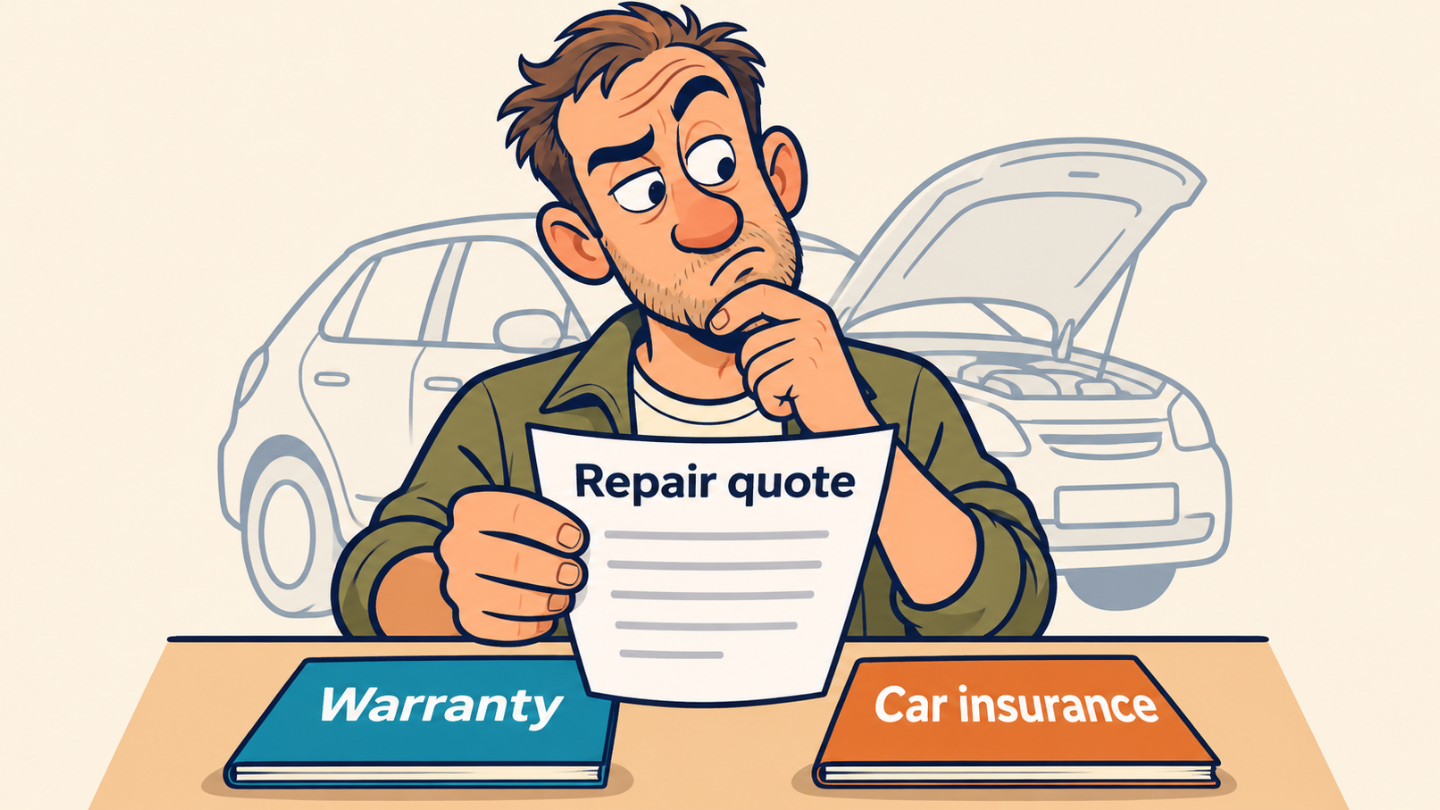
Car warranty vs insurance sounds simple until you find a puddle of coolant under the used car you bought last week. Did the radiator spring a leak on its own, or did something hit it? For a suspected fault, call the dealer who sold you the car or your warranty provider. For impact damage, call your insurer if you have comprehensive cover. If it’s ordinary wear, or your cover leaves out that kind of damage, you could be paying.
One radiator, two very different phone calls
A quote that says ‘replace radiator’ tells you what the workshop wants to do. It leaves out the detail that matters to whoever might pay. Ask the mechanic what they found. A split along a seam and a fresh hole behind a broken grille can leave much the same puddle on the driveway.
| What happened? | Who to call first | What could change the answer? |
| The radiator leaks at a seam with no obvious impact. | The selling dealer if you bought from one, or your warranty provider. | A faulty part may qualify for repair. A mechanic finding years of corrosion points to a different cause. |
| A piece of metal fell off a ute and punched through the radiator. | Your comprehensive insurer. | Accidental damage may be covered. With third party property cover alone, you’d usually need to pay for your radiator or pursue the person responsible. |
| You reverse into a neighbour’s parked car. | Your property damage insurer, even if your own bumper looks fine. | Third party property cover can pay for the neighbour’s car. Comprehensive cover can also pay for yours. |
| Your brake pads have worn down through normal use. | Your mechanic for a quote. | You’d usually pay for new pads. If one pad wore out unusually fast, ask the mechanic to check why before treating it as routine wear. |
Which warranty came with your used car?
Start with the name on the sale contract. If you found the car on a marketplace, the dealer named as the seller is the one to contact about a fault. If Cars24 sold you the car, check the purchase terms alongside your contract. Then check which of these protections applies. You can have more than one.
Manufacturer’s warranty: This is the car maker’s promise to fix certain faults for a set time or distance. Some factory warranties follow the car when it changes hands. Give the brand’s service department your vehicle identification number (VIN) and odometer reading so they can check what’s left.
Statutory dealer warranty: Depending on where you buy, the law can require licensed dealers to fix certain faults on eligible used cars. Age, kilometres and vehicle type can all matter. In Victoria, for example, the warranty on an eligible car runs for three months or 5,000 km after purchase, whichever comes first. Check the rules where you bought yours. Cars24’s guide to used car warranties links to state guidance.
Extended warranty: This is an optional cover you can buy. Check which parts it lists, how much it pays per repair and whether you need approval before a mechanic starts.
Australian Consumer Law guarantees: When you buy from a licensed dealer, the car must be of acceptable quality, including lasting a reasonable time. What’s reasonable for a three-year-old hatch with 30,000 km on it differs from what you’d expect of a much older one bought cheaply.
If the gearbox fails a week after your written warranty ends, tell the selling dealer when it happened and ask them to assess it under Australian Consumer Law. Those rights can outlast the warranty. With a one-off private sale, most consumer guarantees don’t apply and you won’t have a statutory dealer warranty.
Which car insurance pays for what?
Compulsory third party insurance (CTP) deals with injuries to people in a road crash. You need it to register a car. In NSW it’s called a Green Slip. How you pay for it varies around Australia. If you hit a parked car and nobody’s hurt, CTP pays for neither bumper.
Third party property damage covers damage you’re responsible for to someone else’s car or property, such as their front fence. Third-party fire and theft adds cover for your own car if it’s stolen or damaged by fire. Neither normally pays to fix your car when you cause a crash.
Comprehensive car insurance can cover your car in a collision, even if you caused it, as well as damage you cause to someone else’s property. It can also cover events such as hail or theft. A mechanical breakdown on its own is generally excluded. Check your policy for the events it covers and your excess, the amount you contribute to a claim. If your only loss is a $650 repair and your excess is $800, you’d be paying the repair bill yourself.
What to do before anyone picks up a spanner
- Get somewhere safe. If the engine is overheating, pull over safely, switch it off and call for roadside help. Leave the radiator cap alone while the engine’s hot.
- Record what you saw. Photograph the leak or impact marks, any warning light and the odometer. Note when the trouble started. ‘I heard a bang, then the temperature rose’ is more useful than guessing which part broke.
- Find the paperwork. For a fault, have the sale contract, warranty booklet and service records handy. If your booklet names Cars24, you can find the warranty terms and claims contacts here. For an accident, find your policy schedule, the page showing your cover and excess. Gather the other driver’s details if someone else was involved.
- Agree on the next step. Ask where to tow the car, who can inspect it and who pays the inspection fee if the claim is declined. Get approval in writing before authorising repairs. If you need urgent work to make the car safe, ask what emergency costs are allowed and keep the receipts.
Frequently asked questions
Does roadside assistance pay for the repair?
It may get you going or arrange a tow, depending on your plan. A tow to the workshop doesn’t mean the repair bill is covered. Ask about towing limits before choosing a workshop.
What if an uninsured driver hits me?
Call your insurer even if you only have third party property cover. Some policies include limited cover for an uninsured driver who was at fault. Get their name, contact details and rego if you can.
Can I get a hire car while mine is being fixed?
Check what triggered the repair. A policy might include a hire car after theft but require an optional extra after a crash. Ask about daily limits and get approval before booking.
What if the dealer or insurer says no?
Ask for the reason in writing. For a dealer dispute, contact your state or territory consumer agency. For insurance, use the insurer’s complaints process first. If it remains unresolved, you can take an eligible complaint to the Australian Financial Complaints Authority.
Comments
New Comment