




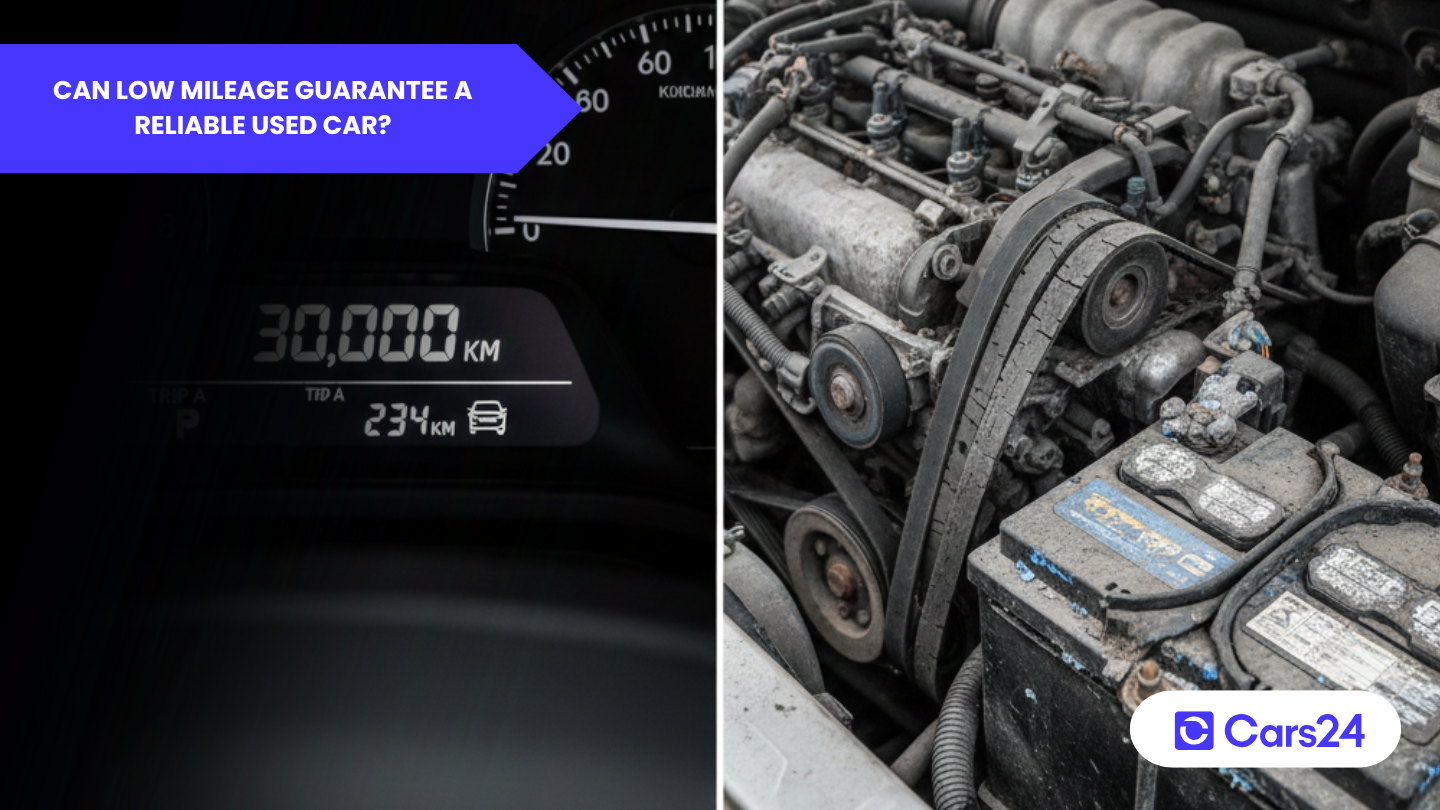
When you see a used car with low kilometres, do you automatically think, “That’s the one”? Many people do. But does low mileage always mean a healthier car? No.
Low mileage can be misleading. A car that barely moved might have ageing rubber parts, degraded fluids, carbon in the engine, or even odometer tampering.
The smarter approach here is to check for the actual car health using the service history and other observation techniques. This article will reveal the truth about bad low-mileage cars and will equip you with the insights to spot good low-mileage used cars.
What is a low-mileage car?
A low-mileage used car is generally defined as one that has been driven significantly less than the Australian average of 11,100 to 13,800 kilometres per year. To determine if a car is “low-mileage”, you should divide the total odometer reading by the car’s age. If the result is under 10,000 kilometres per year, it is typically categorised as low-mileage.
Many people want to buy a low-mileage (or low-kilometre) used car because it may have less wear and tear, higher resale value, and remaining warranty coverage. So, yeah, low mileage matters when buying or selling a used car.
Is it good if a car has low mileage?
Yes and no. While low kilometres are attractive, they are not the only indicator of a used car’s health. For instance, a high-mileage car with a perfect service history can be a better purchase than a low-mileage car that has missed its annual services.
Low-mileage used cars are good only if they are backed up by a consistent time-based service history and are tested to be in good condition. You would also benefit from a good, low-mileage car if you want to sell your car.
Is low mileage a red flag?
Yes and no. It can be a red flag if it sat around a lot, was used for short trips mainly, and its odometer was found “wound back.” It’s not a red flag if it passes a thorough pre-purchase inspection check.
Differences between a good low-mileage and under-used car
A regularly used low-mileage car is like a person who exercises lightly but regularly, while an underused (idle) car is like someone bedridden for years. The underused or “short-trip” low-mileage used cars are frequently flagged by experts as higher risk than cars with higher highway kilometres.
When buying a low-mileage car in Australia, check the service history for date-based entries (every 12 months) rather than just kilometre-based entries. For instance, a car with 20,000 km that hasn’t been serviced in 3 years is an “underused” risk. For extra peace of mind, you can even book a proper car health check.
| Feature | Low-mileage (properly used) | Underused (sat idle) |
| Rubber & seals | Parts like hoses, belts, and engine seals are supple and malleable | Rubber becomes brittle, and seals crack, leading to leaks |
| Lubrication & fluids | Periodic driving ensures oil, coolant, and brake fluids don’t settle | Fluids degrade over time, causing corrosion in the engine and braking system |
| Tyres and brakes | Tyres stay in good shape and brakes rust-free | Flat spots on tyres, rusted brake rotors and seized brake pads |
| Engine health | The engine reaches full operating temperature and prevents carbon build-up | Carbon may start building up in the engine, and can degrade it |
| Battery & electronics | Battery cycle is good, and the electronics work well | Battery capacity degrades permanently; requires replacement |
What is better, low mileage or age?
When choosing between a used car’s age and its low mileage, experts generally agree there is no “correct” answer; instead, the best choice depends on maintenance history and safety technology requirements. You will get a better understanding of this in the used car age vs. mileage article.
While low-mileage used cars that are kept well are a good purchase, people with tighter budgets can still buy a high-mileage used car that they love. For instance, this article mentions the makes and models that make the most reliable high-mileage cars.
What is the ideal mileage for a used car?
There’s no single “ideal” car mileage, but a balance of a car’s age, kilometres, service history and how it was driven. In Australia, the Australian Bureau of Statistics (ABS) and the Australian Automobile Association (AAA) report average passenger-car use around 11,100–13,800 km/year; many experts therefore say that a good mileage for a used car is ~15,000 km/year.
As we discussed, low km alone doesn’t prove a healthy car. Buyers often aim for the 3–5 year “golden window” (≈45,000–75,000 km) where the steepest depreciation is past, reliability remains high, and many brands still offer multi-year warranties and major expensive services are usually yet to come. You can learn about all the aspects of the ideal mileage for a used car in Australia in the linked blog.
Used car age vs. mileage. Which is more important?
Think of used car age and mileage like two sides of the same coin; both matter, but they tell different stories. Age mainly drives material decay (rubber, plastics, fluids) and technology/safety obsolescence, while car mileage reveals mechanical wear (how many times pistons fired, gears shifted).
Experts suggest that the way the car is driven and maintained matters too. Highway kilometres are gentler than stop-start city use, and a high-mileage, well-serviced car can outshine a low-km garage queen that’s developed sludge, rusty rotors and dried seals. Trust service history and driving style above the odometer. You can continue to read the detailed take on used car age vs. mileage in the linked article.
Highway vs. city kilometres on a low-mileage used car
Think of low-mileage cars as retired athletes. They look pretty on paper, but you must know how they were trained. Take two identical cars of the same age.
Car A (6 yrs, 40,000 km) did short city hops. The oil never hit optimal temperature, sludge formed, rotors rusted, seals dried, and it likely missed services. Car B (6 yrs, 120,000 km) lived on the freeway. It ran on steady RPM, had regular 10,000 km servicing, and had a healthy battery and tight suspension.
The interesting thing here is that Car A will likely cost you more and need additional bucks in immediate repairs, while Car B is cheaper and road-ready. So, low car mileage is a red flag if it accompanies short trips, long storage, or missing service records. Always prioritise a full car history check, recent long-run use, and a technical car health check over raw odometer numbers.
Spotting odometer fraud on a “low-mileage” used car

In Australia, “clocking” or winding back an odometer can increase a used car’s value by thousands of dollars. To spot fraud, experts recommend looking for mismatches between the numbers and the physical reality.
1. The paper trail (digital & physical)
You have a few options here. The first place to look at is the service logbook. Check for “too neat” or “doctored” entries. Look for different ink or handwriting for multiple years, or signs that pages were removed or replaced.
Also, see the last few annual odometer readings recorded during safety inspections or registration checks. A quick look at the “Next Service Due” on the windscreen service reminder stickers can also reveal a higher car mileage than on the dashboard. Some comprehensive service report services are also helpful here.
2. Physical wear indicators
An odometer can be reset, but “high-traffic” parts are rarely replaced. For instance, the heavy wear, “shining,” or cracking on the steering wheel, the gear knob, and the pedal rubbers.
If a car has only 30,000 km but the brake pedal is worn down to the metal, the mileage is likely fake. You also check the seat bolsters or the outer edge of the driver’s seat. Excessive sagging or fraying is inconsistent with a truly low-mileage vehicle. Sometimes, the date code on the tyres reveals the scam, too.
3. Signs of dashboard tampering
Look for mismatched screws, scratches, or pry marks around the instrument cluster (the dashboard display). These suggest the cluster was removed to be manually reset or replaced.
4. Car diagnostics
Modern cars store mileage in multiple “brains” (the ECU, transmission module, and ABS). A mechanic using a diagnostic scan tool can often find the “true” mileage hidden in these background systems. This often comes under the full pre-purchase inspection that many people prefer before buying a used car.
5. Psychological red flags
Be wary of stories like “owned by an elderly lady who only drove to church” if they aren’t backed by an annual service history. Moreover, statistics show cars “lose” kilometres more often when they are moved between states (e.g., from VIC to QLD) to hide their history.
Even if it’s revealed to be a high-mileage car, you can get it inspected, and if it’s good, you can negotiate and try to get a heavy discount. You can learn to find hidden value in a high-mileage used car if you need specific guidance on buying a good high-km used car.
Physical deterioration that kilometres don’t measure
Physical deterioration in a used car is often a battle against time and the elements rather than just distance. The age-related wear can be more expensive to fix than mechanical wear because it affects materials that degrade even when the car is stationary. Here are the specific physical deteriorations that an odometer cannot measure:
1. Material degradation (rubber & plastics)
Rubber car components lose their elasticity over time due to oxidation. Rubber suspension bushings also harden and crack with time, leading to “clunking” noises and a harsh ride. In openly parked cars, the UV (sun) rays cause dashboard plastics to become brittle and interior fabrics to fade or crack.
2. Chemical breakdown of fluids
Essential fluids like brake fluid, coolant, and oil degrade chemically over time. There is also a risk of the “engine sludge” when the oil never gets hot enough to evaporate moisture.
3. Corrosion
Moisture in the engine, exhaust, brake rotors, and fuel tank can lead to internal corrosion that an odometer won’t show.
4. Environmental & storage damage
Stationary cars are attractive nesting spots for rodents, which can chew through expensive electrical wiring harnesses. An inactive battery also degrades permanently due to sulfation.
5. Hidden structural stress
For utes and 4x4s, heavy towing or off-roading causes significantly more chassis and transmission stress than a car that covers double the distance on a smooth highway.
Are low-mileage used EVs or hybrids healthier?

When it comes to EVs and hybrids, regular use is often better than low usage. If an EV sits for months with a battery at 0% or 100%, it can suffer permanent capacity loss. Many experts agree that batteries (especially Li-ion) prefer staying between 20% and 80% charge.
If a hybrid (like a Toyota Prius) sits idle, the high-voltage battery can “self-discharge.” Once it drops below a certain voltage, it may become a “brick” and require an expensive replacement. Moreover, hybrids contain both a petrol engine and a battery, making them susceptible to both types of low-mileage damage.
EVs are significantly heavier than petrol cars due to the battery. If they sit idle, the tyres develop flat spots much faster than a standard car. Brake seizing in EVs is faster, too, due to the additional low usage with the feature of regenerative braking.
Australian EVs usually come with an 8-year/160,000 km battery warranty. A car with slightly higher kilometres but a documented “battery health check” from a dealer is a much safer bet than a 4-year-old EV with only 5,000 km and no service history.
The healthier low-mileage used car checklist
To find truly healthy low-mileage used cars in Australia, you need to look for consistency in their maintenance over just a low number on the dashboard.
| Red flags 🔴 | Green flags 🟢 |
| Missing time-based services or DIY maintenance with no receipts | A consistent time-based (annual) service history |
| Physical wear and the odometer reading do not match | Interior wear is less, and electronics are working well |
| Signs of sitting idle, like cracked tyres and underbody corrosion | Clean and shiny brake rotors, indicating regular usage |
| Blocked diesel particulate filters (DPF), indicating low usage | The car was primarily driven on the highway or for regular long trips |
| There is no registered odometer history | Golden-coloured engine oil and a clear coolant fluid with no milkiness |
Final words
Low-mileage used cars look appealing, but low mileage is not a certificate indicative of the car’s good health. You need to be smarter than the used car sellers and be aware of the hidden clues that reveal whether low-mileage is good.
Here’s a rule that works every time: buy condition, not the number. Check for time-based service history, demand receipts for major jobs, and get a professional pre-purchase inspection.
If the paperwork, inspection, and test drive line up, low mileage becomes a real plus. If they don’t, use that lovely low number to negotiate or walk away.

Comments
New Comment