




It is no secret that car theft has gone up in Australia in recent years, especially in places like Victoria. While there is no sure way to get your lost car back, a car tracking device tilts some odds in your favour.
A car GPS tracker works on any car, and it’s not just for theft recovery anymore. Parents, outback travellers, and even businesses use it. If you are thinking of getting a car tracking device, this guide will make your purchase smart.
We’ll break down every type of car tracker available, what works for whom, the pros and cons, how to choose the right one for your needs, and Australian car surveillance laws.
What is a car tracking device?
A car tracking device is a small electronic unit that uses GPS satellites to determine a vehicle’s precise location, while also tracking speed and direction. It then transmits this data to an interface that can be accessed on a user’s smartphone, tablet, or computer via cellular networks (like 4G) in real-time.
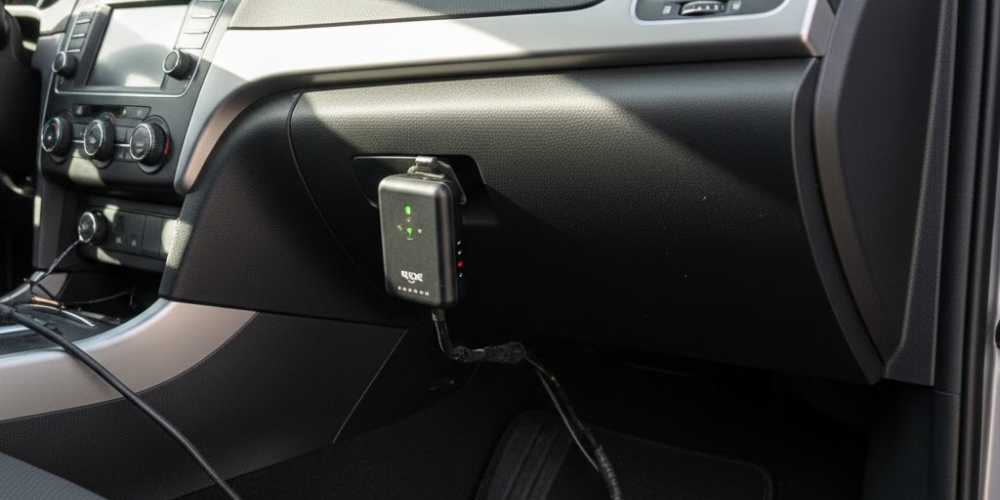
Fundamentally, you use an automotive GPS tracker to provide continuous visibility, enhancing security, safety management, and operational efficiency for both individuals and businesses.
Uses of a car tracking device
Although primarily used by fleet managers, a car tracking device has quietly become one of the most practical upgrades. Let’s break down the reasons why people are fitting their cars with GPS tracker:
1. Theft recovery: In Victoria alone, motor vehicle theft-based insurance claims increased by 59% up until September, 2025. A tracker won’t always stop the theft (like keyless theft), but it may improve your chances of getting the car back.
2. Remote area safety: In the outback or remote regions, mobile coverage disappears quickly. That’s where trackers with satellite fallback, like a heavy-duty GPS tracker for a car, earn their keep. A car tracker becomes a lifeline in emergencies.
3. For young drivers’ safety: Australia’s teenage driver accident rates are still high. Many parents now use trackers not to spy, but to educate and nudge young drivers toward better and safer driving.
4. For elderly family members’ safety: Elderly family members, especially those living with conditions like Alzheimer’s or dementia, need extra care. Even if they become disoriented while driving, they can be quickly located.
5. Insurance premium reductions: Many Australian auto insurance providers offer premium discounts for good driving behaviour, and they track it using an approved tracking device and an app.
6. Tax & compliance simplification: If you’re a business person, car GPS trackers automate ATO-compliant Fringe Benefits Tax (FBT) digital logbooks with precise tracking. One big tax headache, gone.
7. Operational cost savings: Companies save on fuel costs by optimising routes and cutting idle time, using a car tracking device. Many new trackers also ping the app user about kilometres driven and diagnostic alerts, prompting timely car maintenance.
MORE: What car modifications are illegal in Australia?
Pros and cons of a car tracking device for personal use
Car trackers deliver added security, safety, and financial upside, especially for families, commuters, and regional travellers. It is important to choose the right device to locate your car, manage consent properly, and accept the ongoing cost. Here are the main pros and cons:
| Pros | Cons |
| 1. Provides the best chance of car theft recovery | 1. Ongoing subscription costs can add up significantly |
| 2. Insurance premium discount for trackable, good driving | 2. Can hinder trust in a relationship when tracked without consent |
| 3. Geofencing for young or elderly drivers | 3. Parents can develop anxiety with “false alarm” alerts |
| 4. Emergency assistance and SOS in the outback | 4. Legal risk when tracking a person without their consent |
| 5. Use the GPS data as proof in road disputes like a park ding | 5. Some hardwired GPS trackers may drain the car’s battery |
| 6. Everyone knows where the shared family car is | 6. Potential for manipulation by thieves with “GPS jammers” |
| 7. Makes ATO tax returns easier with automatic logbooks | 7. Signal inaccuracy in dense urban areas |
| 8. Vehicle health alerts with OBD-II car trackers | 8. You might become lax about other car security basics |
Pros and cons of a car tracking device for business use
Car tracking for businesses in Australia is a strategic tool for managing high operational costs and meeting strict legal safety standards. Here are the pros and cons to keep in mind before getting one for your business:
| Pros | Cons |
| Long-term cost savings with optimised routes & driving | 1. There is a tendency to micromanage staff |
| Use tracking data to prove Chain of Responsibility laws | 2. Risk of employee resistance and tampering |
| Boost service productivity with real-time fleet tracking | 3. Ongoing monthly fees for software access |
| Provide asset security with geofencing alerts | 4. Poor insights without good data management |
| Makes ESG reporting quantifying easier with data | 5. High legal risks when not following surveillance laws |
| Detect unethical or off-the-books staff behaviour | 6. Spying or misusing a tracker can cause high staff turnover |
| Act as proof for delivery-related disputes with clients | 7. An extra-vigilant driver may cause traffic issues or accidents |
| Better asset management, like selling an underused car | 8. You become liable for inaction against bad staff driving |
| Use road safety data insights to train your staff |
Different types of car tracking devices explained
Not all tracking devices are built the same, and are suitable for different jobs. You can think of trackers like shoes; there’s no single “best”, only the right one based on how it fits your needs, which here is your car usage.
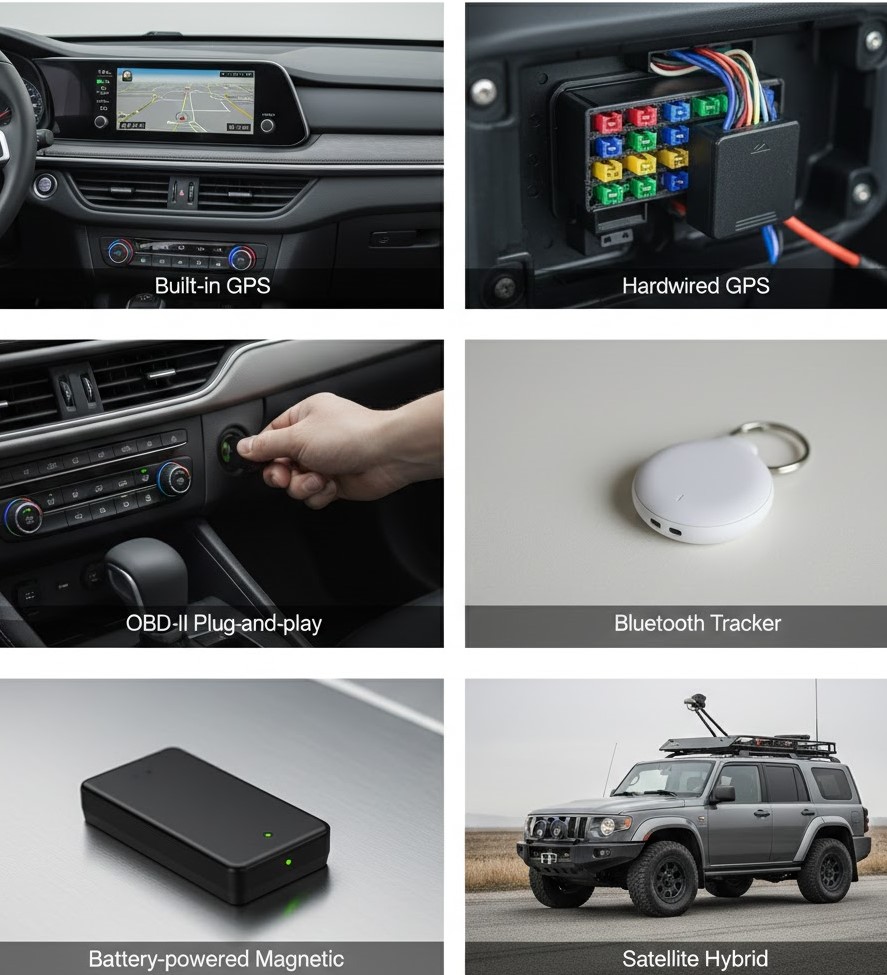
Most of the GPS car trackers use low-power 4G LTE-M and NB-IoT SIM cards to transmit location. Let’s walk through the main categories of car tracking devices available in Australia:
| Tracker type | Power source | Strength | Weakness | Best for |
| Built-in GPS | Car’s battery | High-security, remote app-based features, diagnostics | Subscription, data privacy | New car owners wanting high-level security |
| Hardwired GPS | Vehicle electrical system | High security, hidden install, immobilisation | Professional install required, subscription | Theft prevention, high-value cars |
| OBD-II Plug-and-play | Car’s OBD port | Easy install, vehicle diagnostics, driver monitoring | Easy to locate and unplug | Teens’ driving behaviour, vehicle health tracking, fleet, DIY users |
| Battery-powered magnetic | Internal battery | Portable, waterproof, very long battery life | Not ideal for live tracking | Trailers, caravans, covert ops, flexibility |
| Bluetooth | Coin battery | Cheap, simple, no fees | No live alerts, thief warnings | Backup tracking |
| Satellite hybrid | Internal/Vehicle power | Works outside mobile coverage | Higher cost | Remote & outback travel |
Car tracking device software/app is also important
A car tracking device is only half the package. The other half, and the part you interact with every single day, is the app. And a bad app can actively defeat the whole point of having a tracker in the first place. Let’s talk about why car GPS tracker apps matter.

1. Smart alert customisation: Fine-tune alerts so you always hear about things that matter. Look for geofencing with instant notifications and specific event alerts like ignition on or tamper alert.
2. Advanced visualisations: You don’t just want a live dot on a map, but features like Trace Playback, which shows exact routes driven, speeds, stops, and even a few months of history.
3. Australian compliance & convenience: For tradies and business owners, the app should support one-click ATO-compliant digital logbooks, trips categorisation, and offline tracking through mobile black spots.
4. Safety & vehicle health monitoring: Features like driver scorecards that assess drivers’ behaviour to help parents coach young drivers toward safer habits. And real-time vehicle health insights.
MORE: How a car history check report can save you thousands
How to buy a good car tracking device?
The right car tracking device quietly does its job in the background, protects your investment, and gives you peace of mind when it matters. Let’s walk through the steps to buying a good GPS tracker for a car as an individual:
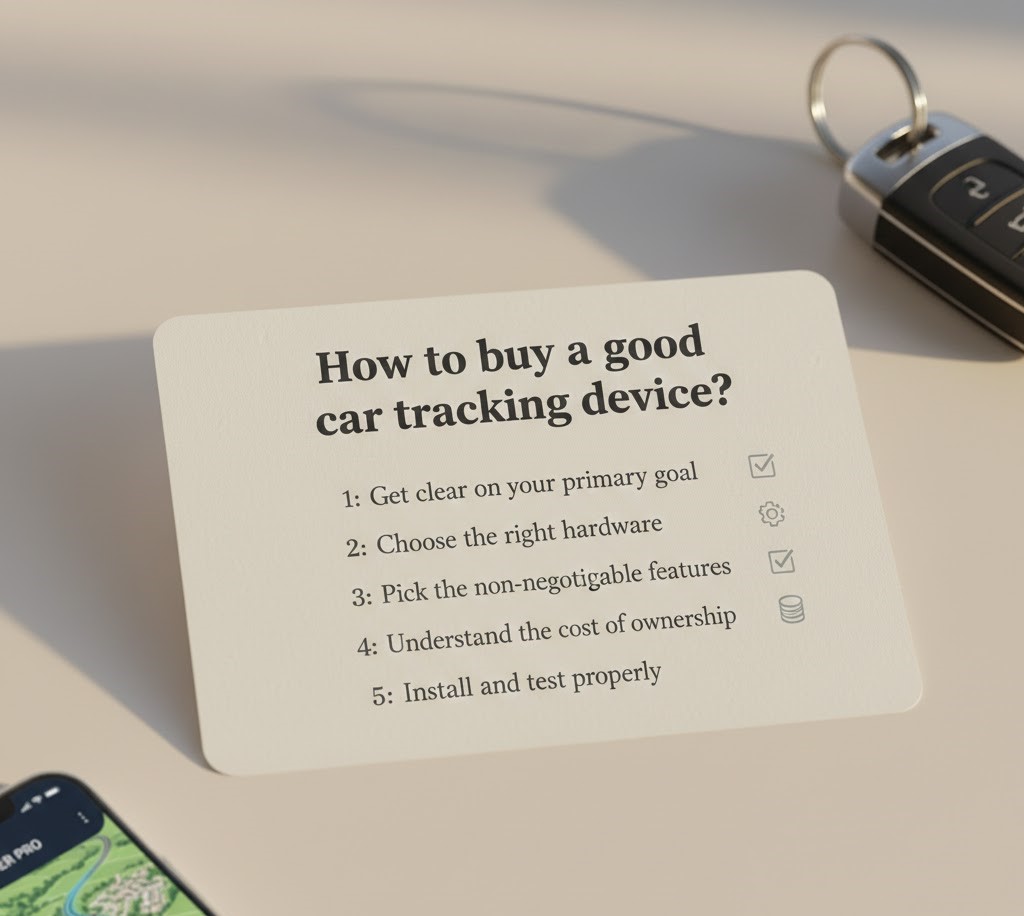
Step 1: Get clear on your primary goal
Before you even look at brands or prices, lock this down. Is it mainly for theft recovery, teen or elderly safety, tax and ATO compliance, or remote/outback travel?
Step 2: Choose the right hardware
We’ve already looked at the types of car tracking devices. There are mainly five different kinds: Hardwired GPS, OBD-II plug-and-play, battery-powered magnetic, Bluetooth-enabled, and satellite hybrid.
Does your vehicle have complex electronics? A vehicle-specific tracker installation without upsetting factory systems is what you need here, especially for luxury brands (BMW, Audi, Mercedes).
Do you drive beyond mobile coverage? A hybrid tracker with satellite fallback (typically Iridium) may be your best option. Choose the gadget that has the capabilities to meet your needs.
Step 3: Pick the non-negotiable features
Think about network compatibility, for instance, 4G LTE-M (Cat-M1) or NB-IoT are very power-efficient, and 3G is dead in Australia. Other features are real-time refresh rate, Australian-based customer support, ruggedness, and data ownership policy. You should also check that the car tracking device uses end-to-end encryption, stores data securely, and has a transparent privacy policy.
Step 4: Understand the cost of ownership
Hardware and installation cost is one-off, while subscriptions are recurring to cover SIM and software access. Budget accordingly to ensure the long-term utility of the car tracking device.
Step 5: Install and test properly
Download the app and register the tracker before fitting it to the car, if possible. Or take a live demo of a functional version before buying it. Be sure to place the car GPS tracker smartly for better reception, and do a calibration drive to test live updates and alerts.
MORE: Stolen car check in Australia: What you must know
What is the best car tracking device for you?
Choosing the right car tracker is about matching your use case, your vehicle, and your tolerance for tech, while staying on the right side of the law. From identifying your primary objective with a car tracking device, to understanding the compatibility with your vehicle, and picking the right hardware to meet your car tracking goals, these are crucial steps to know the right gadget for you.
How much does a car tracker cost you?
The total cost of a car tracking device is the upfront hardware fee and the ongoing monthly subscription costs for cellular data and app access. It will be different for individuals and businesses (or fleet managers). Factor in installation charges, the number of cars (for fleets), and discounts for realistic car tracking device cost calculation. Here are the estimated costs for your rough calculation:
| User type | Hardware (one-off) | Installation (one-off) | Monthly subscription |
| Individual (Basic use) | $50 – $200 | DIY | $7 – $20 |
| Individual (High-security) | $150 to $300 | $50 – $200 | $15 – $30 |
| Small business (Fleet) | Up to $300 per unit | Variable | $15 – $45 per vehicle |
| Enterprise fleet | Variable | Variable | Variable |
Australian car tracking laws to keep in mind
In Australia, car tracking laws boil down to one core principle: consent. Tracking a person without their knowledge or consent is generally illegal. Without consent, you’re exposed to criminal penalties, especially for business owners, fleet operators, and employers, but private individuals aren’t exempt either.
There are two main legal pillars regarding car-related surveillance, like car tracking telemetry data: state-based surveillance device acts (shown in the table below) and the Federal Privacy Act 1988.
| State | Key requirement | Max individual penalty |
| New South Wales | Requires 14 days’ written notice to employees and a visible notice on the vehicle | Up to 5 years imprisonment or ~100 penalty units |
| Victoria | Requires consent from the person being tracked or in lawful possession of the car | Up to 2 years imprisonment or ~240 penalty units |
| Western Australia | Prohibits attaching a device without consent of the person in control of the vehicle | $5,000 fine and/or 12 months imprisonment |
| South Australia | Offence to use a tracker without consent of the owner or person in lawful control | $15,000 fine or 3 years imprisonment |
| ACT | Requires written notice and a visible label on the vehicle | 20 penalty units ($5,000) |
| Northern Territory | Requires consent for tracking | 250 penalty units or 2 years imprisonment |
| QLD & TAS | Tracking without consent can fall under stalking or privacy invasion laws | Varies (best practice is to obtain consent) |
Federal Privacy Act 1988
Personnel’s location data is classified as personal information, and mishandling it can have serious consequences for businesses. The key obligations include: Data security measures, transparency of privacy policy, and Doxxing laws (with potential imprisonment) regarding improper disclosure of geolocation data.
You must follow these requirements before using others’ car tracking data:
1. Get documented consent: If someone else (employee, family member) is driving a trackable car, you need clear consent in writing.
2. Vehicle labelling: In NSW and the ACT, a sticker suggesting GPS tracking for car must be visible on the vehicle.
3. Check app security: Prefer apps that follow APPs (Australian Privacy Principles).
4. Understand personal vs business risk: A “Statutory Tort of Privacy” allows a person to sue an entity or person for serious invasions of privacy like persistent tracking.
Conclusion
Here’s the bottom line we want you to walk away with. Think of a car tracking device like insurance; you can see it working. You hope you never need it, but when something goes wrong, you’ll be glad you made a smart, informed choice.
FAQs
1. Where is the best place to put a tracker on a car?
The best spot for a car tracking device depends on its purpose and signal quality. For high security-level, hide it deep in uncommon spots but avoid places like the metal engine bay or the chassis, as the metal blocks GPS signals.
2. How do I track my vehicle for free?
Honestly, there is no free way to track your car. Some online community members suggest placing an old smartphone hidden in the car with a “Find My” app or Google Maps Location Sharing active. But even this requires a cellular network subscription.
3. Can a car tracker drain my car battery?
Yes. While many modern trackers are designed with “sleep modes” to minimise draw, there are other high-power car GPS trackers that pull power from the car’s battery. If a car is left stationary for several weeks, a tracker can drain the battery enough to prevent the engine from starting.
4. Will a magnet mess up a car GPS tracker?
No. GPS technology relies on high-frequency radio waves from satellites, which are not affected by static magnetic fields. However, ensure the magnet does not physically block the internal antenna’s orientation toward the sky.
5. Can a cell phone detect a GPS tracker on a car?
Partially. A smartphone can detect Bluetooth-based trackers (like AirTags). However, a smartphone cannot directly see a standard GPS/Cellular tracker because those devices transmit data to a cell tower, not to your phone directly. To find those, you would need a RF (Radio Frequency) detector.

Comments
New Comment