




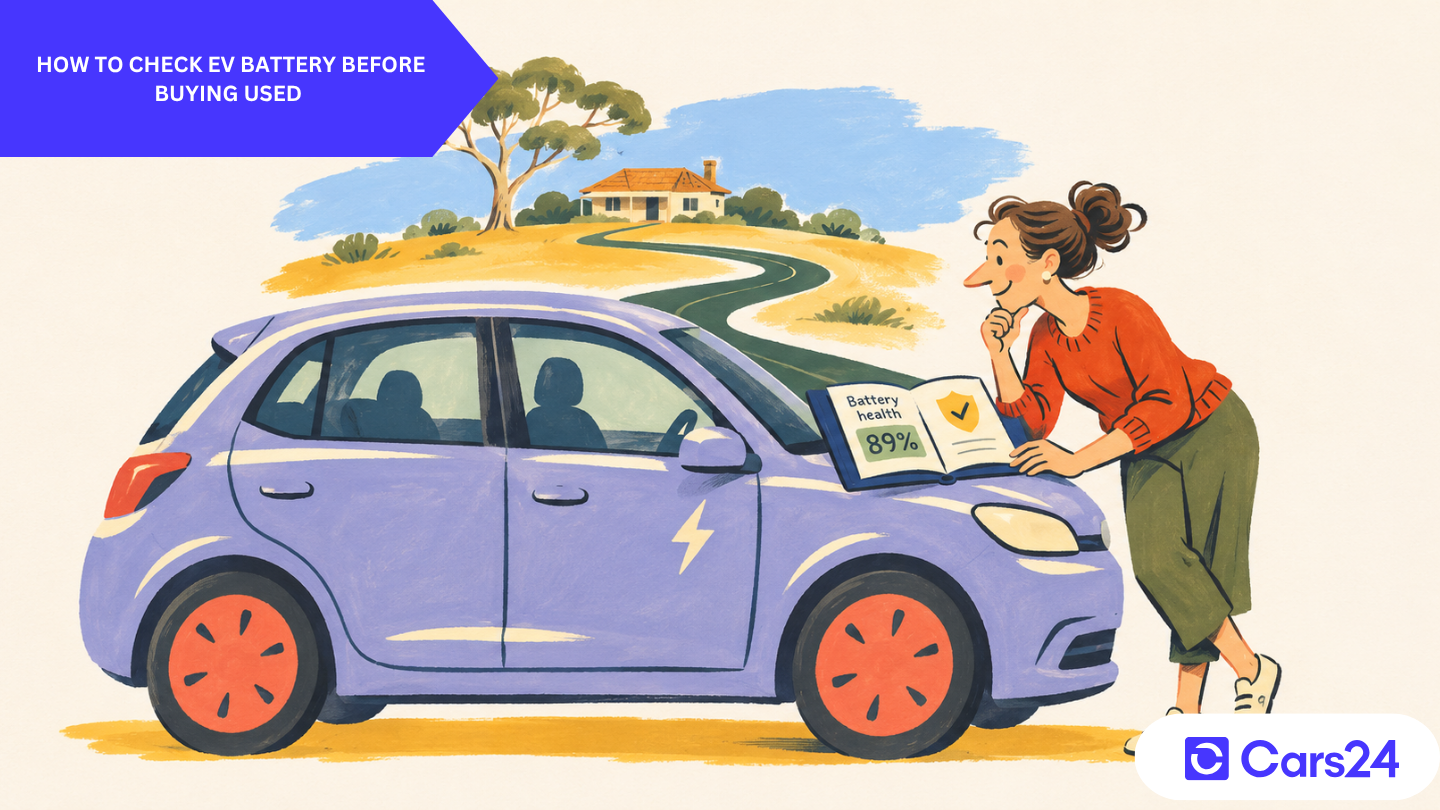
“How far does it go on a full charge?” seems a fair question to ask someone selling an electric car. Trouble is, they might never have driven it far enough to find out. If they plug in at home every couple of nights, they could tell you all about the car and still have to guess at the one answer you came for.
You can get a better idea before you even go for a look. Ask for a recent EV battery health report. It should tell you how much energy that particular battery can hold compared with when it was new. From there, you can work out something rather more useful than the range in the ad. Could you get to your sister’s place and home again without having to borrow her power point?
The photo you want from the seller
If you ask “How’s the battery?” and get a photo of the dash showing 100%, the seller may have understood a different question. That little battery icon shows how full the pack is today. An older battery can fill right up and still hold less energy than it used to. That gradual loss of capacity is what people mean by EV battery degradation.
Try asking this instead. “Have you had the main battery tested? Could you send me the report with the test date and kilometres on it?” Saying the main battery helps here. A receipt for a new 12-volt battery might explain why the car now unlocks reliably, but it won’t tell you how far you can drive.
When the report comes through, match the vehicle identification number (VIN) to the car you’re looking at. Then compare the odometer reading with the ad. If the car has covered another 40,000 km since the test, you’ve learnt something about its history. You’ve still got a good reason to ask for a fresh reading.
Plenty of owners won’t have a report sitting in the glovebox. With the seller’s agreement, ring the manufacturer’s service centre or an independent EV tester. The NRMA also offers mobile checks in some areas. Give the tester the model, year and postcode, then ask what the quoted price buys you. Will you get a written capacity estimate? Is it a reading from the car’s own computer or does the test measure energy as the battery runs down?
Where the 89% on a battery report comes from
Here’s an example you can check for yourself. In November 2022, AVILOO tested a 2019 Tesla Model 3 Long Range AWD with about 60,000 km on the clock. Its certificate lists 74.3 kWh of usable energy when new and 66.12 kWh at the time of testing. Think of a kilowatt-hour, or kWh, as a way of counting how much electricity you have available to spend on a drive.
Divide the second figure by the first and you get 89% state of health. In everyday terms, the driver could still use about 89 units of energy for every 100 the battery originally held. If you do the sum yourself, use the figure marked “usable when new”. The 78 kWh in this Tesla’s model description includes energy the driver couldn’t use, even on day one.
Would I pay more for an otherwise identical car showing 90%? On those figures alone, no. AVILOO gives this particular test a tolerance of ±3%. One percentage point is a pretty thin reason to stretch your budget. And nowhere on that sheet is there a date when the battery will need replacing. What it gives you is a measurement taken on one day in that car’s life.
Take the long way on the test drive
Ask to drive a bit of the road you’d normally use. If you spend most mornings on the freeway, ten minutes around the block with the seller choosing the turns won’t be terribly helpful. With their permission, reset the trip meter before you leave. When you park, look for average energy use, usually shown in kWh per 100 km. You can check the brakes, steering and other items on your test drive checklist along the way.
Now for that visit to your sister. Say it’s 180 km there and back. Using the Tesla’s tested capacity, leaving at 80% charge and keeping 20% in reserve gives you just under 40 kWh for the outing. If your car uses 18 kWh per 100 km, the trip takes about 32 kWh. There’s room for a detour on the way home.
At 22 kWh per 100 km, the same visit takes nearly 40 kWh. Suddenly you might quite like to know where the nearest charger is. Both sums use exactly the same battery. Freeway speeds, cold weather and cabin heating can change what the trip costs you in energy. Use a figure that reflects your driving, especially if you rely on public chargers and pay for each top-up. That choice also affects your EV running costs.
There’s another way to use those figures if you live in a flat and charge at the shops. Add up a normal week’s driving. Include the Saturday swimming lesson and the Sunday grocery run. You might only do 25 km on a workday, yet cover 180 km by Sunday night. Knowing whether one shopping trip a week will cover your charging makes it much easier to choose between two cars.
Back at the seller’s place, ask them to plug the car in. Watch for a charging error or a connection that keeps dropping out. If either happens, get an EV technician to find the cause before you pay. Mention any damage you’ve spotted underneath the car, too. A capacity figure can’t tell you whether the battery casing took a knock. Both are worth adding to your list of used EV warning signs.
The line worth reading in an eight-year warranty
Imagine you’re looking at a six-year-old car advertised with an eight-year battery warranty. You might reasonably pencil in another two years of cover. Have a look at the kilometres before you do.
For example, Tesla Australia lists eight years or 160,000 km for the Model 3 Rear-Wheel Drive, whichever comes first, with a minimum of 70% battery capacity over that period. On those terms, a car that’s already travelled 150,000 km has at most 10,000 km of cover left. For someone doing 500 km a week, that’s about five months.
Ask the manufacturer to confirm the terms for the exact car using its VIN. You want the original start date, the kilometre limit, what level of capacity loss is covered and whether the cover passes to you. If the seller says the battery was replaced, get the invoice and ask what warranty applies to the replacement.
When you’re down to two or three used electric cars, put the price, the date of the battery test and the remaining cover beside each one. Then think about the drive you’d most hate to interrupt for a charge. A cheaper car with a few more kilometres on it might handle that trip comfortably. That’s a better reason to put down a deposit than an extra percentage point on somebody else’s dashboard.
Comments
New Comment