




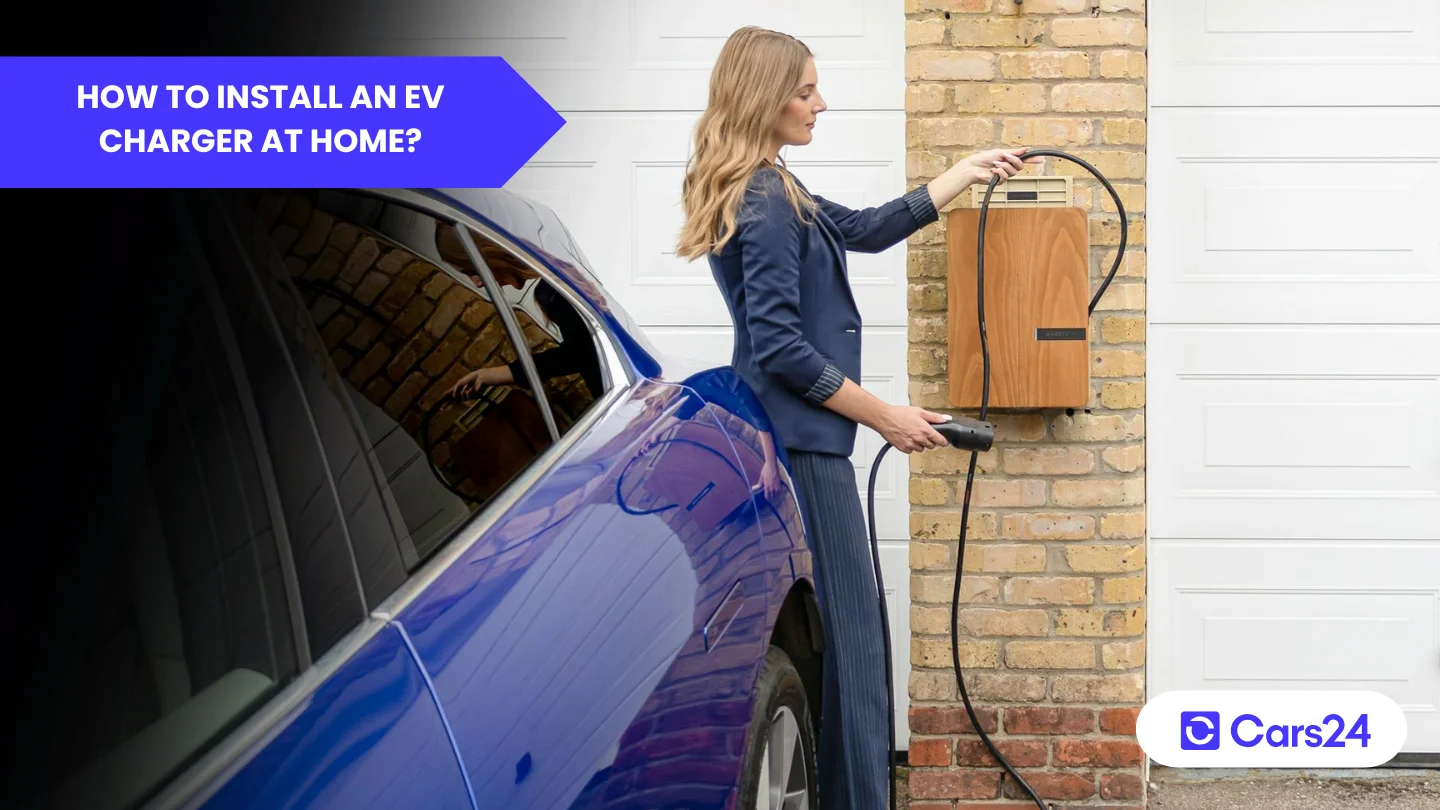
A lot of new EV owners have the same moment of frustration: you plug your car into a normal household socket and realise it could take almost an entire day to refill the battery. That’s usually when you think, “How do I install a real EV charger?”
But choosing the right charger, checking your home’s electrical capacity, and understanding installation costs can feel confusing at first.
Thankfully, most Australian homes can support a safe Level 2 wallbox charger with the help of a licensed electrician. Let’s see the installation steps.
What is a home electric car charger?
A home EV charger (or wallbox) is a dedicated electrical appliance that connects an EV or PHEV to your home’s power supply, bypassing the slow, standard 3-pin portable emergency EV charging cables by safely drawing higher electrical current.
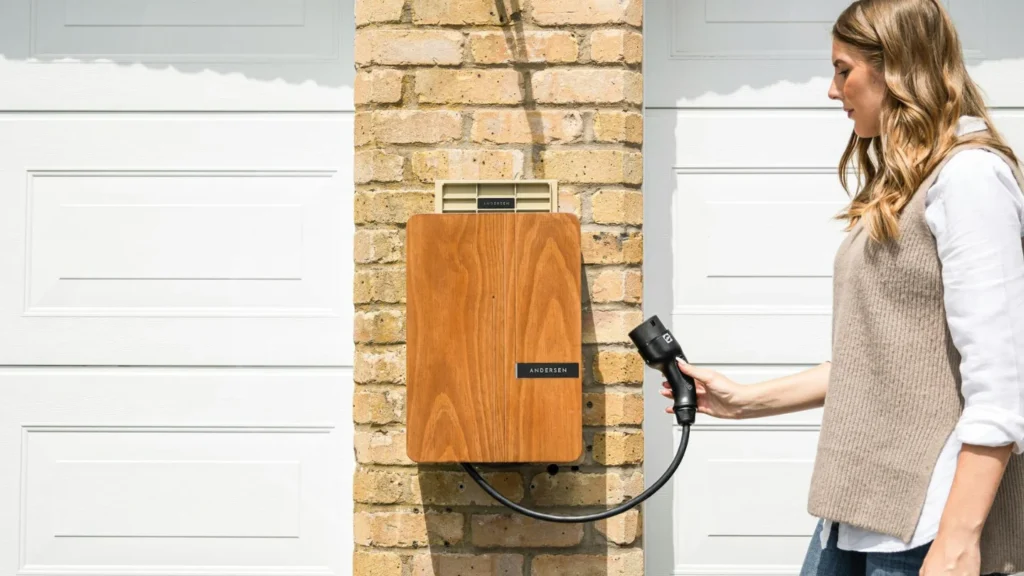
Installing a home EV charger in Australia significantly reduces driving costs compared to petrol cars and provides a convenient energy source. Moreover, a 7.4kW Level 2 charger is fast, can support smart solar charging, overnight automation, and prevents household overloads through intelligent load balancing.
Is there any financial incentive to install an EV charger at home?
Australia has no federal rebate for home EV chargers, but some states offer incentives. The ACT offers 10-year low-interest loans at around 3% from $2,000–15,000.
How to install an EV charger at home in Australia?
Congratulations on your electric car. You’re about to discover the joy of waking up to a “full tank” every morning. No more servos, no more petrol smell, no more watching fuel prices climb.
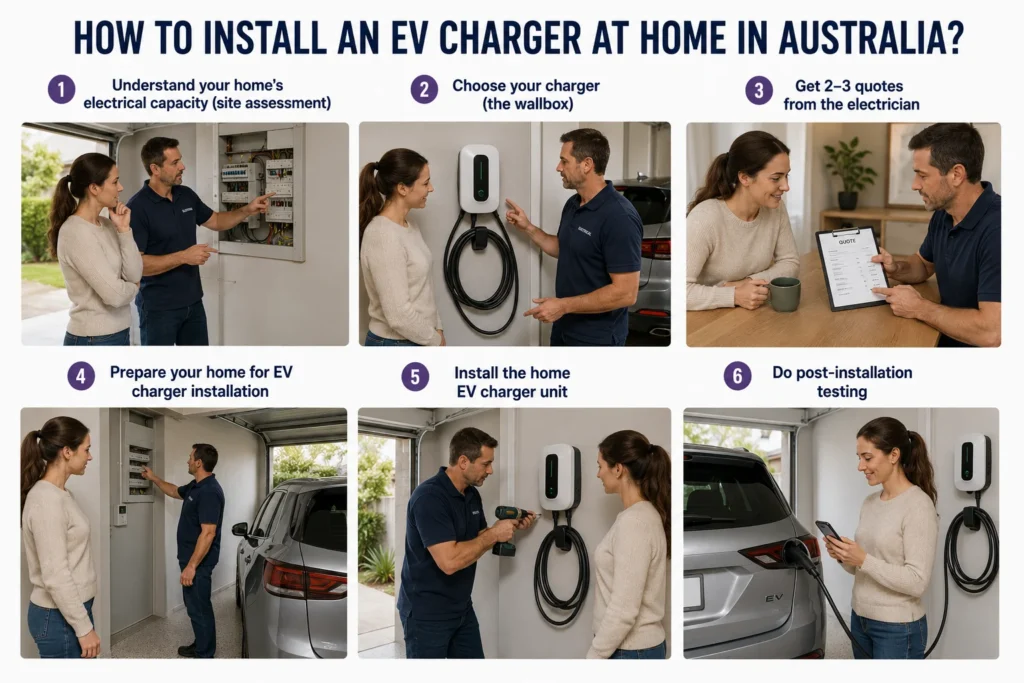
You also don’t need to be an expert to install a home EV charger. With the right charger and a licensed electrician, most Australian homes can support safe overnight EV charging. Here is your complete guide to getting an EV charger installed at home:
Step 1: Understand your home’s electrical capacity (site assessment)
Before installing an EV charger, a licensed electrician should assess whether your home’s electrical system can safely handle the additional charging load. Most Australian homes can support a 7.4kW single-phase charger for overnight charging.
Homes with three-phase power can support faster chargers, though many EVs cannot fully utilise 22kW charging speeds. Older homes may still require switchboard or wiring upgrades before installation.
Tip: Smart chargers with Dynamic Load Balancing can automatically reduce charging speeds when other high-power appliances are running, helping avoid expensive electrical upgrades.
Step 2: Choose your charger (the wallbox)
You need to match the charger’s technical specs or levels with your home’s electrical layout and your car’s charging capabilities.
- Level 1 charging uses a standard household socket and is best suited for occasional or emergency charging.
- Level 2 or a 7.4kW charger is the most common home charging setup in Australia and can recharge most EVs overnight.
- Level 3 or three-phase power can reduce charging times further, provided your EV supports faster AC charging speeds.
You can also choose between tethered vs. untethered cables:
- Tethered (cable attached): The charging cable is permanently wired into the wallbox. You just park and plug it straight into the car without digging a cable out of your boot. It has a fixed cable length.
- Untethered (socket only): The wallbox has a clean, universal Type 2 socket with no hanging cable. It is future-proof, allowing you to plug in any type of charging cable, but you must supply your own Type 2-to-Type 2 cable and manually uncoil and plug it into the wall and the car.
Many modern chargers also support app connectivity, scheduled charging, solar integration, and smart energy management features.
Step 3: Get 2-3 quotes from the electrician
You are not expected to know all the answers, but asking these questions to the electrician signals that you expect a proper installation job:
- “Are you a licensed electrician with EV charger installation experience?”
- “Will you pull a permit and provide a Certificate of Compliance?” (legal requirement in most states)
- “Do I need a switchboard upgrade or a new dedicated circuit?”
- “What is the total installed cost?”
- “How long will the installation take?”
- “Do you supply the charger, or do I buy it separately?”
- “Will the charger be hardwired or have a socket?” (Hardwiring is good for outdoor installations)
- “What’s your warranty on labour?”
Compare a few quotes before deciding, and make sure compliance certification and installation costs are clearly included.
Step 4: Prepare your home for EV charger installation
Before installation day:
- Clear the area where the charger will be mounted
- Ensure the switchboard is accessible
- Confirm your car’s charging port location
Most chargers are installed inside garages or driveways close to the EV’s charging port. Outdoor installations should use weatherproof charging units.
Step 5: Install the home EV charger unit
A standard EV charger installation is usually completed within a few hours, depending on cabling distance and whether switchboard upgrades are required.
After installation, ask the electrician to demonstrate how the charger works and provide the compliance paperwork.
Step 6: Do post-installation testing
Once installed, confirm the EV is charging correctly through the vehicle display or charger app. If your charger supports scheduled charging, set it to charge during off-peak electricity hours to reduce charging costs.
Readers also asked: What are the typical costs of owning an EV in Australia?
Is it worth getting solar panels for home EV charging?
Rooftop solar is highly worthwhile for EV charging in Australia because feed-in tariffs are only 3–9c/kWh, while grid electricity costs 25–45c/kWh. Using solar directly for EV charging can save roughly 30c/kWh versus exporting power to the grid. A 6.6kW–10kW solar system used heavily for EV charging can typically repay itself within 3–5 years.
How long does it take to charge an EV from home?
It depends on the speed of your charger and the size of your electric car’s battery. The table below shows how long it takes to charge from 20%-80% for popular Australian EV models:
| EV model | Battery size (approx.) | Level 1 socket 2.3kW | Level 2 wallbox 7.4kW | Level 2 wallbox 11kW |
|---|---|---|---|---|
| BYD Atto 3 | 50kWh | ~13 hours | ~4 hours | ~3 hours |
| Tesla Model Y (RWD) | 60kWh | ~16 hours | ~5 hours | ~3.5 hours |
| Kia EV6 | 77kWh | ~20 hours | ~6.5 hours | ~4.5 hours |
How to get the most out of your EV charger?
Optimising how and when you charge will directly protect your electric car’s battery and dramatically lower your household power bill. Here are some practical methods to get the most out of your home EV charger:
1. Match charging to “solar sponging” windows: If you have rooftop solar, schedule charging between 10 am–2 pm to absorb peak solar generation instead of exporting cheap feed-in power. Use “Eco+” or “Solar Only” modes on chargers like Zappi or Evnex for dynamic solar-matched charging.
2. Get an EV electricity plan: Use EV electricity plans from providers like AGL or OVO Energy offering 8–15c/kWh super off-peak rates, usually midnight–6 am, and automate charging via apps.
3. Adopt a 20%-80% charging rule: Maintain daily charging between 20–80% to reduce Li-ion battery degradation. LFP batteries in some Tesla and BYD models can safely reach 100% weekly.
4. Pre-condition: Enable pre-conditioning while plugged in to preserve 5–10% driving range.
5. Keep the software updated: Keep the charger firmware updated via Wi-Fi for security and smarter energy scheduling.
Readers also asked: How do I increase my electric car’s range?
How much does it cost to have a home EV charger installed?
A professionally installed home EV charger in Australia typically costs between $1,600 and $4,200, depending on the charger type, installation complexity, and whether switchboard upgrades are required. This pricing includes the hardware cost of the charger itself, the labour required to hook it up to your home’s power grid, smart features, and switchboard upgrade (if needed).

What does it cost to charge an EV from home?
Charging a mid-sized EV using about 18kWh per 100km in Australia costs (per 1000 kilometres) roughly $0.90–2.16 using rooftop solar, $1.44–2.70 on overnight EV tariffs from providers like AGL or OVO Energy, and $5.40–7.20 using standard flat-rate electricity at 30–40c/kWh.
How much will it add to my electricity bill?
You need to calculate your vehicle’s total energy consumption and apply your specific electricity rates to calculate the EV charger’s impact on your electricity bill.
Consider a driver covering roughly 300km weekly (15,000km yearly) in a mid-sized EV consuming 18kWh/100km, which needs about 54kWh of power weekly.
Suppose you have a smart charger on an off-peak EV electricity plan (e.g. from AGL or OVO Energy) at a roughly 12c/kWh rate between midnight and 6 am.
Weekly cost = 54 kWh x $0.12 = $6.48
Monthly electricity bill increase = $6.48 x 4.3 = $27.86
Note: A rooftop solar-powered EV charger can drop your monthly bill increase to $18.58 at the cost of an 8¢/kWh feed-in tariff credit.
Readers also asked: Petrol vs. Hybrid vs. EV running costs for Aussies
Can you install an EV charger at home yourself?
Fixed EV charger installation in Australia legally requires a licensed electrician. DIY wiring can void home insurance after fires or faults and cancel EV charger manufacturer warranties, usually lasting 3–5 years, without a wallbox charger installation certificate. The only legal self-install option is using a Level 1 portable charger plugged into a standard 10A or 15A Australian wall socket.
Can you install an EV charger if I’m renting a home?
Yes, you can install a fixed EV charger (above Level 1) if you are renting, but you cannot do it without formal approvals. The exact approval and compliance path depends entirely on the type of rental property you occupy.
You need to secure landlord (rental provider) approval, navigate strata approvals (for apartments and townhouses) and meet mandatory electrical compliance. You do not need any landlord permission to use the standard 10A portable charging cable that came with your electric car.
What are the common home EV charger installation problems?
Common installation issues include older switchboards needing upgrades, poor Wi-Fi connectivity for smart chargers, and higher installation costs caused by long cable runs. Moreover, long cable runs may require expensive 10mm²–16mm² wiring to avoid voltage drop and charging faults.
Find an EV in your budget with the best discounts of the year. Check it out!
FAQs about home EV charger installation in Australia
1. Do I need a dedicated circuit for an EV charger, and can I use a standard wall outlet?
A home EV charger requires a dedicated circuit for safety and compliance with Australian electrical standards. While you can temporarily use the portable “granny charger” that comes with most EVs through a standard wall outlet, it is much slower and not ideal for daily long-duration charging.
2. What’s the difference between a portable charger and a wall-mounted unit?
Portable chargers plug into a standard household outlet and are best suited for occasional charging, rentals, or emergencies. Wall-mounted chargers require professional installation but offer faster charging speeds, better safety, and smart charging features for everyday use.
3. Does a home EV charger increase my property value?
Marginally, but not significantly. It’s a nice home selling point, not a major value driver. Renters appreciate it. But don’t install one expecting a huge return.
4. Can I take my EV charger with me if I move?
Yes. However, a licensed electrician must disconnect and reinstall the charger safely at the new property.
5. Can any electrician install an EV charger?
Yes, though it’s best to choose a licensed electrician with prior EV charger installation experience.

Comments
New Comment