




You’re probably standing in the driveway staring at that crack in the windscreen and wondering whether it’s a quick repair job or the start of an expensive replacement bill.
And honestly, that’s the exact point where you get stuck, because the difference between an $80 chip repair and a $1,000 replacement often comes down to a few centimetres and the crack’s location.
Here’s how Australian road rules classify windscreen damage, when repairs are possible, and when a full replacement becomes necessary.
Understanding windscreen damage
Australian transport authorities categorise windscreen damage into 4 distinct types of physical defects: cracks, chips/fractures, layer penetration and surface wear or discolouration.
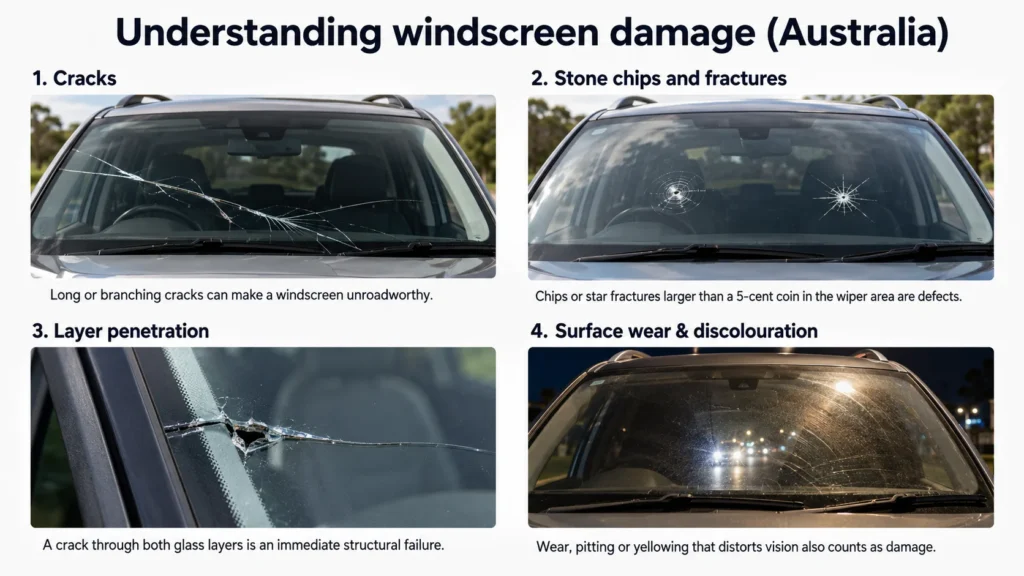
According to the NHVIM and state light vehicle standards, any imperfection that distorts the driver’s forward view or compromises the vehicle’s structural integrity is damage. Here are the types of windscreen damage:
1. Cracks: Hairline cracks over 30mm in the driver’s viewing area are considered illegal. Edge cracks exceeding 75mm are heavily scrutinised. Any crack over 150mm or spider-webbed branching fracture is major damage.
2. Stone chips and fractures: Bullseye and star fractures caused by road debris become roadworthy defects when the damaged area exceeds 16mm, roughly the size of an Australian 5-cent coin, inside the wiper sweep zone.
3. Layer penetration: Modern windscreens contain 2 glass layers bonded by a plastic laminate. If a crack penetrates deeply enough to be felt inside and outside the glass, authorities treat it as an immediate structural failure regardless of length.
4. Surface wear & discolouration: Sandblasting, pitting, wiper scoring and yellowing laminates also count as damage if they distort headlights, create glare, or obstruct the driver’s view at night.
How likely is a cracked windscreen to shatter?
Modern laminated windscreens rarely shatter, but cracks spread quickly. Edge cracks and multi-layer damage carry the highest structural failure risk.
How location alters the definition of windscreen damage
Windscreen damage severity depends heavily on Zone A: a 290mm-wide strip directly ahead of the steering wheel. Authorities apply near-zero tolerance here, meaning almost any visible crack, chip or deep scratch is considered illegal due to public safety risks.
Is it legal to drive with a cracked windscreen in Australia? (State-wise limits)
It is illegal to drive with a cracked windscreen in Australia if the damage penetrates multiple layers of glass, compromises structural safety, or directly impedes the driver’s vision. Driving an unroadworthy or defective vehicle violates state-level transport laws and Australian Design Rule 8 (ADR 8).
Penalties can include fines ranging from $116 to $464, three demerit points, and vehicle defect notices depending on the state or territory.
| State/territory | Driver-side limits (up to 2 allowed) | General/passenger side limits |
|---|---|---|
| NSW, ACT | A hairline crack >30mmAn edge crack >75mm A bullseye or star chip >16mm in diameter Any crack anywhere on the windscreen >150mm | Illegal if any crack extends >150mm or blocks general vision. |
| VIC | Any crack or chip of any size that distorts vision fails inspection | Bullseye/star fractures >16mm wide Cracks >150mm long inside the wiper path |
| QLD | Any crack whatsoever that obstructs the driver’s direct line of sight | Any crack >150mm anywhere on the glass Any deep penetration or complex star fracture |
| WA, SA, NT, and TAS | The driver must maintain a completely clear, undistorted view of the road | Assessed on a case-by-case basis under National Road Transport guidelines |
Repair or replace your cracked windscreen? How to decide?
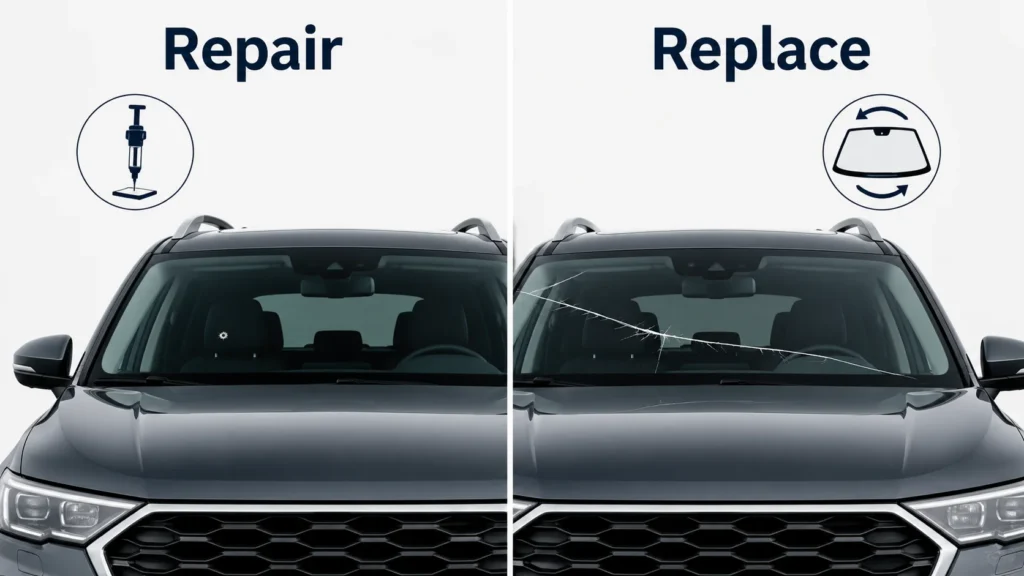
You should repair windscreens when chips are small, stable and outside visibility zones. Replace if cracks weaken the structure, distort vision or exceed repair limits.
When to repair a cracked windscreen
You should repair a windscreen immediately if the damage is small, stable and outside critical visibility areas. Acting quickly saves money, as small chips can rapidly spread into irreparable cracks. Your windscreen damage should be repaired if it meets these conditions:
1. Small damage only
Windscreen repairs are suitable when chips or bullseyes stay under roughly 25–30mm (about the size of an Australian $1 coin). Hairline cracks should generally remain shorter than 30–50mm; anything longer often requires full replacement.
2. Outside Zone A
Damage must sit outside “Zone A,” the 290mm-wide driver vision strip directly above the steering wheel. Even high-quality repairs leave faint marks that can create night glare and fail roadworthy inspections.
3. Away from edges
Chips or cracks should remain at least 50mm from the windscreen edge. Edge damage weakens the glass bond to the vehicle body and spreads rapidly, making safe resin repairs difficult.
4. Outer layer only
Repair is possible only if the outer glass layer is damaged. If you can feel the crack from inside the cabin, the laminate layer is penetrated, and replacement becomes mandatory.
5. No ADAS interference
Damage near cameras or sensors for lane assist or AEB usually requires replacement to avoid calibration and safety-system failures.
Pro tip: Temporary first aid while you wait for professional repair
Cover fresh chips with clear tape until repair to stop dirt and moisture contaminating the crack.
When to replace a cracked windscreen
You must replace your windscreen if the damage compromises the structural integrity of your car, distorts your vision, or exceeds the strict size limits for a simple resin repair. Get your car’s windscreen repaired if the damage meets the following conditions:
1. Damage too large
Replace the windscreen if cracks exceed roughly 30–50mm, chips grow larger than an Australian $1 coin, or multiple defects appear within the driver’s wiper sweep area.
2. Multi-layer penetration
If you can feel the crack from inside the cabin, the damage has penetrated both glass layers and the laminate, severely weakening rollover protection.
3. Edge damage
Any crack or chip within 50mm of the windscreen edge usually requires replacement because edge tension causes rapid spreading and weakens body sealing strength.
4. Zone A visibility risk
Any chip or crack inside “Zone A,” the 290mm-wide driver vision strip above the steering wheel, fails Australian roadworthy standards due to glare and optical distortion risks.
5. ADAS interference
Damage near top-centre safety cameras or sensors can disrupt automatic emergency braking and lane-keeping systems, making replacement necessary.
6. Severe wear or delamination
Cloudy pitting, sandblasting, bubbling edges, or yellow laminate discolouration indicate structural deterioration and poor visibility, especially in bright sunlight or night driving conditions.
A critical step after windscreen replacement
If your car has ADAS features, ensure the cameras and sensors are recalibrated after replacement.
Readers also asked: Tips to protect my car from extreme heat and sunlight
How much would it cost to fix a cracked windscreen?
The cost to professionally repair a cracked/chipped windscreen ranges from $60 to $140 in Australia, taking about 30 minutes. However, if the damage requires a full replacement, the cost jumps to a range of $300 to $1,200+, depending entirely on your car’s built-in technology (like ADAS camera recalibration), which demands extra efforts and specialised glass.
How do professional windscreen chip repairs work?
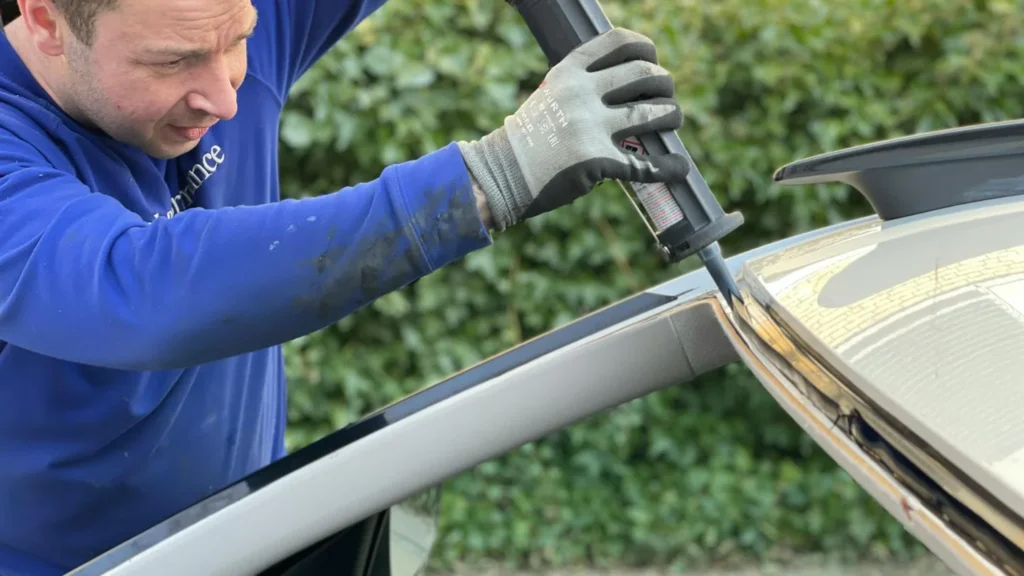
Professional car windscreen chip repair removes trapped air and moisture using a vacuum, then injects clear acrylic resin into the crack. The process of cleaning, vacuuming, resin injection, UV curing, scraping and polishing takes roughly 20–30 minutes.
Most repairs restore around 80–95% visual clarity and are safe to drive immediately afterwards.
Why DIY glass repair kits often cost more in the long run
Cheap DIY windscreen repair kits can create more expensive problems for you due to the risks of trapped air, spreading cracks, yellowing resin, failed repairs, insurance disputes and ADAS camera malfunctions.
Also read: How to fill your windscreen washer fluid?
Some tips to protect your windscreen from damage
1. Increase your following distance: Leave a 4-second gap behind trucks and 4WDs to reduce rock strikes from heavy tyres at highway speeds.
2. Ease off on unsealed roads: Slow to 40–50km/h on gravel or freshly resurfaced roads to minimise stone impact force.
3. Pass oncoming vehicles gently: On narrow dirt roads, ease left and slow down when passing oncoming vehicles.
4. Park in shade: Dashboards can exceed 70°C in summer, rapidly spreading tiny chips into major cracks.
5. Leave side windows open: A 1–2cm gap is enough to reduce cabin heat pressure on laminated glass.
6. Warm frosted glass gradually: Use lukewarm water or gentle heating, but never boiling water. Or use this guide to defog effectively.
7. Clean the wiper blades: Replace wiper blades yearly and clean them regularly to prevent scratches.
8. Never run wipers on dry dusty glass: Always spray washer fluid first.
9. Carry clear sticky tape: Cover fresh chips immediately with clear tape to block moisture and dirt before repairs.
FAQs about windscreen repair or replacement
1. How long does a windscreen repair and replacement take?
Windscreen chip repairs usually take 20–30 minutes. Full replacements can take 1–3 hours, especially if ADAS camera calibration is required.
2. Will a repaired chip still be visible?
Yes, slightly. Expect an 80% to 95% visual improvement; it will look like a faint watermark or speck of dust.
3. Can I drive immediately after a windscreen repair or replacement?
Repair: Yes. Replacement: No. Repairs cure instantly under UV light. Replacements require the car to sit completely still for 30–60 minutes for the structural urethane glue to safely dry.
4. Does comprehensive car insurance cover windscreen damage?
Yes, most comprehensive car insurance policies in Australia cover windscreen damage, but whether you have to pay an out-of-pocket excess depends entirely on your specific policy options.
5. Are mobile windscreen repair services reliable?
Yes. Major Australian networks use the same commercial-grade tools and resins on your driveway as they do in their workshops.
Buy quality inspected used cars with easy financing at Cars24 Australia.

Comments
New Comment