




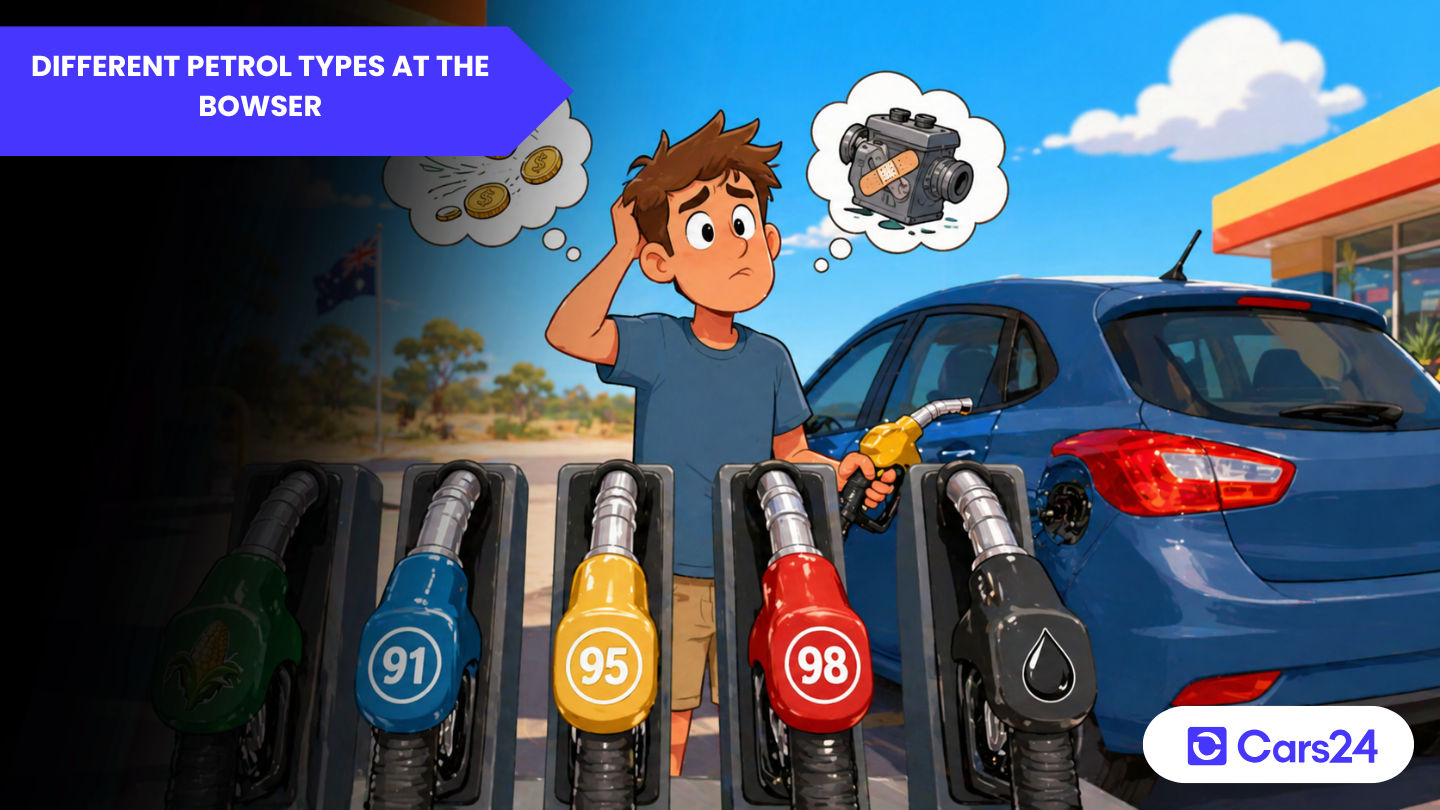
Walk into any servo in Australia and you’re faced with a wall of nozzles: E10, 91, 95, 98, diesel, and sometimes E85. For most drivers, the choice comes down to habit or price. But put the wrong fuel in the wrong car and you’re either wasting money every time you fill up, or quietly doing damage to your engine over time. Here’s what you actually need to know.
Read more: Fuel prices in Melbourne, Sydney, and Brisbane revealed
The number on the bowser is what actually matters
That two-digit number: 91, 95, 98, is the fuel’s RON rating, which stands for Research Octane Number. It measures how resistant the fuel is to “knocking”, the uncontrolled ignition that happens when petrol combusts too early inside the cylinder.
Engines with higher compression ratios (typically found in turbocharged, supercharged, or high-performance vehicles) need higher-octane fuel to function properly. If they don’t get it, the engine knocks, the management system compensates by retarding ignition timing, and performance and fuel economy both suffer. In severe or prolonged cases, engine damage can follow.
The rule is straightforward: use at least the minimum octane rating specified in your owner’s manual. Going higher than specified won’t hurt anything, but it probably won’t help either.
The petrol fuel types, explained
E10, the budget option (91 RON)
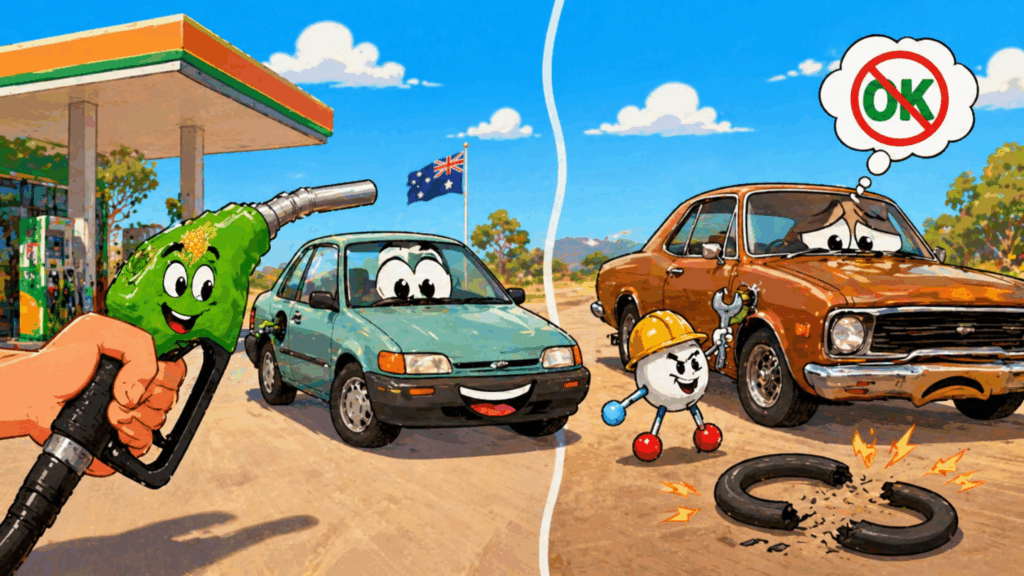
E10 is regular 91-octane petrol blended with up to 10% ethanol, and it’s the cheapest option at the pump. It’s also widely available at major chains across the country.
The catch is compatibility. Most petrol vehicles built after 1986 can run on E10 without issue, but older cars, particularly those with carburettors, older rubber fuel lines, or certain metal components, can have problems. Ethanol is a solvent and can degrade seals and gaskets not designed to handle it. If you own a classic car or a vehicle from the late 1980s or early 1990s, check before you fill.
The second catch is the economy. Ethanol contains less energy per litre than petrol, which means your engine burns slightly more of it to cover the same distance. The price discount at the pump doesn’t always cover the difference. If you’re doing lots of highway driving, it’s worth running the numbers.
Best for: Drivers with a compatible modern car who want to save at the pump, and are happy to check the maths on economy.
Read more: Petrol vs. Hybrid vs. EV running costs for Aussies
91 Unleaded (RULP), the standard choice
Regular unleaded petrol (RULP) is the baseline fuel grade in Australia and the minimum requirement for the vast majority of standard petrol passenger vehicles. It’s available at every petrol station in the country, in every location from capital cities to remote outback roadhouses.
If your owner’s manual says “minimum 91 RON”, and for most everyday hatchbacks, sedans, and SUVs it does, this is your fuel. There’s no benefit to paying more for 95 or 98 if your engine isn’t designed to use them.
Best for: Most standard petrol vehicles, particularly those with naturally aspirated engines.
95 Premium Unleaded (PULP), the mid-grade
95 PULP is where things start to matter more. Many turbocharged engines, most European-spec vehicles, and a growing number of modern engines from Japanese and Korean manufacturers specify 95 as their minimum grade. Running 91 in a car that needs 95 will trigger the knock sensors, which may reduce power and efficiency to protect the engine. You’ll notice it as slightly sluggish performance, and you may not even realise the cause.
If your manual says “minimum 95 RON” or “premium unleaded recommended,” 95 is your floor, not a luxury upgrade.
The price premium over 91 is usually in the range of 10 to 20 cents per litre, which is meaningful over time but worthwhile if your engine genuinely needs it.
Best for: Turbocharged engines, European vehicles, and any car with a manual specifying 95 RON minimum.
98 Premium Unleaded, the high-octane option
98 is the highest octane grade sold at mainstream Australian servos. It’s required by high-compression performance engines, many luxury vehicles, and some sports cars, anything from a BMW M-series to a Porsche to a performance-tuned local vehicle.
For drivers whose cars genuinely require 98, there’s no argument to be had: use it. The cost of running a lower-grade fuel, in lost performance, increased fuel consumption, and potential long-term engine wear, outweighs the saving at the pump.
For drivers whose cars don’t require it, 98 is largely a waste of money. The fuel is fine; your engine just isn’t designed to extract the benefit from it. The marketing language around 98, words like “clean,” “advanced,” and “performance”, can make it sound like a universal upgrade. It isn’t.
Best for: High-performance engines, luxury vehicles, and any car with a manual specifying 98 RON, or “premium recommended” as a firm requirement.
E85, the specialist fuel
E85 is an 85% ethanol, 15% petrol blend. It has an effective octane rating around 100–105 RON and burns cooler than standard petrol, which is why it’s popular in high-performance and motorsport applications.
The critical point: E85 can only be used in flex-fuel vehicles, cars whose fuel systems have been specifically designed or modified to handle high-ethanol content. Put E85 in a standard petrol car and you will cause serious damage to seals, fuel lines, and the fuel pump.
Availability is also limited. E85 is mainly found at select metro servos in Queensland, New South Wales, and Victoria. It’s not a roadtrip fuel.
Best for: Flex-fuel or purpose-modified vehicles only. Not a consideration for the overwhelming majority of Australian drivers.
Fuel quality and regulation in Australia

Australia has strict fuel quality standards governed under the Fuel Quality Standards Act 2000, designed to reduce emissions, improve engine performance, and support modern vehicle technologies.
In normal conditions, petrol sold in Australia is limited to a maximum of 10 parts per million (ppm) sulphur, a key change introduced in December 2025 to align with cleaner Euro 6 vehicle standards.
In March 2026, the federal government introduced a temporary change allowing ‘dirty fuel’ with up to 50 ppm sulphur to be sold, in response to global fuel supply disruptions linked to geopolitical tensions. This measure is designed to support supply and stabilise prices, and is expected to have minimal impact on vehicle performance, health, or the environment.
The temporary standard is scheduled to remain in place until September 2026, with a transition period extending to the end of the year, after which the 10 ppm limit will return.
Read more: Australia allows ‘Dirty Fuel’ for 60 days to boost petrol supply
Common myths worth clearing up
“Premium fuel will make my car go better.” Only if your car is designed for it. If your manual specifies 91, filling up with 98 won’t give you more power or better economy, it’ll just cost more.
“E10 is always cheaper in the long run.” Not necessarily. Because ethanol has lower energy density than petrol, fuel economy typically drops by 2–4% on E10. Whether you come out ahead depends on the price gap at your local servo and how you drive.
“Using a lower grade occasionally is fine.” Modern engine management systems can compensate short-term, but it’s not a habit worth forming. If your car needs 95, fill it with 95.
“Premium fuel cleans your engine.” Some premium fuels do include additional detergent additives, but this is a secondary consideration. The octane rating is what matters for engine health.
Read more: ‘Dirty Fuel’ is back in Australian tanks! Should you be concerned about 50 ppm petrol?
The one thing to do right now
Open your glove box, find your owner’s manual, and look up the fuel specification for your vehicle. It will tell you clearly, minimum 91, minimum 95, or premium required. Then use at least that grade, every time. Everything else is secondary.
If you’ve lost your manual, the fuel cap door on most vehicles also shows the minimum recommended grade. Failing that, the manufacturer’s website or a quick call to a dealer will confirm it in seconds.
The right fuel isn’t necessarily the most expensive one. It’s the one your engine is actually designed for.

Comments
New Comment