




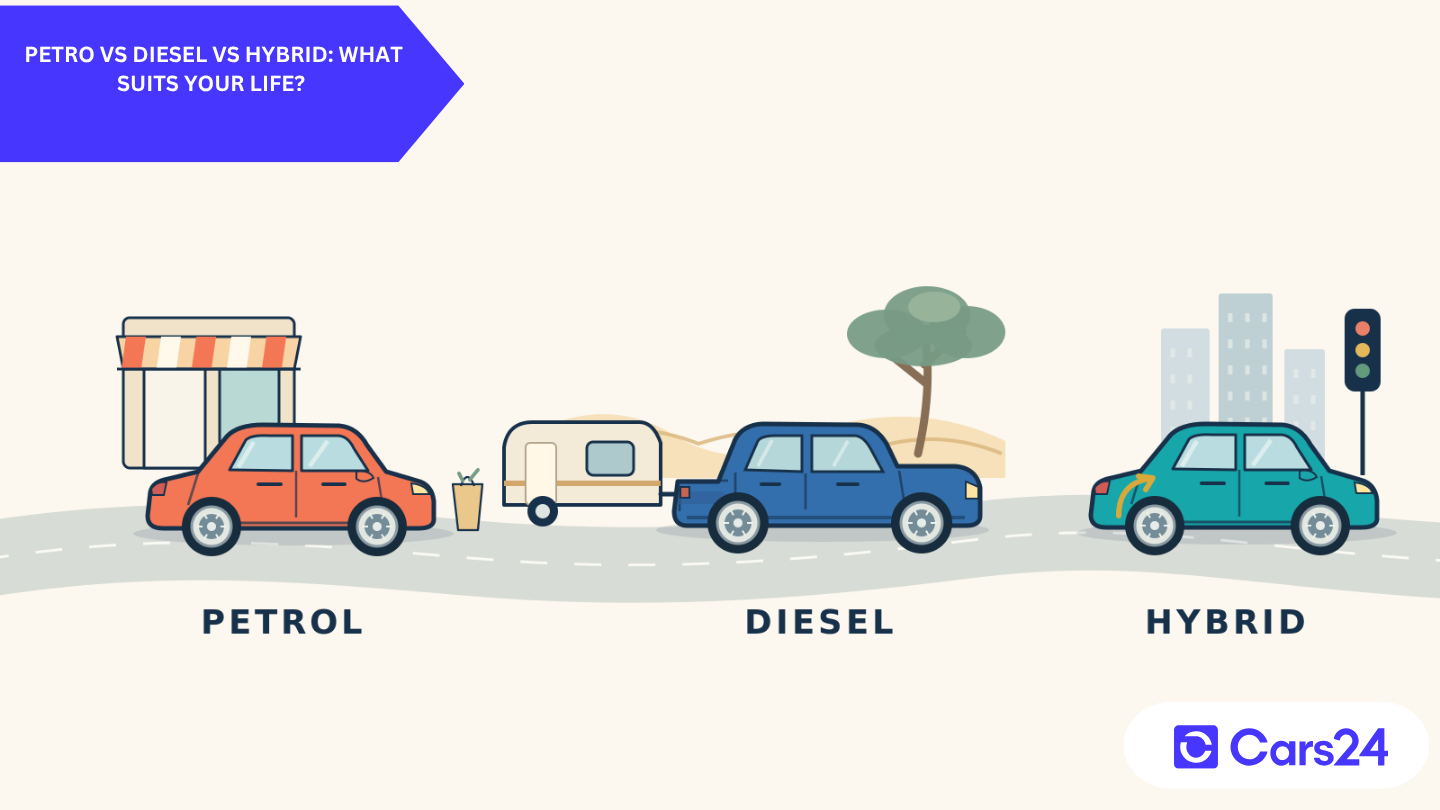
How much of your driving is actually spent on the open road? Not the occasional weekend getaway, but the regular trips to work, the supermarket and everywhere in between. It’s worth thinking about because the kind of driving you do can make a bigger difference to your fuel bill than you might expect.
A hybrid might use considerably less petrol in stop-start traffic, but those savings may look different on a long highway drive. Diesel has its advantages too, although it isn’t necessarily suited to a life of short suburban trips. And sometimes, a good old petrol car is all you really need.
So, if you’re weighing up petrol vs diesel vs hybrid, there’s plenty to consider beyond what you pay at the servo. The trick is knowing which benefits you’ll actually use and which ones you could end up paying extra for.
What’s different under the bonnet?
Let’s start with petrol cars, since they’re what most of us are familiar with. They’re often a sensible option if you don’t drive a lot or simply want something affordable to buy. You might spend a little more on fuel compared with a similar hybrid, but if you’re only driving a few days a week, that difference may not be enough to justify paying more upfront. Of course, not every petrol car costs the same to run. Some need premium unleaded, and servicing costs depend on the model.
Now, diesel is a different story. There’s a reason so many utes and larger SUVs run on it. Diesel engines often have plenty of pulling power even when they’re not working particularly hard, which can be useful for carrying heavy loads or towing. They can also be quite economical on longer drives. But if your car rarely goes beyond the local shops, certain modern diesels may not be the best fit. Repeated short trips can cause trouble for their exhaust filters.
Then there are full hybrids, which use a petrol engine and an electric motor together. Think of the electric motor as an extra helping hand. It can move the car on its own in certain conditions or work alongside the petrol engine when more power is needed. Here’s the clever part: when you slow down or brake, the car captures some of that energy and uses it to recharge its battery. The petrol engine can charge it too. You still fill up at the servo as usual, and there’s no need to plug it in. We’ve explained this further in our guide to how hybrid cars work.
You’ll also come across terms like mild hybrid and plug-in hybrid while browsing cars. They’re not quite the same thing. A mild hybrid has a smaller electrical system that mainly helps the engine use less fuel. A plug-in hybrid has a bigger battery that you can charge externally, allowing it to drive further using electricity alone. The catch with a plug-in? You’ll need to charge it regularly to get the most out of it.
Lots of traffic? A hybrid deserves consideration
Melbourne’s stop-start commute is the sort of driving a full hybrid often handles well. Braking puts some energy back into the battery, and the electric motor can help the car pull away again without the petrol engine doing all the work. That matters when you’re stopping at another set of lights every few hundred metres.
The advantage won’t be identical for every hybrid or every trip. If most of your kilometres are on open roads at steady speeds, compare the petrol and hybrid versions rather than expecting the same city savings.
Petrol still has a case here. A well-priced petrol hatchback that covers only a few kilometres most days could cost less overall than a more expensive hybrid, even if you visit the servo a little more often.
What about regional driving and towing?
If your week means regular trips between towns, a diesel is worth considering. Some diesels use fuel efficiently on longer runs and offer useful low-speed pulling power. Modern hybrids can be economical on highways too, so check the figures for the cars you’re considering.
There’s a reason to be cautious about diesel for local errands: the diesel particulate filter, or DPF. It catches soot from the exhaust and periodically burns it off in a process called regeneration. Repeated short trips can make regeneration difficult to complete on some models. Ignore advice that every diesel needs the same weekly motorway run. Check the owner’s manual and service history instead.
Taking a caravan away? Don’t shop by torque alone. A diesel ute may be suitable, but a petrol or hybrid vehicle can tow if it’s approved to carry that load. Check the braked towing limit, towbar rating, payload and gross combination mass (the maximum permitted weight of car and trailer together). The Queensland Government’s towing guidance explains why the loaded weights matter.
Do the fuel savings actually pay you back?
A low L/100km figure looks attractive, but it isn’t the whole budget. Take two hypothetical cars averaging 5 and 7L/100km. At 12,000km a year and an assumed $2 a litre for both, the first saves $480 in fuel annually. Helpful, yes. But a higher purchase price could take years to recover through fuel savings alone.
Your fuel bill depends on how far you drive, pump prices and real-world consumption. Australia’s official combined figures come from controlled tests, not your Monday commute. Even the same model can differ by engine, transmission or drivetrain. Cars24’s guide to fuel economy in Australia helps explain those figures, while the government’s Green Vehicle Guide lets you compare particular variants.
Add insurance, servicing and any major repairs due. Lower fuel use can reduce tailpipe carbon dioxide, but it doesn’t tell you everything about other exhaust pollutants. A full hybrid still produces emissions when its engine runs.
Buying used? The history matters more than the label
Whatever the fuel, look for service records backed by invoices, take a test drive and arrange an independent mechanical inspection. Here’s why service history matters even when the odometer looks reassuring.
For petrol cars, check the usual engine and cooling-system condition, leaks, warning lights and maintenance due for that exact model. On a diesel, ask about DPF warnings or repairs, and get the turbo, injection system and emissions equipment checked where relevant.
With a used hybrid, pay attention to battery condition and any available manufacturer diagnostic check. Battery warranty isn’t the same as lifespan. Coverage varies by make, model year and conditions, and age alone won’t tell you whether a battery is healthy.
Before paying for any used car, run a PPSR vehicle search to check for registered security interests and available stolen or written-off information. That won’t replace a mechanical inspection.
The shortlist I’d start with
For regular stop-start commuting, compare a full hybrid with a similar petrol model. For occasional driving and a tighter purchase budget, don’t overlook petrol. If you’re covering big regional distances or towing regularly, look at suitable diesels alongside petrol and hybrid alternatives that meet the same job.
A good fuel figure can’t make up for an inflated asking price or costly repairs waiting around the corner. On Cars24, check used hybrid cars against similar petrol options for price, kilometres and history, not just their fuel figures.
Frequently asked questions
Is a hybrid worth it if I mostly drive on the highway?
Possibly. A full hybrid can still be economical at highway speeds, but the difference from an equivalent petrol car may be smaller than in city traffic. Compare both versions’ consumption and purchase prices before deciding.
Is diesel cheaper to run than petrol?
It depends on the two cars and your mileage. A diesel’s lower fuel use on some journeys can help, but fuel prices, servicing and potential repairs all affect the bill. Compare the costs over the years you plan to own it.
How long does a used hybrid battery last?
No single age or kilometre figure applies to every battery. Check its condition, maintenance records and the manufacturer’s warranty terms for that vehicle. A battery-health inspection may offer more reassurance than an odometer reading alone.
A better way to choose
Think about last month’s driving, not a holiday trip you might take next summer. Work out what each car would cost you to buy and keep, then check its condition properly. You still have to like driving it. Fuel type is an important part of the decision, but it’s not the whole car.
Comments
New Comment