




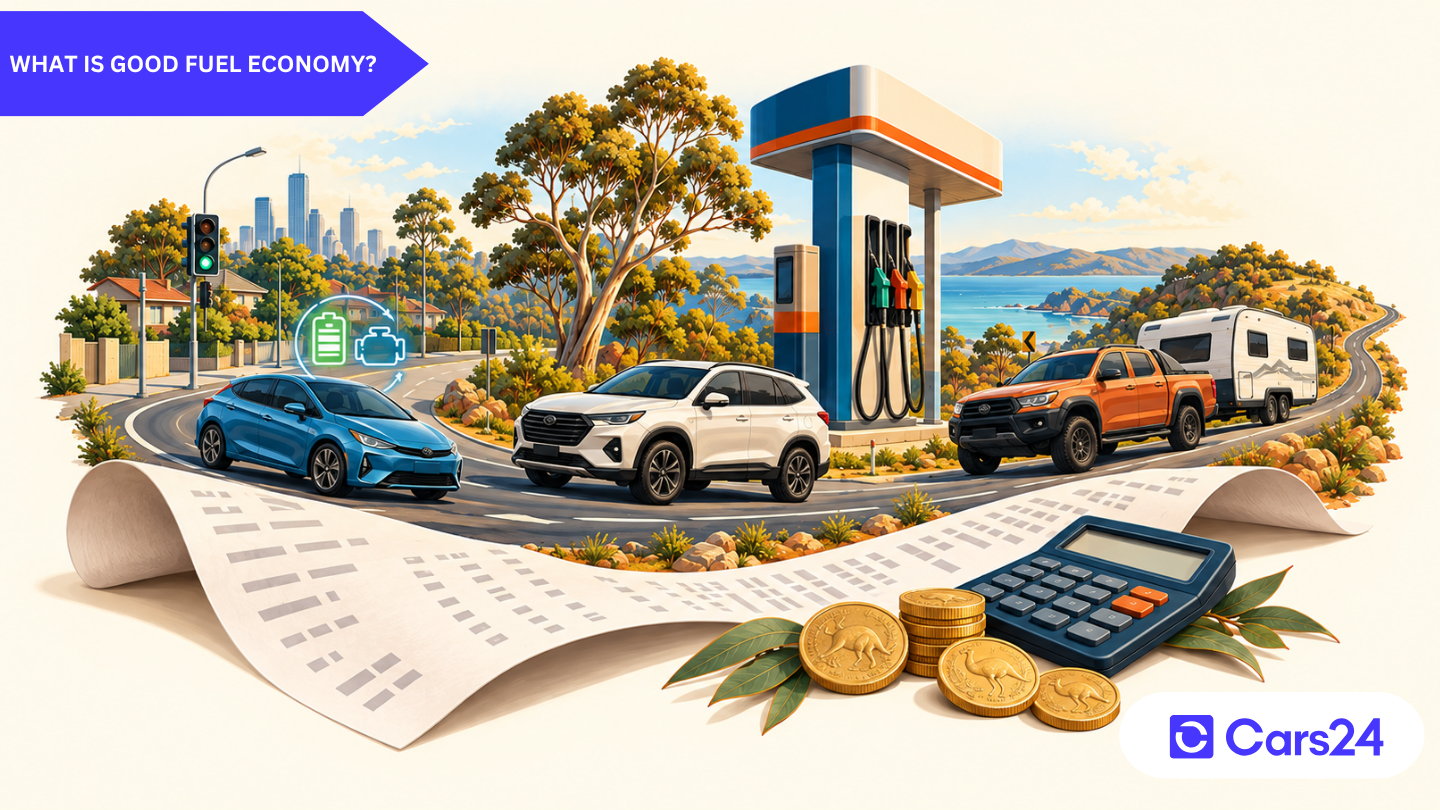
You’ve barely finished paying for one tank of petrol before the fuel light’s back on. Didn’t you just fill up? It’s the sort of thing that gets you looking at fuel consumption a bit more closely when you buy your next car. Trouble is, a listing saying “7L/100km” doesn’t tell you whether you should be pleased with that.
So, what is good fuel economy? It means using less fuel than similar cars doing the same job. A small hatch and a ute towing a caravan need different comparisons. Once you’ve worked out which cars belong on your shortlist, those fuel figures become much easier to judge.
What is good fuel economy in Australia?
If you need a ute for work, you probably won’t be persuaded to buy a little hybrid hatch just because it uses less petrol. You still need somewhere to put the tools.
Start with cars that can do what you need. When comparing used utes, look at similar engines and carrying ability. If you tow, look for evidence of fuel use while towing too.
With used SUVs, narrow the search a little further. “SUV” covers everything from small city cars to large seven-seat diesels. Even within one model, the engine or a change from two-wheel drive to all-wheel drive can affect consumption.
What counts as good fuel consumption, then? A figure that compares well with those close alternatives, using the same test method. These published Australian figures give you a few reference points:
| Vehicle example | Official combined consumption | What you’re looking at |
| Toyota Yaris Ascent Sport Hybrid, in the upgraded 2024 range | 3.3L/100km | Small 1.5-litre hybrid hatch |
| Kia Carnival S Hybrid, MY27 | 5.8L/100km | Eight-seat 1.6-litre turbo hybrid |
| Kia Carnival S Diesel, MY27 | 6.5L/100km | Eight-seat 2.2-litre diesel |
Examples from Toyota Australia’s Yaris announcement and Kia Australia’s Carnival specifications. All use ADR 81/02 combined test figures. They are reference points, not class averages or promised road results.
Same body and eight seats, yet the hybrid sits 0.7L/100km below the diesel. The Yaris is a far smaller car, so 3.3 and 5.8 can both be good results. A blanket ‘under 7 is good’ rule can’t cover that, and an average across all cars wouldn’t either.
L/100km meaning: how much fuel are we talking about?
L/100km means litres per 100km. If a car returns 6L/100km, it uses six litres to travel 100 kilometres. At 9L/100km, it uses nine litres for the same distance.
Three extra litres might not sound like much. Over 15,000km, though, you’re looking at 900 litres versus 1,350 litres. At an example price of $2 a litre, that’s $900 more across the year.
Those sums assume you achieve the stated consumption. If you’ve taken the number from an advertisement, it’s generally an official lab-test figure. We’ll get to why your own result can differ.
For now, don’t let the size of a fuel receipt put you off a car. Someone spending more at each fill might simply have a bigger tank and leave longer between visits. You need to know how far they drove on that fuel.
Combined fuel consumption: what does the label tell you?
Combined fuel consumption comes from a prescribed lab test. It gives buyers a consistent starting point for comparison.
Older Australian test data commonly includes:
- Urban: lower-speed driving with frequent stops.
- Extra-urban: a higher-speed test stage, sometimes loosely called the highway fuel consumption figure. It isn’t a steady motorway cruise.
- Combined: a result calculated across the test stages, rather than a simple average of the two displayed numbers.
Say your week involves crawling through Melbourne traffic, with one clear run on Sunday. There’s no reason that particular mix should match the test.
The Australian Government’s Green Vehicle Guide explains fuel-consumption labels, including why figures from different testing systems need care.
WLTP vs NEDC: what changed in 2026?
As of October 2026, Australia is transitioning from the New European Driving Cycle (NEDC) to the Worldwide harmonised Light vehicle Test Procedure (WLTP).
Under Australian Design Rule ADR 81/03, the newer labelling requirements apply to newly approved models first supplied from 1 July 2026, then to all new light vehicles from 1 July 2028. The Department of Infrastructure explains the phase-in dates.
WLTP uses different test stages, and the newer label displays a combined fuel figure. Both systems will remain relevant to used-car buyers after 2028 because older vehicles retain their original test data.
Comparing a 2019 car with a newer model? Check which test produced each number before reading too much into a small difference.
Why real-world fuel consumption can be higher
Say your neighbour has the same car as you and reckons it’s great on fuel. You’re less convinced. They leave before peak hour and get a clear run to work; your morning involves the school queue, a short trip to the shops and another cold start later. You’re both describing the car honestly. It’s just having a different week.
Keep that in mind when reading road tests. Check which engine was tested and how the car was driven. If you’re buying it to tow a caravan, an unloaded run along a flat road can only tell you so much.
How hybrid fuel consumption works
Seen a hybrid with a surprisingly low fuel figure? Before adding it to your shortlist, check what kind of hybrid it is.
A full hybrid has an engine and an electric motor. When the car slows down, it can recover some energy that would otherwise be lost and store it in the battery. Electric power then helps reduce engine use. That can work well in stop-start traffic.
A mild hybrid provides more limited assistance, and some cannot drive on electric power alone. You’ll want to check the system fitted to any used hybrid cars you’re considering.
Plug-in hybrids (PHEVs) can be charged from a power point, and their official fuel figure counts battery-powered driving. Charge often on short trips and petrol use can stay very low. Drive long distances between charges and it won’t.
Their batteries can be charged from an external supply, and their official fuel figures include battery-powered driving. Regular charging and suitable short trips can keep petrol use low. If you drive long distances between charges, expect a different result.
The Green Vehicle Guide’s hybrid information explains how the systems differ. For a plug-in hybrid, include the electricity bill when you work out running costs. The petrol figure won’t cover that.
How to calculate fuel costs before buying
You don’t need to be good at maths for this. Grab your phone’s calculator and use:
Annual kilometres × L/100km ÷ 100 × fuel price per litre.
Suppose you drive 15,000km a year and achieve 7L/100km. That comes to 1,050 litres. At an example price of $2 a litre, you’d spend $2,100 a year, or roughly $40 a week.
Use your own distance, even if it’s only an estimate. If you drive a long way to work each day, a small reduction in consumption can add up. If the car mostly stays in the garage, the annual saving will be smaller.
Before settling on a figure, check what goes in the tank. Petrol and diesel have different prices, and a car that requires premium petrol needs its sums done at the premium price. The table below shows how much that can change a comparison.
| Hypothetical comparison over 15,000km | Car A | Car B |
| Fuel consumption | 7L/100km | 6.5L/100km |
| Required petrol | Regular 91 | Premium 95 |
| Example price per litre | $2.00 | $2.20 |
| Annual fuel use | 1,050 litres | 975 litres |
| Annual fuel cost | $2,100 | $2,145 |
Car B uses 75 fewer litres but costs $45 more to fuel. Check the owner’s manual for the required fuel grade, then use local prices. The Green Vehicle Guide’s fuel-cost calculator can help. Allow for servicing and other costs of buying a used car as well.
How to calculate your own fuel consumption
A fill-to-fill check gives you a practical estimate of what your car uses. Fill to the pump’s automatic cut-off and reset the trip meter. Drive normally. At the next refill, stop at the automatic cut-off again and record the litres added and kilometres travelled.
Litres added ÷ kilometres travelled × 100 = L/100km.
For example, 35 litres added after 500km gives:
35 ÷ 500 × 100 = 7L/100km.
Keep the filling method consistent and don’t top up after the cut-off. For a better estimate, total the litres and kilometres across several refills before calculating. That reduces the effect of small filling differences or an unusual week of driving.
What to check in a used car beyond fuel economy
Look up the figure for the exact year and version, including engine, gearbox and two-wheel or all-wheel drive. Then look at the car itself. Service records and tyre condition tell you a lot, and a roof rack adds drag.
Then turn to the car’s condition. Read the service records and inspect the tyres. Note accessories such as roof racks, which can add air resistance.
Cars24 Select vehicles include a 300-point inspection and Car Condition Report. Read the information for the particular vehicle; those checks don’t guarantee a specific fuel-consumption result. Our used-car buying guide covers the broader checks.
For everyday savings, keep up with servicing, maintain the recommended tyre pressures and remove loads you don’t need. Smooth driving helps too, as outlined in the Green Vehicle Guide’s fuel-saving advice.
Still deciding how big a car to buy? Have a look at used hatchbacks alongside the larger options. Take the pram along, or whatever usually causes the boot-space argument, and check that it fits. Once you know a car can handle everyday life, you can give its fuel bill a proper place in the decision.
Frequently asked questions about fuel consumption
Is 7L/100km good fuel economy?
For some larger vehicles or diesel utes, yes, it can be competitive. For a small full hybrid, it would be relatively high. Put it beside figures for similar versions of the cars you’re considering, and check that they were measured using the same test method.
Is 10L/100km bad fuel economy?
Ten litres per 100km would be fairly thirsty for a small car doing everyday trips. But was that figure recorded with a caravan behind a large four-wheel drive? That changes the comparison. Look at what similar vehicles use under similar conditions before deciding whether the number is a concern.
What is good fuel consumption for an SUV?
“SUV” covers a lot of ground. You could be looking at a small hybrid for the school run or a seven-seat diesel for family trips and towing. Narrow your used SUV shortlist by size and fuel type first. Then compare the exact versions, including whether they have two-wheel drive or all-wheel drive.
Is lower L/100km always better?
Lower means the car uses fewer litres over the same distance. It doesn’t necessarily mean a smaller bill, though. A car requiring premium petrol can cost more to fuel than one using slightly more regular unleaded. For plug-in hybrids, add charging costs too. The Green Vehicle Guide’s fuel-cost calculator helps with the litres-to-dollars calculation.
Why is my fuel use higher than advertised?
Your week probably looks quite different from a lab test. Sitting in traffic, making lots of short trips or carrying extra weight can all affect consumption. The AAA’s Australian road testing found that many tested cars used more than their official figures. Measure yours across several refills rather than judging it from one trip.
Does 98 petrol improve fuel economy?
Don’t assume the dearer pump will save you money. Some engines can benefit from higher-octane petrol, but the improvement might not cover the extra cost per litre. Follow the manufacturer’s fuel requirements rather than choosing 98 purely in the hope of getting further.
Do hybrids use less fuel in the city?
Stop-start traffic can suit a full hybrid. It can recover some energy as it slows down and use electric power to reduce engine use. How much that helps depends on the car and the trip. When browsing used hybrid cars, check whether you’re looking at a full hybrid, mild hybrid or plug-in hybrid. Their systems work differently.
Does a bigger fuel tank mean worse economy?
Not by itself. You might pay more to fill a bigger tank, then drive further before you need to stop again. To judge the economy, check the litres used against the kilometres travelled. One expensive servo receipt doesn’t give you both.
Comments
New Comment