




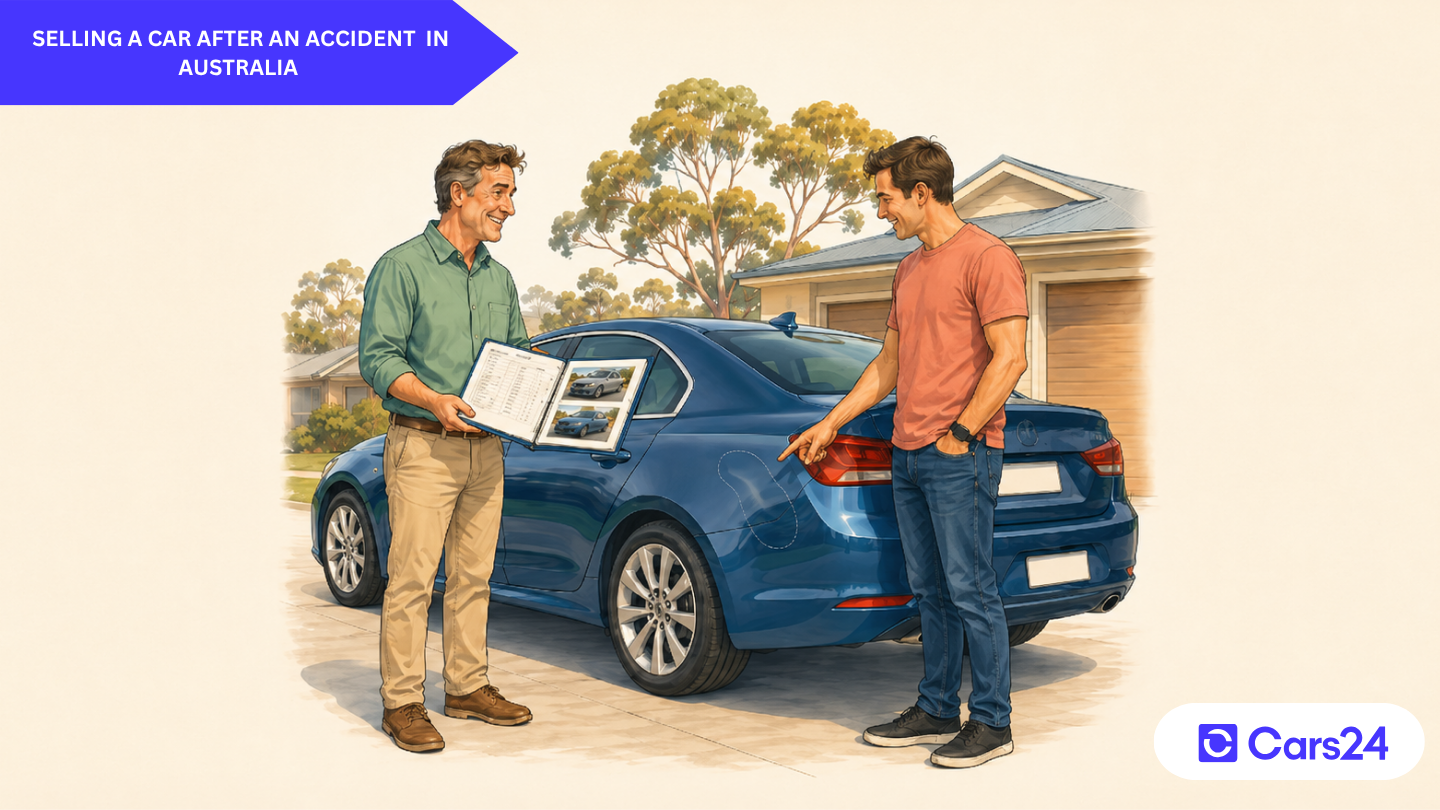
Selling a car after an accident raises an obvious question: what should you tell the buyer? Learn what to disclose, what a PPSR check can miss and how written-off vehicle rules differ across Australia.
Selling a car after an accident in Australia: what should you tell the buyer?
So, your car has been in an accident and now you’re ready to sell. But how much of that history do you actually need to share with buyers?
The repair work is done, the car is back on the road while the invoice is tucked away in a drawer. As time passes, the accident starts to feel like old news. Only for it to resurface when you decide to sell your car.
Suddenly, that old prang is part of the conversation again. Should it go in the ad? What if the buyer never asks? Is a replaced bumper treated the same way as chassis damage or a repairable write-off?
If you are selling a car after an accident, the difficult part is knowing what needs to be mentioned, what can be kept brief and which rules apply where you live. This guide takes you through it, so you know what to tell the buyer and what to keep on record.
Do private sellers have to disclose a car’s accident history?
If this is your own car and you’re selling it privately, this guide is for you. Dealers and car-selling businesses follow a different set of rules.
For a private sale, you do not fill in one Australia-wide form listing every scrape, insurance claim or repaired panel. The ACCC explains that most consumer guarantees do not apply to one-off sales between two people when the seller is not running a business. Guarantees covering ownership, undisturbed possession and undisclosed debts or charges still apply.
That does not give a seller room to invent a cleaner history. Anything you say about the car should match what you know. If it has been in a crash, do not advertise it as “accident-free” or “never crashed”. If the buyer asks about earlier damage, answer from the information you have. When the accident happened before you owned the car, say that instead of trying to fill in the blanks.
Written-off vehicles need closer attention because some states impose specific requirements. In Victoria, the seller must disclose that a vehicle has been written off even when the buyer does not ask. Western Australia’s transfer form asks about written-off status directly. Queensland and South Australia currently treat private sellers differently, as explained in the state table below.
The sensible approach is to tell the buyer about known damage that could affect safety, value or their decision to purchase. That does not mean turning the ad into a repair diary. It means making sure the buyer is not given the wrong impression.
What should you tell the buyer about the accident?
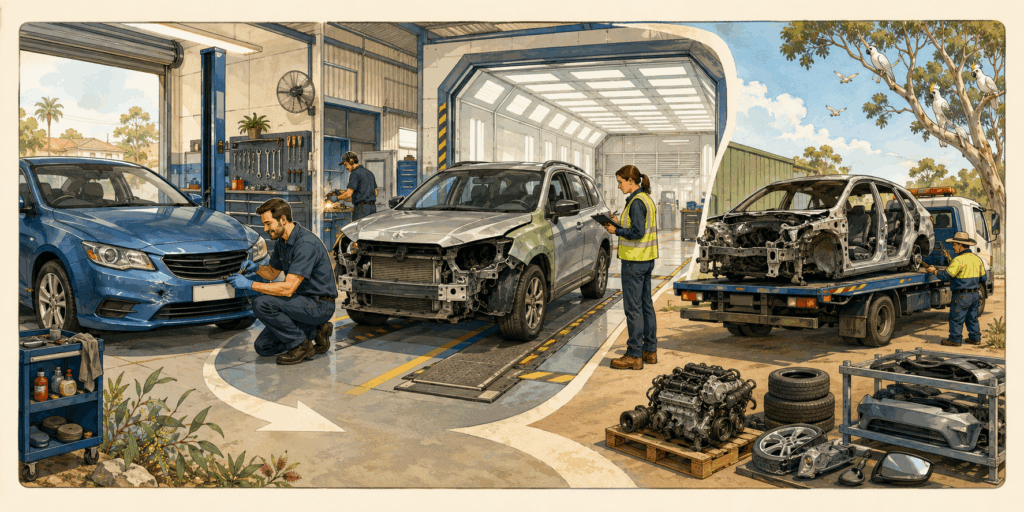
The buyer does not need a minute-by-minute account of the crash. They need enough information to understand what was damaged, how it was repaired and what condition the car is in today. A small repair can be covered in one sentence: “The rear bumper was replaced after a low-speed collision, and I have the repair invoice.”Be upfront about:
- Repairable or statutory written-off status
- Chassis, frame or structural repairs
- Airbags that deployed and whether they were replaced
- Accident damage involving the steering, suspension or brakes
- Body, mechanical or electrical damage that has not been repaired
- Warning lights, leaks, unusual noises or other faults that remain
- Insurance assessments, repair invoices or inspection reports you have
If you are unsure whether damage is only cosmetic, avoid calling it cosmetic until a qualified mechanic or repairer has checked it.
Does an accident automatically make a car a write-off?
For vehicles covered by the local scheme, written-off status generally follows a formal total-loss assessment. An assessor decides whether the vehicle is a total loss and whether it should be classified as repairable or statutory. A repairable write-off is generally based on repair costs and salvage value compared with the car’s pre-damage value. Statutory status is based on prescribed damage criteria.
A repairable write-off may be eligible to return to the road after the required repairs, inspections and registration checks. Approval is not automatic, and the process changes between states and territories.
A vehicle classified as a statutory write-off under the current scheme cannot be re-registered anywhere in Australia. It is generally limited to parts, dismantling or scrap, subject to local rules about which components may be reused.
What changes from state to state when selling a written-off car?
| State or territory | What sellers need to remember |
| Victoria | Tell the buyer before they have to ask. Transport Victoria says written-off status must be disclosed. Also, do not present a roadworthy certificate as proof that the car is mechanically trouble-free. It only confirms that certain safety items met the required standard at the time of inspection. |
| Queensland | A private seller is not currently required to disclose WOVR status. However, if an insurer or another authorised notifier has not recorded a total write-off, the owner must notify TMR before selling or disposing of it. Seller-disclosure reforms are expected in 2027, but they are not yet in force. |
| New South Wales | NSW has stricter rules. A written-off light vehicle generally cannot be re-registered, apart from limited exceptions. If the vehicle does not qualify, it is for parts or scrap. Do not promise a buyer that they can repair and register it. |
| South Australia | CBS SA says licensed dealers must disclose written-off or flood status. Private sellers do not have the same legal requirement. Even so, putting the history in writing gives the buyer a clear record and reduces the chance of arguments later. |
| Western Australia | The MR9 transfer form asks directly whether the vehicle is listed on the WOVR, and the seller declares that the answer is correct. WA Consumer Protection also warns that a seller may be held liable for failing to reveal a known serious defect. |
| ACT | A statutory write-off cannot return to the road. An economic repairable write-off can be repaired and re-registered after meeting the required standards and checks. Access Canberra explains both categories. |
| Tasmania | A statutory write-off cannot be registered. A repairable write-off must pass three stages of inspection covering structural integrity, roadworthiness and identity. The Tasmanian WOVR guide explains the process. |
| Northern Territory | Written-off vehicles must be reported to MVR. When a statutory write-off is offered for sale, it must carry a clear warning label stating that it cannot be registered and is only suitable for parts or dismantling. |
Will a PPSR search reveal every accident?
Only if the damage led to a recorded write-off. A PPSR report checks for registered security interests, usually linked to finance, and includes stolen and written-off information from NEVDIS. It will not uncover every prang, insurance claim or repaired panel. NEVDIS details can also be unavailable or out of date.
Run the search before you advertise, because an interested buyer probably will. Cars24 explains how to read a PPSR report and understand the key difference: “not recorded as written off” does not mean “never damaged”.
Do you need a seller disclosure statement for a damaged car?
Complete the usual sale and transfer paperwork for your state or territory, but do not rely on those forms to explain the car’s full repair history.
Before the buyer agrees to the sale, add a short note about the accident and repairs to the receipt or sale agreement. This gives both of you a clear record of what was disclosed. A short note could look like this, provided every detail is true:
| Accident history: Rear-left bumper and quarter panel repaired after a collision in May 2025. Repair invoice and before-and-after photos provided to the buyer. A PPSR report dated 1 September 2026 showed no recorded write-off. No accident-related problems are known to the seller at the time of sale. The buyer was invited to arrange an independent inspection. |
Keep it short and stick to facts you can prove. Both sides should sign and keep a copy. This note helps show what you disclosed, but it does not replace the official transfer documents or any roadworthy or safety certificate required in your state or territory.
How to sell a damaged car without making the sale messy
- Run a PPSR search and check the rego record to confirm whether the car is registered, repairable or a statutory write-off.
- Get a written assessment or quote before you describe it to anyone and don’t call damage “cosmetic” unless it’s actually been checked.
- Compare the repair quote against the car’s likely value once it’s fixed. No fixed percentage repairs are worth doing; it depends on the car.
- Be honest with your ad and say what was damaged, what’s been fixed and what still needs attention. Skip words like “perfect” or “accident-free” unless you can actually back them up.
- If the car is unsafe or unregistered, don’t offer a normal road test.
- Save the ad, your messages with the buyer, the receipt and the transfer confirmation. For the full list, check the other documents needed to sell a car.
Trading in a car with problems in Australia
Not keen on telling the same accident story to a string of private buyers? A trade-in or direct sale to a dealer can involve less back-and-forth.
The damage still matters. Tell the dealer or car buyer what happened, which repairs were completed and whether anything remains unfixed. An online valuation based on missing or incorrect information may change when the car is inspected.
Before deciding, compare a private sale with selling to a dealer. You can also begin with an online car valuation and enter the condition accurately from the start.
There is no standard accident-history discount. A replaced bumper will be treated differently from chassis damage or a written-off record. The car’s age, kilometres, current condition and repair quality will all affect what a buyer is prepared to offer.
Frequently asked questions
Do I have to tell a private buyer about an old accident?
If you are selling your own car in a one-off private sale, you are not working from a national checklist of every nick, dent and paint repair. Written-off status is where local rules become important. Victoria, for example, requires the seller to disclose it even if the buyer does not ask. Whatever the rules are where you live, keep the ad accurate and answer questions from what you genuinely know.
Can I sell the car once the accident damage has been repaired?
Yes, in most cases. Check the rego and written-off record first, then explain what was repaired and show the buyer any invoices or reports you still have. A vehicle classified as a statutory write-off under the current scheme can be sold for permitted parts, dismantling or scrap, but it cannot return to the road.
What if it was only a scrape in a car park?
A small scuff does not need a dramatic backstory. Show any visible damage in the photos and mention it in the condition description. If the bumper or another part was repaired or replaced, one line is enough: “Rear bumper replaced after a low-speed knock. Invoice available.”
Do I need a seller disclosure statement?
There is no national seller disclosure statement for ordinary private car sales. Complete the transfer paperwork required in your state or territory first. If those documents do not cover the accident history, add a short note to the receipt saying what was damaged, what was repaired and which records the buyer received.
Does “sold as is” stop the buyer from coming back to me?
Treat “sold as is” as a description, not a legal shield. It may help show that the buyer accepted the car in its present condition, but it cannot fix a misleading description or cancel a written-off vehicle requirement. A receipt that lists the known faults is far more useful than those three words on their own.
Can the person who buys my repairable write-off register it?
Maybe, but you should not promise that they can. Repairable write-off rules are different around Australia, and NSW allows repair and re-registration only in limited circumstances. Give the buyer the recorded status, then let the relevant transport authority confirm whether that particular vehicle can be registered.
My PPSR search is clear. Does that prove the car has never crashed?
No. A PPSR search is not a complete accident diary. It may show a recorded write-off when the relevant NEVDIS information is available, but it will not uncover every collision, insurance claim or panel repair. “Not recorded as written off” and “never damaged” are not the same thing.
Will a dealer take a car with accident history as a trade-in?
That comes down to the buyer and the condition of the car. Some dealers and car-buying services consider professionally repaired vehicles, while others may exclude certain damage or written-off records. Share the repair paperwork and describe the condition properly, as any figure given online may change after inspection. You can begin with the Cars24 Sell My Car process to see whether the vehicle meets the applicable acceptance criteria.

Comments
New Comment