




Without a used car buying guide or basic research, the process feels like stepping into a maze. Listings look great, sellers sound convincing, and prices swing wildly between dealers and private sellers.
One wrong move and you could inherit someone else’s nightmare. The real problem isn’t finding a car. It’s knowing how to buy one properly.
That’s why we have compiled this advice on buying a used car, covering a thorough checklist, tips, red flags, negotiation, car history, financing, and more. We’re sure you would walk more confidently towards that used car dealership after reading this.
How to buy a second-hand car? (A roadmap)
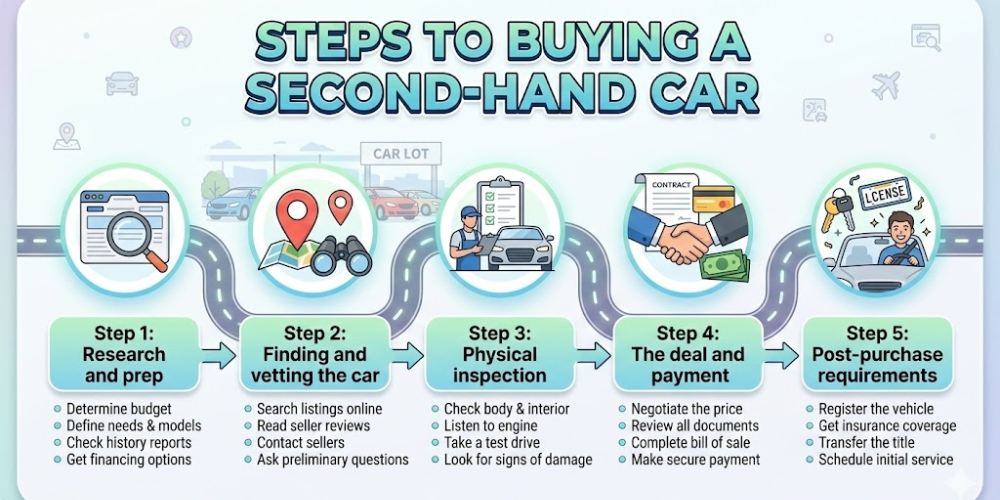
The steps to buying a second-hand car in Australia include research, legal and physical checks, and post-purchase administrative deadlines.
Step 1: Research and the prep work
Setting your budget, identifying your car needs, and researching the car.
Step 2: Finding and vetting the car
Visiting the seller, doing the paperwork, car valuation, and car history check.
Step 3: Physical inspection and test drive
Observing the car yourself, test driving and getting a pre-purchase inspection done.
Step 4: The deal and payment
Negotiating the final price, paperwork, payment, and drive away.
Step 5: Post-purchase requirements
Complete registration transfer, stamp duty, and insurance and have a g’day.
We’ve also written detailed checks and steps to buying a used car in another advice blog.
Things to consider before buying a used car
Before you even browse listings, you must define your day-to-day car usage parameters and the true cost of ownership. Here are some things to know before buying a used car:
1. Defining your needs and lifestyle
Create a checklist of your needs to narrow your used car search. Think about your commute, parking space, local streets, your passengers, cargo, car convenience and safety needs.
2. Establishing a realistic budget
Use the 10–15% rule that suggests spending no more than 10%–15% of your monthly take-home pay on monthly car expenses. Your total monthly debt repayments should not exceed 36% of your gross income. And, you must also include hidden costs like stamp duty and rego transfer fees.
3. Calculating Total Cost of Ownership (TCO)
Before committing to a used car, estimate weekly or monthly cost factors like fuel/charging costs, insurance, maintenance, depreciation/resale value, registration fees, etc.
4. Safety considerations
Newer used cars generally offer better ANCAP ratings and advanced safety technology like reversing cameras and autonomous emergency braking.
Choosing your source: Dealer vs. private vs. auction
Choosing between a car dealer, a private seller, or an auction in Australia involves balancing cost, legal protection and convenience.
| Feature | Licensed dealer | Private seller | Car auction |
|---|---|---|---|
| Price | Typically higher due to overhead and margins | Usually lower; potential for bargains | Potential for significant savings vs retail |
| Legal protection | Includes statutory warranties and cooling-off periods | Generally none | Generally none |
| Test drive | Usually available and encouraged | At the owner’s discretion | Generally not allowed; engine start only |
| Finance | Easy, in-house dealer finance, banks, or brokers | Banks, credit unions, or personal loans | Usually pre-arranged personal or car loans |
| Paperwork | Handled entirely by the dealer | Responsibility of the buyer and seller | Buyer handles fees and registration |
| Vehicle history | Generally clear title; no finance owing | Risk of encumbrance | Guaranteed clear title (no money owing) |
| Consumer guarantees | Full protection under Australian Consumer Law (ACL) | Limited to title, possession, and no hidden debts | Very limited; mainly guarantees a clear title |
What’s the most reliable place to buy a used car?
Licensed dealers offer the most security and reliability but at higher prices, while auctions and private sales can provide significant savings but carry more risk.
Used car buying checklist
To simplify the process of buying a second-hand car, we have categorised the used car checking requirements into five key pillars. Here are all the things to check before buying a used car in a checklist form:
| Category | Checklist |
|---|---|
| 1. History and legal paperwork | PPSR search |
| VIN verification | |
| Proper service history (consistent) | |
| Cross-check the used car’s valuation | |
| Safety certificate (e.g pink slip; as per state law) | |
| 2. Exterior and structural condition | Body panels (paint, dents, ripples, gaps) |
| Rust (on wheels, doors, floor, underbody) | |
| Tyres (uneven wear, tread depth) | |
| Glass and lights (chips/cracks and exterior lights) | |
| 3. Interior and electronics | Safety features (dash warning lights, seat belts) |
| Controls and accessories (AC, windows, locking, infotainment) | |
| Wear and tear (seats, steering wheel, pedals) | |
| 4. Inspection (under the bonnet) | Own look (engine oil, leaks, battery corrosion) |
| Pre-purchase inspection by professional mechanics | |
| 5. Test drive performance | Engine noise (no knocking, ticking, or rattling) |
| Handling (responsive steering, alignment) | |
| Braking (firm pedal, smooth stopping) | |
| Transmission (no delays, slipping, or grinding sounds) | |
| Exhaust smoke (no blue, white or black smoke) |
Used car inspection checklist
A pre-purchase inspection of a used car involves tests like electronic and diagnostic checks with a full ECU scan, fault code retrieval, and EV battery health check. There are also advanced mechanical testing, structural and body analysis, and specialised system verification.
A professional used car inspection uses technology to identify hidden mechanical, electronic, and structural faults. Know more about the used car inspection checklist in the detailed take on “How to inspect a used car?”
A used car test drive checklist
A proper used car test drive checklist often involves observing the car’s behaviour during engine and startup, handling and steering, braking, and gear shifting. You also closely feel the ride quality and look for strange noises, suspension issues, and whether all cabin functions are working well.
If you want a more comprehensive take on what to look for when buying a used car, then this dedicated blog on “used car buying checklist” will be helpful for you.
7 lesser-known tips for buying a used car

Beyond the standard tips of getting a used car mechanical inspection and checking the PPSR, we suggest several lesser-known tactics to uncover a used car’s true condition.
1. The “cold start” requirement
Many engine issues, such as worn valve stem seals or timing chain rattles, only appear when the engine is cold. Ask the seller not to start the car before you arrive to observe these hidden issues.
2. The magnet and paper trick
Take a soft fridge magnet and place a paper against a panel, and see if the magnet sticks through it. If the magnet falls off or feels weak in a spot, that area likely has a damage-hiding plastic filler underneath.
3. Identifying odometer “wind-back”
A low-mileage car isn’t always what it seems. If the digital reading is low, look for physical wear that contradicts it. Inspect the rubber pedals, shiny steering wheels or sagging driver’s seat bolsters, which indicate high usage.
4. Detective work via service stickers
Check the windscreen, the driver’s door jamb, and even the glovebox for small service stickers. If a sticker says “Next service due at 120,000 km” but the odometer says 90,000 km, you’ve found a clear red flag.
5. Check the dry spot
A clean engine bay can actually be a red flag if it has been steam-cleaned right before you arrive to hide leaks. After your test drive, let the car idle for 5–10 minutes and check the ground for any fresh fluid drips.
6. The “gut and home” assessment
How a person maintains their home is often a reflection of how they maintain their car. If buying privately, always meet at the seller’s home (and also verify it matches their ID/registration). Observe how clean and tidy their home and garden look.
7. Electronic stress test
While idling, turn on the AC to max, the rear demister, and the high-beam headlights simultaneously. If the engine stumbles significantly or the interior lights dim heavily, the alternator or battery may be near failure.
Looking for more details on these tips? You will find the article on tips for buying a used car helpful.
12 red flags when buying a used car
We have identified these red flags across categories of history and paperwork, seller behaviour, physical condition, and mechanical performance.
| 🔴Red flags in used car buying |
|---|
| 1. Gaps in service history, missing pages, or non-stamped DIY entries |
| 2. Signs of odometer fraud, like unusual interior wear or a history report |
| 3. A “too good to be true” price, below the market value |
| 4. Any reluctance or refusal to allow a pre-purchase inspection |
| 5. Seller using urgency to rush your decision |
| 6. Unusual meeting spot rather than at a home or business address |
| 7. Flood damage indicators like mildewy smell or rusted screws |
| 8. Concealed damaged or rusted parts or floorboard |
| 9. Uneven tyre wear hinting alignment issues |
| 10. Blue, white or black exhaust smoke |
| 11. Froth on the oil cap or rusty or oily coolant in the radiator |
| 12. Any “on” dashboard warning lights while the car is running |
How to check a used car history?
Verifying a car’s digital and physical paper trail is the only way to ensure you aren’t buying a vehicle with hidden debts, a history of major accidents, or a tampered odometer.
1. The national PPSR check
For a small fee, you get a Personal Property Securities Register (PPSR) report that reveals whether there is an active loan on the car, a “statutory write-off” (can never be registered again) or a “repairable write-off” (damaged but fixed), and its “stolen” status.
2. State-based registration checks (free)
Every state transport authority offers a free “Rego Check” tool. In NSW, you can see the last three odometer readings. A registration expiry check confirms if the car is currently legal to drive. You can also match the car description from the document.
3. The physical service logbook
Look for consistent service stamps from reputable mechanics every 10,000 km or 12 months. Observe the unusual entries in the logbook like fresh ink for old logs. You can also contact the service workshop to verify the service history.
4. Comprehensive commercial reports
If the PPSR isn’t detailed enough, companies like Cars24 Australia offer “car history reports” that compile various information about the used car.
5. Physical “detective” work
If paperwork is missing, the car itself often hides its history. Check for service stickers, replacement stickers under the bonnet, and observe the interior wear vs. the odometer reading.
6. Manufacturer/dealer database
You can often walk into a manufacturer’s dealership service centre with the VIN. Request, and they may confirm if the warranty is still valid and if the service schedule is up to date.
A more detailed blog on checking a used car history will make you more confident while checking a car’s background.
How to negotiate when buying a second-hand car?
Negotiating for a used car requires understanding the seller’s professional level and the environment of the sale. And don’t forget to check the used car’s valuation beforehand. Here is how to negotiate better when buying a second-hand car from different sellers:

1. Negotiating with a licensed dealer
Dealers are professional negotiators who usually focus on drive-away prices and monthly payments to hide margins. Always negotiate the total final cost.
If a dealer won’t budge further on the car’s price, pivot to negotiating for value-adds like free servicing, new tyres, window tinting, or floor mats. Visit at the end of the month, quarter, or financial year when salespeople are under pressure to meet targets.
2. Negotiating with private sellers
Private sellers are often emotionally attached or in a hurry, providing more flexibility but less protection. Use evidence-based haggling, don’t just ask for a lower price; justify it using the cost of upcoming repairs identified during your inspection.
Identify their motivation for selling. If they are moving overseas or have already bought a new car, they may prioritise a quick, hassle-free sale over the highest possible price.
Use the “if/then” technique. Silent tactics can also work. Stop talking, and let the seller fill the silence; often, they will counteroffer or justify why they can’t go lower, revealing their bottom line.
A brief guide to used car finance in Australia
Securing finance for a used car depends heavily on the purchase method, as lenders perceive different risk levels between a licensed dealer and a private individual.
1. Buying from a licensed dealer
Dealers often provide one-stop-shop financing through linked credit providers. While fast, dealer finance may include balloon payments (large final lump sums) and higher fees to cover commissions.
2. Buying from a private seller
Lenders view private sales as higher risk due to the lack of statutory warranties. To protect their interest, lenders will require a finance inspection to verify the VIN, odometer, and condition. You must provide the seller’s ID, bank details (matching their ID), and a copy of the current registration certificate.
Understand state-wise safety inspections for used car buying
While all states require proof of identity, a bill of sale (receipt), and a transfer of registration form, the requirements for safety inspections vary significantly.
| State | Inspection name | When is it required? | Validity |
|---|---|---|---|
| QLD | Safety Certificate | Before advertising a registered vehicle for sale | 2 months or 2,000 km (whichever comes first) |
| VIC | Certificate of Roadworthiness (RWC) | For the transfer of a registered vehicle privately | 30 days from issue |
| NSW | Safety Inspection Report (Pink Slip) | If the vehicle is >5 years old at the time of registration renewal. | 6 months from issue |
| ACT | Roadworthy Certificate | For vehicles >6 years old at the time of sale | Check with Access Canberra |
| WA | None | Not required for most private sales | N/A |
| SA | None | Not required for private sales | N/A |
| TAS | None | Not required for standard private sales | N/A |
| NT | Roadworthy Inspection Report | Only for certain circumstances (e.g., vehicles over a certain age or type) | Check with NT MVR |
Finalising the purchase of a used car
Finalising a used car purchase involves a handoff of legal responsibility from the seller to you.
What are the final checks before buying a used car?
These are the final checks before buying a used car to ensure it matches the contract. Firstly, you see that there is no new damage (e.g., fresh dents) since the initial inspection and recheck the odometer.
You verify that all included items are present, such as the original logbook, service manual, and tool kit. Then you review the final paperwork.
The paperwork for making it yours
To complete the sale, you must gather specific documents that prove ownership and roadworthiness: Proof of Purchase (receipt/invoice), Registration Certificate (“rego” papers), Notice of Disposal (NOD) (seller lodges it), and Safety/Roadworthy Certificate (as per your state).
Tasks after you buy the car
These are Transfer of Registration (14-day window), payment of stamp duty, insurance, and e-toll updation for the “new” used car.
Final words
Used car buying guide comes down to three things: checks, true condition, and calm. Sometimes, thinking like you want to sell your car also helps to identify hidden car issues and negotiate better. Don’t rush it, trust the evidence, and finalise the transaction with clean paperwork.

Comments
New Comment