




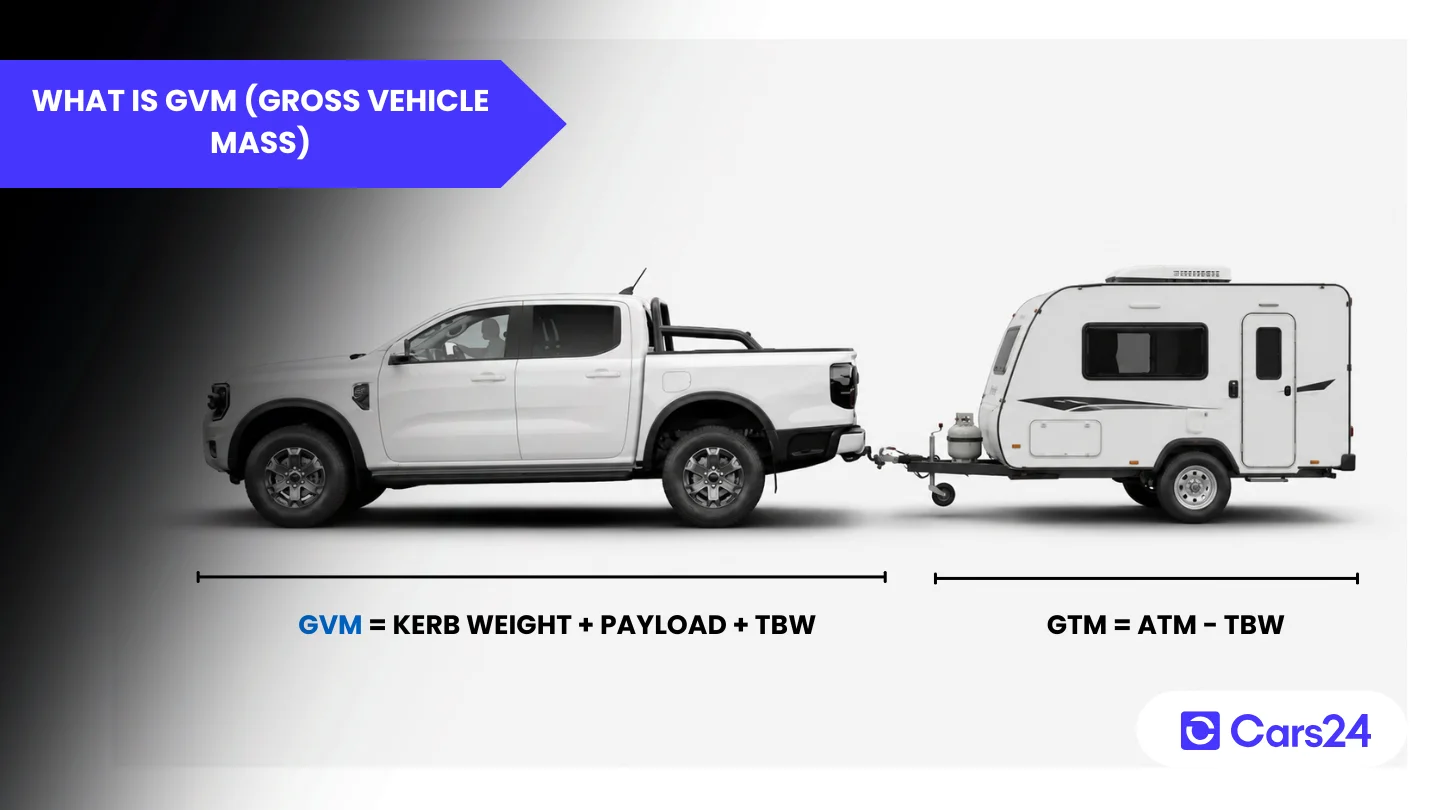
You’d be surprised how quickly a tough-looking ute or 4WD can run out of legal carrying capacity in Australia. You add up the weights and find out that a vehicle, ready for the Outback, is overloaded before the caravan is even attached.
That’s why you need to understand legal GVM (Gross Vehicle Mass) in Australia, GVM upgrade laws and regulations, different weight terms, and more to stay safe on the road and within the legal weight limits.
What is GVM (Gross Vehicle Mass)?
Gross Vehicle Mass (GVM) is the maximum total weight (in kg or tonne) a vehicle is legally allowed to weigh when fully loaded, including the vehicle itself, fuel, passengers, cargo, accessories, and even tow ball weight. It is calculated as kerb weight plus payload. Think of it as the vehicle’s hard ceiling. Go over it, and you’re not just unsafe but illegal, too.
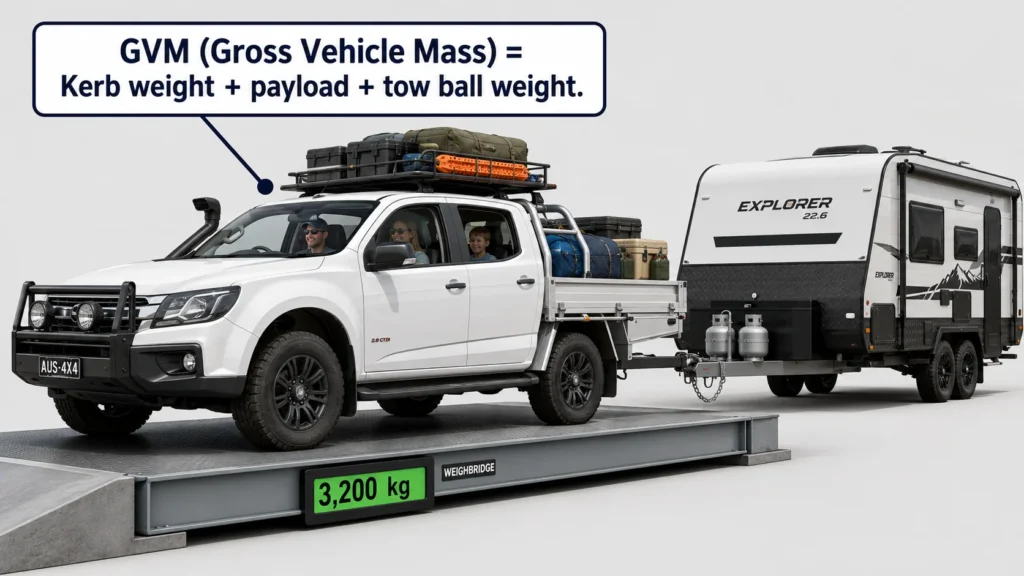
GVM calculator: What factors make up your vehicle’s GVM?
GVM = Kerb Weight + Payload
- Kerb Weight = The vehicle’s weight as it rolls off the factory floor (full fuel tank, no passengers, no cargo)
- Payload = Everything you add: people, dogs, tools, cargo, camping gear, bullbars, canopy, roof rack, water tanks plus tow ball weight (TBM/TBW)
Example: Toyota HiLux
- Specification: HiLux SR5 Dual Cab (typical)
- GVM: 3,200 kg
- Kerb Weight: ~2,100 kg
- Calculated Payload: 1,100 kg
That 1,100 kg payload sounds like a lot. But watch how quickly it disappears:
- Driver + passenger: 180 kg
- Two kids in the back: 80 kg
- Bullbar: 70 kg
- Canopy: 80 kg
- Roof rack + roof top tent: 100 kg
- Fridge + camping gear: 100 kg
- Full water tanks (100L): 100 kg
- Tools + recovery gear: 80 kg
- Total weight or payload: 790 kg
You’ve only got 310 kg left for a trailer ball weight, a load of firewood, or that new dual-battery system.
What does “4.5 tonnes GVM” mean?
If your vehicle has a 4.5-tonne GVM, it means the absolute maximum your vehicle can weigh when fully loaded with fuel, passengers, cargo, and accessories is exactly 4,500 kilograms. 4.5 tonnes GVM is the exact legal boundary line in Australia that separates a standard light passenger vehicle from a heavy commercial vehicle.
Where can you find your vehicle’s GVM?
You can find your vehicle’s Gross Vehicle Mass (GVM) on the compliance plate, owner’s manual, or state registration records. The compliance plate, usually on the driver-side B-pillar or firewall, is most accurate, listing VIN, build date and weight ratings in kg. Registration certificates from authorities like VicRoads or Transport for NSW also display official GVM details digitally or on paper.
Readers also asked: What’s the average weight of a car in Australia?
Why should you care about GVM?
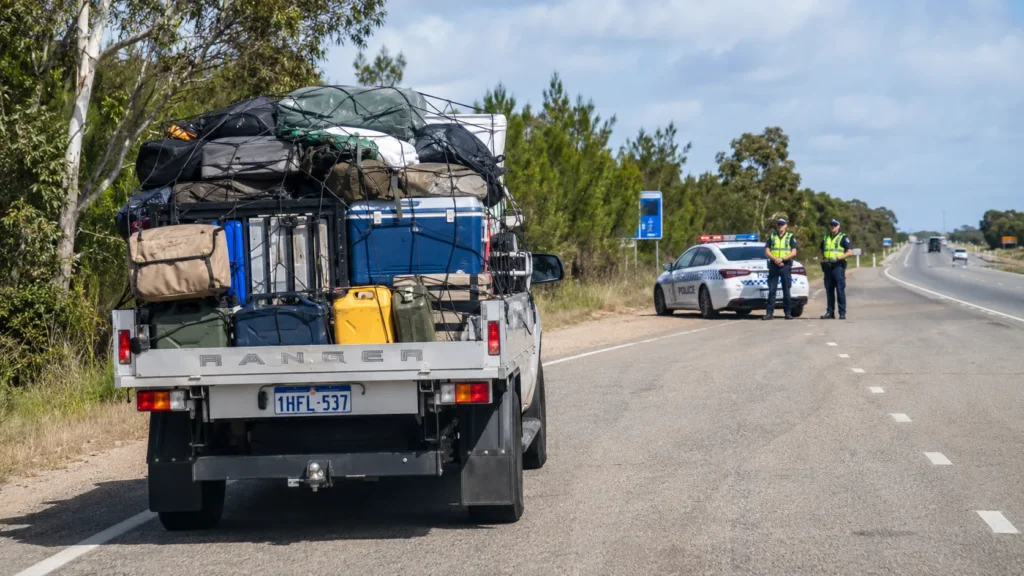
Driving over your vehicle’s GVM can affect safety, insurance, warranty coverage, and legal compliance in Australia. Police and transport authorities may inspect overloaded vehicles using portable scales and weighbridges.
1. You void your warranty. Exceed GVM and have a suspension failure? The manufacturer will reject your claim.
2. Your insurance is invalid. Crash while overloaded? The insurer can (and will) deny your claim.
3. You’re breaking the law. Police can pull you over and weigh you. Fines and demerit points vary by state.
4. Your vehicle becomes dangerous. Brakes overheat. Tyres blow. Handling becomes unpredictable. You’re not just risking your licence; you’re risking lives.
5. Workplace liability (for tradies and businesses). Company directors, fleet managers, and drivers can face massive corporate fines and criminal prosecution for overloaded vehicle accidents.
What are the key vehicle weight terms every Aussie driver should know?
| Term | What it means | Typical unit |
|---|---|---|
| GVM (Gross Vehicle Mass) | Maximum total weight of the vehicle when fully loaded (including TBM) | kilograms (kg) or tonnes (t) |
| GCM (Gross Combined Mass) | Maximum total weight of vehicle + trailer/caravan combined | kilograms (kg) or tonnes (t) |
| Towing Capacity | Maximum legal weight your vehicle is allowed to pull behind it | kilograms (kg) or tonnes (t) |
| GTM (Gross Trailer Mass) | Maximum weight resting on the trailer’s wheels/axles when hitched to a car | kilograms (kg) or tonnes (t) |
| ATM (Aggregate Trailer Mass) | Total weight of the trailer when fully loaded (including tow ball weight) unhitched from a car | kilograms (kg) or tonnes (t) |
| Tare Weight (Tare) | Empty vehicle weight with only 10 litres of fuel (No people, luggage, or accessories) | kilograms (kg) or tonnes (t) |
| Trailer Tare | Empty trailer weight with (No people, luggage, or accessories) | kilograms (kg) or tonnes (t) |
| Kerb Mass (Kerb) | Vehicle weight as it leaves the factory (full fuel, no people, no cargo) | kilograms (kg) or tonnes (t) |
| Payload | Maximum weight you can add to the vehicle (people + cargo + accessories) | kilograms (kg) |
| TBM/TBW (Tow Ball Mass / Weight) | Weight pressing down on the tow ball (typically 10% of trailer weight) (Counts toward GVM) | kilograms (kg) or tonnes (t) |
| GRTM (Gross Road Train Mass) | Maximum legal total weight of an operational road train | tonnes (t) |
Why does GVM matter for towing?
Tow Ball Mass (TBM) counts toward your vehicle’s GVM. In Australia, TBM commonly sits around 10% of trailer weight, meaning a 3,000kg caravan can add roughly 300kg directly to your available payload. After passengers, accessories, and cargo are added, many utes and SUVs can approach their legal GVM limits quickly while towing.
What are the legalities and regulations surrounding GVM in Australia?
GVM is regulated by federal and state laws in Australia. Exceeding your vehicle’s legal weight limit can lead to fines, defect notices, insurance issues, and safety risks.
1. Legal GVM upgrades
GVM upgrades can be done either:
- before registration under the national SSM scheme, or
- after registration with engineering approval and state certification.
2. Enforcement and penalties
Police and NHVR officers use portable scales and weighbridges to identify overloaded vehicles. Drivers may be fined, defected, or required to remove excess weight before continuing.
3. Insurance and liability
Driving over GVM may affect insurance claims and increase legal liability if an accident occurs.
4. Safety compliance
Approved GVM upgrades must still comply with Australian Design Rules (ADRs) for braking, stability control, tyres, suspension, and axle load limits.
How to legally weigh your vehicle?
The most accurate and legally recognised way to weigh your vehicle in Australia is by using a certified public weighbridge. This weight printout acts as proof of compliance for transport authorities, insurers, or engineers.
Step 1: Find a certified public weighbridge
Search the National Measurement Institute (NMI) registry or visit waste transfer stations, metal recyclers, landscape suppliers, and major truck stops like Shell, BP or Coles Express. Most charge AUD$20–40 per weighing session.
Step 2: Load the vehicle exactly as you drive it
Prepare the vehicle exactly as used on-road to get a true legal operating weight with fuel tanks, accessories, luggage, camping fridges, tools, food and recovery equipment. All regular passengers and pets should sit inside during weighing to replicate real-world GVM conditions accurately.
Step 3: Use the “3-weight” method for towing
If you are towing a caravan, boat or trailer, perform three separate weighings. This method provides the most accurate legal towing data.
- Weight 1: Entire connected rig to measure Gross Combination Mass (GCM)
- Weight 2: Disconnect the tow vehicle and leave only the trailer on the scale to calculate Actual Trailer Mass (ATM)
- Weight 3: Drive only the fully loaded tow vehicle (trailer hitched) to measure the actual Gross Vehicle Mass (GVM)
You have to ensure that Actual GVM and Actual Trailer Mass remain under the legal limits.
Step 4: Calculate Tow Ball Mass (TBM/TBW)
Use your weighbridge tickets to calculate Tow Ball Mass, which directly affects legal payload and rear axle loads. TBM is usually about 10% of trailer weight.
TBM (Tow Ball Mass) = Weight 3 or weight of the car alone when hitched to trailer (GVM) – Weight of the car alone without hitching
If no public weighbridge is nearby, mobile weighing services use portable electronic wheel scales to measure GVM, GCM and left-to-right axle distribution directly at your driveway.
What is a GVM upgrade, and should you upgrade?
A GVM upgrade involves swapping out factory components for heavier-duty suspension, brakes, and sometimes tyres and chassis to legally increase your vehicle’s GVM. It’s certified by an engineer who also updates your vehicle’s legal paperwork.
| Yes. Seriously consider a GVM upgrade | Do you need a GVM upgrade? |
|---|---|
| School run, commute, occasional Bunnings trip | No. Standard GVM is fine |
| Weekend camping with a family | Unlikely. Check your payload carefully |
| Full-time touring with a rooftop tent, fridge, water, and gear | Yes. Seriously consider GVM upgrade |
| Towing a caravan or boat | Highly likely. Check GCM, not just GVM |
| Using a canopy, bullbar, winch, and dual batteries | Yes. These eat payload fast. Weigh everything. |
| Trade/work vehicle with a tray full of tools, building materials, or diesel tanks | Yes. The weights usually push work utes past their 1-tonne limits |
FAQs about GVM (Gross Vehicle Mass) in Australia
What’s the difference between GVM, ATM, and tare weight?
GVM is the maximum legal loaded weight of your vehicle, while ATM is the maximum legal loaded weight of a trailer or caravan when unhitched. Tare weight refers to the unloaded weight of a vehicle or trailer before passengers, cargo, or accessories are added. The difference between tare weight and GVM is your available payload capacity.
What is GVM vs ATM vs tare?
- GVM (Gross Vehicle Mass): The maximum legal weight limit of your loaded car.
- ATM (Aggregate Trailer Mass): The maximum legal weight limit of your loaded trailer (unhitched).
- Tare Weight: The baseline weight of either your car or your trailer before anything is loaded into it.
What does a 4.5-tonne GVM mean for my license?
A 4.5-tonne GVM is the legal threshold separating light vehicles from heavy vehicles in Australia. Vehicles rated at 4,500kg GVM or below can usually be driven on a standard Class C licence, while vehicles above this limit may require a heavy vehicle licence and additional compliance requirements.
What is the 80/20 rule for towing?
It is an unofficial but recommended safety guideline that states: The total loaded weight of your trailer or caravan should not exceed 80% of your tow vehicle’s total weight, leaving a 20% safety margin.
Can a Hilux tow 3500kg without exceeding GVM?
No, a standard Toyota HiLux cannot realistically tow 3,500 kg in real-world conditions without exceeding its legal GVM or GCM limits. Considering a factory Kerb of 2,110kg, the HiLux would need to have less than 240kg of payload only, which is even less than the 350kg of TBM (Tow Ball Mass) exerted by the 3.5 tonne trailer.
Do I need a GVM upgrade for towing a caravan?
Whether you need a GVM upgrade for towing a caravan depends entirely on the loaded weight of your caravan and how much gear you pack into your tow vehicle. You likely need a GVM upgrade if your caravan is heavy, the car is heavily modified, and you travel fully loaded.
Is 2.5 tonnes heavy for a car?
Yes, 2.5 tonnes (2,500 kilograms) is considered heavy for a standard passenger car, but it is the average weight for modern Australian 4WDs and dual-cab utes.

Comments
New Comment