




Most car buyers spend hours comparing purchase prices and almost no time thinking about the one cost that often matters more: depreciation. Over a typical ownership period, it can gradually take more out of your pocket than petrol, insurance and servicing combined.
Most buyers compare what a car costs today. Fewer think about what it might be worth in three or five years. That gap between what you pay and what you get back is where car depreciation really hits.
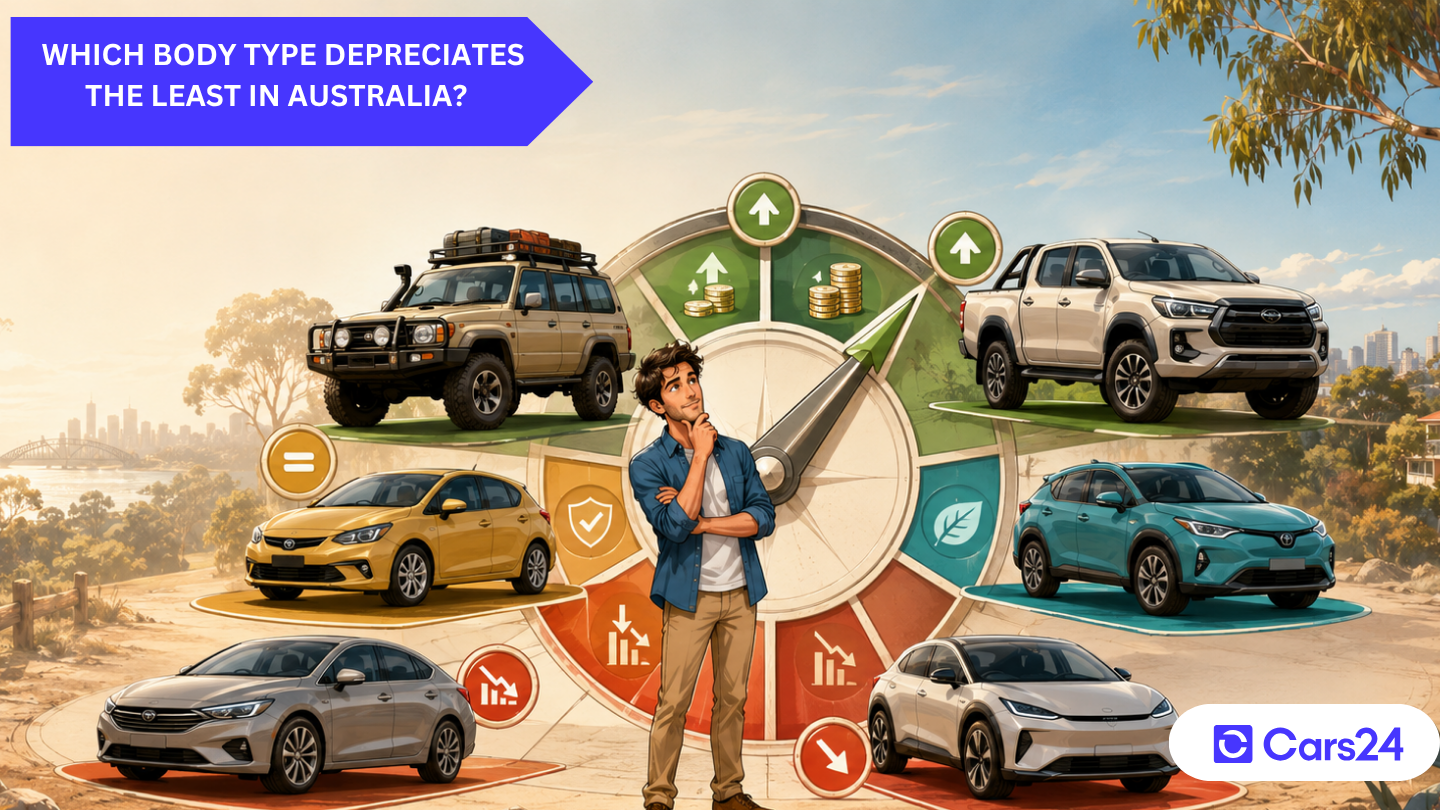
So which body type loses the least value in Australia? The answer is more useful than a simple ranking. The body types that hold value best are the ones with the deepest used-car demand: off-road SUVs and 4WD wagons, dual-cab 4×4 utes, hybrid SUVs and proven small cars. But body type is only the first filter. The model, fuel type, kilometres, condition and service history do the real work.
A clean Toyota Corolla can hold value better than a tired SUV. A well-kept Ford Ranger can stay in demand for years. A Toyota RAV4 Hybrid benefits from both SUV demand and hybrid running-cost appeal at the same time. The body type gets a car onto your shortlist. The right used example decides whether it stays there.
Quick answer
In Australia, off-road SUVs, 4WD wagons and dual-cab 4×4 utes tend to depreciate the least. Hybrid SUVs and reliable small cars also hold value strongly. The strongest individual performers are specific models, including Suzuki Jimny, Toyota LandCruiser, Toyota RAV4 and Ford Ranger, not entire body type categories.
What the data actually shows
Public Australian retained-value data is grouped into broader segments such as Passenger, SUV, LCV-Utes and EVs, rather than neatly ranking every body shape. That actually makes the answer more useful, because the pattern is more interesting than a simple ladder.
Source note: The retained-value figures in this section are drawn from AADA’s June 2025 Automotive Insights Report. These figures are report-based rather than repeated on every public webpage, so they should be read alongside the report.
For 2023 model-year vehicles, roughly 2 to 3 years old, the report recorded the following average retained values:
- LCV-Utes: 90.3%
- Passenger: 88.5%
- SUV: 84.3%
- EV: 68.0%
For 2020 model-year vehicles, roughly 5 to 6 years old, the same report showed:
- Passenger: 78.9%
- LCV-Utes: 76.5%
- SUV: 74.2%
- EV: 45.9%
Near-new utes look especially strong. Older passenger cars perform better than most people assume, and can outperform the average SUV category once a car passes the five-year mark. EVs trail the broader market across both windows.
At model level, the picture sharpens further. The Suzuki Jimny recorded 111.7% retained value among 2 to 4-year-old SUVs and 115.0% among 5 to 7-year-old SUVs in the same AADA report. Toyota Corolla, Toyota Camry, Kia Picanto, Honda Jazz and Toyota Yaris also appeared strongly in passenger-car retained-value lists.
The strongest answer is not “buy any SUV.” It is this: choose a body type Australia keeps wanting used, then find the right example inside it.
Why SUVs are not the automatic answer
SUVs dominate Australian roads because they suit families, road trips, school runs, regional driving and the general need for space without buying something too specialised. FCAI reported SUVs at 60.7% of total new-vehicle sales in Australia in 2025, with light commercial vehicles at 22.6% and passenger vehicles down to 13.0%, and falling 22.6% year on year, in its 2025 Australian new-vehicle market summary.
But popularity in the new-car market does not automatically translate to strong resale value in the used market.
An oversupplied SUV with poor fuel economy or weak demand can still lose value quickly. A small car with strong brand trust and low running costs can remain easy to sell for years. That same demand logic is what makes off-road SUVs, utes, hybrids and small cars each worth looking at separately, because they hold value for different reasons.
Body type depreciation in Australia: the practical ranking
| Body type | Outlook | What drives resale value |
| Off-road SUVs and 4WD wagons | Strongest | Touring, towing, regional demand and trusted nameplates keep buyer pools deep |
| Dual-cab 4×4 utes | Very strong | Work, family and towing use cases give utes a wide second-hand buyer base |
| Hybrid SUVs and hybrid passenger cars | Strong | Lower running-cost appeal, especially in trusted Toyota models |
| Small hatchbacks and reliable passenger cars | Strong | Affordability, easy ownership and steady demand from first-car and city buyers |
| Mainstream SUVs | Good, but mixed | High demand, but resale depends heavily on model, variant and supply |
| Sedans | Mixed | Camry, Corolla and i30 Sedan hold up, while large or low-demand sedans face a smaller buyer pool |
| EVs and luxury cars | More volatile | New-car price changes, tech shifts, battery concerns and higher running costs affect resale |
This is a guide, not a guarantee. A rough ute will not hold value just because it is a ute. A clean hybrid sedan can outperform a petrol SUV if buyers trust it, running costs are lower and the price is right.
Off-road SUVs and 4WD wagons: strong because they solve Australian problems
The strongest SUV resale stories are not just about size. They are about purpose.
Models like the Suzuki Jimny, Toyota LandCruiser, Toyota LandCruiser Prado, Toyota RAV4, Nissan Patrol, Toyota Fortuner, Ford Everest and Isuzu MU-X suit the way many Australians actually drive: long trips, towing, camping, regional roads and family travel. That gives them a second-hand buyer pool that stays active even as the car gets older.
The AADA Automotive Insights Report backs this up directly. The Suzuki Jimny led the 2 to 4-year-old SUV retained-value list at 111.7% and also led the 5 to 7-year-old list at 115.0%. Toyota LandCruiser recorded 101.4% in the 2 to 4-year category and 93.3% in the 5 to 7-year category. Toyota RAV4 was at 98.0% for 2 to 4-year-old SUVs and 83.0% for 5 to 7-year-old SUVs.
The best SUV resale performers usually have a clear use case, strong badge trust and limited buyer hesitation. Before choosing a used SUV, ask whether the model has demand beyond its first owner. If the answer is yes, the resale case starts to make sense.
That same use-case logic, one car doing several jobs well, is exactly what makes utes one of Australia’s strongest resale stories.
Utes hold value because they are work cars and lifestyle cars
A dual-cab 4×4 ute can be a work vehicle, family car, towing vehicle and weekend car all at once. That versatility gives models like the Ford Ranger, Toyota HiLux, Isuzu D-MAX and Mitsubishi Triton a wide pool of second-hand buyers who are not going away any time soon.
Models such as Ford Ranger, Toyota RAV4, Toyota HiLux, Isuzu D-MAX and Ford Everest were among Australia’s strongest-selling vehicles in 2025, according to FCAI’s 2025 new-vehicle sales summary. The used market tells the same story. Ford Ranger and Toyota HiLux were among the top used models sold nationally in AADA’s June 2025 data.
For anyone comparing used utes, condition is the deciding factor. A clean dual-cab 4×4 with full service history is a very different car from a hard-worked ute with heavy towing wear, poor modifications or tired suspension. Buyers check the tray, tow bar, tyres, underbody, brakes and service records carefully, and they should.
Utes hold value because Australia keeps needing them. The good examples hold value better because buyers can trust them.
That trust factor travels across body types. It is also why small cars continue to punch above their weight in the used market.
Small cars are underrated because affordability still sells
Small cars no longer dominate new-car sales, but they still matter in the used market. A Toyota Corolla, Toyota Yaris, Hyundai i30, Mazda3, Kia Picanto, Suzuki Swift or Honda Jazz stays attractive because it is easy to understand, easy to park and usually cheaper to run than a larger car.
When buyers are watching fuel, insurance, maintenance and loan repayments, those things matter.
AADA’s June 2025 retained-value data for 2 to 4-year-old passenger cars showed Toyota Corolla at 97.1%, Kia Picanto at 95.0%, Toyota Camry at 94.3% (now mostly sold as a hybrid) and Hyundai i30 at 88.7%. For 5 to 7-year-old passenger cars, familiar small-car names such as Honda Jazz, Toyota Corolla, Toyota Yaris and Kia Picanto also appeared strongly in the retained-value lists.
A small car does not need to be fashionable to hold value. It needs to be trusted, affordable and easy to live with. For first-car buyers, students, city commuters and households looking for a second car, that can be more persuasive than a larger body type.
If you are comparing used hatchbacks, this is where kilometres, service history and ownership history become just as important as the badge.
Sedans fit the same logic, and they are more relevant than their reputation currently suggests.
Sedans are less fashionable, but not automatically poor value
Sedans have lost ground because SUVs now dominate family buying. That shift is real, but it does not make every sedan a weak resale choice.
A Toyota Camry Hybrid, Toyota Corolla Sedan, Hyundai i30 Sedan, Mazda3 Sedan or Kia Cerato Sedan can still appeal to commuters, rideshare drivers and buyers who do not need SUV height or a bigger footprint. They often offer comfortable highway driving, usable boot space and better value than an SUV of similar age and kilometres.
The Toyota Camry is the clearest example of why body type alone can mislead. As the current Camry range in Australia is hybrid-only, it belongs in a different conversation entirely. The AADA June 2025 report placed the Toyota Camry at 94.3% retained value for 2 to 4-year-old passenger cars, which is a stronger result than many mainstream SUVs in the same age bracket.
So when comparing used sedans, do not dismiss the body type. Check the model, fuel type, kilometres and ownership history. A trusted sedan with low running costs can still be a sharp used-car buy. Fuel type, particularly hybrid, is increasingly the factor that makes or breaks that verdict.
Hybrids are changing the depreciation conversation
In 2026, how a car holds value is not just shaped by its body type. Fuel type is shifting buyer demand in ways that cut across every category.
AADA reported 28,395 used hybrid vehicles sold nationally between January and April 2026, representing 11.2% of all used sales for 2021 to 2025 model-year vehicles, in its Used Hybrid and PHEV Market report. Used hybrid supply tightened from 53.8 days in January to 42.3 days in April. That is a meaningful signal: buyers are actively choosing lower running costs, and supply is not keeping up with demand.
The same report said 2025 model-year hybrids averaged more than 100% retained value, while 2021 model-year hybrids still averaged 88.2% of original purchase price. Toyota RAV4 and Corolla models accounted for eight of the top 10 used hybrid models by sales volume.
A Toyota RAV4 Hybrid benefits from SUV demand and hybrid demand simultaneously. A Corolla Hybrid benefits from small-car practicality and hybrid running-cost appeal. A Camry Hybrid can make the sedan format feel far more relevant to used buyers than the shape alone suggests.
In the current market, hybrid demand is not a bonus feature. It is actively changing which cars hold value and which do not.
EVs can be good used buys, but resale is more volatile
Used EVs need a balanced read, and it depends which side of the transaction you are on.
For buyers, EV depreciation can create real opportunity. If a used EV has already absorbed a bigger value drop, the entry price can be more accessible than buying new, especially with charging infrastructure continuing to improve and most daily driving well within modern EV range.
For anyone buying with resale in mind, the picture is less settled. EV values can be affected by new-car price changes, battery-health concerns, charging habits, warranty balance, fast-moving technology and brand-new model releases. AADA’s June 2025 data showed EV retained values trailing Passenger, SUV and LCV-Ute averages across both model-year windows, with 68.0% for 2023 EVs and 45.9% for 2020 EVs.
A used EV can make sense when the numbers are right. Check battery warranty, real-world range, service support and how the asking price compares with current new-car deals. But if avoiding depreciation is the main goal, hybrids are currently the more stable choice in the Australian used-car market.
What affects car depreciation more than body type?
Body type is useful, but it cannot save a poor example of a car.
Two cars can share the same make, model, year and body type and sell very differently because one has clean service history, sensible kilometres and straightforward ownership, while the other has accident history, missing records and obvious wear.
Kilometres matter because they show how much the car has been used. Service history shows how it has been cared for. Accident history, finance owing and PPSR status affect buyer confidence before a conversation even starts. Variant matters too: a popular trim or drivetrain can hold value better than a low-demand version of the same model.
If you want to compare more than the body type alone, start with used cars in Australia and narrow your search by body style, budget, kilometres, fuel type and features.
How Cars24 helps you compare used cars with more context
Choosing a body type is only one part of buying a used car. The harder part is knowing whether the actual car in front of you has the condition, history and ownership details to support its price.
Cars24 certified used cars include a 300-point inspection, Car Condition Report, RWC and PPSR, giving buyers more information before making a decision. Eligible certified cars also come with a 30-Day Return Guarantee*, 3-month warranty and roadside assistance.
For more detail on warranty protection, you can read the Cars24 guide on used car warranty in Australia. If vehicle history is a priority, the Cars24 car history check page explains how PPSR, registration and vehicle history information can support a more informed used-car purchase.
No used-car platform can honestly promise lower depreciation. What inspection and history transparency can do is reduce the risk of buying an example that depreciates faster than it should because the seller had nothing to hide.
How to calculate car depreciation before buying used
You do not need a complicated car depreciation calculator to understand the basic number.
Depreciation amount = Original price minus current market value
Car depreciation rate = Depreciation amount divided by original price x 100
For example, if a car originally cost $50,000 and is now worth $35,000, the depreciation amount is $15,000. The car depreciation rate is:
$15,000 divided by $50,000 x 100 = 30%
You can also use retained value to look at depreciation from the other side.
If a 2023 model-year ute segment has an average retained value of 90.3%, a car originally priced at $50,000 would retain about $45,150 in value. That means the estimated depreciation is $4,850, or 9.7%.
If another segment has a retained value of 68.0%, the same $50,000 starting price would suggest a retained value of $34,000. That means estimated depreciation of $16,000, or 32.0%.
That is why the car depreciation rate matters more than the listing price alone. Two cars can cost similar money today but behave very differently when you sell them later.
Treat the calculation as a guide, not a verdict. Advertised prices and actual sale prices can differ, and a cleaner car with better history will often sit above the average for its model. Use the calculation to compare smarter, then dig into the actual kilometres, condition, service records, fuel type and how many similar examples are already listed.
So, which body type should you buy if resale value matters?
Start where Australian used-car demand is strongest. Off-road SUVs and 4WD wagons make sense when they have proven demand, clean history and the right badge. Dual-cab 4×4 utes are strong when they have not been worked too hard. Hybrid SUVs and hybrid passenger cars are increasingly compelling because lower running costs now matter more to buyers.
Reliable small hatchbacks remain smart for affordability and simple ownership. Sedans are not a write-off either, especially when they are efficient, trusted and priced well against comparable SUVs.
If you are leaning towards Toyota because of its strong presence across retained-value examples, you can also compare used Toyota cars across SUVs, hatchbacks, sedans, utes and hybrids.
Final verdict
In Australia, resale strength follows demand. Off-road SUVs, 4WD wagons, dual-cab 4×4 utes, hybrid SUVs and proven small cars keep performing because used buyers still want them.
The data does not support a lazy “SUVs always win” answer. Near-new utes regularly outperform them, and older passenger cars can surprise people too. Standout models, including Suzuki Jimny, Toyota LandCruiser, Toyota Corolla, Toyota RAV4 and Toyota Camry Hybrid, can outperform their broader categories by a significant margin.
When thinking about used car depreciation Australia-wide, the question that matters most is not “is this an SUV or a sedan?” It is: will the next buyer want this car too? If the answer is yes, the car has a better chance of holding its value. If it is not, no body type will save it.
FAQs
Which body type has the best resale value in Australia?
Off-road SUVs, 4WD wagons and dual-cab 4×4 utes generally have the strongest resale value in Australia. Hybrid SUVs and reliable small cars also perform well when model, condition and kilometres are right.
Do SUVs depreciate less than sedans?
Not automatically. SUVs dominate new-car demand but do not always depreciate less than every sedan. A Toyota Camry Hybrid or Toyota Corolla Sedan can hold value better than a low-demand SUV with poor condition or high kilometres.
Do utes hold their value in Australia?
Popular dual-cab 4×4 utes hold value well because they suit work, towing, regional driving and weekend lifestyle needs. Ford Ranger and Toyota HiLux are key examples, but condition and service history still determine the final value.
Are hatchbacks good for resale value?
Many are. Toyota Corolla, Toyota Yaris, Hyundai i30, Mazda3, Kia Picanto, Suzuki Swift and Honda Jazz are strong examples because they are affordable, easy to run and popular with first-car buyers and city drivers.
Do hybrids depreciate less than petrol cars?
Many hybrids are currently holding value strongly in the Australian used-car market. AADA’s May 2026 data showed strong used hybrid sales, tightening supply and high retained values for recent model-year hybrids.
Do EVs depreciate faster in Australia?
EV resale values are more volatile than petrol or hybrid equivalents. New-car discounts, battery-health concerns, fast-changing technology and warranty balance can all affect depreciation. A used EV can still offer good value, but buyers should compare pricing carefully against current new-car deals.
How do I calculate car depreciation?
Subtract the car’s current market value from its original price. Divide the depreciation amount by the original price and multiply by 100. That gives you the car depreciation rate as a percentage.
Is a car depreciation calculator accurate?
It gives a useful estimate, but it cannot account for every real-world factor. Kilometres, condition, service history, accident history, fuel type and local demand can all move the final resale value above or below any calculated average.

Comments
New Comment