




Choosing the right tyre can feel a bit like decoding a secret language. There is a printed dimensions strip to decode, and the online guides talk about a ton of different tyres.
But once you understand what those tyre dimensions mean and how car tyres are classified, the confusion disappears quickly. Let’s get started on the legal, informal, terrain-based, seasonal, technology, and performance car tyre types or classifications.
How are car tyres classified in Australia?
Car tyres in Australia are regulated under Australian Design Rules (ADRs), and every tyre carries codes showing its size, construction, load capacity, and speed rating. Understanding these markings helps you choose safe and legally compliant tyres.
1. Vehicle type classification
- P (Passenger Car): For standard cars like sedans and hatchbacks
- LT (Light Truck): Reinforced tyres with multi-ply sidewalls built for dual-cab utes and heavy-duty 4WDs
- C (Commercial): Heavy-load tyres for commercial vans and light delivery trucks
- XL/HL (Extra Load / High Load): Extra-load tyres for heavier EVs
2. Terrain-based tyre classification
- H/T (Highway Terrain): Quiet tyres mainly for 90% sealed road use
- A/T (All Terrain): Roughly 50/50 road and gravel capability
- M/T (Mud Terrain): Deep-grooved off-road tyres for 80% heavy mud and rock crawling
3. Tyres with different dimension codes (example: 205/55R16)
- 205: Tyre width in millimetres
- 55: Sidewall height as 55% of width (i.e. 112.75mm)
- R: Radial construction, standard in Australia
- 16: Wheel rim diameter in inches
4. Service description tyre ratings (Load and Speed)
Codes like 91V printed on car tyres are legally important.
- 91: Load index supporting 615kg per tyre
- V: Maximum safe speed of 240km/h
Australian law prohibits fitting tyres below your factory load rating, as incorrect tyres can compromise braking, stability, insurance coverage and roadworthiness inspections.
An optimum tyre pressure is also a safer driving practice. Here is how to find the right tyre pressure.
What are the car tyre types according to season?
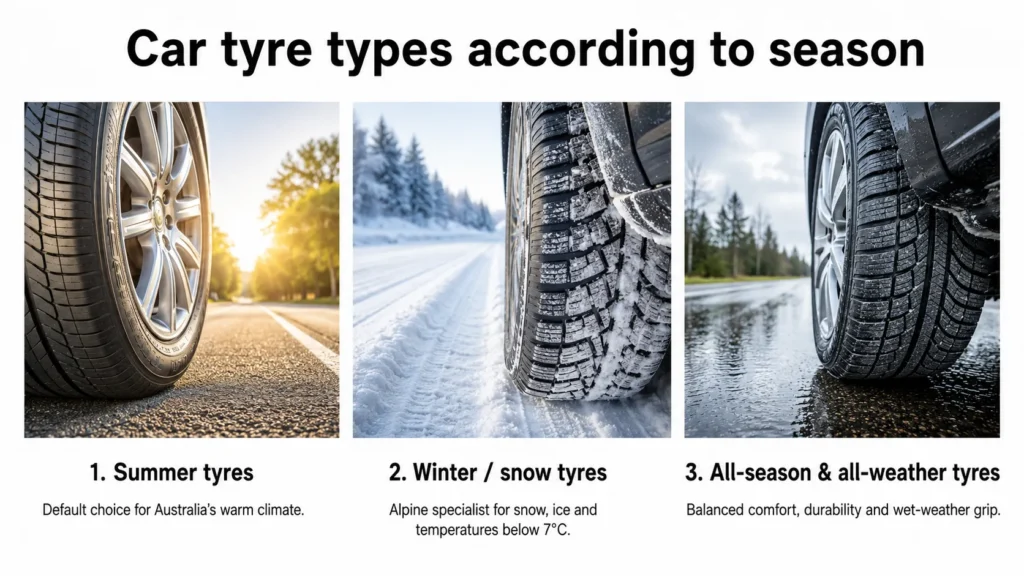
Most of Australia experiences a mild, temperate, or tropical climate, so you do not have a legal requirement for seasonal tyre swapping in major cities.
| Seasonal car tyre types | Temperature sweet-spot | Best suited for |
|---|---|---|
| Summer tyres | Above 7°C up to extreme heat | City commuters, coastal drivers, and tropical regions (QLD, NT, WA). |
| All-season tyres | Wide range (-5°C to 40°C) | Regional/inland drivers (ACT, Southern NSW, Inland VIC). |
| Winter tyres | Strictly below 7°C | Alpine locals, snow sports athletes, and ski field workers (Jindabyne, Mt Buller, Thredbo). |
1. Summer tyres (default choice)
Hard rubber tyres that suit Australia’s warm climate and are fitted to most passenger cars, SUVs, and utes.
2. Winter/snow tyres (alpine specialist)
These are flexible high-silica rubber tyres with “sipes” that grip well in snow and icy conditions below 7°C.
3. All-season & all-weather tyres
All-season tyres balance comfort, durability, and wet-weather grip across mixed conditions.
Car tyre types explained by performance
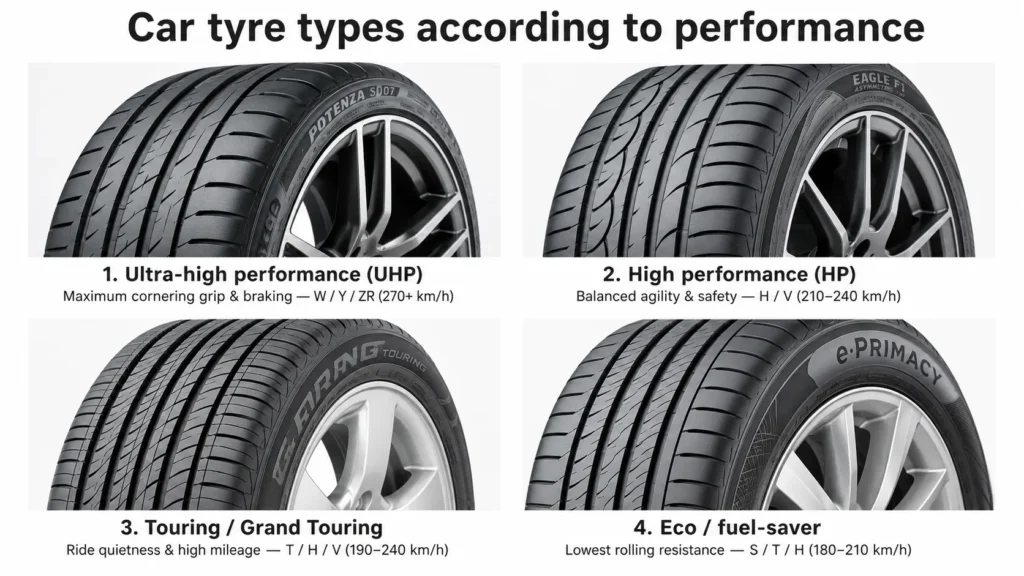
Here are the car tyres classified by performance based on their grip levels, steering responsiveness, temperature management, and capability to handle speed:
| Car tyre types by performance | Primary target attribute | Typical Speed Rating |
|---|---|---|
| Ultra-high performance (UHP) | Maximum cornering grip & braking | W / Y / ZR (270+ km/h) |
| High performance (HP) | Balanced agility & safety | H / V (210–240 km/h) |
| Touring/Grand Touring | Ride quietness & high mileage | T / H / V (190–240 km/h) |
| Eco/fuel-saver | Lowest rolling resistance | S / T / H (180–210 km/h) |
1. Ultra-high performance (UHP) and max performance
Common on sports cars, premium sedans, and performance EVs, UHP tyres use soft rubber compounds and stiff sidewalls for maximum grip, sharper handling, and stronger braking. The trade-off is faster wear and a firmer ride.
2. High performance (HP)
HP tyres balance responsive handling, wet-weather grip, and everyday comfort, making them popular on sporty hatchbacks, SUVs, and modern passenger cars.
3. Touring and grand touring
Touring tyres prioritise comfort, low road noise, fuel efficiency, and long tread life, making them ideal for commuting and long-distance highway driving.
4. Eco/fuel-saving tyres
These are designed to lower rolling resistance using high-silica compounds. They improve fuel or EV battery efficiency, but generally provide less wet-weather traction.
Car tyre types by tread pattern
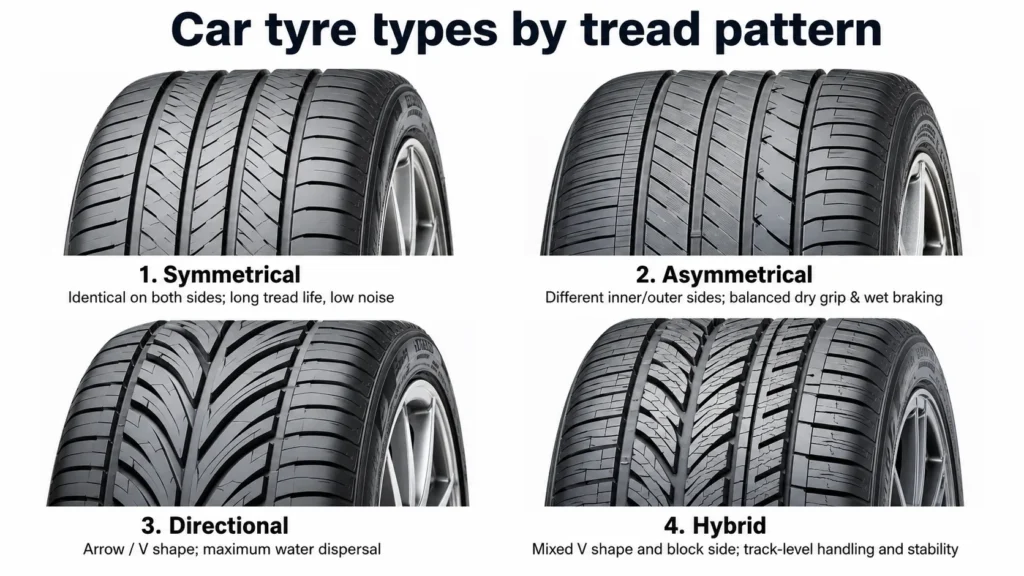
The pattern of the tyre tread dictates how water is dispersed, how much noise the tyre makes, and how the car handles high-speed cornering. Here are the four car tyre types based on their tread pattern
| Car tyre types by tread pattern | Visual characteristic | Key performance benefit |
|---|---|---|
| Symmetrical | Identical on both sides | Long tread life, low noise |
| Asymmetrical | Different inner/outer sides | Balanced dry grip & wet braking |
| Directional | Arrow / “V” shape | Maximum water dispersal |
| Hybrid | Mixed “V” shape and block side | Track-level handling and stability |
What are the car tyre types according to innovations?
Modern tyres now include technologies designed to improve efficiency, comfort, and puncture resistance.
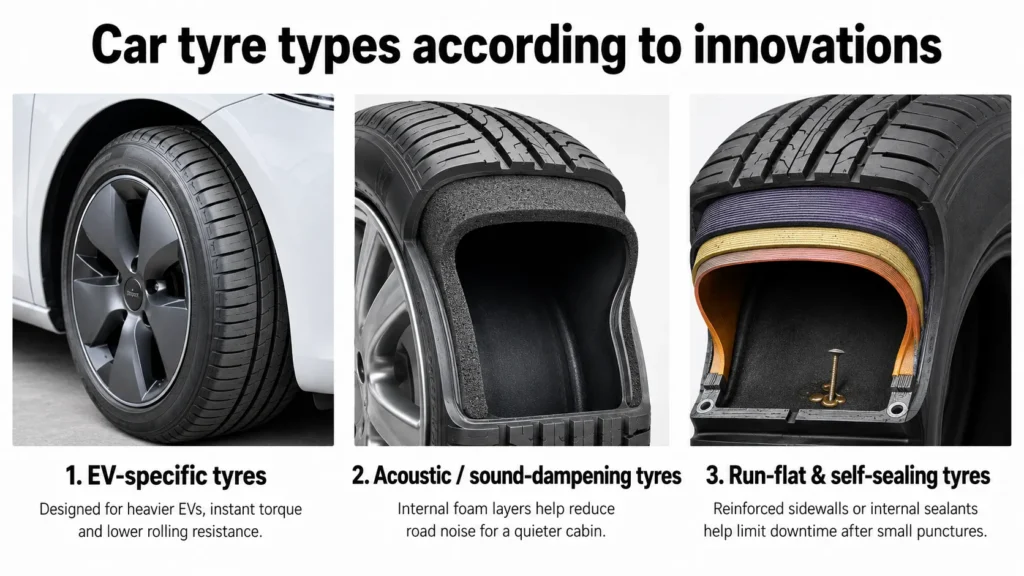
1. EV-specific tyres
EV tyres are designed to handle the heavier weight and instant torque of electric vehicles. Many also use low rolling resistance technology to improve driving range and efficiency.
2. Acoustic/sound-dampening tyres
These tyres use internal foam layers to reduce road noise, making them popular on EVs and luxury vehicles where cabin refinement is more noticeable.
3. Run-flat and self-sealing tyres
Run-flat tyres use reinforced sidewalls that allow limited driving after a puncture, while self-sealing tyres use internal sealants to reduce air loss from small punctures.
What is the informal car tyre classification in Australia?
Australians often use a distinct set of informal, cultural, and slang classifications for car tyres beyond the ADR ratings.
1. Budget and quality classifications
- “Mayruns” or “Linglongs”: Slang for ultra-cheap imported tyres with basic performance and low prices, even if the actual brand is different
- Mid-tier “workhorses”: Reliable everyday tyres like Kumho or Hankook, considered the sensible option for commuters and family SUVs because they balance cost and durability
- Premium / “Good Rubber”: High-end brands such as Michelin or Pirelli. Saying a car has “good rubber” suggests the owner values handling, grip, and safety over saving money.
2. Enthusiast and slang classifications
- “Burnout tyres” or “skid tyres”: Old, bald, or cheap secondhand rear tyres used only for burnouts or “hoon” sessions
- “Taxi tyres”: Hard-compound narrow tyres designed to last beyond 80,000km, but often mocked by enthusiasts for weak grip and poor performance feel
- “Rubber bands”: Extremely low-profile tyres wrapped around oversized alloy wheels, commonly 20-inch-plus rims, giving the tyre a thin, stretched appearance
- “Slicks”: Semi-slick performance tyres with minimal tread. Often called “cheater tyres” because they resemble worn tyres while delivering massive dry-road grip
3. Off-road and 4WD culture classifications
- “Pizza cutters”: Tall, narrow off-road tyres like 235/85 R16s, valued for cutting through mud but criticised for looking skinny
- “Fat meats” or “Balonys”: Very wide 12.5-inch-plus tyres chosen for an aggressive stance
- “Muddies”: Shorthand for Mud Terrain tyres built for deep off-road conditions
Readers also asked: How do I install wheel covers?
How to choose the right tyres for your car?
Follow this five-step process to find the perfect set for your car:
Step 1: Check your tyre placard
Locate the placard inside the driver’s door or fuel cap. Codes like 205/55R16 91V show the legal tyre dimensions such as Load Index and Speed Rating. Fitting tyres of a different code (or size) is illegal.
Step 2: Match tyres to your driving
Consider the terrain, towing requirements, climate, etc.; for example, H/T or Touring tyres suit city highways.
Step 3: Choose a performance tier based on your budget
Premium: Michelin, Bridgestone, Pirelli.
Mid-tier: Kumho, Hankook, Yokohama.
Budget tyres suit low-speed or temporary use.
Step 4: Look for promotions
Australian retailers commonly offer “Buy 3, Get 1 Free” deals and cashback offers.
Step 5: Ask for a drive-away quote
Confirm that fitting, balancing, valves, recycling levy, and wheel alignment are included in the quote.
Use this guide to know when you should change the tyres of your car.
What is the most common type of tyre?
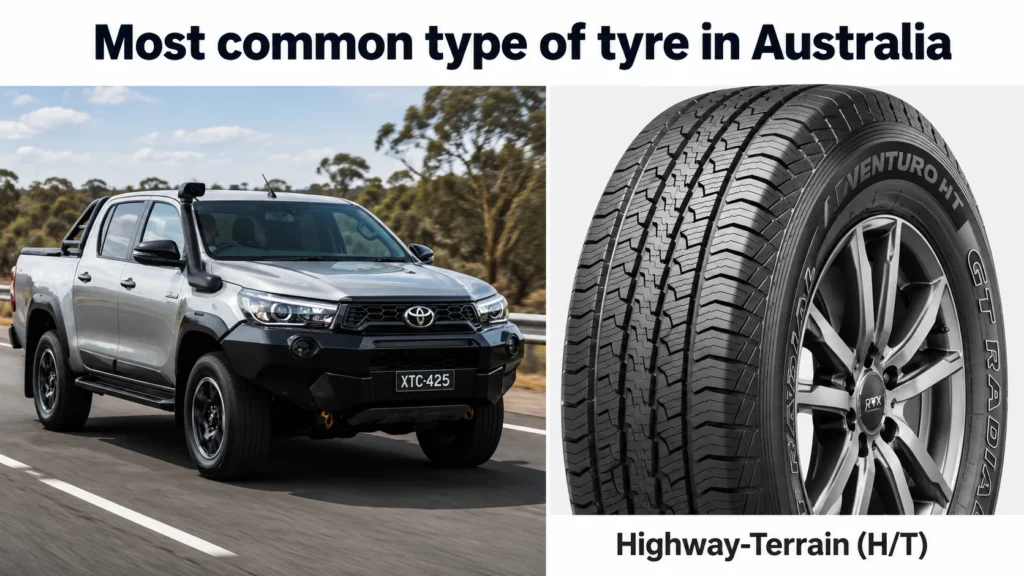
Australia’s most common tyre type is the all-season highway terrain (H/T) tyre with symmetrical or asymmetrical tread patterns. It dominates because it is factory-fitted to popular vehicles, including the Toyota RAV4, Toyota HiLux, Ford Ranger, plus everyday hatchbacks, sedans, and mid-sized SUVs.
How to check if your tyre tread is legal in Australia?
Tyre tread must remain at least 1.5mm deep across the central 75% of the tyre and its full circumference in Australia. Below this, the car becomes unroadworthy and risks fines, demerit points, or insurance issues. You can check your car’s tyre tread using tread wear indicators, the 20-cent coin test, or tread depth gauges.
FAQs about car tyre types
1. How often should I replace my car tyres?
Most tyres should be replaced every 5–6 years or sooner if tread depth falls below 1.5mm, or if there is uneven wear, cracking, or sidewall damage.
2. Which tyre types are good for towing and touring?
Light truck (LT), highway terrain (H/T), and all-terrain (A/T) tyres are commonly used for towing, touring, and long-distance driving.
3. Can I mix different tyre types on my car?
It’s best to replace tyres in pairs or full sets. Mixing different tyre sizes or tread patterns across the same axle can affect handling and stability.
4. What’s the difference between summer and winter tyres?
Summer tyres work best in warm conditions, while winter tyres use softer rubber compounds for better grip in snow and temperatures below 7°C.
5. Do I need different tyres for wet and dry roads in Australia?
No. Most modern road tyres are designed to handle both wet and dry conditions, although asymmetrical tread patterns can improve wet-weather grip.

Comments
New Comment