




Be honest, how many times have you looked at a tyre code like 235/55R19 101V and thought “What does it even mean?” And if you want to get your car’s tyres changed or are simply curious, you need to understand the tyre dimensions.
That alphanumeric string determines whether a tyre fits your car, handles safely, and stays legal on Australian roads. This guide breaks down tyre markings so you can choose the right (and legal) ones with confidence.
Where can you find your vehicle’s tyre size?
There are four primary places where you can find the tyre dimensions for any vehicle you are exploring:

1. The tyre placard
Required under Australian Design Rule 24/01, it’s usually in the driver’s door jamb, glove box, fuel filler cap, or under the bonnet. It lists approved sizes and the right tyre pressure.
2. The tyre sidewall
Look for the alphanumeric code (e.g., 225/45 R17) moulded into the outer wall of the rubber.
3. Owner’s manual
Every vehicle’s manual includes a “specifications” or “technical data” section that lists all approved tyre and wheel combinations for that car model.
4. Online registration (rego) lookups
Most Australian tyre retailers offer a free ‘Search by Rego’ tool that pulls manufacturer specs for your exact vehicle.
Readers also asked: When should you change the tyres of your car?
Why should you know about your car tyre size?
Knowing your car’s tyre dimensions in Australia is essential for legality, safety, insurance and travel reliability. Australian legal rules require replacement car tyres to match or safely exceed placard/sidewall specifications.
Incorrect tyres can trigger defect notices, invalidate insurance claims, disrupt ABS and ESC systems, and alter speedometer accuracy, increasing speeding fine risks. Tyre dimensions also determine load and speed ratings, critical for SUVs, towing and high-speed driving.
Tyre dimensions: What do numbers on tyres mean?
Car tyre dimensions are a standardised set of numbers and letters found on a tyre’s sidewall that define its physical size and performance capabilities.
Example: 225/55 R18 98V
Let’s decode the tyre size description for this printed alphanumeric code:
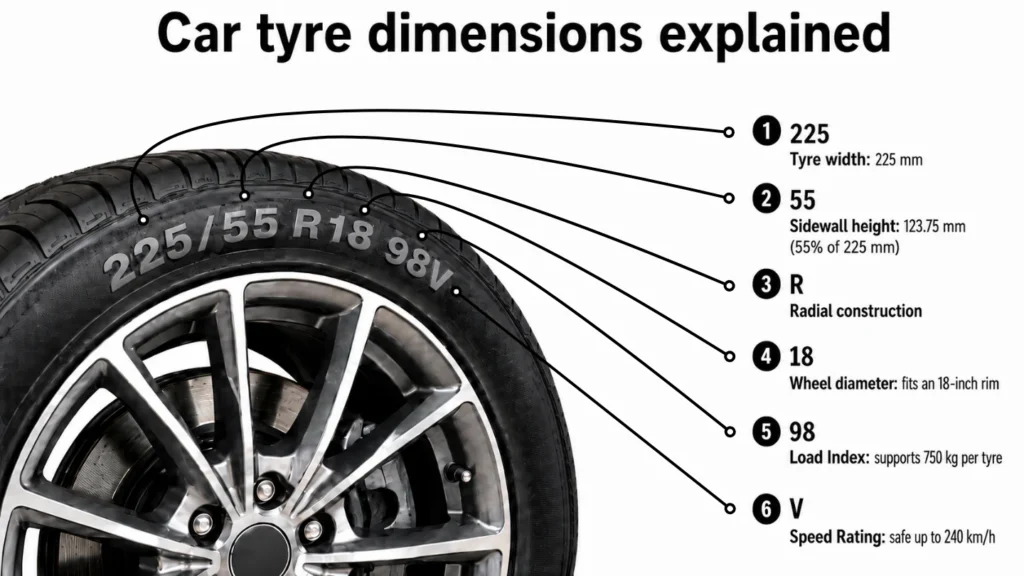
- 225: 225mm wide
- 55: Sidewall height is 123.75mm (55% of 225mm)
- R: Radial construction
- 18: Fits an 18-inch rim
- 98: Can support 750kg per tyre
- V: Safe up to 240km/h
Here are all the tyre dimensions explained, along with the tyre size calculator to help you understand what the numbers on tyres mean.
Tyre width
The tyre width (also “section width”) is the first three-digit number in the code, and is measured in millimetres at the tyre’s widest inflated point, excluding any raised lettering or ribs.

Significance of tyre width
Wider tyres typically provide better grip for cornering, braking, and acceleration on dry roads. Narrower tyres roll with less resistance, which helps fuel economy. Going too wide, though, can cause tramlining (the tendency to follow road grooves).
Tyre width changes with car types
Light hatchbacks (e.g., Toyota Yaris, Mazda 2) often use narrower widths like 175mm or 185mm (e.g., 185/60 R15) to prioritise fuel efficiency and low cost.
Larger SUVs and performance cars (e.g., Mazda CX-5, Volkswagen Golf GTI) usually feature wider tyres from 235-255mm (e.g., 235/45 R18) to handle higher weight or provide sportier handling.
Tyre aspect ratio or tyre profile
The aspect ratio (also “tyre profile”) is the second number in a tyre’s dimension code, following the forward slash. It represents the height of the tyre’s sidewall expressed as a percentage of its width.

For example, in a 205/55 R16 tyre, the profile is “55,” meaning the sidewall is 55% as tall as the tyre is wide (approximately 112.75mm).
Sidewall height calculator
Multiply the width by the aspect ratio decimal to find the physical height of your sidewall.
Formula: Width x (Aspect ratio/100) = sidewall height
Example (235/40 R18): 235mmx0.4 = 94mm
Significance of tyre aspect ratio/profile
Higher profiles (65+) absorb bumps better and cushion the rim against damage. Lower profiles (50 and below) have stiffer sidewalls for sharper handling and a sportier look.
Tyre aspect ratios change with car types
Small hatchbacks (e.g., Toyota Yaris) often use a 65 or 70 profile (e.g., 175/70 R13) to prioritise a soft ride and low replacement costs. Sports & luxury vehicles (e.g., VW Golf GTI, Audi S3) usually come with 35-45 profile tyres (e.g., 225/45 R17) for enhanced high-speed stability and aesthetics.
4WDs & off-roaders (e.g., Toyota Prado) often use profiles of 70 or 75 (e.g., 265/65 R17) to absorb heavy impacts and provide a larger footprint when aired down.
Tyre construction
Construction is represented by a letter (usually “R”) that identifies how the internal layers of the tyre are built.

Radial construction: Layers of cord plies (steel or fabric) run radially at a 90-degree angle to the direction of travel (from bead to bead). They are typically reinforced with steel belts under the tread for stability.
Bias construction: Plies run diagonally in a criss-cross pattern, making the tyre stiffer. Mostly found on older classics, heavy trucks, or specific off-road equipment.
Significance of tyre construction type
The internal architecture defines the tyre’s fuel efficiency, durability, and comfort. R (radial) tyre construction, which is the most common, offers better fuel efficiency, comfort, and longevity.
B (bias-belted)/D or “–” (bias-ply/diagonal) are mostly found on older classic cars, heavy-duty trucks, or specific off-road equipment. They are highly durable for rugged terrains and heat more.
Tyre construction varies with car types
A Toyota Corolla or Mazda CX-5 will almost exclusively use “R” (e.g., 205/55 R16) for fuel savings and a smooth ride. A restored 1950s Holden might use Bias-Ply tyres (often marked with a “–” or “D”) to maintain an authentic appearance and period-correct handling.
Wheel diameter/rim size
The wheel diameter (“rim size”) is the number following the construction letter (R) in a car tyre’s size code. It specifies the diameter of the wheel rim in inches that the tyre is designed to fit. For example, in a 225/45 R18 tyre, the “18” indicates the tyre must be mounted on an 18-inch wheel.

The measurement is taken across the centre of the wheel from one bead seat (where the tyre edge sits) to the other.
Significance of wheel diameter
This dimension is critical for ensuring the tyre physically fits the vehicle’s hardware and maintains proper safety standards:
Larger wheel diameters are often used on performance cars to provide enough space for larger brake discs and callipers.
Smaller rim diameters usually allow for “taller” tyre sidewalls, which cushion better on rough roads.
Wheel or rim size changes with car types
City Cars (e.g., Kia Picanto, Suzuki Swift) commonly use 14″ or 15″ wheels for low weight and affordable tyre replacement costs. Family SUVs & Sedans (e.g., Toyota RAV4, Mazda CX-5) have rim sizes that usually range from 17″ to 19″ to balance aesthetics with a comfortable ride.
Load index
The load index is a numerical code on a tyre’s sidewall that specifies the maximum weight a single tyre can safely carry when fully inflated. In a tyre marked 205/55 R16 91V, the number 91 is the load index, which corresponds to a maximum capacity of 615 kg per tyre.

Load index numbers map to standardised weight capacities. Here is a Tyre Load Index Chart to calculate tyre load capacity.
| Load index | Max load per tyre (kg) | Example total vehicle capacity (4-wheeler) |
|---|---|---|
| 88 | 560kg | 2,240kg |
| 91 | 615kg | 2,460kg |
| 94 | 670kg | 2,680kg |
| 98 | 750kg | 3,000kg |
| 104 | 900kg | 3,600kg |
Significance of the tyre load index
In Australia, it is illegal to fit tyres with a load index below your tyre placard spec. The penalties include fines, a failed roadworthy inspection, or a rejected insurance claim in the event of an accident.
Tyre load index changes with car types
Compact Hatchbacks (e.g., Hyundai i30) often feature a load index of around 91 (615 kg), suitable for the vehicle’s lighter kerb weight. Heavily loaded EVs (e.g., Tesla Model 3) frequently require Extra Load (XL) tyres with ratings like 98 XL.
Dual-cab utes (e.g., Ford Ranger) require much higher tyre load indices, often 112 or above (1,120+ kg), to handle towing and heavy trays.
Speed rating
The speed rating (the final letter, e.g. V in 205/55 R16 91V) indicates the maximum speed the tyre can safely maintain while carrying its maximum load.

Speed ratings are assigned based on rigorous laboratory tests. The most common symbols for passenger cars in Australia are in this Tyre Speed Rating Chart:
| Speed symbol | Maximum speed | Common vehicle type |
|---|---|---|
| N | 140km/h | 4WDs with off-road features |
| S | 180km/h | Entry-level passenger cars |
| T | 190km/h | Standard family sedans/hatchbacks |
| H | 210km/h | High-performance sedans and small SUVs |
| V | 240 km/h | Sports cars and performance SUVs |
| W | 270 km/h | High-performance exotic vehicles |
| Y | 300 km/h | Supercars (e.g., Lamborghini, Ferrari) |
Significance of tyre speed rating
As with load index, you must match or exceed the speed rating on your tyre placard; fitting a lower-rated tyre is illegal and can void your insurance.
Tyre speed rating changes with car types
Standard family cars (e.g., Toyota Corolla) typically use an H (210 km/h) or V (240 km/h) rating to ensure safety during sustained highway cruising in high Australian temperatures.
Luxury & performance EVs (e.g., Tesla Model 3 Performance) often require Y (300 km/h) rated tyres due to their rapid acceleration and high-speed capability.
Off-road 4WDs (e.g., Toyota LandCruiser) may have a lower tyre speed rating like R (170 km/h) or S (180 km/h), as these are geared for durability off-road rather than top speed.
Readers also asked: How to fix a flat tyre?
4WD and all-terrain tyre dimensions explained
Tyre dimensions of 4WDs and all-terrain vehicles are primarily distinguished by their construction and sizing systems as they prioritise off-road durability and load-carrying.

1. Light truck (LT) construction
Many passenger cars use “P” (Passenger) rated tyres, and serious 4WDs often use LT (Light Truck) tyres. These may look identical in size but have vastly different internal builds.
LT tyres have reinforced, multi-ply sidewalls (sometimes up to 10-ply). They typically feature tread depths of 10mm to 14mm, compared to roughly 8mm for standard passenger tyres. 4WD tyres often prioritise durability, higher load ratings, and off-road traction over speed and efficiency.
Speed ratings are also lower (R, S, T) in LT tyres than higher (H, V, W) in other passenger cars.
2. Flotation vs. metric sizing
4WD tyres in Australia often use two different ways to describe their dimensions:
Metric sizing (e.g., 265/70 R17)
This is similar to passenger cars, where the first number is the width in mm and the second is the aspect ratio percentage. It is common for factory-fitted all-terrains on modern dual-cab utes like the Ford Ranger or Toyota HiLux.
Flotation sizing (e.g., 33×12.5 R15)
This is common for aftermarket off-road tyres.
- 33: The actual height of the tyre in inches.
- 12.5: The width of the tyre in inches.
- 15: The rim diameter in inches.
3. Terrain-specific dimensions
The style of the tyre also dictates its physical dimensions and on-road performance.
- All-Terrain (A/T) for 50% Road/50% Dirt
- Mud-Terrain (M/T) for 80% Off-Road/20% Road
- Highway-Terrain (H/T) for 90% Road/10% Dirt
Do EVs have different tyre dimensions?
While the standard tyre size format (e.g., 235/45 R18) remains the same in electric vehicles, the internal construction and performance ratings are specifically engineered for the unique demands of electric vehicles.

| Feature | Traditional/hybrid tyre | EV-specific tyre |
|---|---|---|
| Load index | Standard | Reinforced/High-load (HL) |
| Speed and torque rating | Standard | High (advanced compounds) |
| Rolling resistance | Variable | Very low (range maximisation) |
| Noise profile | Standard | Acoustic foam insulated |
| Average life | 40,000–70,000km | 30,000–50,000km |
1. Unique dimensional and size characteristics
Modern EV platforms often use tall and narrow but larger tyres to reduce aerodynamic drag and rolling resistance while maintaining grip. Some EVs also use different sizes for the front and rear axles to better manage weight distribution and rear-wheel-drive torque.
2. Critical specification differences
EVs are typically 20% heavier than similar-sized ICE vehicles because of heavy battery packs. You will often need tyres with an Extra Load (XL) or the newer High Load (HL) capacity to support this mass safely.
EV tyres use stronger compounds to handle instant torque. Low Rolling Resistance (LRR) tyres are vital for EVs to maximise driving range.
3. Acoustic insulation
Road and tyre hum become significantly more noticeable in EVs because they lack engine noise. Many EV-specific tyres contain a layer of sound-absorbing foam on the inside to dampen cabin noise.
What are the legal and mechanical limits of changing car tyres in Australia?
The legal limits for changing tyres are governed by the National Code of Practice (VSB 14) and specific state regulations in Australia. Tyre changes must comply with safety regulations, speedometer accuracy, and braking performance.
1. Overall diameter (rolling diameter)
It is the total height of your new tyre and wheel combination and is strictly regulated to avoid significant speedometer error.
Passenger vehicles
- Maximum diameter increase: +15mm
- Maximum diameter decrease: -26mm
4WDs & goods vehicles
- Maximum diameter increase: +50mm
Speedometer accuracy: For older vehicles, the variance is +/- 10% over 40 km/h. For new vehicles (1 July 2006 onward), the variance is +10% + 4 km/h (ADR 18/03).
The tyre figure changes are compared to the manufacturer’s specification on the tyre placard for your vehicle.
2. Wheel and track width
Modifying how far your wheels stick out or how wide they are can affect your car’s suspension and stability.
Passenger cars
- Maximum wheel width increase: +25–26mm
- Maximum track width increase: +25mm
Track width is the distance between the centres of the left and right tyres.
At no point should the tyre or rim protrude past the vehicle’s bodywork (including flares), nor should they touch any part of the suspension or chassis during full steering lock.
3. Load index and speed ratings
You are legally required to match or exceed the ratings specified on your car’s official placard.
- New tyre load index: Equal to or higher than the factory requirement
- New tyre speed rating: Must be suitable for the vehicle’s top speed
4. Roadworthiness and maintenance
The legal minimum tyre tread depth in Australia is 1.5mm across all principal grooves. Driving on tyres below this limit can result in fines and demerit points.
The use of aftermarket wheel spacers is strictly illegal in most Australian states unless they were fitted as original equipment by the manufacturer.
What are UTQG tyre ratings for treadwear, traction, and temperature?
UTQG (Uniform Tyre Quality Grading) is a US standard, not legally required in Australia, but it appears on many global tyre brands sold locally.
If you see it on a sidewall, the temperature grade (A being the highest, B and C the minimum for passenger cars) tells you how well the tyre manages heat at speed.
FAQs about tyre dimensions
What are the common abbreviations used in tyre measurement?
- R (Radial): Construction type
- LT (Light Truck): Heavy-duty construction
- P (Passenger): A standard car tyre
- C (Commercial): Heavy-load commercial use tyre
- XL (Extra Load)/RF (Reinforced): Common on EVs like Teslas
- HL (High Load): For heavy electric vehicles
- SL (Standard Load): The baseline capacity
- TL (Tubeless): Tyres without an inner tube
- RBT (Raised Black Letters Tubeless)
- OWT (Outline White Letters Tubeless): Outline of the letters is filled with white rubber
- RWT (Raised White Letters Tubeless): The entire face of the raised letters is white
- LWT (Line White Tubeless): Solid white line running around the rim
- VSB/BSL (Vertical Serrated Band/Black Serrated Letters): Decorative patterns or textures
- TT (Tube Type)
- RFT/ROF/SSR (Run-flat): Run-flat tyre or self-supporting run-flat to continue driving after a puncture.
- TWI (Tread Wear Indicator): Small bumps inside the tyre grooves
- DOT (Department of Transportation): Tell you the week and year of manufacture.
- M+S (Mud and Snow): Common on all-terrain tyres
- 3PMSF (Three-Peak Mountain Snowflake): Certified for severe snow conditions
- PSI (Pounds per Square Inch): Common pressure unit in Australia
- kPa (Kilopascals): The metric unit for pressure
- MO/MOE (Mercedes Original/Mercedes Original Extended (Run-Flat)
- Star: Specially designed for BMW
- N0, N1, N2: Specifically engineered for Porsche models.
- AO (Audi Original)

Comments
New Comment