




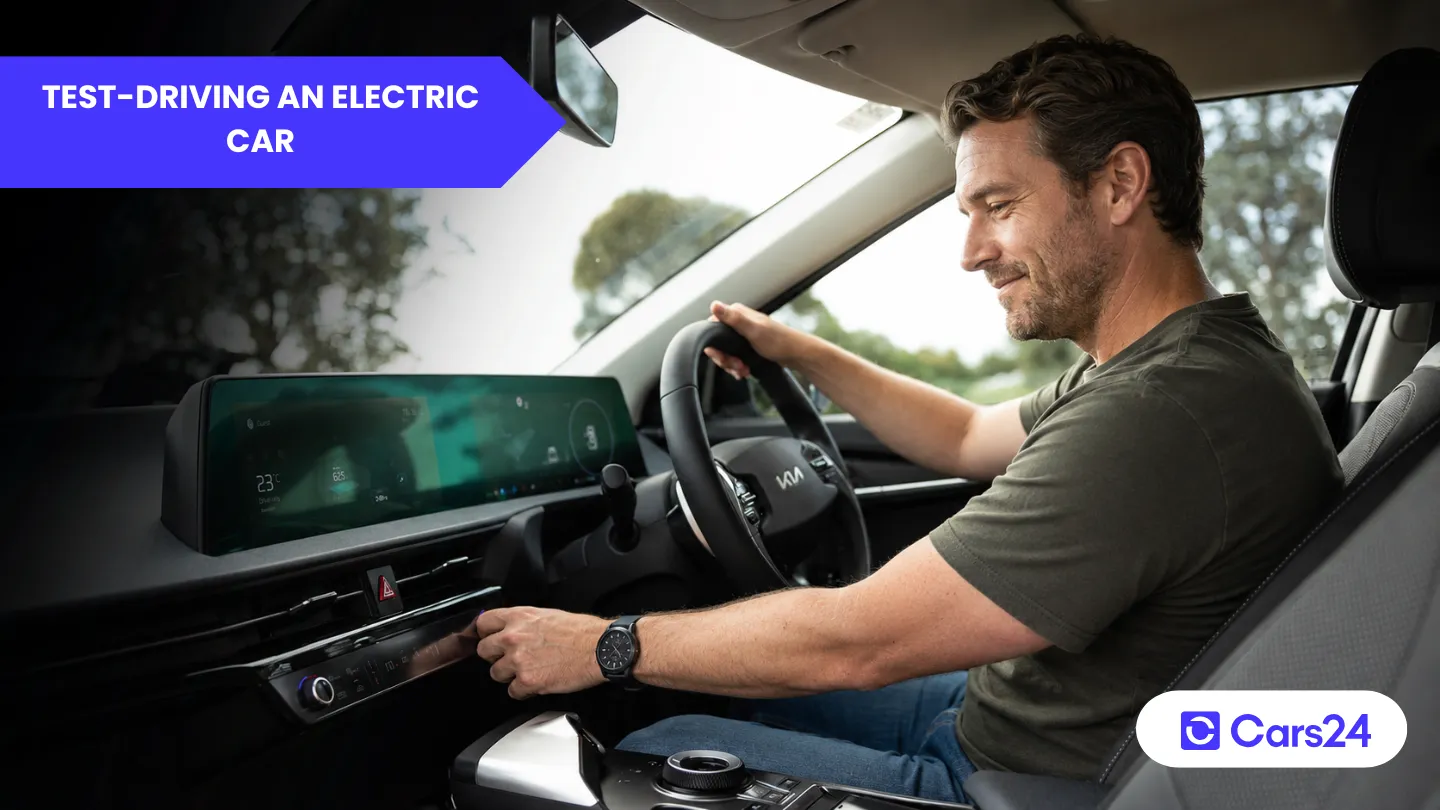
You may have heard from your neighbours that their futuristic electric car drives well, but you still have doubts about how it will fit your driving style and home.
Is one-pedal driving really that different? Can your home solar actually charge an EV? Are public EV chargers reliable? Will it really save me that petrol bill? The best way to answer these questions is with a proper test drive on your regular route.
Get the practical steps to successfully test-drive an electric car and walk away knowing how the car will fit into your commute and home setup.
Why should you test drive an EV?
You need to test drive an EV, not because it’s “different,” but because it changes how you drive. A petrol car responds with a delay. An EV responds instantly. That takes getting used to.
A petrol car coasts when you lift off the accelerator. An EV can brake aggressively through regenerative braking. That can feel jerky or brilliant, depending on the setting.
A petrol car has engine noise. An EV is silent, which can be disorienting or calming.
You won’t know if the range estimates, driving settings, or screen menus suit your routine until you experience them yourself.
A short test drive saves you years of regret. Don’t skip it.
How to test drive a new electric car in Australia?
A test drive in an EV isn’t (wholly) like a petrol car. You’re mostly feeling the engine, transmission, and steering with a petrol car. With an EV, you’re evaluating an entire ecosystem of charging habits, battery range, home integration, and regenerative braking. Here’s your step-by-step guide to a successful EV test drive:
Phase 1: Before the test drive (prep work)

Step 1: Know your specific needs
Write down your real-world answers to these questions and bring them with you:
- What’s your daily commute distance (return)?
- How many long road trips (>300km) per year?
- Can you charge at home? (Garage, driveway, street parking?)
- Do you have solar panels?
- What’s your typical weekly driving pattern? (City, highway, mixed?)
Step 2: Research the specific EV’s numbers
It helps to know these three numbers for the exact model you’re test-driving:
- Official WLTP range
- Real-world range
- Maximum DC fast charging speed (kW)
- Charging port location (front, rear, side, or nose?)
- Boot space with seats up and down
Phase 2: At the dealership

Tell the salesperson clearly whether you are buying today or you are just here to test drive and compare. This sets expectations and buys you mental space.
Step 3: Do a “cold start” inspection
Before anyone touches the car, check the State of Charge (SoC) on the display. What percentage is it showing? If it’s below 30%, ask them to charge it or reschedule.
Note the recommended tyre pressures in the Tyre Placard (inside driver’s door). EVs are heavy and sensitive to pressure.
Open the charging port. Is it easy? Does it feel flimsy? Note the location.
Step 4: Sit in the driver’s seat
Take 2 minutes of silence. Just sit. Adjust the seat, steering wheel, and mirrors. Look at the dashboard and main screen. Is the clutter overwhelming?
Can you reach all controls without leaning? Check the rear visibility (often poor in aero-optimised EVs).
Put your phone on the wireless charging pad (if it has one). Does it fit? Does it slide around? This is a daily annoyance in some EVs.
Phase 3: The test drive
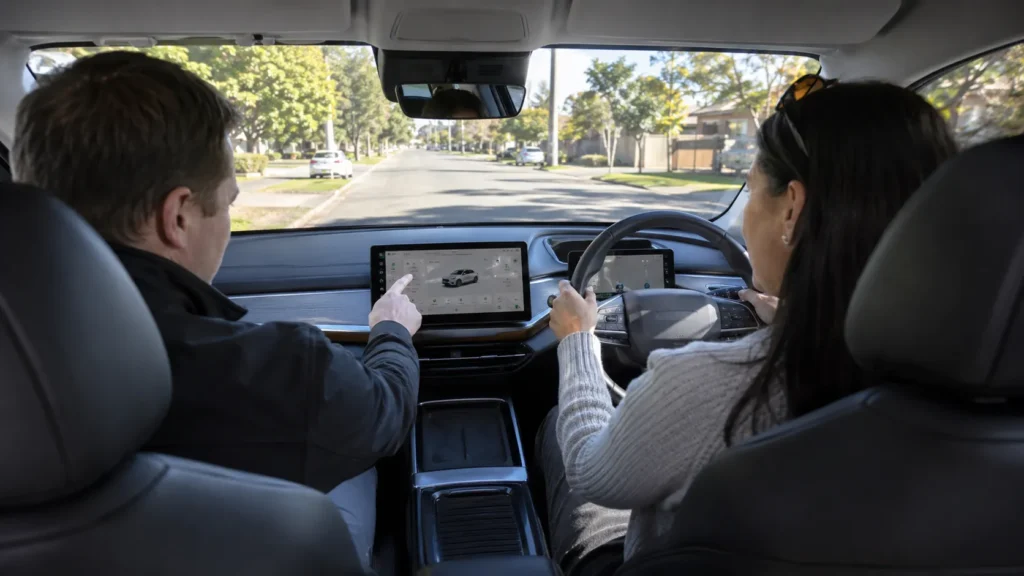
Step 5: Reset the trip meter
Before you move, find the trip meter reset button. Reset Trip A to zero. Also, reset the energy consumption display (usually shown in kWh/100km or km/kWh). This gives you real-world efficiency data based on your driving conditions.
Step 6: Drive your normal route (if possible)
The salesperson will suggest a short, smooth loop. Politely decline. Insist on driving a route that mimics your commute.
For example, a bit of stop-start city traffic. An 80km/h zone (typical main road). A 100-110km/h highway on-ramp and short stretch. A few speed bumps (to feel the suspension). A hill if you live near any.
Do the NVH (Noise, Vibration, and Harshness) audit. Turn off the radio and drive at 100km/h on a non-urban road to check if the cabin silence holds up.’
Don’t forget to use the heater/heat pump (winter) and AC (summer) at the same settings you normally use on your commute for more accurate energy consumption estimation.
Drive to your own home or a similar street if possible. This tests real-world navigation, screen glare at different times of day, and parking in a standard driveway.
Step 7: Master one-pedal driving
EVs have regenerative braking. Most have adjustable levels (Low, Medium, High, or “One-Pedal Mode”). Test all of them:
- Low regen: Feels most like a petrol car. You still use the brake pedal.
- High regen/One-Pedal Mode: The car slows significantly when you lift off the accelerator. You rarely touch the brake.
Test EV regeneration on a clear road. Completely lift off the accelerator pedal from 60km/h. Observe:
- How quickly does it slow down?
- Does the brake light come on automatically (it should)?
- Does it feel smooth or jerky in traffic?
Practice a full stop using only one-pedal mode. Some EVs won’t come to a complete stop. You’ll need the brake pedal for the final meter. This is critical to test for daily driving comfort.
Step 8: Test the real acceleration (safely)
Find a clear on-ramp or straight road. Use the full accelerator for 3-5 seconds from a standing start or low speed. Notice:
- The instant torque
- Differences in Normal, Eco, and Sports driving modes
- The sound (or lack thereof). Any high-pitched whine from the motor?
- Does the steering feel heavy or light?
Don’t sign a contract just because it’s fast. Focus on daily usability.
Step 9: Check the screen & infotainment lag
While driving safely, with eyes on the road, ask a passenger or the salesperson to open the navigation, change the climate control temperature, and switch from the radio to Bluetooth audio.
Look for lag, stuttering, or menus so significant you’d be distracted while driving.
Also test the electric car app’s (if there is one) responsiveness for pre-cooling and remote monitoring. Check which app features are free for life and which will require a paid subscription.
Step 10: Do a parking lot test
Find a tight parking space at the end of the drive. Reverse park (using camera and sensors), forward park, and check the turning radius. Later, turn off the cameras and use only mirrors. Is visibility acceptable? Because cameras may fail.
Readers also ask: How far can a Tesla travel on zero battery?
Phase 4: After the drive
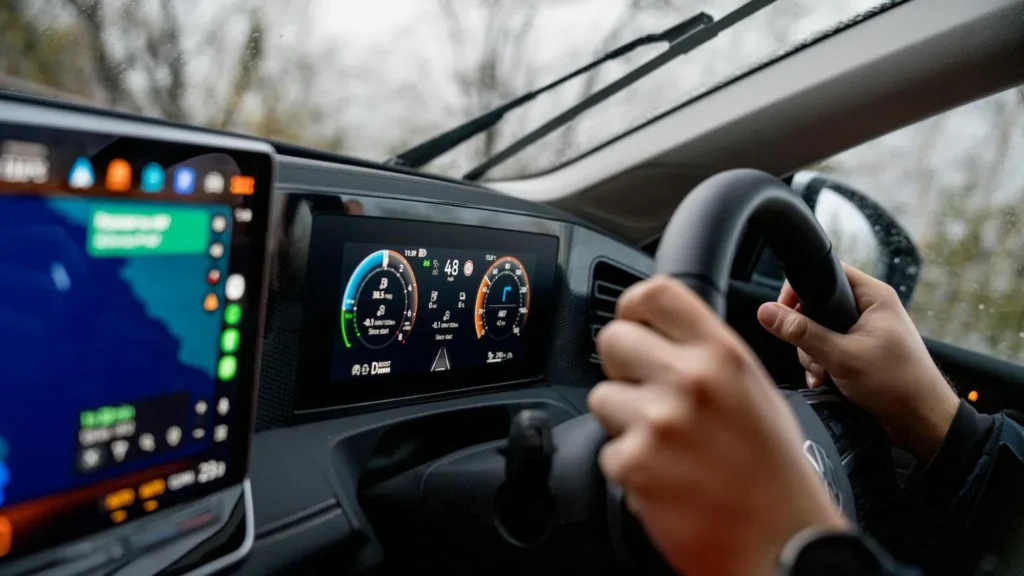
Step 11: Read your trip data
Stop the car. Look at the trip meter you reset earlier. Note:
- Distance driven (km)
- Energy used (kWh)
- Average energy consumption (kWh/100km or km/kWh). Your personal efficiency number.
For example, you drove 25km. The car used 4.5 kWh. Average energy consumption = 18.0 kWh/100km. Now calculate your real-world range:
Take the car’s usable battery size (in kWh).
Divide by your average energy consumption (per km).
Example: Battery = 60 kWh usable. Your average = 18.0 kWh/100km = 0.18 kWh/km.
Estimated range = 60 ÷ 0.18 = 333 km
Compare it to the official range (say 450km+), and now you know the real number for your commute.
Step 12: Do a home charging simulation
You need to know these if you can charge an EV at home:
- Can your garage/driveway fit the electric car? Use your tape measure. Measure width (open doors), length (past a closed garage door), and height.
- Where is the charging port? Can your home charging cable reach from your wall box?
- How long to recharge for your daily commute? Formula: Charge time (hours) = (Daily km × Car’s kWh/100km) ÷ (Charger kW × 1000)
Example: Daily commute = 50km. The car uses 18 kWh/100km. Home charger = 7kW.
Daily energy needed = (50 × 18) ÷ 100 = 9 kWh.
EV charge time = 9 kWh ÷ 7 kW = 1.3 hours.
You can also calculate the daily home EV charging costs by multiplying the daily energy needed by the electricity rate. For example, for a 35c/kWh rate, your daily EV charging cost = $3.15 (AUD).
You can have a rough estimate of electric car ownership costs in this blog.
Step 13: Do a road trip simulation
Calculate a real trip you do, for example, Sydney to Canberra (280km). Your real-world EV range from the last step: 333km.
280km is within that range. You would make it without charging. But add a 10% buffer for cold/hot weather, headwinds, or detours. 280km is tight.
Ask the salesperson to show you the nearest fast charger to this dealership on the route you drive. See how easy it is to charge and how much time it takes.
Phase 5: Questions to ask before leaving

Step 14: Get answers to these questions
- “What is the actual usable battery size, not nominal?”
- “What is the real-world highway range at 110km/h in winter?”
- “Does the car have a heat pump?”
- “What’s the 10-80% fast charging time on a 150kW+ charger?”
- “Is the battery preconditioning automatic when navigating to a fast charger?”
- “Can I set a maximum charge limit (e.g., 80% for daily use)?”
- “What home charger does the manufacturer recommend? Any deals?”
Step 15: Request an overnight test drive (if possible)
Some electric car dealers offer 24-48-hour test drives. Tell them that you need to see how it fits in your garage and on your commute.
If they allow it, do all of the above, plus park it in your garage/driveway overnight, do your actual morning commute, try plugging it into a standard wall socket (to see the slow speed), and see how your family fits in the back seats.
Readers also asked: What are some methods to increase my EV’s range?
How to test-drive a used electric car in Australia?
Your entire used EV test drive should be geared toward assessing the battery and the car’s honest range. First of all, see the remaining warranty on the used car battery and its current State of Health (SoH) percentage. Walk away if it’s below 85%, unless the price is dramatically reduced (and you understand the risk).
EVs are heavy and have instant torque, so they eat tyres faster than petrol cars. Check tread depth, uneven wear, and if the car has “EV” tyres.
Then, do the same steps for the test drive as you did for a new electric car and calculate its energy consumption. Ask the car owner/dealer about its service history, charging habits, battery replacement, warranty claims, etc.
If you like a used electric car, get a professional EV inspection done before buying it. In case you are wondering, “Who buys a used EV?” Aussies are buying ‘em.
Moreover, here is a sweet guide on buying a used EV in Australia in 2026.
Final words
A successful EV test drive isn’t about falling in love with the torque. It’s about proving the car fits your real life. You should walk away knowing that it will be an energy-efficient tool for your travel needs. Test-drive multiple EVs if needed before making your decision. Good luck!

Comments
New Comment