




You plugged your EV into a fast charger on a road trip and watched it charge rapidly to 80%, only for the speed to fall off a cliff suddenly. Many EV owners assume something is wrong with the charger or the battery itself.
After all, when you’re paying for a 150kW or faster charger, seeing charging speeds slow dramatically can be frustrating. But this slowdown is usually completely normal.
If you’ve ever wondered why EV charging slows down after 80%, the answer lies in how lithium-ion batteries are designed and protected. Modern electric cars follow a programmed charging curve designed to protect the battery from heat, stress, and premature degradation.
Understanding why charging speeds change at different battery levels can help you make smarter decisions about when to unplug and get back on the road.
Why does EV charging slow down after 80? The science
Lithium-ion (Li-ion) battery technology is the dominant power source for EVs and PHEVs sold in Australia. All lithium-ion batteries produce energy by moving lithium ions back and forth between a cathode and an anode.
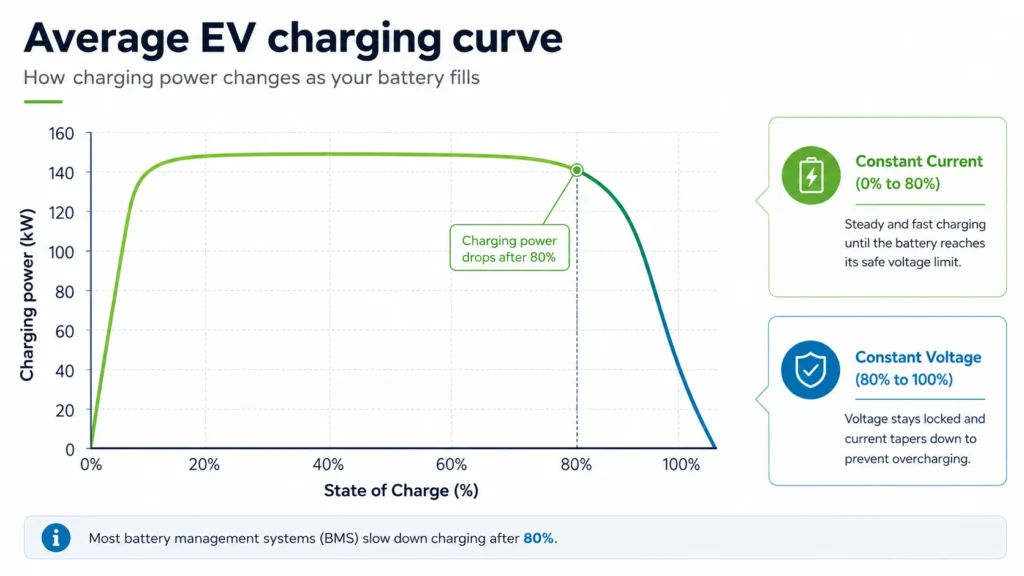
Most battery management systems (BMS) slow down charging after 80% due to a change in electrical charging phases, combined with a phenomenon called concentration polarisation.
Think of a lithium-ion battery like a sponge. When the sponge is dry, it absorbs water rapidly. As it fills up, it can only take in water slowly, drop by drop, or it will overflow.
In a battery, forcing energy in too quickly when it is nearly full causes permanent internal damage. Here are three key reasons why electric car makers limit the charging speed after 80%:
1. Two charging phases (CC to CV)
EV fast chargers do not deliver a constant rate of power into the car. They are forced to switch between two distinct phases:
- Constant Current (0% to 80%): Steady and fast current flows into the battery until its voltage rises to a maximum safe limit (generally 80%)
- Constant Voltage (80% to 100%): Once the battery hits 80%, the charger automatically locks the voltage to prevent overcharging and tapers down the current (amperage), bringing charging speed to a crawl.
2. The microscopic bottleneck (Lithium intercalation)
Intercalation means pushing lithium ions out of the cathode, through a liquid electrolyte, and into tiny microscopic spaces inside the graphite anode.
Below 80%, the graphite anode is mostly empty and can accommodate Li ions immediately. Above 80%, the anode spaces are nearly full.
The remaining lithium ions cannot readily find a home and begin piling up on the anode’s surface.
3. The risk of Lithium plating
If the charger kept delivering full power after 80%, the lithium ions piling up on the anode would bond together, forming metallic lithium plating on the surface.
Over time, this metallic buildup forms sharp microscopic needles called dendrites. The growing dendrites can pierce the battery’s internal separator, which may contribute to internal cell damage, capacity loss and, in rare cases, serious battery failures.
Slow charging after 80% gives lithium ions enough time to diffuse safely deep into the crowded anode.
Readers also asked: What are the replacement costs of EV batteries?
Is it your slow EV charging curve, or a bad charging station?
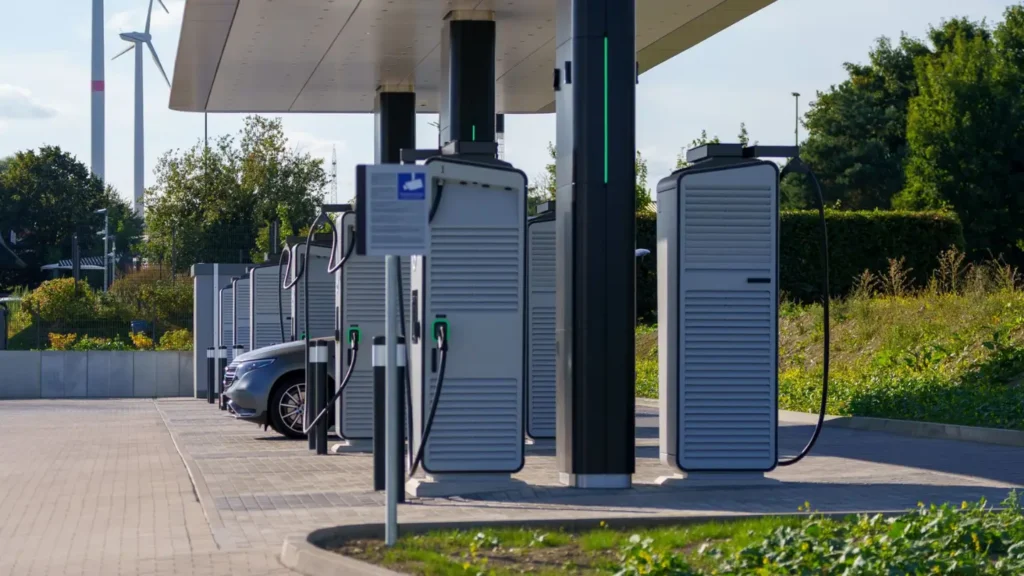
Public EV chargers, especially paired ones, often work on power sharing (also called Dynamic load balancing). You can easily spot them with split charging cables on a single cabinet, labelled pairing numbers, a sudden drop in your charging speed when another car plugs in, or real-time station screens showing reduced output.
And you may experience an unusual EV charging slowdown sometimes in the summer on public chargers. This could happen with the compounding effect of battery chemistry physics, high ambient temperatures, and network-level power limits.
High state of charge (80%+) + summer ambient heat + Shared cabinet derating = Serious charging throttling
When you combine a nearly full battery, extreme summer heat, and shared electrical infrastructure, your car’s onboard computer actively throttles charging speeds to prevent catastrophic battery damage.
Readers also asked: What are the typical costs of owning an EV in Australia?
Is slow charging better for an EV battery?
Yes, slow AC charging is generally better for the long-term health of lithium-ion batteries (including Nickel Manganese Cobalt (NMC) and Lithium Iron Phosphate (LFP). It drastically minimises heat, chemical stress, and structural wear inside the battery cells.
| Metric | Slow charging AC | Fast charging DC |
|---|---|---|
| Typical power output | 7kW to 22kW | 50kW to 350kW |
| Thermal strain | Very low; battery stays near ambient temperature | High; cells rapidly heat up, requiring intensive active cooling |
| Ideal use case | Daily overnight garage charging or all-day park-and-ride | Highway road trips and urgent top-ups |
| Impact on lifespan | Maximises longevity; battery may even outlast the car | Slightly increases degradation over time if used exclusively |
If slow charging is good, why do EV makers offer fast DC charging?
Offering ultra-fast DC charging capability alongside the recommendation to slow-charge is not a contradiction but a vital engineering balance between daily battery preservation and essential vehicle utility.
Fast charging is essential for long-distance travel, and a slow overnight home EV AC charger works well for most other people who have short daily commutes.
The ideal ownership approach is slow charging for routine usage and fast charging for long-distance travel convenience.
Also read: EV charging levels explained (Level 1, Level 2 and DC fast charging)
When should you charge your EV to 80%?
You should charge your electric car to 80% for routine driving if your car uses an NMC battery, when stopping at a public DC fast charger during a road trip, or during extreme summer heatwaves.
On public chargers, charging speeds drop off a cliff after 80%. Leaving at 80% saves you time, clears the bay for other drivers, and saves you money (for per-minute costing).
When should you charge your EV to 100%?
It depends entirely on your immediate driving plans and the EV’s battery chemistry (LFP vs. NMC).
If you are driving into parts of regional Australia with sparse charging infrastructure (e.g., crossing the Nullarbor, outback touring), charge to 100% whenever available to maximise your safety buffer.
If your EV has an LFP battery, you should charge it to 100% at least once a week. It recalibrates the Battery Management System (BMS) so your digital dashboard range estimator stays accurate.
If your EV has an NMC battery, you can charge it to 100% only right before a long-distance road trip. Otherwise, you should cap your charge limit to 80% or 90%. NMC batteries suffer severe chemical stress when left sitting at a high voltage.
FAQs about EV charging slowing down after 80%
1. How to turn off slow charging after 80%?
You cannot turn it off. The slowdown is an automatic safety feature, enforced by the car’s computer, to prevent the battery from overheating or catching fire.
2. What is the 20 40 80 rule in EV charging?
It is a commonly used battery preservation guideline rather than an industry-standard rule: Avoid letting your battery drop below 20%, utilise cheap/solar slow charging when it is between 40% and 80%, and stop charging at 80% to avoid the high-heat slowdown.
3. Is it OK to charge an EV to 90%?
Yes. It is perfectly fine for daily driving in NMC battery vehicles if you need the extra range, and completely safe for LFP vehicles.
4. How often should I charge my EV to 100?
At least once a week if you have an LFP battery (to calibrate the range display). Only right before a long road trip if you have an NMC battery.
5. Should I charge my EV to 80% or 90%?
Use 80% for maximum long-term NMC battery health. Move it to 90% if your daily commute is slightly longer or unpredictable.

Comments
New Comment