




The 2026 Toyota Hilux has secured a 5-star ANCAP safety rating, with the new-generation ute demonstrating strong protection across all major crash categories and a significantly expanded suite of active safety technologies. The rating applies to all variants sold in Australia and New Zealand except the HiLux Rugged X, which remains unrated.
The updated Toyota Hilux, released in New Zealand in November 2025 and Australia in December 2025, was tested in SR5 dual-cab form with the 2.8L 48V diesel engine, and performed convincingly across ANCAP’s latest 2023–2025 protocols.
Breaking down the scores
Adult Occupant Protection – 84%
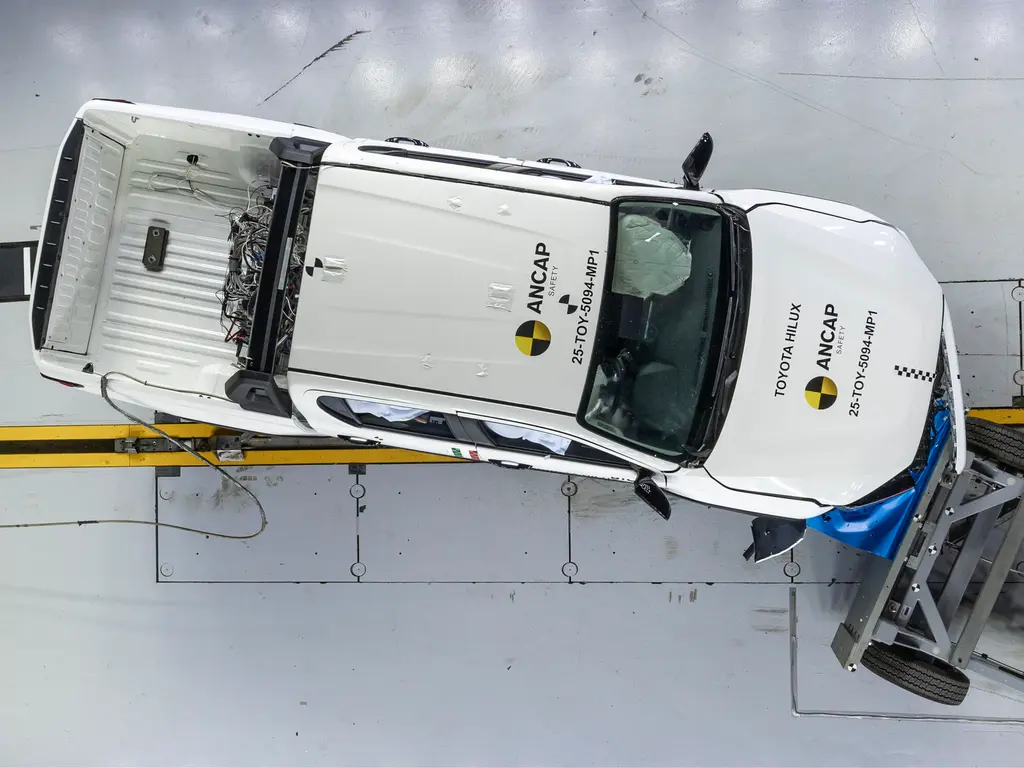
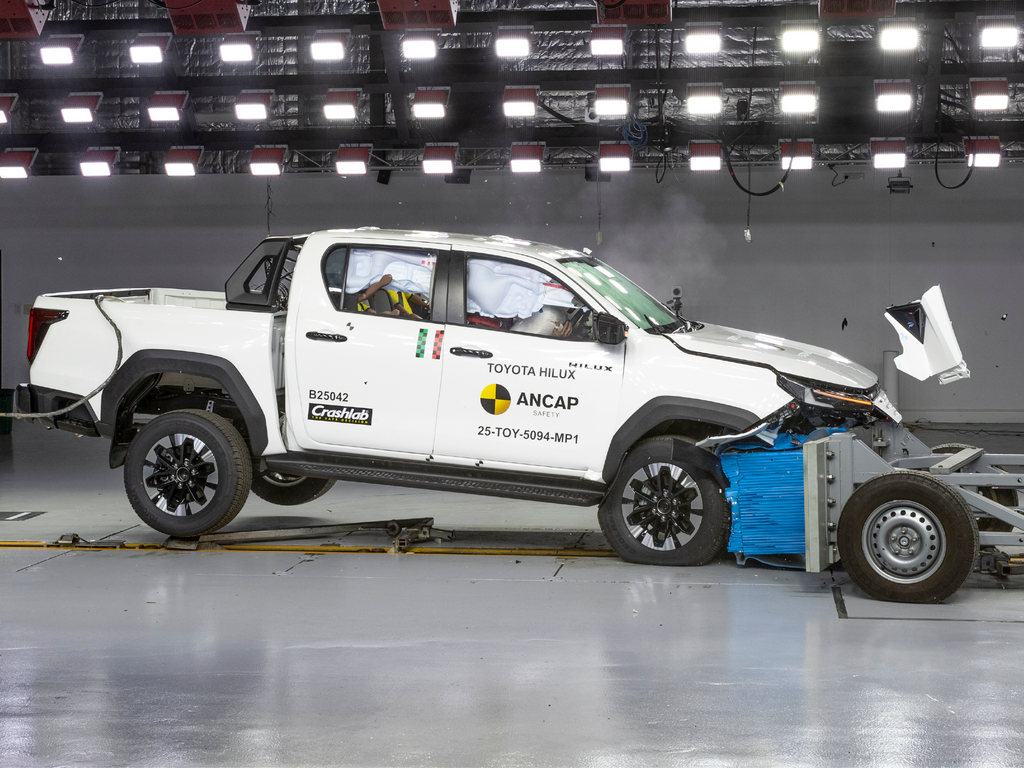
ANCAP’s testing showed the Toyota Hilux provides strong overall protection for adult occupants, with a stable passenger compartment in the frontal offset crash. The driver’s chest and lower legs received ‘Adequate’ protection, slightly reducing the score, while all other critical areas for both driver and front passenger were rated ‘Good’.
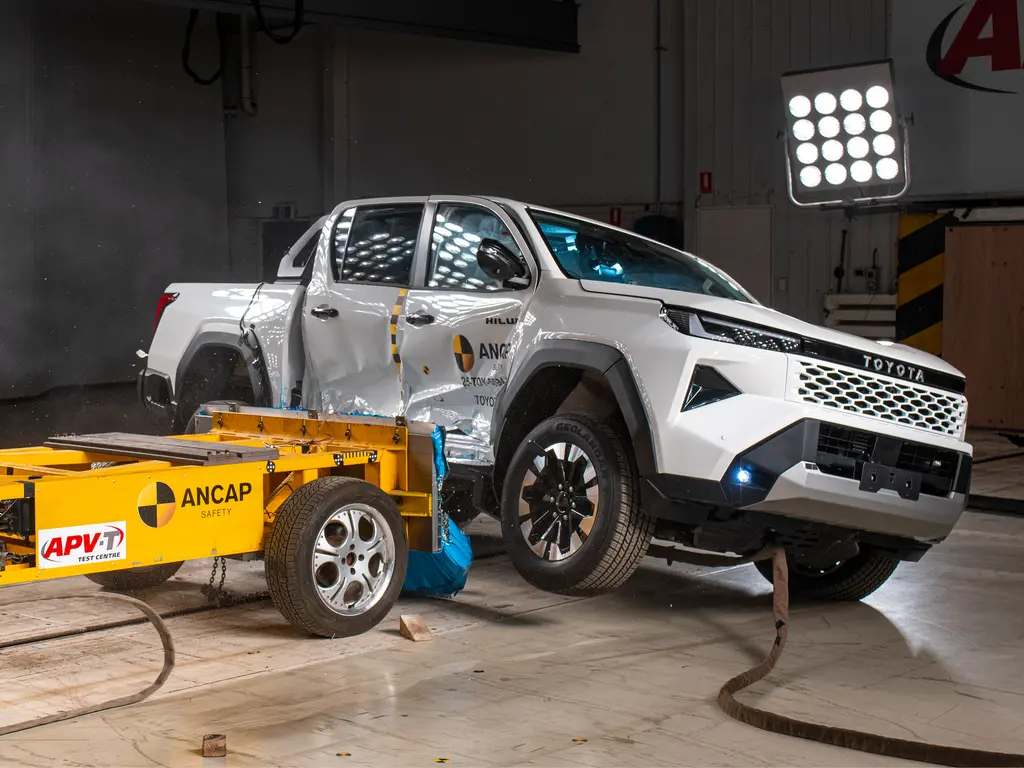
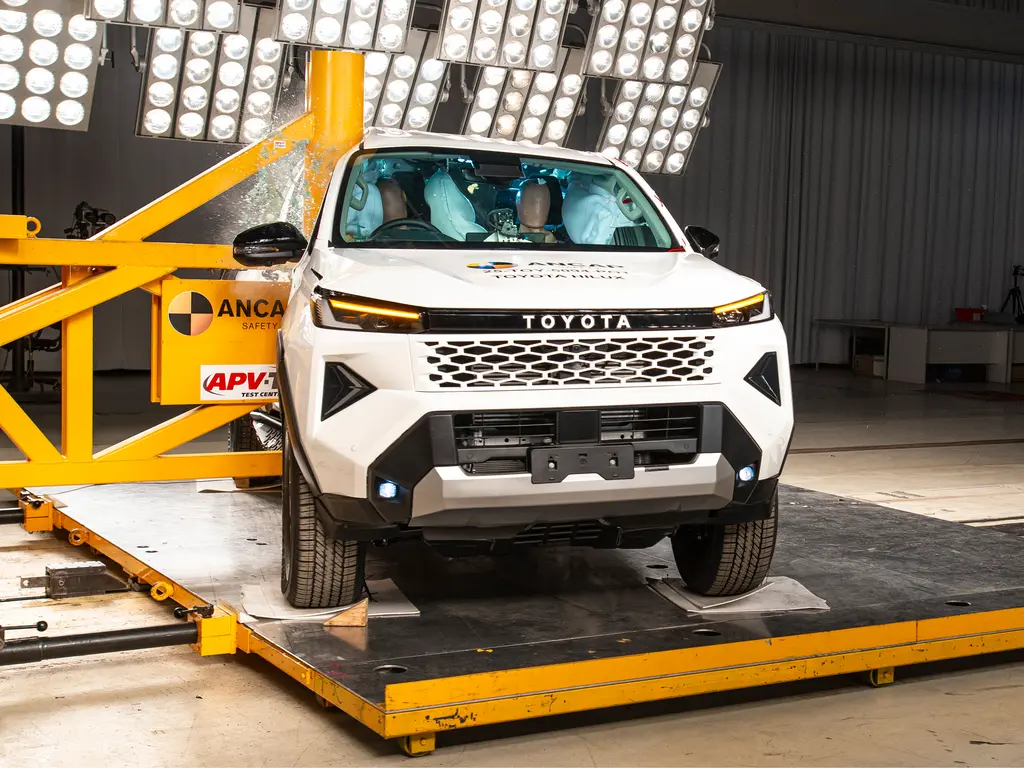
In the full-width frontal test, the driver’s neck was assessed as ‘Marginal’, though the remaining body regions for both occupants ranged from ‘Adequate’ to ‘Good’. The Hilux performed particularly well in side-impact testing, scoring maximum points, and showed ‘Good’ protection in the oblique pole test, aside from ‘Adequate’ chest performance. The centre airbag further contributed to high scores by reducing the risk of head injury in far-side crashes. Overall, the new-generation Toyota ute scored 33.96 out of a potential 40 points.
Child Occupant Protection – 89%
The 2026 Toyota Hilux demonstrated excellent protection for younger passengers, scoring full points in both frontal offset and side-impact dynamic tests for the 6-year-old and 10-year-old child dummies. Dual-cab variants include ISOFIX and top-tether anchor points on the rear outboard seats, enabling secure installation of a wide range of child restraints.
ANCAP noted that while the Hilux’s structural performance and restraint effectiveness were strong, single-cab models cannot safely accommodate child restraints due to the absence of top-tether anchorages. Dual-cab versions are also equipped with a child presence detection system, adding an important layer of safety that contributed to the high overall score of 44 points out of 49.
Vulnerable Road User Protection – 82%
The new Hilux performed well in tests involving pedestrians, cyclists, and motorcyclists. The bonnet and windscreen provided a combination of ‘Good’ and ‘Adequate’ head protection over most of their surfaces. However, it lost a lot of marks because the stiff A-pillars and leading bonnet edge recorded ‘Poor’ results. Lower-body impact results were notably strong, with maximum points awarded for pelvis, femur, knee and tibia protection.
Beyond structural performance, the ute’s autonomous emergency braking (AEB) system showed ‘Good’ capability across nearly all scenarios, detecting pedestrians, cyclists and motorcycles, including during turning manoeuvres and emergency lane-keeping events. The 2026 Toyota Hilux also includes cyclist anti-dooring alerts to help prevent collisions when occupants open the driver’s door into the path of an approaching rider.
Safety Assist – 82%
The all-new Toyota Hilux is equipped with a comprehensive suite of standard active safety features under the updated Toyota Safety Sense package. Autonomous Emergency Braking (AEB) for vehicles, pedestrians, cyclists and motorcyclists is supported by junction, crossing and head-on crash avoidance capabilities, most of which earned ‘Good’ performance ratings in ANCAP’s evaluations.
The ute also includes lane departure warning, lane keep assist, emergency lane keeping, blind spot monitoring and intelligent adaptive cruise control with speed sign recognition. Seatbelt reminders cover all seating positions in dual-cab variants, and a driver-drowsiness monitoring system is fitted as standard. Together, these systems showed strong real-world crash-prevention potential, helping the Hilux achieve its solid Safety Assist score of 14.83 points out of a possible 18. It lost the most points for a driver monitoring system that does not intervene under any circumstances.
Standard safety equipment
The Toyota Hilux is equipped with a comprehensive suite of safety features across all rated variants, with Toyota Safety Sense fitted as standard. Key safety equipment includes:
- Airbags: Dual frontal, side chest-protecting (front seats), and side head-protecting curtain airbags for both front and second-row passengers. A driver knee airbag is also standard.
- Centre airbag: A centre airbag is fitted between the front seats to reduce injury from occupant-to-occupant contact during side impacts.
- Autonomous Emergency Braking (AEB): The system detects vehicles, pedestrians, cyclists, and motorcyclists, and supports junction, crossing and head-on crash-avoidance scenarios. AEB Backover is available on some variants.
- Lane support systems: Standard lane departure warning (LDW), lane keep assist (LKA), and emergency lane keeping (ELK) help prevent unintended lane departures and assist in critical avoidance situations.
- Speed Assistance System: Features include speed sign recognition and intelligent adaptive cruise control, allowing the Hilux to adjust set speeds based on detected speed limits.
- Blind spot monitoring: Alerts the driver to vehicles approaching in adjacent lanes, improving awareness during lane changes.
- Driver monitoring: An indirect driver drowsiness monitoring system is fitted as standard to detect signs of fatigue.
- Seatbelt reminders: Intelligent seatbelt reminders are fitted to all seating positions on dual-cab variants.
- Cyclist dooring detection: Provides information and warnings when a cyclist is approaching from behind as occupants open the driver’s door.
- Multi-collision braking: Applies brakes automatically after an initial crash to reduce the risk of secondary impacts.
What does ANCAP say about this result?
ANCAP says the Toyota Hilux’s 5-star result reflects the strong safety performance expected of one of Australia’s top-selling utes. The organisation highlighted the Hilux’s solid crash protection across frontal, side and far-side impact tests, along with its extensive suite of active safety features, many of which performed at a high standard during assessment.
ANCAP Chief Executive Officer Carla Hoorweg noted that models like the Hilux demonstrate the importance of continuous safety improvements across all segments, including popular work and recreational vehicles. She emphasised that ANCAP’s latest round of assessments shows how manufacturers are advancing both structural protection and advanced driver-assistance technologies across new model generations.
According to ANCAP, the Hilux’s result gives buyers, whether private owners, fleets, or commercial operators, confidence that the ute provides high levels of protection not only for occupants inside the vehicle but also for pedestrians, cyclists and motorcyclists sharing the road.
Final Thoughts
The Toyota Hilux’s 5-star ANCAP result confirms it as one of the safest utes available in Australia and New Zealand. Its combination of solid structural performance, strong protection for adults and children, and a broad suite of active safety technologies reflects Toyota’s commitment to improving safety in one of the country’s most popular vehicles.
While the Hilux receives a full penalty for vehicle compatibility in frontal offset testing, its impressive results across side-impact, oblique pole and crash-avoidance systems ensure it meets ANCAP’s toughest rating requirements. For families, fleets and private buyers alike, the 2026 Hilux delivers the reassurance of a modern ute designed with safety at its core.

Comments
New Comment