




Key highlights
- The GAC Aion UT, BYD M9 and Xpeng X9 have all received five-star ANCAP safety ratings.
- The GAC Aion UT and Xpeng X9 lost points for relying heavily on touchscreens for everyday driving functions.
- The Xpeng X9 recorded the lowest Safe Driving score of the three models, despite strong crash protection results.
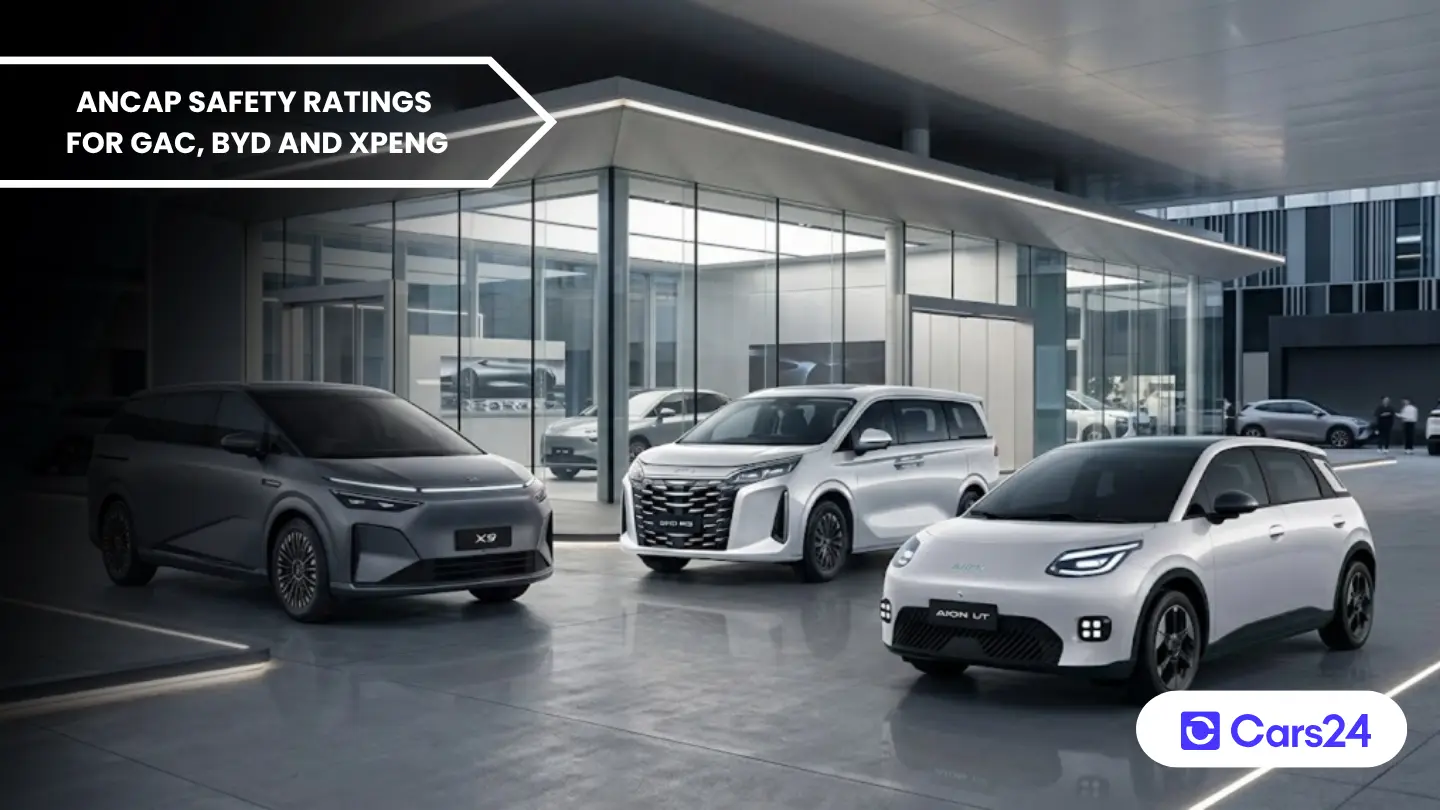
Three Chinese vehicles have secured five-star safety ratings from the Australasian New Car Assessment Program (ANCAP), although two have drawn criticism for relying too heavily on touchscreens for everyday driving functions. The models are the GAC Aion UT electric hatchback, BYD M9 plug-in hybrid people mover and Xpeng X9 electric people mover. All three achieved ANCAP’s maximum overall rating, but their individual assessment scores highlight differences in driver assistance, crash protection and post-crash safety.
The GAC Aion UT went on sale in Australia in April 2026, while the Xpeng X9 arrived in August 2026. The BYD M9 was introduced in Australia in the third quarter of 2026, with its seven-seat variants covered by the five-star rating. Eight-seat BYD M9 variants are currently unrated. For Australian buyers, the results offer another way to compare newer Chinese vehicles beyond their technology and equipment lists. They also raise a practical question about modern cabin design: how easy is it to operate essential controls without looking away from the road?
Read more: Toyota RAV4 five-star ANCAP rating could unlock more fleet sales
How the three models scored
ANCAP assesses vehicles across four safety categories, covering driver behaviour and assistance systems, collision prevention, occupant protection and what happens after a crash.
| ANCAP assessment | GAC Aion UT | BYD M9 | Xpeng X9 |
| Safe Driving | 68% | 75% | 56% |
| Crash Avoidance | 74% | 78% | 82% |
| Crash Protection | 90% | 89% | 91% |
| Post Crash | 88% | 100% | 91% |
The scores measure different aspects of safety rather than simply ranking the vehicles from safest to least safe. Safe Driving covers areas such as driver monitoring, seatbelt use and vehicle controls. Crash Avoidance assesses technologies designed to prevent collisions, while Crash Protection measures occupant protection in an impact. Post Crash examines features that help occupants escape and emergency responders assist after a collision. The results show different strengths across the three vehicles. The Xpeng X9 recorded the highest Crash Avoidance and Crash Protection scores, while the BYD M9 achieved a perfect Post Crash result. The GAC Aion UT’s strongest category was Crash Protection, at 90 per cent.
GAC Aion UT loses points for touchscreen controls
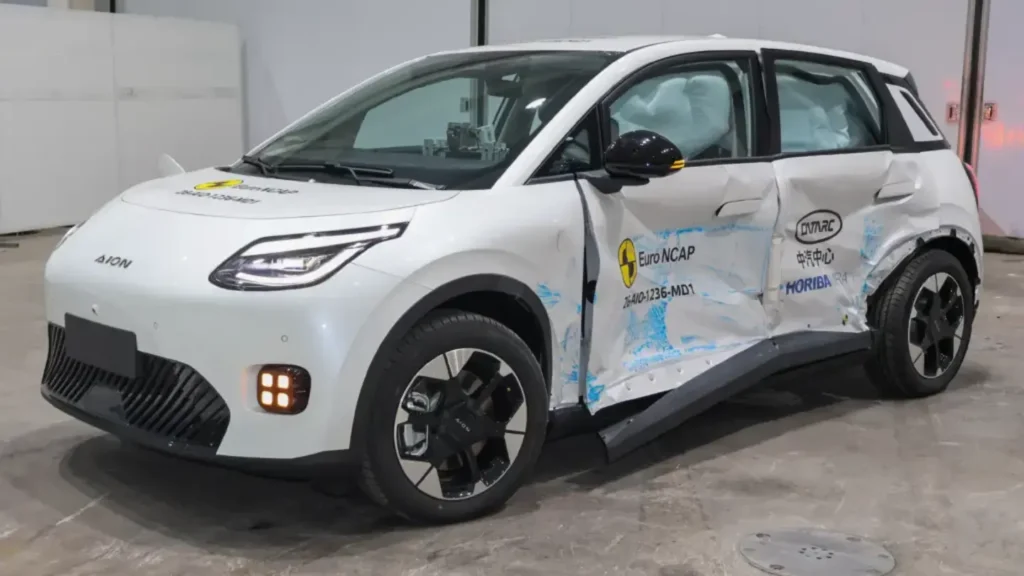
The GAC Aion UT recorded 68 per cent for Safe Driving, 74 per cent for Crash Avoidance, 90 per cent for Crash Protection and 88 per cent for Post Crash. Its strongest results came in crash protection, particularly side-impact testing. The electric hatchback scored 99 per cent in the side-impact assessment, with ANCAP awarding maximum points for the driver in the side-impact and oblique pole tests. Its centre airbag also helped limit the risk of the driver and front passenger striking each other in a side collision.
However, ANCAP found that several commonly used functions require interaction with the central touchscreen, limiting the car’s score in the driving controls assessment. The Aion UT’s adaptive cruise control also does not adapt to road features such as roundabouts and intersections. During on-road testing, its speed assistance system correctly identified 67 per cent of speed-limit change events, equivalent to 94 per cent of the distance driven. The Aion UT’s results highlight the distinction between protecting occupants in a crash and helping drivers avoid one in the first place.
BYD M9 achieves a perfect post-crash score
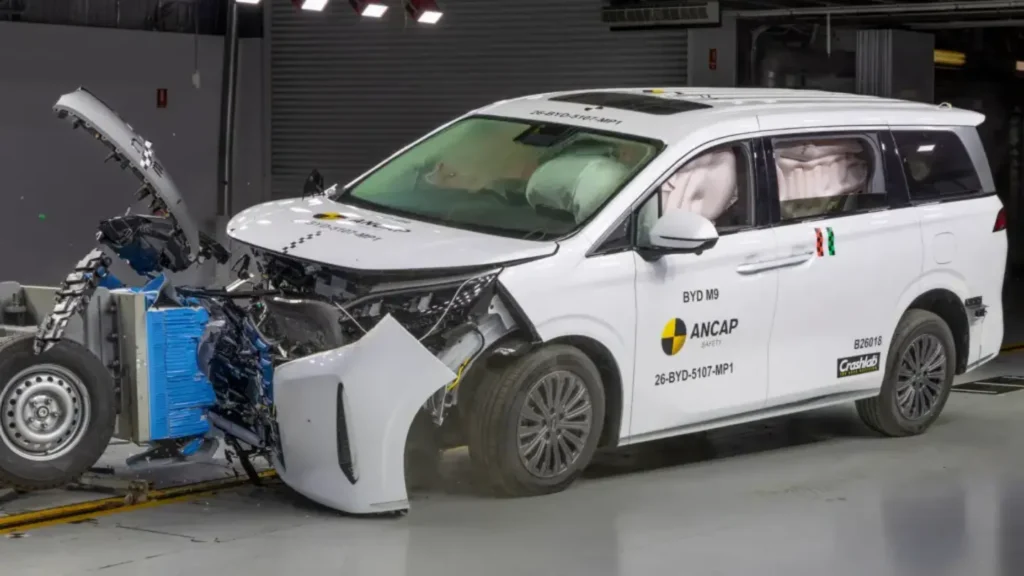
The BYD M9, a plug-in hybrid people mover, scored 75 per cent for Safe Driving, 78 per cent for Crash Avoidance, 89 per cent for Crash Protection and 100 per cent for Post Crash. ANCAP praised its post-crash safety equipment, including emergency response information, multi-collision braking and hazard light activation following an impact. The M9 also provides eCall functionality to Australian and New Zealand owners for the minimum six-year period required by ANCAP. The system can help contact emergency services following a collision.
Its crash protection performance was also strong. The M9 achieved maximum scores for the driver, front passenger and child occupants in the frontal offset test, as well as maximum scores for adult and child occupants in the side-impact test. However, ANCAP applied a significant deduction for crash compatibility in head-on collisions, where the M9’s structure presents a higher risk to occupants of an oncoming vehicle. There is also an important distinction for buyers comparing different configurations. The five-star ANCAP rating applies to seven-seat BYD M9 variants only. Eight-seat variants are currently unrated, so buyers should check which configuration they are considering.
Xpeng X9 delivers strong crash protection
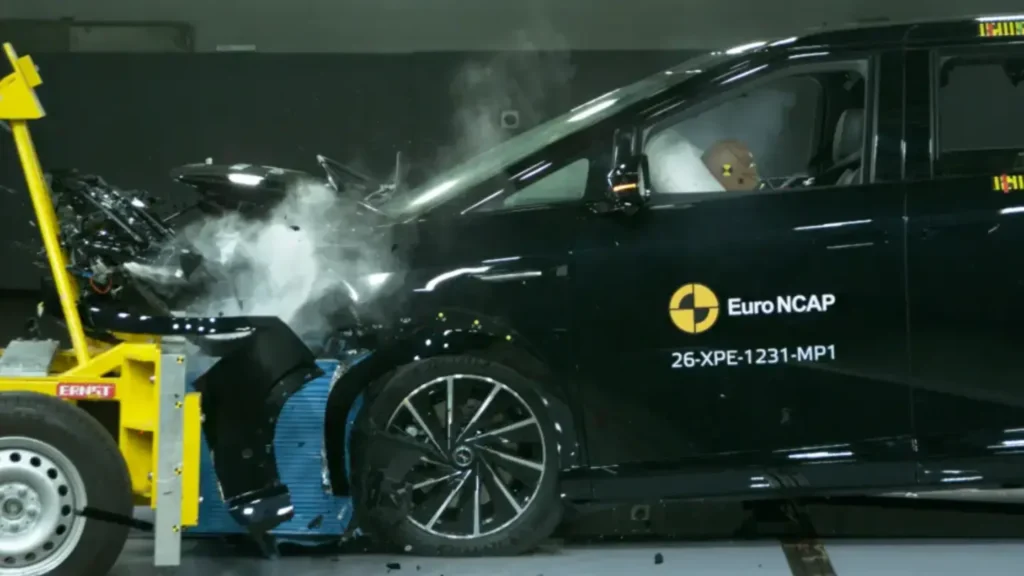
The Xpeng X9 scored 56 per cent for Safe Driving, 82 per cent for Crash Avoidance, 91 per cent for Crash Protection and 91 per cent for Post Crash. Its ANCAP rating applies to all variants, following its Australian introduction in August 2026. The electric people mover recorded the highest Crash Protection score of the three models. ANCAP awarded maximum scores for driver, passenger and child occupants in the frontal offset and full-width frontal tests, as well as for adult and child occupants in the side-impact test.
Its Crash Avoidance score was also the highest of the group, at 82 per cent. The autonomous emergency braking system performed well in several scenarios involving vehicles, motorcycles, pedestrians and cyclists. Low-speed collision avoidance was particularly effective when the vehicle turned across the path of another vehicle or motorcycle. However, the X9’s lane departure prevention system was less effective at stopping the vehicle from running off the road. Its cyclist dooring protection, designed to reduce the risk of a vehicle occupant opening a door into an approaching cyclist’s path, was also limited.
The X9’s lowest result was Safe Driving, at 56 per cent. ANCAP found that some key driving controls relied too heavily on the touchscreen, potentially increasing driver distraction. The driver monitoring system demonstrated some ability to detect fatigue and different forms of distraction, but did not detect phone use. ANCAP also noted that the X9’s eCall hardware is fitted but the function is not yet active. XPENG has committed to making eCall operational in all X9 vehicles by October 2027, a commitment required by ANCAP for points to be awarded in this category.
ANCAP calls for physical buttons to return
ANCAP chief executive Carla Hoorweg has called on carmakers to bring back physical buttons for functions drivers use every day, including operating windscreen wipers, switching on headlights and clearing a fogged-up windscreen. The concern is that drivers may need to look away from the road to navigate touchscreen menus for basic functions. While touchscreens can consolidate controls and reduce cabin clutter, frequently used driving functions need to remain intuitive and accessible.
For Australian buyers, the takeaway is to look beyond the five-star headline. The category scores reveal where each vehicle performs well and where limitations remain. Details such as touchscreen operation, driver assistance behaviour and child-seat compatibility can make a practical difference to everyday ownership. A five-star rating remains a useful starting point when comparing new cars, but it does not mean every safety system performs equally well or that every variant is covered. In the BYD M9’s case, checking the seating configuration is particularly important, while the GAC Aion UT and Xpeng X9 highlight why the accessibility of everyday controls deserves attention alongside crash-test performance.

Comments
New Comment