




ANCAP has announced its biggest change in over 30 years, resetting the way Australians read vehicle safety. It is not just tightening the tests for occupant and road-user safety, but reorganising the entire assessment around a concept called the “Stages of Safety.”
ANCAP Chief Executive Carla Hoorweg said, “Our role is to continually push for improvements in all areas of vehicle safety, and our 2026 protocols reflect that.”
A new safety rating system begins in 2026
The current ANCAP safety rating covers four pillars – front occupant safety, child occupant safety, vulnerable road user protection and safety assists (active tech features and advanced driver assists). While comprehensive, it still had gaps that were not reflected in the overall car safety experience.
As an agency striving to encourage manufacturers to make cars safer and buyers to make informed decisions around vehicle safety, ANCAP has given its assessment and scoring protocols a massive overhaul going into 2026.
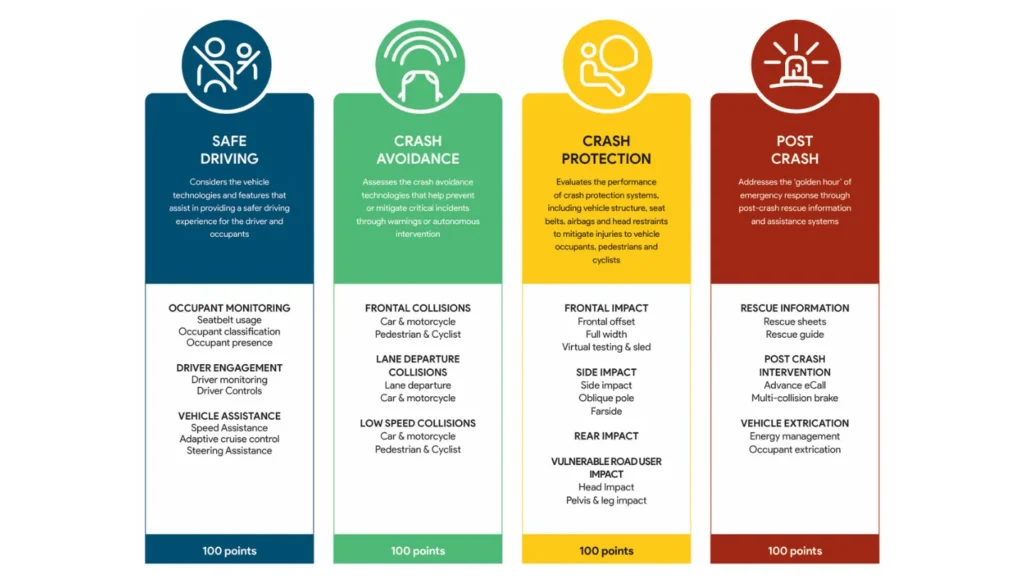
ANCAP is now mirroring the Haddon Matrix, a decades-old model used in crash research that examines what happens before, during, and after a crash. This reshapes safety into 4 stages, which are explained in the next section. In other words, ANCAP isn’t simply crash-testing cars anymore. It’s evaluating the entire chain of survival.
As Carla Hoorweg puts it, “The Stages of Safety approach will allow ANCAP to incorporate useful feedback, enhance existing tests and incorporate new areas of focus.”
MORE: ANCAP FACT SHEET: What’s New From 2026?
What are the 4 stages of vehicle safety?
Long-time Aussie road users know that crashes don’t follow clear-cut patterns. Kangaroo strikes, highway fatigue, roundabout confusion, high-speed rural rollovers, and other unpredictable crashes must be considered in newer safety criteria. That’s where the entire vehicle crash chain assessment helps.
Stage 1: SAFE DRIVING
This means staying out of trouble in the first place, and ANCAP looks at what happens before a crash can occur. These are systems that help drivers stay informed and alert with:
- Driver monitoring
- Driver controls
- Seatbelt usage
- Occupant presence
- Speed assistance
- Adaptive cruise control
- Steering assistance
Stage 2: CRASH AVOIDANCE
If a crash is imminent, can the car avoid the impact? This includes features like autonomous braking (AEB), junction-turning AEB, backover prevention, pedestrian & cyclist detection, and now motorcycle detection in T-bone scenarios.
Furthermore, ANCAP will also test how smoothly and consistently these systems function. This aspect of driver tech safety has garnered spotlight mainly from new, cheaper models where ADAS features exist but are intrusive or unreliable in regular Australian driving conditions.
Stage 3: CRASH PROTECTION
This is the core of the ANCAP safety rating system over the years. Once the crash has happened, how well does the car protect its occupants based on the functioning of airbags, structural integrity, and usefulness of the restraints. It is still the most heavily weighted category. Now it includes:
- New deformable barriers for full-width frontal crashes
- Additional small-female and THOR male dummies
- Stricter rollover curtain airbag requirements
- Penalties for “red” body regions
- Additional rear impact assessment
Stage 4: POST-CRASH
The ‘golden hour’ response becomes part of the star rating system. This is arguably the biggest philosophical shift for ANCAP, and it will focus more on the accessibility and effectiveness of eCall systems from 2026. It will assess the following aspects of post-crash occupant safety:
- Rescue information
- Advanced eCall performance
- Multi-collision brake
- Energy management
- Occupant extrication
Each of the four stages will receive a score out of 100 points and, as is currently done, will be presented as a percentage for consumers. Minimum thresholds will still be enforced for each stage, which will influence the overall star rating.
Added points for physical buttons
Included in this new four-stage safety rating system is the acknowledgement that other elements of the vehicle’s design and user experience contribute to the overall safety of the occupants. This includes encouraging carmakers to do the following:
- Bring back physical buttons: It acknowledges that the touchscreens and sub-menus are too much of a distraction compared to easy-to-use stalks and buttons.
- Electric door handles to work post-crash: Switch-like electric releases for door handles, especially those that pop out from sitting flush in the door, that replaced physical door handle mechanisms must remain functional in the event of a crash.
- Effective driver alerts: Systems like driver monitoring systems to support drivers rather than irritate them with endless beeping that can be more distracting or counter-productive.
MORE: Audi updates controls and technology across new A5, A6, Q5 and e-tron
Why does this new system matter for Australian roads?
Australia’s road trauma isn’t just a problem in the cities, but a regional problem also. Last year, 1,592 Australians and New Zealanders died in vehicle-related crashes. A disproportionate number were on high-speed rural roads.
The new ANCAP safety rating system directly targets the realities of Australian driving, like high-speed regional crashes, animal strikes, the crashing of large SUVs and utes, and rear seat safety for kids.
“Through these upgraded protocols, ANCAP is setting a clear bar that will continue to challenge industry beyond regulation, inform consumers, and help reduce road trauma. We look forward to seeing vehicle manufacturers continue to meet the highest levels of safety in a competitive market,” Ms Hoorweg continued.
MORE: BYD confirms all-new 2026 flagship SUV above Sealion 8
What to expect next?
The automotive landscape is moving fast with electrification, automation, and new ADAS layers. ANCAP’s evolving system ensures manufacturers cannot deliver minimum-compliant vehicles.
Entry-level models will be forced to adopt high-end safety tech much sooner than previously anticipated. By 2027 or 2028, even a 3-year-old car may lag significantly behind new models in ADAS robustness, occupant monitoring and post-crash capability.
New tests may also compel families to increasingly weigh safety depreciation against financial depreciation. Overall, the new ANCAP evaluation means a more holistic understanding of what makes a vehicle genuinely safe.

Comments
New Comment