




Australia has officially launched the Vehicle-Grid Network (VGN), which is the nation’s first coordinated collaboration platform designed to transform electric vehicles into mobile power stations that can feed electricity back to the grid. It is led by Climate-KIC Australia and the Institute for Sustainable Futures at the University of Technology Sydney (UTS).
The VGN dreams of a future where people’s parked EVs don’t just sit idle but send electricity from car batteries back into the national power grid to power others’ homes. Once established well, the system can even pay EV owners who contribute power to the grid.
What is the Vehicle-Grid Network (VGN)?
The Vehicle-Grid Network establishes Australia’s first nationally coordinated industry collaboration platform specifically focused on accelerating electric vehicle-to-grid integration. The network aims to create structured cross-sector engagement, facilitate knowledge sharing, and develop practical tools that make bidirectional EV charging accessible to consumers.
The Vehicle-to-Grid (V2G) technology
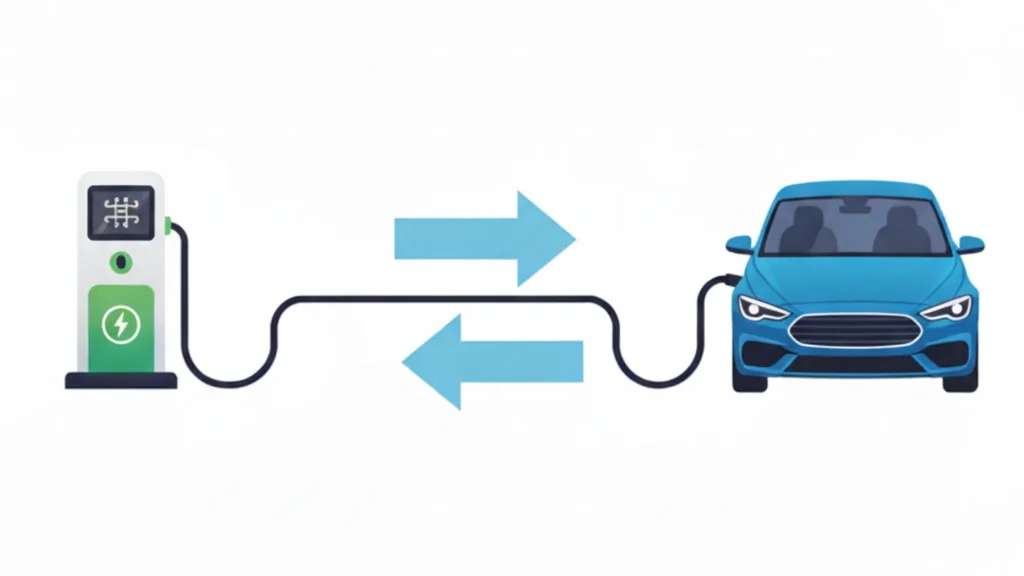
This setup transforms EVs from passive energy consumers into active grid participants through bidirectional charging: the ability to both draw power from and supply power back to the electrical grid. V2G implementation requires sophisticated software coordinating individual vehicles with grid-wide demand patterns.
A bidirectional charger converts AC (from the grid) to DC (for car batteries), and it can also convert DC (from battery) to AC (for the grid or home). This allows both V2G (car to power grid) and V2H (car to power your home).
Research organisation Pecan Street estimates that one plug-in electric vehicle can power a single home for two to five hours, or five homes for approximately one hour, using stored battery capacity. The scale and coordination of the grid make the difference. When thousands of EVs coordinate through V2G technology, they create a distributed storage capacity rivalling traditional power station output.
Australian government’s plan for VGN
South Australia was the first in the country to allow V2G (Vehicle-to-Grid) energy transfer. Since May 2024, owners of Mitsubishi Outlander PHEV and Mitsubishi Eclipse Cross PHEV could sell electricity back to SA Power Networks (SAPN).
Launch details and goals of the VGN program

Federal Climate Change and Energy Minister Chris Bowen launched the VGN program, and Climate-KIC Australia (the nation’s largest climate innovation initiative) leads VGN development alongside the Institute for Sustainable Futures (ISF) at UTS, which brings research expertise in sustainable energy systems. The RACE for 2030 Cooperative Research Centre serves as a founding partner, connecting industry, researchers, and government to achieve Australia’s energy transition targets.
The network responds directly to recommendations from the 2024 National Roadmap for Bidirectional EV Charging, commissioned by RACE for 2030 in partnership with the Australian Renewable Energy Agency (ARENA). That roadmap identified coordination failure as the primary barrier preventing V2G scaling.
VGN pursues 3 interconnected objectives over its three-year mandate: Establish nationally coordinated collaboration, strengthen technical and market foundations, and build sector and consumer capability. This overarching ambition positions Australia for international V2G leadership.
Funding primarily comes from ARENA, through its Driving the Nation Program and RACE for 2030 CRC. Money partners also include industry entities, the Electric Vehicle Council and infra provider JET Charge.
Support from automakers
Nissan pioneered V2G with the LEAF, and BYD (Chinese carmaker) actively supports V2G and has partnered with Australian trials, including Amber Electric’s program, where BYD now has 50 customers’ EV batteries participating in V2G operations.
“With millions of EVs expected on our roads in just a few years, we have an unprecedented opportunity to turn those batteries on wheels into a viable solution for grid stability and renewable energy storage,” Chris Thompson, Amber Electric Co-founder, expressed.
Tesla, Hyundai, Kia, and MG have not clearly committed to V2G support in Australian market vehicles, though some international models include hardware capability.
MORE: Best-selling EVs in Australia in September 2025
V2G programs in other countries
Many countries have already implemented V2G programs, such as France, which has eliminated charging costs for many EV owners with V2G. Other countries having significant V2G reach include Denmark, the United Kingdom, the Netherlands, Norway, and the US.
What’s next for the Aussie EV owners?
In 2023, the government launched the National Electric Vehicle Strategy with goals to make EVs cheaper and easier to access and improve EV charging infrastructure. Moreover, the New Vehicle Efficiency Standard (NVES) came into effect on 1 January 2025, which fines carmakers if they exceed CO₂ emission limits.
The adoption of hybrid and EVs has increased, too. For instance, Battery electric vehicles (BEVs) reached record total sales and market share in Australia during the three months leading up to 30 September.

Comments
New Comment