




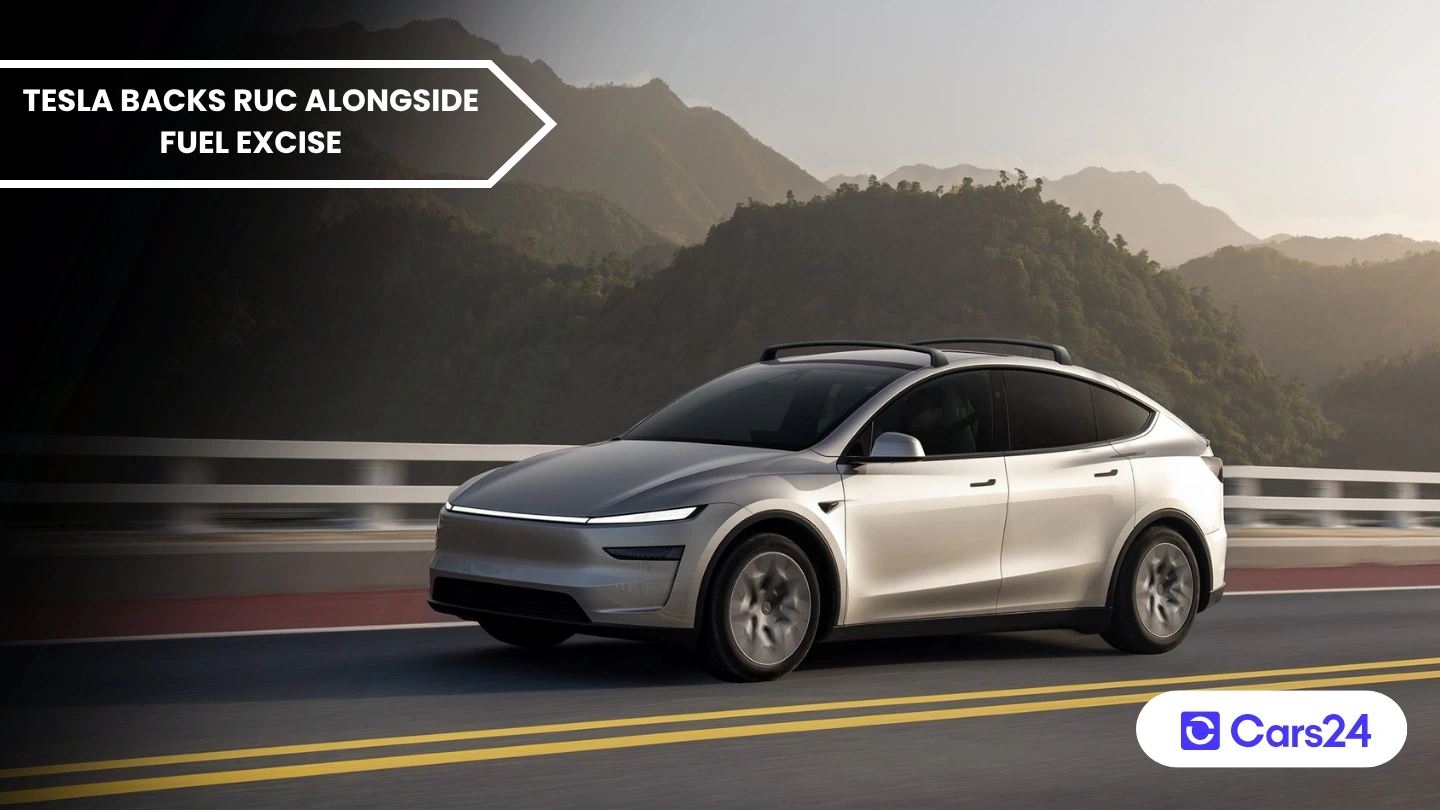
Key highlights:
- Tesla wants road user charges to sit alongside fuel excise
- Its proposal exempts vehicles registered before January 2030
- AEVA proposes a universal charge based on weight and distance
Tesla has backed a distance-based road user charge for Australian motorists, arguing it could discourage unnecessary driving and improve productivity, but the EV maker wants the new charge to sit alongside the existing fuel excise, rather than replace it.
The company also recognises that motorists could have “justifiable community pushback” against another vehicle-related tax. Its proposed solution is to apply the charge only to vehicles registered from a future cut-off date, such as January 2030.
Why Tesla wants a road user charge
In its detailed submission to the federal government’s Select Committee on Productivity in Australia, Tesla argued that a road user charge could help improve productivity by discouraging unnecessary car journeys. Australia currently collects fuel excise on every litre of petrol and diesel sold.
The tax adds around 51 cents per litre and operates on the principle that vehicles which use more fuel contribute more towards road funding because they generally use the roads more. However, fully electric vehicles use no petrol or diesel, while hybrids consume less fuel.
This has prompted experts to call for a different funding model, including a proposed charge of 3 cents per kilometre driven, to ensure motorists contribute fairly towards road use. Tesla argues that motorists do not see fuel excise as a direct road-use fee, and a distance-based charge would make the cost of driving more obvious and could discourage discretionary trips.
“A transparent, distance-based road user charge (cents per kilometre) is an effective lever to introduce the price salience of road use that fuel excise lacks, serving to directly discourage marginal, discretionary car journeys in favour of public and active transport,” Tesla said.
Why Tesla wants fuel excise to stay
Tesla does not want the government to scrap fuel excise when it introduces a road user charge. The company argues that burning petrol and diesel creates wider societal costs beyond the damage vehicles cause to road surfaces, which include:
- Local air pollution and related health impacts, including respiratory and neurological diseases
- Greenhouse gas emissions
- Inflationary effects linked to global oil supply shocks
Tesla said these costs justify retaining fuel excise alongside a distance-based charge. As a brand that sells only EVs, Tesla also stands to benefit when fuel excise makes petrol and diesel vehicles more expensive to run.
Also read: Australia considers tougher tyre rules to stop poor-quality imports
Tesla proposes a 2030 cut-off
Tesla acknowledges that introducing a road user charge could trigger “justifiable community pushback,” and to reduce opposition, it proposes applying the charge only to vehicles registered after a specified date. For example, vehicles registered from January 2030 would pay the road user charge, while those registered before that date would remain exempt.
This approach would give existing vehicle owners protection from the new charge while gradually bringing newer vehicles into the system.
Government says the timing must be right
The federal government is already working towards a road user charge, but it has yet to settle how the system would operate or whether it would replace fuel excise or run alongside it. In August, Climate Change and Energy Minister Chris Bowen said Australia should work towards introducing a road user charge, but the government must get the timing and design right.
Bowen said the proposal represents a major undertaking and should not be rushed. He also confirmed that the government left it out of the May 2026 Budget because it needed more work.
“The Treasurer and I are of one mind on that. That’s why it wasn’t in the budget [in May 2026] because it needs more work. It’s a conversation that we’ll continue to have,” Bowen said.
During the same National Press Club of Australia address, Bowen said he had found broad support for the principle of a road user charge, including among electric vehicle industry representatives. He said EV industry participants did not oppose the charge itself and their message was to ensure the government implemented it properly.
AEVA wants every vehicle to pay
The Australian Electric Vehicle Association (AEVA), an EV advocacy group separate from the Electric Vehicle Council (EVC) lobby group, has also backed a universal road user charge. Its proposal would calculate the annual charge using three factors: vehicle weight, annual kilometres travelled, and a rate of three cents per kilometre.
The proposed formula would apply regardless of whether a vehicle uses petrol, diesel, electricity or another powertrain, and it produces the following annual charges for selected vehicles:
| Vehicle | Weight | Annual distance | Proposed annual charge |
|---|---|---|---|
| 2026 Toyota HiLux SR5 dual-cab | 2.1 tonnes | 13,000km | $823 |
| Toyota LandCruiser 300 Series Sahara | 2.6 tonnes | 13,000km | $1,025 |
| 2018 Suzuki Swift Sport | 970kg | 13,000km | $379 |
| Tesla Model Y | Approx. 1.9 tonnes | 13,000km | $741 |
The figures show how the proposed formula would make heavier vehicles pay more, while lighter vehicles would face a smaller annual bill. Petrol and diesel vehicles such as the HiLux and LandCruiser would still pay the existing fuel excise, which means the road user charge would become an additional levy for them, rather than a replacement tax.
The Tesla Model Y, Australia’s best-selling electric vehicle, would face the proposed $741 annual charge without paying petrol or diesel fuel excise.
AEVA’s policy convener, Dr Chris Jones, said the government should not immediately introduce the full 3-cent rate. He argued that the rate should build up gradually and only reach its maximum when EVs make up the majority of Australia’s vehicle fleet.
“We’ve said that’s the maximum it should ever be. When EVs make up the majority of the fleet. We want to build up to that,” Jones said.
The association also proposed two possible ways to protect existing vehicles:
- Introduce the charge gradually over 10 years, reaching three cents per tonne-kilometre by 2035, plus inflation
- Apply the charge only to vehicles manufactured after a specified year, potentially 2021
Its policy proposal stated: “AEVA recommends that a universal RUC should either be introduced gradually over a 10-year period, eventually reaching 3 c/km by 2035 (plus inflation) or only applied to vehicles manufactured after say, 2021”.
And all of this makes more sense for discussion right now as EVs take a larger place in the market. The Tesla Model Y alone has become the first EV to top Australia’s monthly vehicle sales charts three times in 2026.

Comments
New Comment