




A car accident can leave you asking one big question: “What do I do with it now? You might be wondering whether it’s even legal to sell it, whether an insurance write-off has ended your options, or if you’re about to lose thousands of dollars by making the wrong decision.
A damaged car can still be sold, whether your car is repairable, written off, or only worth selling for parts. But first, you need to understand the legal requirements and choose the right buyer.
Learn when you can legally sell a damaged car after an accident, how laws affect the process, and the best ways to recover as much value as possible without creating legal or financial headaches.
What qualifies as accidental damage on a car in Australia?
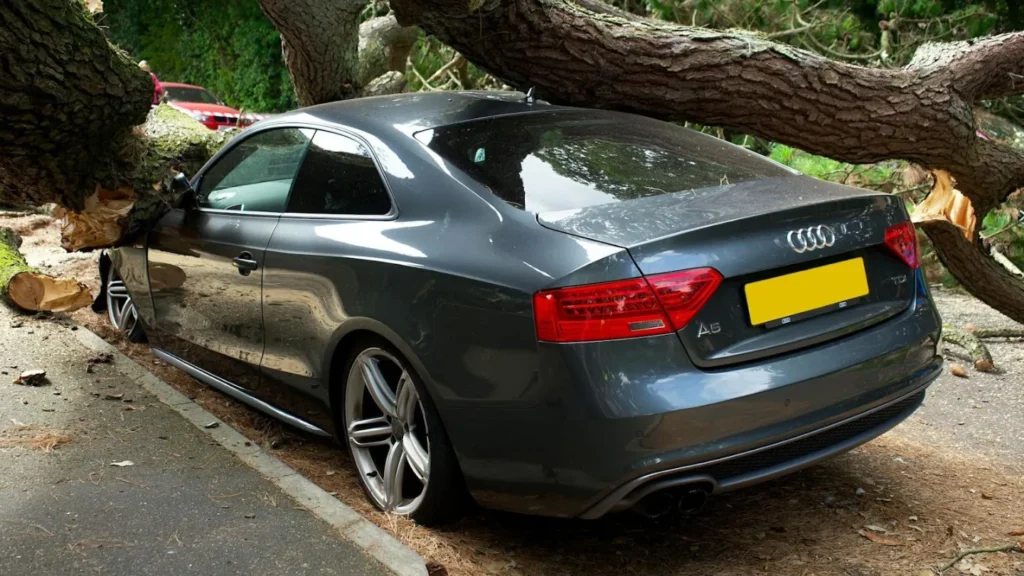
Accidental damage is defined as loss or harm caused by a sudden, unforeseen, and unintended event that occurs at a specific time and place. It essentially covers damage resulting from an external action rather than internal failure.
For instance, due to collisions, natural disasters, vandalism, attempted theft, or unintentional mishaps like dropping something on the car. Accidental damage does not include a car’s wear and tear, mechanical or electrical failure, or intentional damage.
Can you legally sell an accident-damaged car?
It’s entirely legal to sell an accident-damaged car in Australia, and it can be straightforward if you follow the right steps. The best path depends on whether your vehicle is still “roadworthy” or has been declared a “write-off” by an insurer.
| Vehicle status | Damage | Can you sell it? | Best selling path | Legal requirements |
|---|---|---|---|---|
| Minor damage | Dents, scratches, or minor mechanical issues | Yes | Private Sale for the highest price | Must disclose accident history to avoid future legal disputes |
| Repairable Write-Off (RWO) | Cost of repairs exceeds the car’s market value | Yes | Specialist Salvage Buyers or auctions. | Must be recorded on the WOVR. Cannot be re-registered until VIV/safety inspection |
| Statutory Write-Off (SWO) | Severe structural, fire, or flood damage | Yes (only for parts) | Car Wreckers/Cash for Cars services | Strictly prohibited from ever being re-registered in AU. Sold as “parts only” |
| Unregistered/Non-running | Mechanical failure or expired registration due to an accident. | Yes | Wreckers often provide free towing and instant cash | Remove number plates and return to the state authority (e.g., VicRoads) for a possible refund |
Should you repair your damaged car after an accident?
Deciding whether to repair your accident-damaged car involves weighing the repair costs against the vehicle’s final market value while considering the permanent “repaired write-off” tag on its history.
A common industry benchmark is to repair the car if costs are under ~50% of its market value, and consider selling it as-is if repairs exceed ~70%.
Your accident-damaged car is worth repairing if it has minor cosmetic damage, it is a rare vehicle with high resale value, and if you can repair the car to a good roadworthy condition yourself (DIY).
Also read: What to do when your car is damaged in a flood?
How to sell a damaged car in Australia legally?
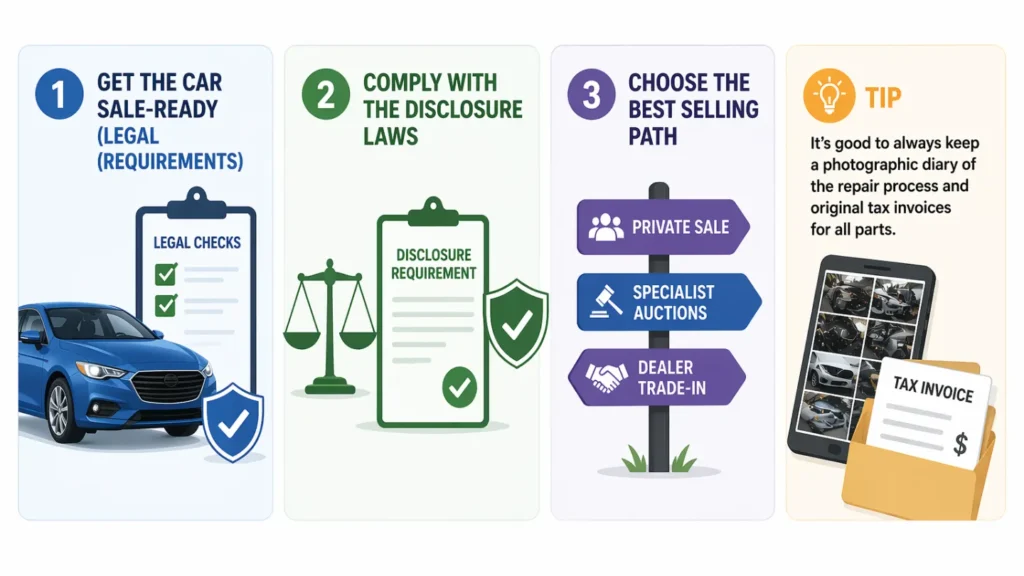
You must first restore the vehicle’s legal status on the WOVR and then comply with strict disclosure laws to sell a repaired write-off car in Australia (outside of NSW). The process is generally standard across Victoria, Queensland, and other states, though specific inspection names vary.
Step 1: Get the car sale-ready (legal requirements)
After all the professional repairs and detailing, get your car cleared from the WOVR. This requires a two-step inspection process.
Vehicle Identity Validation (VIV): An intensive inspection (e.g., VicRoads VIV or QLD WOVI) to ensure the car isn’t rebirthed from stolen parts. You must provide receipts and VINs for all major replacement parts used during the repair.
Roadworthiness Certificate (RWC): A standard safety check to ensure the repairs meet manufacturer standards and the car is safe for the road.
Step 2: Comply with the Disclosure Laws
Honesty is a legal requirement under Australian Consumer Law. You are legally obligated to disclose the car’s write-off history to potential buyers, even if it is fully repaired.
While some private sellers traditionally haven’t been bound by this in Queensland, the state is moving toward national consistency, and failing to disclose can still lead to civil disputes.
New laws (as of June 2024) in Western Australia mandate that dealers must display a specific notice on the car window if it is a repaired write-off, with fines for non-compliance.
Step 3: Choose the best selling path
The repairable write-off (RWO) car’s market value will be significantly lower than that of an undamaged equivalent because the “write-off” tag stays on the vehicle’s history forever via the PPSR check.
In a private sale, you are likely to get the highest price from a buyer looking for a bargain, but they are harder to find, and you may have to handle time-wasters and hagglers.
In specialist auctions, the sale is fast because buyers (like Pickles) expect damaged/repaired stock, but they have high commission fees and potentially a lower final price.
In a dealer trade-in, you can have the most peace of mind if it sells, but many dealers refuse to buy repaired write-offs, and those who do will offer very low prices.
Tip: It’s good to always keep a photographic diary of the repair process and original tax invoices for all parts. Most VIV inspectors will demand these before they grant a clearance certificate.
What to do with your accident-damaged EV or hybrid car?
The EV and hybrid car accident scenarios are more complex because the battery is often the most valuable and sensitive component. Even minor impacts can result in a total loss if the battery casing or internal cells are compromised. Damaged lithium-ion batteries can also pose delayed fire risks after a crash.
Insurers often write off EVs because they lack the proprietary software to see inside the battery. You may need to pay for a private battery health check to prove to the insurer that it is safe to repair, if you want to keep the car.
If your EV is a Statutory Write-Off, it probably still has high salvage value. Specialist recyclers or second-life battery companies may pay more than traditional scrap metal wreckers.
In some cases, you have to just sell your wrecked EV or plug-in hybrid (PHEV) as salvage, for example, when it has a bent battery tray or is flood-damaged. Here is how you can identify a flood-damaged car.
Also read: EV battery replacement costs and more
Tips to maximise a used car’s resale value after an accident
You need a strategy built on extreme transparency and professional proof of repair to maximise the resale value of a Repairable Write-Off (RWO) or a car with minor accident damage. Your goal is to prove the car is just as safe as an undamaged one. Here are some tips:
1. Document repairs (Your truth file)
Keep a detailed diary of every repair step, including “before,” “during,” and “after” photos of the damage. Retain every receipt for parts. Ensure second-hand parts have the VIN of the donor vehicle recorded for RWO cars (required for VIV inspections). Here are more documents needed to sell your car.
2. Price and advertise right
Expect to list a repaired RWO at 25-30% below the current market price of an undamaged equivalent. Mention “WOVR listed” or “Repaired Write-Off” directly in the online ad.
Even a damaged car sells for more if it is professionally detailed. A clean interior and polished (undamaged) panels suggest the owner cared for the mechanics.
3. Choose a buyer for the best returns
Private sale is the best for minor damage cars. Many buyers will still consider an accident-damaged car if they are provided with full documentation.
Choose specialist auctions on platforms like Pickles or Manheim, which specialise in salvage and repaired stock. They attract buyers who understand the WOVR system.
If you are selling for parts, shop around and pit wreckers against each other to get a higher bid.
Is it worth claiming for accidental damage?
Deciding whether to claim for accidental damage in Australia depends on the cost of repairs versus your insurance excess (out-of-pocket part) and the long-term impact on your future premiums.
It is recommended to claim your accidental car insurance in cases of major damage, third-party involvement, not-at-fault, theft or total loss.
You should consider paying out-of-pocket if repairs cost ≤ excess, because your premiums can spike, and you have to protect your NCB.
In Australia, you must usually notify your insurer of any accident, even if you don’t intend to claim, as failing to do so could void your policy if a problem arises later.
Also read: Car Insurance jargon: Guide to understanding important terms
Can you buy back a car after a write-off in Australia?
Yes, you can buy back a written-off car in Australia, but your ability to drive it again depends on the type of write-off listed in the Written-Off Vehicle Register (WOVR).
You can buy back a Repairable Write-Off (RWO) car in most states (except NSW) and repair, inspect, and re-register it. You can also buy a Statutory Write-Off (SWO) car, but only for parts or scrap.
In New South Wales (NSW), nearly all written-off vehicles are treated as statutory write-offs and cannot be re-registered, even if they appear “repairable,” unless they were only damaged by hail.
Buying a wrecked car back from the insurer
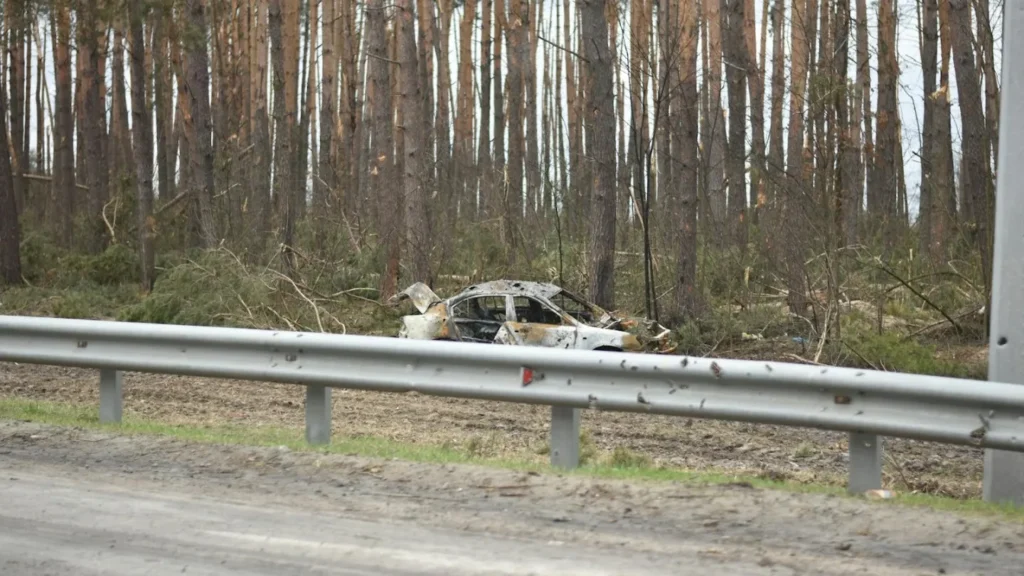
The SWO vehicle is legally “dead” for registration purposes. Insurers may often allow you to retain the wreck, but you can only buy it for parts or scrap metal value, and you will get the “buyback” price (salvage value) deducted from your total insurance payout.
Tell your insurer before the claim is finalised that you want to retain the salvage. It becomes much harder to buy back once they send it to a commercial auction house like Manheim or Pickles.
The insurer will set the buyback price based on what they expect to get for it at a scrap auction, typically 5-15% of the car’s market value for an SWO.
You can contact local car wreckers to see what similar damaged or parts-only cars are selling for, to estimate your wrecked car’s buyback price.
The bottom line
You can sell an accident-damaged car in Australia, but the smart move depends on what kind of damage you’re dealing with.
Minor damage can still sell privately if you’re honest. A repairable write-off can be worth repairing and selling, but only if the repair costs are less, you clear the legal checks, keep every receipt, and disclose its history clearly. A statutory write-off is finished as a road car and is really a parts-or-salvage story.
So here’s the rule to remember: sell your car according to its legal status. If repairs are sensible, document everything and sell with full transparency. If the numbers do not stack up, cut your losses and move it on as salvage.
FAQs
1. How does damaged car removal work in Sydney?
The removal process for a damaged vehicle in Sydney is typically fast and often results in an instant cash payment. You get instant quotes from car removal companies online, and salvage value usually covers disposal and towing.
2. What is the best way to sell a totalled car?
A totalled (insurance write-off) car is best sold through car wreckers or cash-for-cars services for a quick sale, or via salvage auctions if the vehicle still has demand. You can also part it out to maximise value, depending on its condition.
3. How to prove accidental damage?
You need a clear evidence trail: scene evidence, third-party details (drivers or witnesses), a Police Incident Report (if applicable), and a professional mechanic assessment.
4. Can you sell a car after an accident in Victoria?
Yes, but you must follow VicRoads requirements of Roadworthy Certificate (RWC), mandatory disclosure (for WOVR), and Notice of Disposal.

Comments
New Comment