




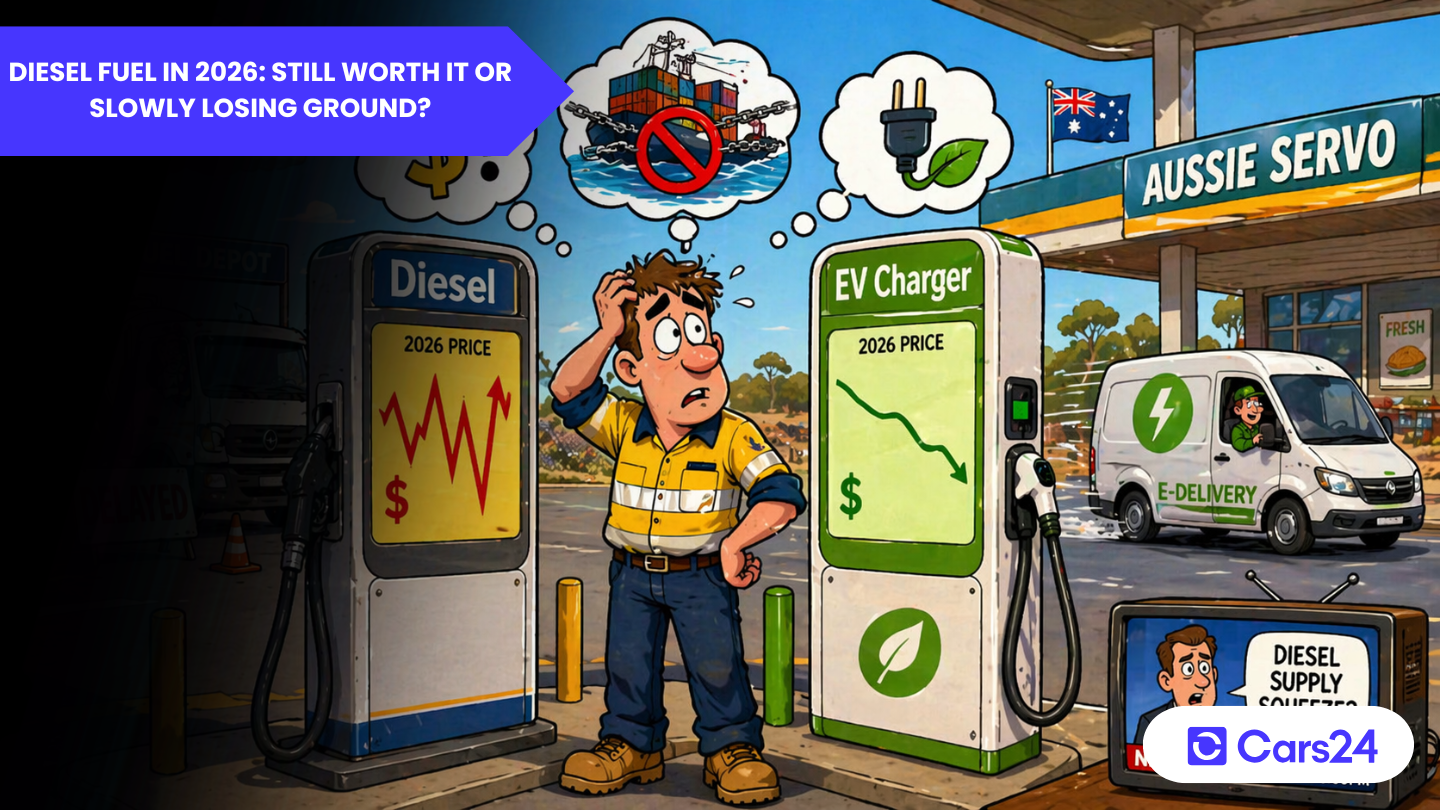
Pull into any servo in 2026 and the question appears before you even reach the bowser: is diesel still worth it?
It’s no longer a simple calculation. Between global supply pressure, shifting emissions standards, and a growing EV market, the diesel question in 2026 is about long-term ownership strategy as much as cents per litre. Recent warnings about a delayed diesel supply squeeze in Australia, driven by high import dependency and tightening Asia-Pacific demand, have only added to concerns around price stability this year.
Why is diesel back in the conversation?
Diesel fuel has returned to the headlines for reasons that go beyond the pump. Disruptions to key global shipping routes, particularly through the Middle East, have added sustained pressure to already tight supply chains. More significantly, Australia imports around 87 per cent of its diesel, leaving the market structurally exposed to shocks that countries with domestic refining capacity can absorb more easily.
What makes this particularly challenging is timing. Even when international conditions begin to stabilise, Australia often continues to feel the effects of earlier disruptions. Analysts call this the “long tail”, a period where prices and availability remain under pressure because supply adjustments across the Asia-Pacific region happen on a delay. In short, diesel doesn’t just react to what’s happening now. It’s still responding to what happened months ago.
Read more: Australia secures massive 200 million litre diesel supply
Why do diesel prices move differently to petrol?
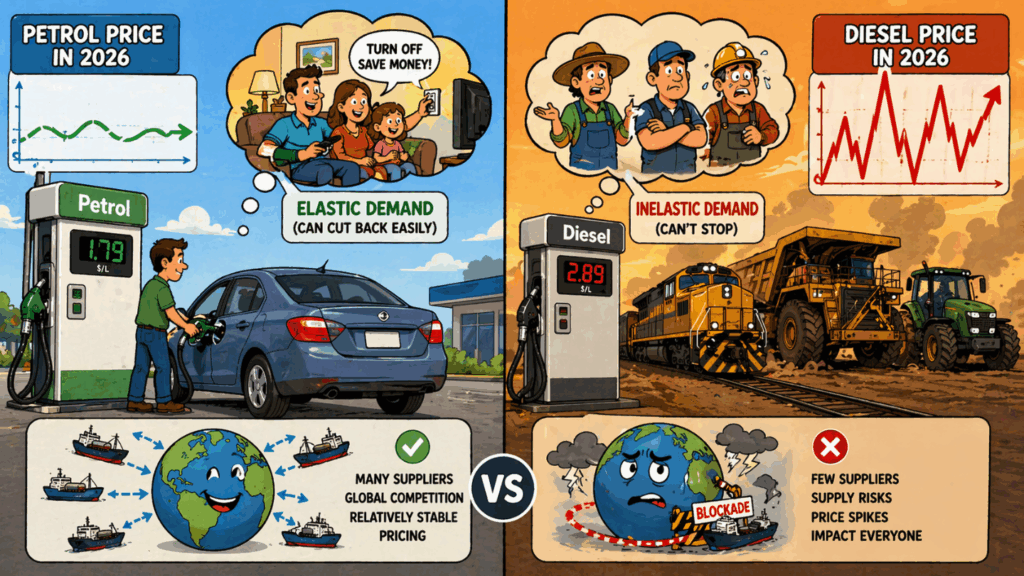
Diesel has always followed its own pricing logic, and that difference has become harder to ignore in 2026.
Unlike petrol, diesel is the lifeblood of industrial activity. It powers freight networks, agriculture, construction, and mining, sectors with inelastic demand that can’t simply cut back when prices spike. It also trades on different global benchmarks, which tend to move more sharply during supply disruptions.
The downstream effect matters too. When diesel prices rise, transport costs follow, supply chains tighten, and pressure flows through to everyday goods. It’s a fuel with consequences that extend well beyond the vehicle.
At the same time, fuel perception has also played a role in how diesel is discussed in Australia. A similar debate has previously surfaced around the dirty fuel narratives and how petrol and diesel are characterised in public discourse compared to regulated fuel standards, particularly as emissions rules have tightened and fuel quality has improved over time.
Read more: ‘Dirty Fuel’ is back in Australian tanks!
What’s happened to diesel prices this year?
2026 has already delivered significant volatility. At the peak of global disruption, prices briefly exceeded $3 per litre in some locations before easing following temporary government intervention, though that relief shouldn’t be read as stability returning.
Prices remain sensitive to global conditions, and the more notable feature of 2026 isn’t necessarily the level of diesel costs but the speed at which they can shift.
The deeper problem: Australia’s structural dependency
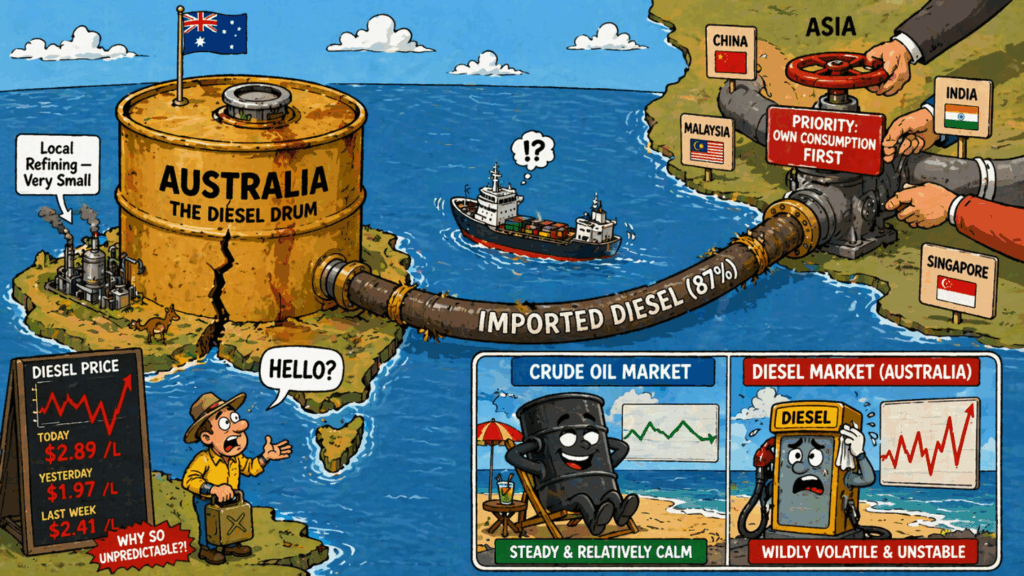
The real vulnerability in Australia’s diesel situation isn’t visible in any single price movement, it’s structural. With limited domestic refining capacity, Australia is competing for refined fuel products in a region where exporting countries may choose to prioritise their own consumption during periods of high demand. Even when crude oil markets settle, diesel availability can remain constrained.
This is where the long tail matters most. Diesel pricing pressure doesn’t end when global headlines move on.
Who still benefits from diesel in 2026?
For the right driver, diesel remains a clear choice.
High-mileage users continue to benefit from better fuel efficiency, which offsets the higher per-litre cost over time. In regional and rural Australia, where the infrastructure for alternatives remains genuinely limited, diesel is less a preference than a practical necessity.
Towing and heavy-load applications are another stronghold. Torque delivery and sustained performance under load still give diesel a meaningful edge over petrol and most hybrid alternatives.
Read more: EU revokes its 2035 ban on diesel cars
Where does diesel start losing the argument?
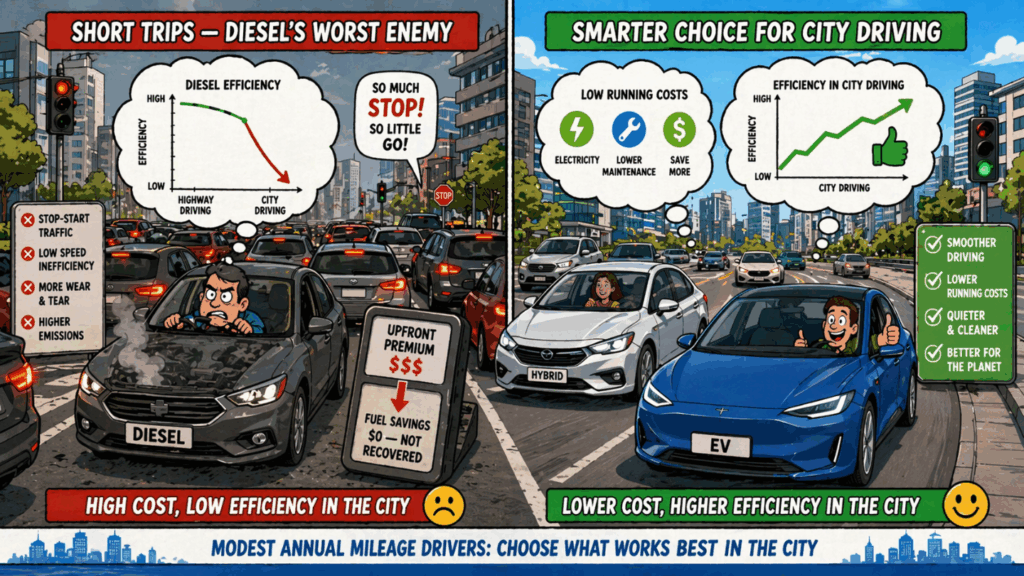
In cities, the equation flips.
Short trips and stop-start traffic neutralise diesel’s efficiency advantage. Hybrids and EVs increasingly offer lower running costs in exactly the conditions where diesel performs worst. For drivers with modest annual mileage, the upfront premium of a diesel vehicle is unlikely to be recovered through fuel savings.
There’s also a longer horizon to consider. As emissions standards tighten and electrification continues to expand, diesel vehicles may face softening resale demand in metropolitan markets, a factor worth weighing for anyone thinking about the five-year picture.
Read more: Should I be buying a diesel car?
Diesel vs EVs and hybrids
Electric and hybrid vehicles are gaining genuine share in 2026, driven by lower running costs and insulation from fuel price swings. In urban segments, the transition is moving faster than many expected.
But diesel retains clear advantages where it counts: long-distance travel, towing, and regional reliability. The market isn’t splitting cleanly into winners and losers, it’s segmenting. Diesel remains relevant, but within an increasingly defined set of use cases.
One pricing moment to watch
A temporary fuel excise reduction introduced earlier in 2026 is set to expire mid-year. Once that reverses, diesel prices may rise again, particularly if global supply pressure remains elevated. The second half of 2026 is worth planning around.
Bottom line
Diesel in 2026 is not in decline, it’s in transition.
For high-mileage drivers, regional users, and anyone with genuine towing or heavy-duty requirements, it remains the most practical option available. For urban drivers doing short distances, the alternatives are increasingly difficult to argue against.
The shift in thinking required is this: diesel is no longer the default answer. It’s the right answer for a specific kind of driver, and knowing whether you’re that driver is now the real question.

Comments
New Comment