




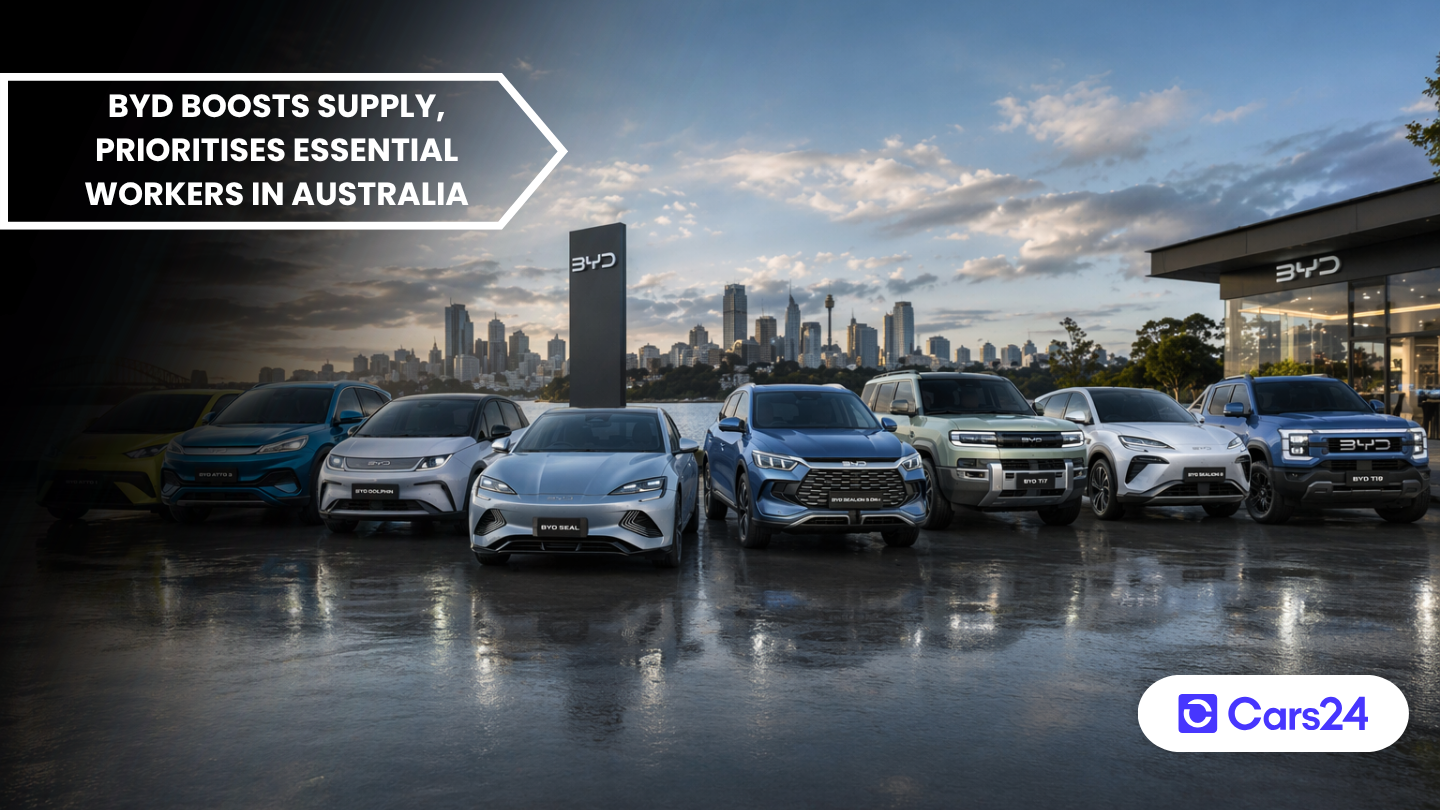
BYD has confirmed a significant supply increase for the Australian market, alongside a new initiative to prioritise vehicle deliveries for essential workers.
The company will allocate 30,000 additional new energy vehicles (NEVs) to Australia, with deliveries scheduled across May and June 2026. Further production increases are also expected in Q3 2026, as the brand looks to respond to sustained demand for electric and hybrid vehicles.
The move comes at a time when long wait times and rising cost-of-living pressures are influencing buyer decisions, particularly for those reliant on daily mobility.
Read more: 100,000 BYD cars now on Australian roads
Priority delivery program targets essential workers
As part of the announcement, BYD will introduce a priority delivery program aimed at Australians working in critical public service roles.
Eligible groups include:
- Healthcare professionals (doctors, nurses, frontline medical staff)
- Emergency services (police, fire, ambulance, SES volunteers)
- Education and community services (teachers, social workers)
BYD Australia has clarified that the program will provide priority access rather than exclusive allocation, ensuring broader customer availability remains unaffected.
Eligibility will be verified through standard employment documentation, with internal auditing processes in place to maintain fairness and consistency.
Read more: BYD Australia Market Comparison: Which model offers the best value?
Leadership commentary
BYD’s Asia Pacific leadership, including Liu Xueliang, endorsed the initiative during a recent visit to Australia, framing the move as a response to heightened demand and broader social responsibility.
Locally, BYD Australia COO Stephen Collins said the additional allocation would help ease delivery delays across all customers, while ensuring essential workers receive faster access to reliable and cost-effective transport.
Production scale and supply chain advantage
A key factor behind the increased allocation is BYD’s vertically integrated production model, which allows the company to control key components such as batteries and semiconductors in-house.
This structure enables:
- Faster production ramp-ups
- Reduced dependency on external suppliers
- Greater flexibility during demand spikes
BYD claims this capability positions it to respond more quickly than many traditional automakers facing ongoing supply chain constraints.
Market context: strong demand for EVs and hybrids

Australia continues to see growing demand for EVs and ultra-efficient hybrids, driven by:
- Rising fuel costs
- Expanding model availability
- Increasing consumer awareness
BYD’s expanding local portfolio—including models like the Atto 3, Dolphin and Seal—has contributed to shorter supply in certain segments, prompting the need for increased production allocation.
Previous rapid-response initiatives
The company has previously demonstrated production flexibility during the COVID-19 pandemic, when it repurposed manufacturing facilities to produce personal protective equipment (PPE).
Within weeks, BYD scaled mask production from 5 million to approximately 50 million units per day, supplying frontline workers and international markets.
What does this mean for buyers?
Buyers can expect shorter wait times from mid-2026, along with improved availability across BYD’s EV and hybrid range. Verified essential workers will benefit from faster delivery access under the priority program, although it does not exclude general customers. While this introduces a tiered delivery approach, BYD maintains that the overall increase in supply will ease pressure across the broader market.

Comments
New Comment