




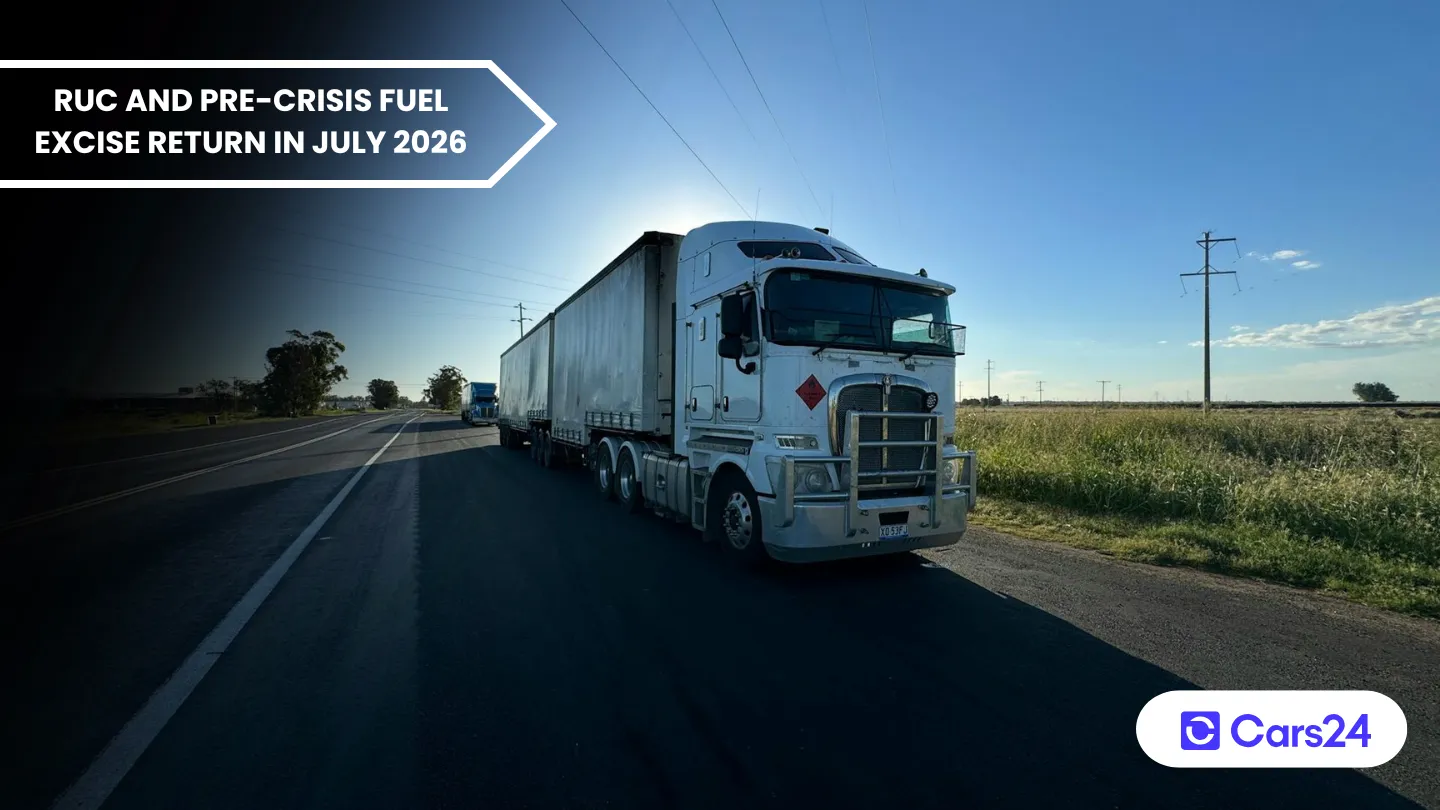
Australian motorists are about to feel the return of higher fuel taxes from July 1, 2026, as the Federal Government prepares to end the temporary excise plus RUC (Road User Charge) introduced during the recent fuel supply crisis.
Canberra is also continuing discussions with the states and territories around possible future road-user charging models for electric vehicles. It’s a major conversation that could reshape the way road funding works in Australia, especially as hybrid and electric vehicle sales continue to surge.
Fuel excise relief and RUC officially ending
The temporary fuel excise relief and the suspension of the heavy vehicle RUC (Road User Charge) introduced on April 1, 2026, are now ending on July 1, 2026. Fuel excise rates will return to normal, and the heavy vehicle RUC will return to 32.4 cents per litre.
The reason for discontinuing the fuel tax relief

Australian federal budget papers show the temporary fuel tax cuts came at a significant cost. The 3-month fuel excise reduction alone is estimated to cost $2.9 billion in lost tax revenue.
Government documents also reveal a combined $3.8 billion shortfall in fuel excise and heavy vehicle RUC revenue for the 2025-26 financial year and a further $350 million shortfall forecast for 2026-27.
Despite that, fuel excise revenue is expected to rebound sharply once the full tax returns. Forecast earnings are expected to rise from $22.78 billion in 2025-26 to $28.26 billion in 2026-27. That’s a projected increase of 24% in just one year and 37.5% growth across four years.
The fuel tax revenue faces long-term pressure
Even with fuel excise revenue recovering in the short term, the government knows the long-term model is under pressure. This comes as Australians continue shifting towards electrified vehicles.
According to the budget papers, hybrid and electric vehicles accounted for 46% of all new vehicle sales last month (April 2026). That creates a major funding challenge because Australia’s current road funding system relies heavily on fuel excise collections.
As more Australians buy hybrids, plug-in hybrids, and EVs, the Government expects long-term pressure on fuel excise revenue to increase. That’s why the Federal Government is now openly discussing a possible future future nationwide road user charge (RUC) system
Why implementing a Road User Charge is complicated
Implementing a national RUC system in Australia won’t be simple because, currently, fuel excise is a federal tax, and vehicle registrations are controlled by states and territories. Any nationwide Road User Charge would therefore require cooperation between both levels of government.
“Consistent with the recommendation of the Economic Reform Roundtable, the Government is continuing to work with states and territories on the development of a Road User Charge for electric vehicles to ensure fair and sustainable funding for road investment and maintenance,” the latest federal budget papers said.
There’s also legal precedent involved. Victoria previously introduced a road-user charge for EVs and plug-in hybrids, but the High Court struck it down in 2023, ruling that only the Federal Government has the constitutional power to impose such a tax.
EV Road User Charge delayed for now

Interestingly, the Federal Budget stopped short of formally introducing an EV RUC. The idea was widely expected to appear but was ultimately postponed.
The Australian Automobile Association (AAA), however, says delaying action may only make the transition harder later. AAA managing director Michael Bradley called for planning to begin immediately.
“Australia needs a distance-based road-user charge with the revenue directed to funding recharging stations and other upgrades needed to support the rapid growth of electric vehicle ownership.”
“The time to act is now.”
But Transport Minister Catherine King suggested the government is cautious about introducing any measure that could slow EV adoption.
“At the moment we’re trying to encourage as much electric vehicle uptake as we possibly can,” (she said in an interview with ABC Insiders) “We don’t want to disincentivise that at all, so there is a balance to be struck here.” She added, “It may not be the time for it right now.”
Industry groups divided over timing of relief end
Not everyone agrees that now is the right time to bring back fuel taxes or discuss new charging systems. NatRoad CEO Warren Clark strongly criticised the decision to reinstate the heavy vehicle RUC from July 2026. (Source: Natroad)
He argued that many transport operators are still under enormous financial pressure. “This is the wrong call and a kick to Australians who are already on their knees,” Mr Clark said.
“We have said over and over. The RUC should be suspended until the end of the year to keep the country going.”
Mr Clark said the temporary RUC saving had been critical for many small operators. “For many smaller operators, the 32.4 cents per litre saving from cutting RUC was not a bonus. It was the difference between parking up and staying afloat.” He warned operators were already struggling with higher fuel costs, rising insurance premiums, finance costs, and compliance expenses. And said reinstating both the RUC and fuel excise could heavily impact small business cashflow.
What is a Road User Charge or RUC in Australia?
In Australia, Road User Charge (RUC) usually refers to the federal Heavy Vehicle Road User Charge applied to vehicles over 4.5 tonnes GVM to recover road damage costs. It is collected through diesel fuel excise by reducing Fuel Tax Credit refunds. The RUC rises 6% yearly, currently at 32.4c/L and paused since April 2026 and resuming in July 2026, increasing to 34.3c/L from 1 January 2027. Australia is also exploring possible distance-based charging for EVs.
The bigger picture
July 1 will likely bring an immediate sting at the bowser as fuel excise and heavy vehicle Road User Charges return to normal in Australia.
The government also thinks the traditional fuel-tax system is beginning to collide with the rapid rise of hybrid and electric vehicles. It now faces a delicate balancing act of maintaining road funding, supporting EV adoption, avoiding higher living costs, and ensuring fairness between petrol, hybrid and EV owners. Discussions around future road-user charging models are continuing, but no nationwide EV charge has been formally introduced yet.

Comments
New Comment