





For years, diesel drivers in Australia have had it easy. While petrol buyers weigh up 91, 95, or 98, diesel fuel has mostly been a one-pump affair. That hasn’t changed entirely, but the landscape around it has. Premium diesels promise cleaner engines, biodiesel blends are more common than many realise, and newer fuel types are starting to appear in policy and industry discussions.
It’s enough to make a simple choice feel unnecessarily complicated. In reality, most of these differences are subtle and for everyday driving, they don’t change as much as you might expect.
Read more: Petrol types in Australia: 91, 95, 98, E10 explained
The basics: Australia has one grade of diesel
Unlike petrol, which comes in 91, 95, and 98 RON grades, there is only one grade of diesel base fuel sold in Australia, so it generally doesn’t matter which pump you pull up to. Rather than a “rating” system like petrol’s octane number, diesel quality is measured by its Cetane rating, which reflects how easily the fuel ignites under compression. All diesel fuel sold in Australia meets or exceeds a Cetane rating of 46.
In 2026, the Australian Government introduced a temporary change to diesel standards to support fuel supply, slightly lowering the minimum flash point requirement until 30 September 2026. For everyday drivers, this doesn’t change how diesel performs or how it should be used, but it does reinforce how tightly fuel quality is regulated across Australia.
Petroleum diesel, sometimes called fossil diesel, is the most common type, used in freight trucks, trains, buses, farm equipment, and many passenger vehicles. Its components are derived from the fractional distillation of crude oil.
Read more: Top 5 diesel SUVs in Australia for long-distance driving
Premium diesel: Worth the extra cost?
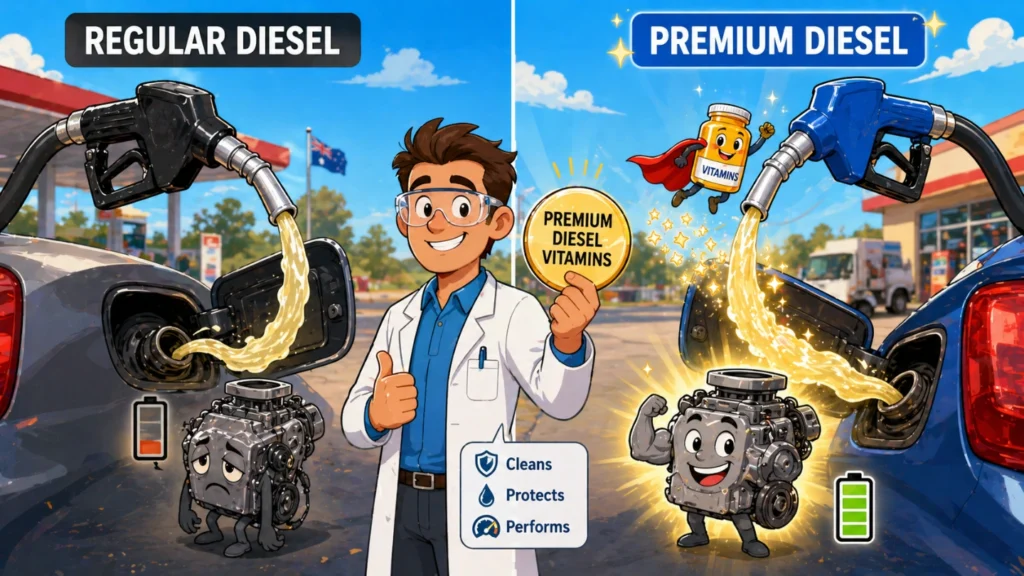
Walk into most major service stations and you’ll spot a “Premium Diesel” option alongside regular. So what’s the difference?
Premium diesels are the same grade of diesel fuel as the standard bowser, but often contain additives designed to assist with engine cleaning, performance, and maintenance. Think of it less like an upgrade and more like a vitamin supplement for your fuel system.
Premium diesel doesn’t increase horsepower or fuel economy, but it helps maintain your engine over time. For most everyday drivers doing short suburban runs, the benefit is modest. But for 4WD touring or remote travel, premium diesel can help keep injectors and fuel systems cleaner, particularly useful when fuel quality in remote areas can be less consistent.
The bottom line: premium diesel isn’t essential, but occasional use can be a low-cost way to look after your engine long-term.
Read more: Diesel fuel in 2026: Still worth it or slowly losing ground?
Biodiesel: The greener blend
Biodiesel is an alternative renewable fuel made from vegetable oils, animal fats, or recycled restaurant grease. It sounds exotic, but there’s a good chance you’ve already been using it without knowing.
Australian regulations allow for biodiesel to be added to standard bowsers in up to 5% quantities by volume without any extra labelling. Higher blends can be sold, with B5 and B20, referring to the percentage of biodiesel, being the most common variants.
For the average driver, a B5 blend (5% biodiesel, 95% regular diesel) is completely transparent, your car will run the same and you won’t notice a difference at the pump. B20 blends are less common and may not be suitable for all engines, so it’s worth checking your manufacturer’s handbook before using them regularly.
Paraffinic diesel: The new kid on the block

This one is newer to Australia. In December 2023, the Australian Government announced the Fuel Quality Standards (Paraffinic Diesel) Determination 2025, which establishes a national standard for paraffinic diesel, including renewable diesel.
Paraffinic diesel burns more cleanly than conventional diesel and is compatible with existing diesel engines, reducing barriers to entry for drivers and fleet operators. It’s not yet widely available at the bowser for everyday consumers, but it’s a space worth watching as Australia moves toward cleaner fuel alternatives.
What about AdBlue / Diesel Exhaust Fluid (DEF)?
You may have seen “AdBlue” mentioned in your owner’s manual or spotted a separate filler cap in your car. It’s important to know: Diesel Exhaust Fluid (DEF), AdBlue being a common brand name, is not a fuel and should absolutely not be added to your fuel tank under any circumstances.
DEF is a fluid used by modern diesel engines with selective catalytic reduction (SCR) systems to reduce harmful exhaust emissions. It goes into its own separate reservoir. DEF is essential for the operation of modern diesel engines fitted with these systems, without it, these vehicles cannot run. If your vehicle requires it, you’ll need to top it up periodically, much like coolant or windshield washer fluid.
Read more: Everything you need to know about diesel exhaust fluid
Winter diesel: Do you need to worry?
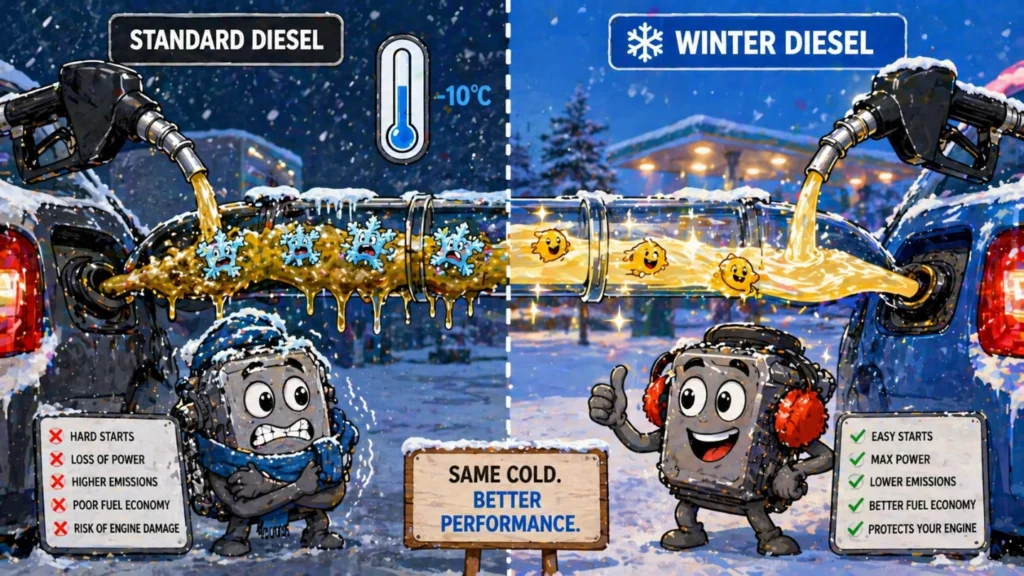
Because of diesel’s chemical makeup, it is much more susceptible to partially freezing, or “gelling,” in extremely cold conditions. In alpine regions where temperatures drop to -10°C or lower, a special blend of diesel is sometimes sold, generally out of the standard bowser without special signage.
For the vast majority of Australian drivers, this is never a concern. Unless you’re regularly driving in alpine regions of Victoria or NSW in the dead of winter, standard diesel will serve you perfectly well year-round.
The simple takeaway
For most Australians driving a diesel car or ute, the choice is straightforward:
- Regular diesel — perfectly fine for everyday use.
- Premium diesel — worth considering occasionally if you tow, tour, or want to maintain injector health over the long term.
- AdBlue — not a fuel; keep it out of your tank but make sure to top up its separate reservoir if your vehicle needs it.
- Biodiesel blends — likely already in your tank in small amounts; nothing to worry about for B5.
Australia’s diesel standards are tightly regulated, so wherever you fill up, metro or regional, you can be confident the fuel meets quality requirements. When in doubt, your owner’s manual is always the best guide for your specific vehicle.

Comments
New Comment